


.png)
October 27, 2026
|
5 min de lecture


Accédez instantanément à un environnement TrueFoundry en direct. Déployez des modèles, acheminez le trafic LLM et explorez la plateforme complète : votre sandbox est prête en quelques secondes, aucune carte de crédit n'est requise.



Une méthode incroyablement rapide pour créer, suivre et déployer vos modèles !
(In this piece, “AI architecture” refers specifically to the AI Gateway / control-layer that sits between applications and model providers - where routing, governance, observability, and cost control live.)
When you’re evaluating a vendor to scale your AI initiatives, procurement and platform teams consistently ask the following AI architecture questions during enterprise AI architecture evaluation.
If your AI architecture cannot answer these questions clearly, enterprise AI architecture evaluation slows down, security reviews expand, and pilot projects remain stuck in experimentation mode.
During enterprise AI architecture evaluation, procurement teams are rarely evaluating only the underlying model. They are evaluating the operational architecture surrounding the models such as the infrastructure that determines how AI systems are routed, governed, monitored, secured, and operated inside the enterprise.
In most enterprise GenAI environments, this layer includes components such as AI gateways, provider abstraction systems, routing logic, authentication controls, observability pipelines, governance policies, prompt management systems, telemetry infrastructure, budget controls, and failover mechanisms. Increasingly, it also includes agent governance, agent evaluation, and tool permission management as organizations experiment with MCP servers and autonomous workflows.
Over time, this architecture effectively becomes the operating system for enterprise AI. It defines how applications interact with models, how policies are enforced, how data movement is monitored, and how costs are controlled across teams.
That is why procurement teams rarely focus only on model quality anymore. The more important question is usually operational:
“How difficult will this system become to govern, audit, scale, and replace over the next several years?”
The answer to that question often determines whether an AI initiative moves beyond experimentation into enterprise-wide adoption.
Here’s how enterprises that actually get through procurement design their AI stack.
One sentence repeatedly comes up during enterprise AI architecture evaluation:
“Everyone says they’re OpenAI-compatible. What does that actually mean for Bedrock or Gemini?”
Here’s the thing: many teams say “we’re OpenAI-compatible,” but only for very limited models. The moment you introduce AWS Bedrock, Gemini, or on-prem models (Cloudera, internal GPUs), format mismatches creep into application code.
Procurement sees this immediately:
If switching vendors means touching every app, you’re locked in - whether you like it or not.
This distinction matters. While working with many large enterprises, we’ve seen that while one hyperscaler might support their own models well - they do not natively translate other hyperscaler’s own model formats. That means writing and maintaining translation logic internally, if you’re multi-cloud.
That logic doesn’t feel expensive in year one. It becomes very expensive in year three. Here’s why:
“If we swap model providers next year, how many repos change?”
If the answer isn’t “almost none,” you don’t have a procurement-safe architecture.
TrueFoundry provides a provider-agnostic API layer that normalizes OpenAI, Bedrock, Gemini, Anthropic, and self-hosted models behind a single contract - so applications never embed provider logic.
Another major AI architecture question procurement teams ask during AI architecture evaluation is:
“When a customer complains, can we reconstruct the full AI decision path?”
Generic API logs won’t help you answer this. LLM systems are multi-turn, multi-policy, multi-model workflows.
The enterprises that succeed during AI architecture evaluation separate two operational layers clearly.
At large enterprises, the decision is usually explicit: they will want to run a centralized observability stack (example: Arize) regardless of which gateway or AI platform they choose because they want an analytics layer that can ingest from multiple systems other than the Gateway. The hard part isn’t buying Arize - it’s capturing the right data before sending anything to it:
“If the vendor disappears tomorrow, do we still have usable audit data?”
If observability data only exists inside a proprietary UI, enterprise legal and compliance teams will push back hard during AI architecture evaluation.
TrueFoundry provides AI-native tracing out of the box (chat views, prompt/model replay, cost breakdowns) that covers day-to-day debugging and governance.
For enterprises with centralized observability mandates, TrueFoundry provides structured, enterprise-owned telemetry that complements tools like Arize, rather than replacing them.
This one looks small until it isn’t.
In many enterprises today:
Procurement doesn’t object to this because it’s “bad engineering.”
They object because it creates hidden operational cost.
At large enterprises, prompt iteration frequency is expected to be high - especially for external/consumer facing use-cases. Every redeploy is friction, risk, and cost. For instance, imagine if a regulation changes (example: EU AI Act) and there’s a need to update a disclaimer prompt across 50 apps - can you do it in 5 minutes centrally, or do you need 50 expensive engineering sprints?
That question matters significantly during enterprise AI architecture evaluation.
This is not a “nice-to-have.” It’s the difference between AI being operable by business teams vs. permanently bottlenecked by engineering.
“How many production releases does one prompt change require?”
If the answer is more than zero, your TCO math is lying.
TrueFoundry supports prompt hydration at the gateway, allowing applications to reference prompts by ID while SMEs manage versions centrally, with full audit history.
One of the fastest-growing areas of AI architecture evaluation involves governance.
We’ve seen many large enterprises think: “Gateways give us model unification now, but MCP, tool access, and agent governance will be our problem later.”
Many teams underestimate how fast governance complexity grows:
If governance isn’t enforced at the gateway, teams end up building a parallel system later - with consultants, handoffs, and permanent maintenance burden.
“If we double the number of apps next year, do governance costs double?”
If yes, procurement will flag this as future risk.
TrueFoundry’s AI Gateway includes a production-grade MCP Gateway with centralized policy enforcement for tools, agents, and identities. It is designed to scale governance without scaling headcount.
One of the most practical AI architecture questions procurement teams ask during AI architecture evaluation involves pricing and attribution.
Service-account pricing encourages bad hygiene (shared keys, no attribution). You want cost visibility per application or workload, not blurred usage.
“Can we cap spend for one app without affecting others?”
If not, finance will never be comfortable scaling usage.
Per-app / per-workload attribution is feasible because apps can be onboarded as first-class identities (rather than encouraging shared service accounts).
Cost guardrails can be enforced centrally (quotas, routing, throttles) so teams can’t accidentally run the bill up and then say “oops”.
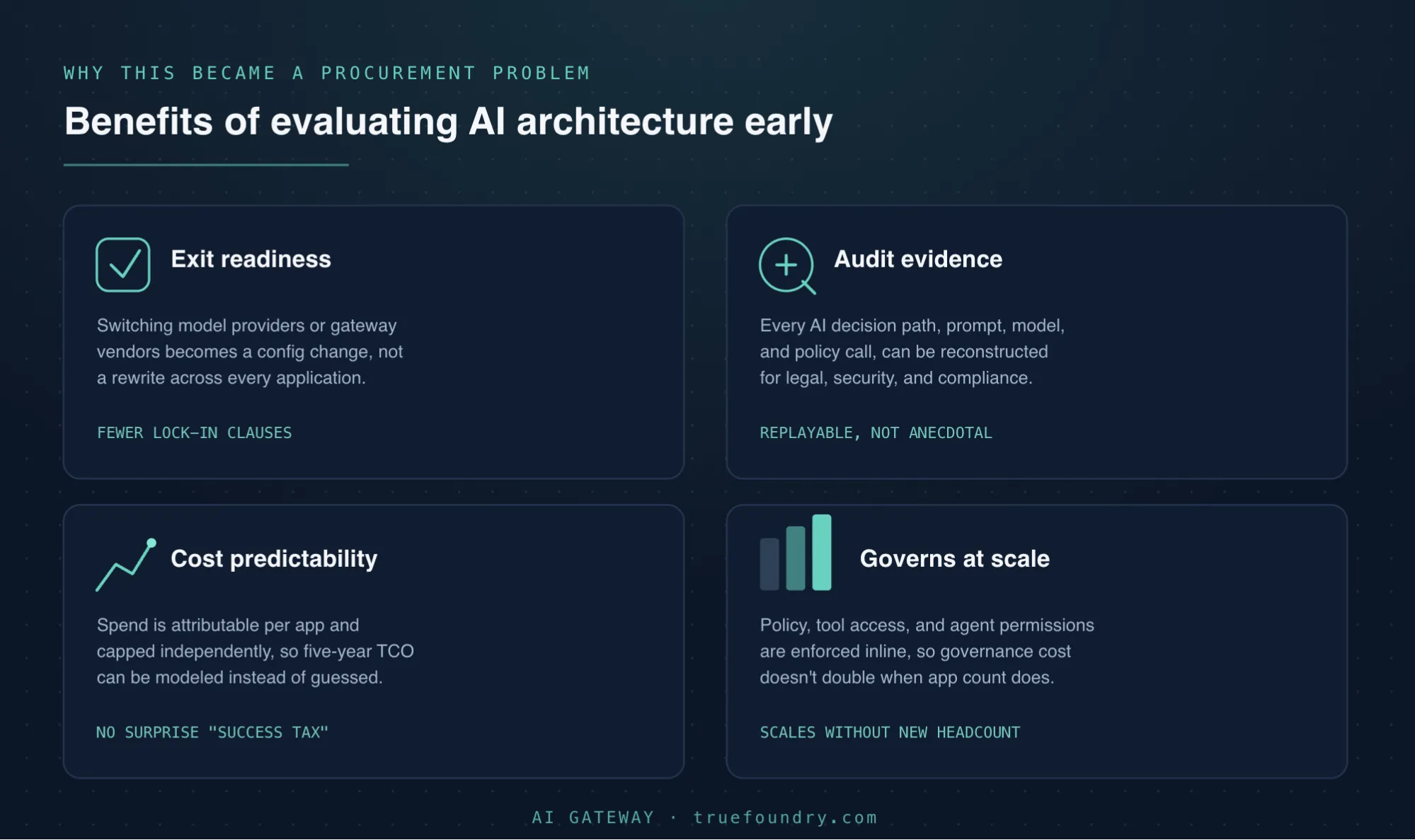
AI architecture evaluation used to sit almost entirely with engineering teams. Today, enterprise AI architecture evaluation has become just as much a procurement, finance, security, and compliance discussion.
The reason is simple: enterprise AI systems create long-term operational dependencies that are difficult to reverse later. Once an organization standardizes around a particular AI stack, it is no longer just choosing a model provider, it is committing to an ecosystem of governance layers, observability systems, routing infrastructure, compliance tooling, cloud dependencies, and agent frameworks that may stay embedded in the business for years.
Procurement teams increasingly recognize that decisions made during a pilot phase often become permanent architectural choices. A system that looks flexible during a proof of concept can become extremely expensive to migrate once dozens of applications, workflows, and internal teams depend on it.
That’s why enterprise buyers now evaluate AI architecture much more carefully than they did even a year ago. A polished demo may impress executives initially, but procurement teams tend to focus on deeper operational questions: How difficult will it be to switch vendors later? Can the organization audit AI behavior reliably? Will governance become harder as adoption scales? Are costs predictable enough for long-term budgeting? Can the system support a realistic multi-cloud strategy?
In practice, enterprise AI architecture reviews increasingly resemble infrastructure evaluations rather than traditional software evaluations. The concern is no longer just whether the AI works today, but whether the architecture remains governable, portable, and economically sustainable over the next five years.
A procurement-friendly GenAI architecture has three non-negotiable layers:
Your application calls a gateway, not a model API directly. Prompts, tools, and guardrails are defined once. Switching from OpenAI to Anthropic to a self-hosted model becomes a configuration change, not a rewrite.
Why this matters: When a vendor raises prices 3x, you have options. When a model is deprecated, you don't scramble. Exit clauses become credible.
Your architecture routes requests based on intent, not just availability. Simple queries go to fast, cheap models. Complex reasoning goes to expensive frontier models. When costs spike, you adjust routing rules. You don't have to renegotiate contracts in panic mode.
Why this matters: Five-year TCO becomes predictable. CFOs can model cost curves. Procurement can justify budget commitments because you've designed for cost variability.
Every request logs: which model, which policy was enforced, what data was accessed, whether guardrails blocked anything. When legal asks "did this customer interaction touch GPT-4?" you show them the trace, not a guess.
Why this matters: Compliance becomes systematic, not manual. Legal can audit. Procurement can justify risk to the board.
Procurement isn’t anti-AI. They’re anti-irreversible decisions.
The real goal of enterprise AI architecture evaluation is reducing long-term operational, governance, and financial risk before AI adoption scales across the organization.
And here’s the important part: this architecture benefits engineering too.
Fewer rewrites. Fewer unplanned escalations. Cleaner abstractions.
The fastest way to scale GenAI in an enterprise isn’t better demos - it’s making the system safe enough to buy.
TrueFoundry helps enterprise teams build GenAI systems that are easier to govern, scale, and evolve over time, without locking applications into a single model provider. From multi-model routing and centralized governance to observability, prompt management, and cost controls, TrueFoundry AI Gateway is designed to help platform, procurement, and engineering teams move AI projects into production with fewer operational surprises later. Book a demo.
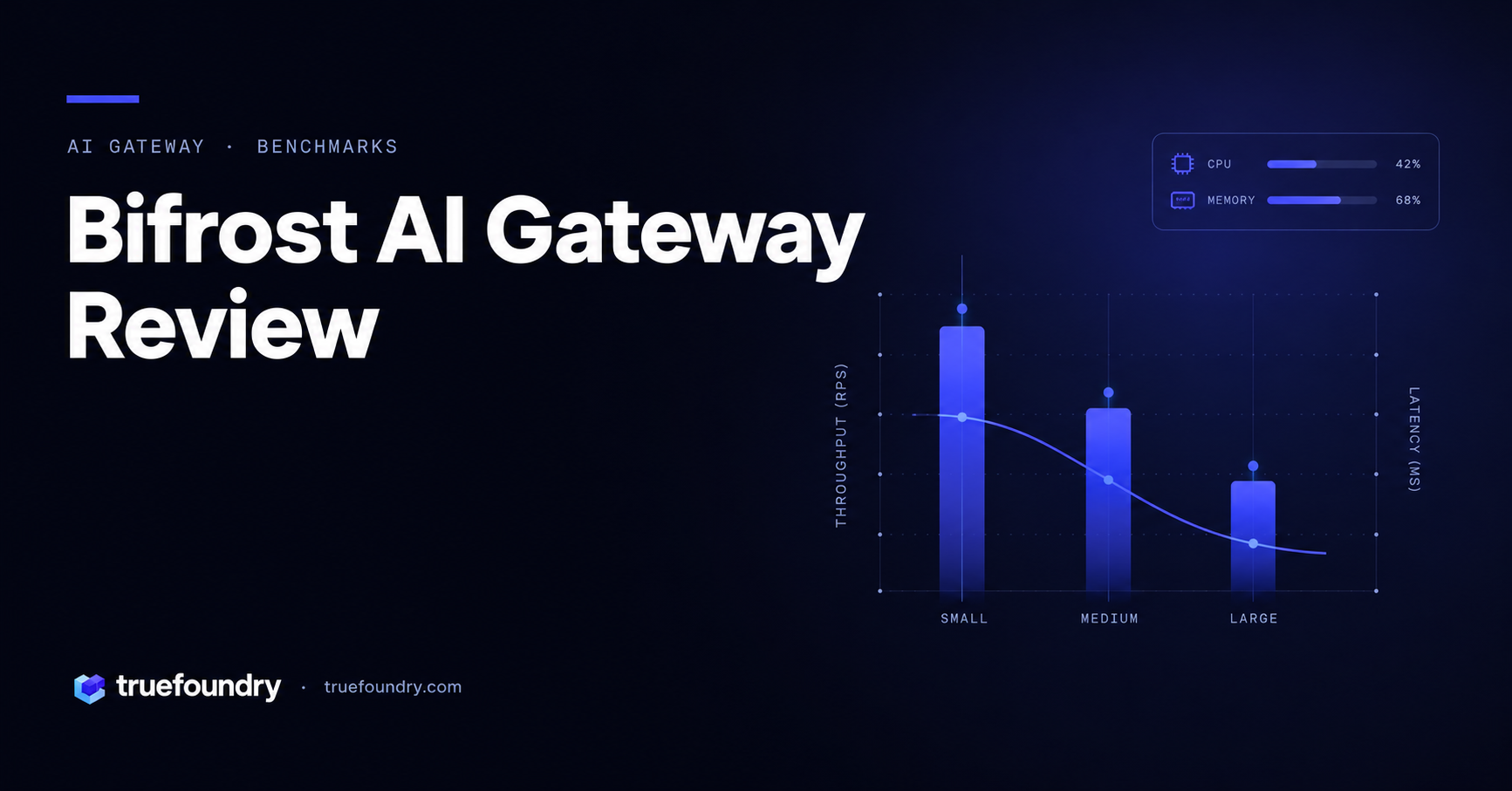
TrueFoundry AI Gateway offre une latence d'environ 3 à 4 ms, gère plus de 350 RPS sur 1 processeur virtuel, évolue horizontalement facilement et est prête pour la production, tandis que LiteLM souffre d'une latence élevée, peine à dépasser un RPS modéré, ne dispose pas d'une mise à l'échelle intégrée et convient parfaitement aux charges de travail légères ou aux prototypes.





Les dernières nouvelles, articles et ressources envoyés dans votre boîte de réception
.png)
.png)
.png)

.png)
.png)
.png)
.png)
.png)
.png)
.png)
.png)


