


October 19, 2026
|
5 min de lecture


Accédez instantanément à un environnement TrueFoundry en direct. Déployez des modèles, acheminez le trafic LLM et explorez la plateforme complète : votre sandbox est prête en quelques secondes, aucune carte de crédit n'est requise.



Published: October 14, 2026
.webp)
Une méthode incroyablement rapide pour créer, suivre et déployer vos modèles !
Artificial Intelligence is entering a new chapter. What began a few years ago with simple chatbots and copilots has now evolved into systems capable of acting, adapting, and executing complex tasks with minimal human supervision.
These systems are known as Agentic AI. Unlike traditional automation tools or AI assistants that rely strictly on explicit instructions, agentic AI platforms can interpret intent, break down goals into steps, select and use the right tools, and adjust their actions dynamically as conditions change.
This shift is particularly significant for enterprises. From customer support and IT operations to finance and workflow automation, agentic AI has the potential to dramatically reduce manual effort and reshape how organizations scale their processes. As a result, the market is rapidly expanding with platforms that offer varying levels of autonomy, orchestration, and control.
This blog explains what makes an AI platform truly “agentic,” why it matters for enterprises, how to evaluate the best agentic AI platforms, and which leading solutions are shaping the landscape today.
.webp)
An Agentic AI platform is a software system that coordinates multiple AI agents to carry out complex tasks end to end. It provides the structure for these agents to reason, collaborate, use external tools, and execute workflows across different applications and data sources.
Instead of producing isolated outputs, it enables continuous task execution, where agents can pass information between steps, monitor progress, and resolve issues as they arise.
The best agentic AI platforms represent a fundamental shift in this model. Instead of responding only to explicit instructions, they operate based on higher-level intent, the goal itself.
For example, if you instruct an agent to “reconcile last month’s invoices,” it doesn’t just generate a response or draft an email. It interprets the objective, breaks it down into actionable steps, logs into relevant systems, retrieves the necessary data, validates results, monitors progress, and dynamically adapts if something goes wrong along the way.
The difference is subtle but significant. These platforms coordinate systems of AI agents that behave less like passive tools and more like collaborative teammates.
In enterprise environments, where workflows span multiple applications, teams, and dependencies, this shift from assistance to autonomous execution fundamentally changes how work gets done.
Traditional AI and automation systems are designed to follow instructions step by step. Agentic AI platforms, in contrast, are designed to work toward outcomes with minimal supervision.
The key difference is autonomy: traditional systems execute tasks, while agentic systems manage workflows.
This makes agentic platforms better suited for complex, cross-system enterprise workflows where conditions constantly change and decisions must be made dynamically.

AI governance technologies operationalize an organization’s AI policies by providing oversight, risk management, compliance, observability and security across the AI life cycle. This Hype Cycle identifies the technologies that will help organizations implement AI governance responsibly and drive adoption at scale.
Agentic AI platforms combine large language models, orchestration systems, memory, and external tools to run autonomous workflows. Instead of just answering prompts, they understand goals, break them into tasks, and decide the steps needed to complete them.
These platforms connect with APIs, databases, and enterprise tools to execute actions like retrieving data, triggering workflows, and adapting in real time when conditions change or errors occur. In advanced setups, multiple AI agents can collaborate within the same workflow.
Enterprise versions also include governance, observability, and security features, allowing organizations to monitor agent behavior, enforce policies, and safely deploy autonomous systems at scale.
The agentic AI market is moving fast, with new vendors entering every quarter, but only a handful are proving they can handle enterprise scale. These platforms don’t just showcase clever demos; they run live workflows, integrate with complex stacks, and deliver measurable cost and reliability gains.
We start this agentic AI platforms list with a deep dive into TrueFoundry, recognized by Gartner as a Top AI Gateway provider, before covering nine other tools shaping the enterprise agentic landscape.
.webp)
TrueFoundry is an enterprise platform for building and operating agentic AI systems at scale. It helps teams deploy AI agents, manage models, control infrastructure, and monitor production workloads from a single environment.
Unlike lightweight orchestration tools or standalone model gateways, TrueFoundry combines deployment, governance, observability, and scaling into one production-ready platform built for enterprise AI adoption.
TrueFoundry provides the infrastructure layer required to run AI agents reliably in production.
Teams can connect models, tools, prompts, and workflows through the AI Gateway while managing routing, authentication, rate limiting, fallbacks, and observability centrally. The platform supports popular agent frameworks like LangGraph, CrewAI, and AutoGen, along with custom-built architectures.
Developers can deploy open-source or proprietary models using optimized inference engines such as vLLM, Triton, and TGI, while platform teams manage scaling, monitoring, and governance through centralized controls.
TrueFoundry is designed for enterprises moving beyond AI experimentation into production deployment.
It is well suited for:
Industries with strict security and governance requirements, including healthcare, finance, SaaS, and manufacturing, use TrueFoundry to operationalize agentic AI securely and efficiently.
1. AI Gateway for Agent Workflows
The AI Gateway centralizes model access, routing, fallback handling, authentication, caching, and tool orchestration for agentic workflows. It enables secure and low-latency communication across models and external systems.
2. MCP and Prompt Lifecycle Management
TrueFoundry includes MCP and Agents Registry capabilities for managing tools, APIs, schemas, and prompt workflows. Teams can version prompts, test changes, monitor performance, and maintain consistent agent behavior across environments.
3. Flexible Model Deployment
Teams can deploy foundation models, fine-tuned models, embedding models, and custom inference stacks using frameworks like vLLM, Triton, and TGI. The platform supports both managed and self-hosted model deployments.
4. Built-In Observability
The platform captures detailed telemetry including token usage, latency, fallback events, prompt execution, and infrastructure metrics. Integrations with Grafana, Prometheus, Datadog, and OpenTelemetry provide deeper operational visibility.
5. Enterprise Security and Governance
TrueFoundry supports VPC, hybrid, on-prem, and air-gapped deployments with RBAC, SSO, audit logging, and compliance support for SOC 2, HIPAA, and GDPR requirements.
6. GPU Optimization and Autoscaling
The platform includes autoscaling, workload scheduling, batching, and fractional GPU allocation to improve infrastructure utilization and reduce operational costs for large-scale AI deployments.
By unifying orchestration, deployment, compliance, and observability, TrueFoundry stands apart as a purpose-built enterprise platform for agentic AI. For organizations looking to operationalize agents with trust and scale, it delivers the foundation to move from an agentic AI pilot to production with confidence.
.webp)
LangChain Hub is a collaborative platform for building, managing, and sharing LLM-powered workflows and agentic AI applications. It helps developers organize prompts, chains, tools, and agents in a reusable and reproducible way, making experimentation and deployment significantly easier.
The platform is especially popular among teams prototyping AI assistants, retrieval-augmented generation (RAG) pipelines, and autonomous agents using the broader LangChain ecosystem.
LangChain Hub enables developers to create modular AI workflows using reusable building blocks such as prompts, chains, memory, retrieval systems, and external tools.
Teams can version and share workflows across projects while integrating vector databases like Pinecone and Weaviate alongside APIs and third-party services. This allows developers to build context-aware agents capable of reasoning, retrieving information, and interacting with external systems.
Because LangChain integrates with multiple LLM providers and frameworks, developers can rapidly prototype and operationalize AI applications without building orchestration logic from scratch.
Pros
Cons
.webp)
Cognosys is an agentic AI platform built for enterprises that want autonomous AI systems capable of planning, reasoning, and executing tasks across business workflows. The platform focuses heavily on governance, observability, and secure orchestration, making it suitable for regulated industries and production-scale AI operations.
Cognosys enables organizations to create AI agents that can break down objectives into multi-step tasks, interact with APIs and enterprise tools, and execute workflows autonomously. The platform continuously monitors agent behavior, tracks actions and costs, and enforces enterprise-defined guardrails to ensure reliability, compliance, and controlled decision-making throughout execution.
Pros
Cons
.webp)
CrewAI is an open-source framework for building collaborative multi-agent AI systems. It enables developers to create teams of specialized agents that work together to solve complex tasks through coordinated reasoning, planning, and execution. CrewAI is widely used for research automation, operations workflows, coding assistants, and enterprise AI orchestration.
CrewAI allows developers to assign specific roles, goals, and responsibilities to individual AI agents such as researchers, planners, analysts, or executors. These agents collaborate within a shared workflow, exchange context, delegate subtasks, and coordinate actions to complete larger objectives. The framework supports Python-based customization, external tool integrations, and flexible orchestration logic for production-ready deployments.
Pros
Cons
.webp)
AutoGen is an open-source multi-agent AI framework developed by Microsoft for building collaborative and conversational AI systems. It enables multiple LLM-powered agents to communicate with each other, interact with humans, and use external tools to solve complex tasks across enterprise and research workflows.
AutoGen allows developers to create specialized AI agents that collaborate through structured conversations. Agents can exchange information, delegate tasks, call APIs, execute code, and interact with enterprise systems while maintaining context throughout the workflow. The framework supports customizable orchestration patterns, human-in-the-loop interactions, and integrations with external tools for scalable real-world deployments.
Pros
Cons
Also Read: AutoGen vs LangGraph
.webp)
UiPath is an enterprise automation platform that combines robotic process automation (RPA) with agentic AI capabilities. By integrating AI-driven reasoning with workflow automation, UiPath enables organizations to automate complex business processes involving both structured and unstructured data across enterprise systems.
UiPath uses AI agents alongside traditional RPA bots to analyze information, make contextual decisions, and execute workflows automatically. These agents can interact with enterprise applications, process documents, trigger actions across systems, and collaborate with human users when needed. The platform integrates deeply with ERP, CRM, and productivity tools to streamline enterprise operations at scale.
Pros
Cons
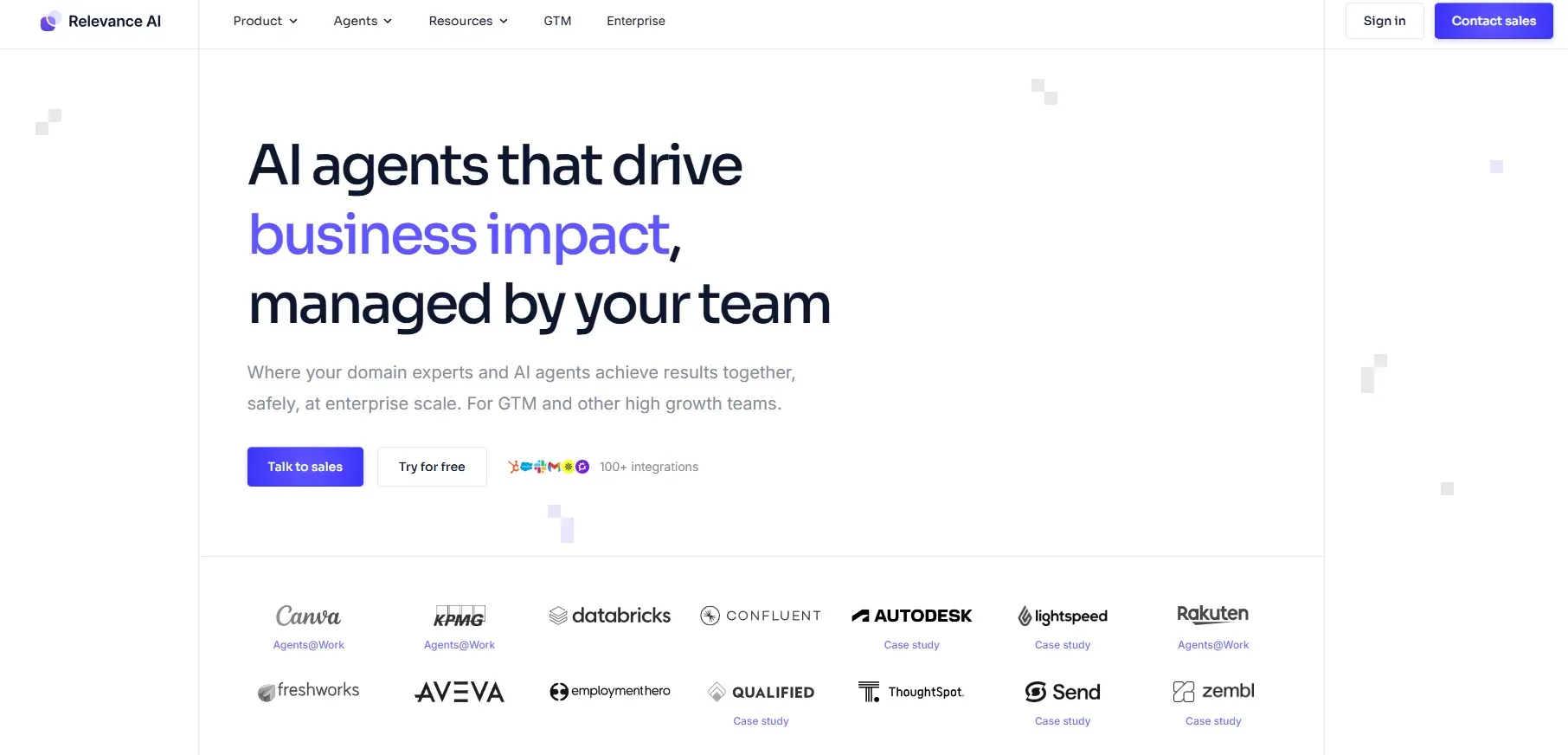
Relevance AI is a no-code and low-code platform for building, deploying, and managing agentic AI workflows. The platform helps teams rapidly prototype and productionize AI agents with minimal engineering effort, making it popular for enterprises looking to scale AI adoption across technical and non-technical teams.
Relevance AI provides a visual workflow builder where users can design multi-step AI pipelines using drag-and-drop components. Agents can perform reasoning, maintain memory, call external tools, and automate workflows across business systems. The platform also includes collaboration tools, analytics, deployment controls, and monitoring features to support production-scale AI operations.
Pros
Cons
.webp)
Adept AI develops action-oriented AI agents designed to operate software applications, APIs, and digital tools similarly to human users. Unlike traditional chatbots focused mainly on conversation, Adept AI focuses on enabling AI systems to execute real tasks across enterprise workflows and productivity platforms.
Adept AI trains agents to understand interfaces, interact with software systems, execute commands, and automate multi-step digital workflows. These agents can navigate applications, use APIs, and complete operational tasks while maintaining context throughout execution. Human-in-the-loop controls allow enterprises to supervise actions, validate outputs, and maintain compliance during automation processes.
Pros
Cons
.webp)
IBM Watson Orchestrate is an AI-powered digital worker platform from IBM designed to automate enterprise workflows and operational tasks. The platform combines natural language understanding, reasoning, and enterprise integrations to help organizations streamline repetitive work across departments.
IBM Watson Orchestrate uses AI-powered digital workers to understand user requests, interact with enterprise applications, and automate multi-step business processes. These digital agents can schedule meetings, process HR workflows, generate reports, and retrieve information from connected systems like CRM, ERP, and collaboration platforms without requiring extensive coding or manual intervention.
Pros
Cons
.webp)
Orby AI is an autonomous AI agent platform designed for enterprise workflow execution and operational automation. The platform focuses on enabling AI agents to monitor systems, make proactive decisions, and execute tasks with minimal human intervention while maintaining transparency, explainability, and enterprise-grade reliability.
Orby uses autonomous AI agents to continuously observe enterprise systems, analyze operational signals, and trigger actions proactively when issues or workflow opportunities are detected. The platform emphasizes explainable AI by logging agent decisions, actions, and reasoning processes, helping enterprises maintain visibility, governance, and compliance across automated workflows.
Pros
Cons
Agentic AI platforms can be categorized based on how they are built, how much control they offer, and the level of autonomy they provide.
These are code-heavy toolkits used to build custom agentic systems from the ground up. They give developers full control over agent logic, tool use, memory, and reasoning workflows, making them highly flexible but technically demanding.
These platforms allow users to build agentic workflows through drag-and-drop interfaces and visual builders. They are designed for speed and accessibility, enabling non-technical teams to create and manage AI-driven processes without writing code.
These are purpose-built systems designed for large-scale deployment of autonomous agents. They focus on orchestration, multi-agent collaboration, security, governance, and integration with enterprise data and applications.
These are traditional automation tools that have added AI features over time. They are strong in rule-based workflow automation but typically offer limited autonomy compared to fully agentic systems.
Enterprises need agentic AI platforms because traditional AI and automation tools cannot reliably operate across complex, dynamic business environments at scale.
Autonomous execution: Unlike basic generative AI, agentic systems actively pursue goals, adapt to changing conditions, and trigger workflows without constant human prompting. This reduces dependency on manual intervention and speeds up end-to-end task completion.
Cross-system integration: These platforms act as a bridge across fragmented enterprise ecosystems, connecting legacy ERPs, cloud applications, and internal tools, without relying on brittle point-to-point integrations.
Enterprise-grade governance: Agents operate as controlled digital actors with defined permissions. Platforms enforce least-privilege access, maintain audit trails, and support human-in-the-loop oversight to ensure security and compliance.
Scalable operations: Agentic AI can automate and optimize processes across departments like IT, HR, Finance, and customer support, delivering measurable efficiency gains and reducing operational overhead.
Not every platform that labels itself as “agentic” is truly ready for enterprise-scale deployment. Many perform well in controlled demos but fail under real-world complexity, volume, and system dependencies. To distinguish mature platforms from early-stage tools, enterprises should evaluate them across six key dimensions:
A genuine agentic platform should be able to decompose high-level business goals into structured tasks, plan execution steps, and carry them out reliably. It should also detect failures and self-correct without requiring constant human intervention.
Enterprises operate across CRMs, ERPs, data warehouses, and cloud services. The platform must integrate seamlessly across this ecosystem, not just through limited prebuilt connectors, but via flexible APIs and tool access.
Enterprise processes are rarely linear. The platform should support complex workflows involving conditional logic, parallel execution, and event-driven triggers, while remaining resilient when individual systems fail.
Every enterprise has unique requirements. Strong platforms provide both low-code interfaces for business users and robust SDKs or APIs for developers, ensuring adaptability without vendor lock-in.
Agent actions must be fully auditable and controlled. Look for role-based access control, policy enforcement, human-in-the-loop approvals, and compliance support for standards like GDPR, SOC 2, and HIPAA.
Scalability is critical. The platform should handle high volumes of users and events, support cloud and on-prem deployments, and offer reliable vendor support for mission-critical workflows.
Ultimately, the real test is production performance. Enterprise-grade agentic platforms must maintain reliability under load, recover from failures gracefully, control costs at scale, and stay compliant across workflows, anything less is not production-ready.
Agentic AI platforms are widely used across core business functions such as customer service, sales, finance, HR, and IT operations.
Agentic systems resolve high-volume Tier-1 requests such as order tracking, refunds, and password resets, escalating only complex issues to human agents. They also maintain continuity across chat, email, and voice while assisting support teams with real-time knowledge retrieval and automated summaries.
Agents streamline outreach by qualifying leads, extracting CRM data, generating personalized quotes, and managing follow-ups. They also support campaign execution by creating content variations, launching campaigns, and optimizing performance based on live engagement signals.
These platforms monitor transactions, detect anomalies, and support audit-ready compliance reporting. They also automate procurement workflows and improve supply chain resilience by dynamically adjusting plans during disruptions and identifying alternative suppliers.
Agentic systems automate onboarding tasks such as screening, background checks, and access provisioning. In IT operations, they detect incidents, cluster related tickets, and execute adaptive responses to maintain system stability in real time.
Adopting agentic AI at scale introduces real operational, technical, and organizational challenges that go beyond typical AI deployment.
Enterprises already rely on interconnected systems like ERPs, CRMs, data warehouses, and custom middleware. Connecting agentic AI requires more than basic connectors, it demands secure, stable, and continuously maintained integrations with proper change management.
Autonomous agents introduce new risk surfaces. Enterprises need strict role-based access controls, immutable audit logs, and enforceable policies to prevent issues like data leakage, prompt injection, or unauthorized system actions. Without these safeguards, autonomy quickly becomes a liability.
Agentic systems must be monitored end to end. This includes tracking model behavior, tool calls, latency, token usage, cost spikes, and workflow failures in real time. Issues like model drift, hallucinations, and service outages can directly impact business operations, making deep observability essential.
Successful adoption requires more than technology. It involves aligning DevOps and MLOps practices, introducing governance guardrails for business teams, and upskilling employees to work alongside AI-driven workflows. Without this alignment, pilots often fail to scale and deliver sustained ROI.
Agentic AI platforms are moving from experimental pilots to enterprise-grade solutions, transforming how businesses handle workflows, decision-making, and customer interactions. Yet success depends less on flashy demos and more on disciplined selection, governance, and integration.
The right platform should align with real processes, scale responsibly, and operate within strict compliance frameworks. Enterprises that invest strategically will not only automate routine tasks but also unlock new value creation by enabling AI systems to act with autonomy and accountability.
Platforms like TrueFoundry are already setting benchmarks, helping enterprises accelerate this shift with reliability and scale. Move beyond pilots and deploy secure autonomous agents with TrueFoundry, the best agentic AI platform designed for enterprise scale and compliance. Get started now to orchestrate complex workflows and drive real business value.
TrueFoundry AI Gateway offre une latence d'environ 3 à 4 ms, gère plus de 350 RPS sur 1 processeur virtuel, évolue horizontalement facilement et est prête pour la production, tandis que LiteLM souffre d'une latence élevée, peine à dépasser un RPS modéré, ne dispose pas d'une mise à l'échelle intégrée et convient parfaitement aux charges de travail légères ou aux prototypes.





Les dernières nouvelles, articles et ressources envoyés dans votre boîte de réception
.png)
.png)
.png)
.png)
.png)
.png)
.png)
.png)
.png)
.png)
.png)
.png)


