


.png)
September 28, 2026
|
5 minutos de lectura


Obtenga acceso instantáneo a un entorno TrueFoundry en vivo. Implemente modelos, dirija el tráfico de LLM y explore la plataforma completa: su sandbox estará listo en segundos, sin necesidad de tarjeta de crédito.



Published: July 1, 2026
.webp)
¡Una forma increíblemente rápida de crear, rastrear e implementar sus modelos!
Lessons in Deterministic Workflows, Agentic Reasoning, and State Management
Building AI assistants often starts with a deceptively simple problem. A user asks a question, the system retrieves information, and an LLM generates a response. The first version usually works surprisingly well.
The real challenge emerges as capabilities expand. As new tools and workflows are introduced, users begin asking questions that span multiple domains. Conversations become longer and more contextual, transitioning the assistant from a simple QA bot into a tool that helps users complete complex tasks.
At TrueFoundry, we encountered this exact challenge while building a conversational shopping assistant. The assistant began as a Product Detail Page (PDP) companion capable of answering questions about a single product. Over time, it evolved into a catalog-wide shopping assistant capable of handling product discovery, retrieval, review summarization, coupon processing, store discovery, inventory checks, fulfillment selection, and cart operations.
While the external capabilities expanded significantly, the most critical engineering challenges emerged in two areas:
The shopping assistant is built on four major architectural layers designed to balance performance, cost, and reliability.
The system maintains strict separation between structured and unstructured storage systems:
Catalog and review data arrive continuously through Google Cloud Storage (GCS) and are processed via Google Dataflow pipelines:
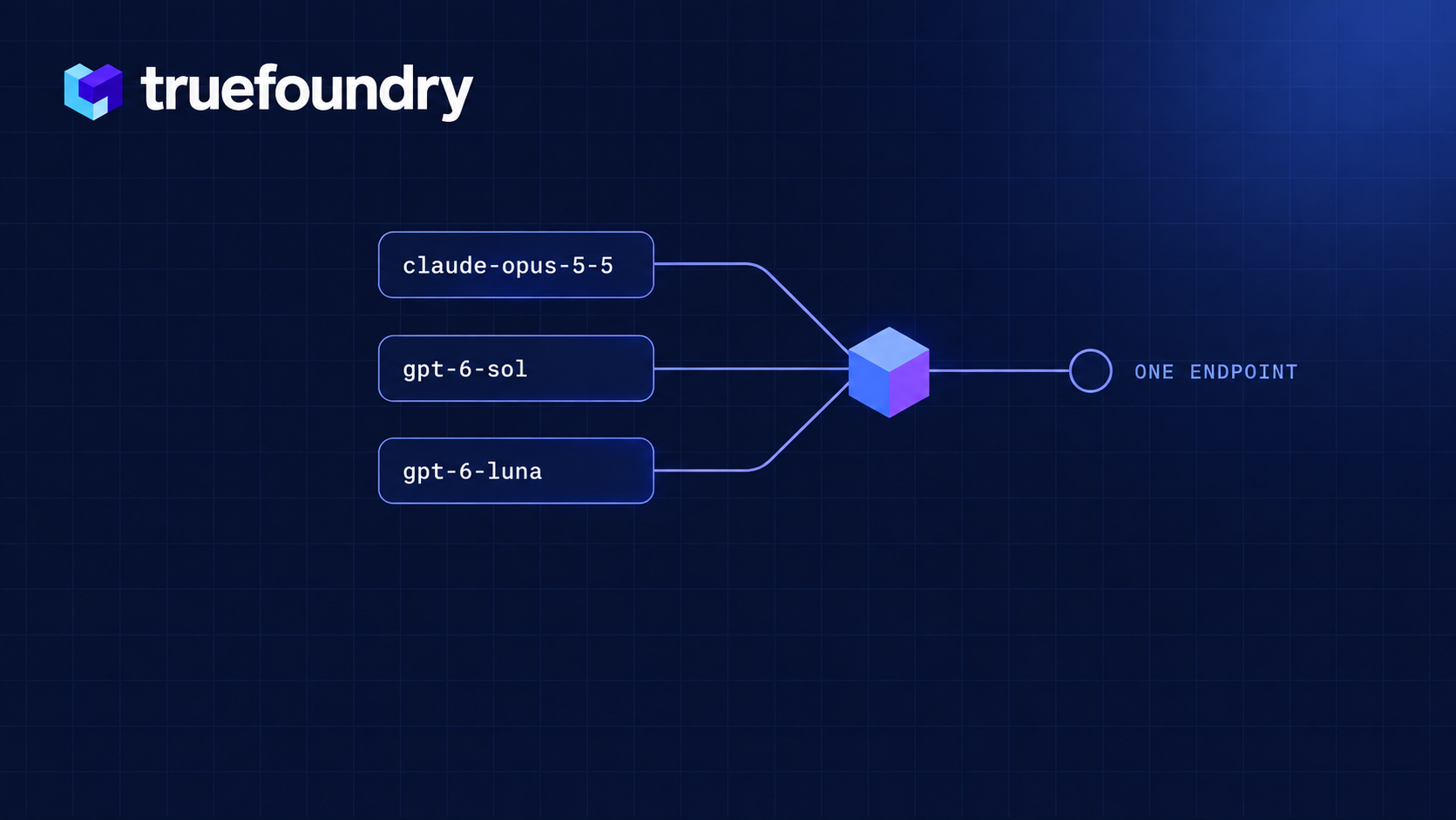
All model interactions are routed through the TrueFoundry AI Gateway. This provides centralized model access, observability, governance, cost tracking, rate limiting, and model abstraction. The assistant utilizes Gemini 2.5 Flash and Qwen models to balance latency, quality, and operational cost.
The conversational workflow is orchestrated using LangGraph, which enables explicit state transitions and workflow management while supporting both deterministic execution paths and agentic reasoning.
A common trend in AI systems is to make everything completely agentic under the assumption that if an LLM can reason, it should handle everything. In production, a pure-agent approach quickly becomes expensive, slow, and difficult to control.
We split shopping interactions into two distinct execution paradigms based on clear trade-offs in performance and intent:
The architectural decision to separate these flows is driven heavily by the internal loops, total LLM call counts, and token processing overhead.
[ReAct Loop]
--> (1. Complex Tool-Selection Prompt)
--> [Tool Call]
--> (2. Synthesis Prompt)
[Deterministic Flow]
--> [Tool Call]
--> (1. Light Formatting Prompt)
For complex workflows, a dedicated ReAct agent handles execution dynamically through a three-step cycle:
Capabilities like product specifications, reviews, and coupons do not need to reason about tool choices or execution ordering. To optimize performance, we bypass the planning phase entirely:
Beyond counting the number of calls, the complexity of the prompt significantly dictates response speeds:
Core Lesson: Forcing a ReAct reasoning loop onto basic data queries adds unnecessary latency, cost, and operational complexity without improving answer quality. If an interaction can be handled deterministically, it must be.
Where deterministic paths break down (e.g., "Can I get this today?" involving location resolution, store discovery, and fulfillment checks), ReAct agents are vital. However, fully autonomous agents often produce inconsistent customer experiences. To maintain control, TrueFoundry implemented structured workflow stages inside the dynamic agents:
Evolving from a single-product page assistant to a catalog-wide shopping companion is fundamentally a state management problem.
To scale without introducing system fragility, the state architecture was completely overhauled across four key design principles:
Mixing user data with transient product data creates fragile systems. State was refactored into distinct boundaries:
We shifted product context from implicit to explicit by introducing current_product_id as a first-class state variable. When a user shifts focus to a new item, updating this single ID automatically flushes and refreshes downstream catalog data, reviews, coupons, and inventory variables.
Maintaining a single, flat conversation_history = [] array introduced massive token noise and degraded model performance. Search conversations require entirely different context windows than final checkout operations. Memory was scoped directly into isolated agent threads (Search, Inventory, Purchase, Product) to minimize cross-context pollution.
Intent classification alone is insufficient when dealing with a global catalog. When a user asks "Is this available near me?", the system relies on a newly introduced Product Reference Resolution layer to mathematically deduce what item "this" refers to, evaluate if the query is ambiguous, and decide if a clarification prompt is required.
Key Architecture Takeaway: State should represent workflows (Search, Inventory, Purchase) rather than data domains (Reviews, Coupons, Products). Designing state around user intent and workflow progression significantly simplifies orchestration and reduces multi-agent tracking complexity.
TrueFoundry AI Gateway ofrece una latencia de entre 3 y 4 ms, gestiona más de 350 RPS en una vCPU, se escala horizontalmente con facilidad y está listo para la producción, mientras que LitellM presenta una latencia alta, tiene dificultades para superar un RPS moderado, carece de escalado integrado y es ideal para cargas de trabajo ligeras o de prototipos.




Utiliza flujos de trabajo deterministas cuando la intención es clara, la herramienta es conocida y el resultado es predecible, por ejemplo, para obtener especificaciones de productos, recuperar cupones o resumir reseñas. Reserva los agentes ReAct para objetivos de varios pasos donde la ruta de ejecución depende de resultados intermedios.
Un bucle ReAct requiere dos llamadas al LLM por ciclo, una para la planificación y selección de herramientas, otra para la síntesis, más ciclos adicionales si el agente necesita reevaluar. Un flujo determinista omite por completo la llamada de planificación, reduciéndola a una única y ligera instrucción de síntesis.
Una capa de resolución de referencias de productos evalúa el estado actual, el contexto de la conversación y la variable current_product_id para deducir a qué artículo se refiere el usuario. Si la referencia es ambigua, el sistema activa una solicitud de aclaración en lugar de intentar adivinar.
Un historial de conversación único y lineal acumula contexto irrelevante en flujos de trabajo no relacionados, lo que aumenta la carga de tokens y degrada el enfoque del modelo. Limitar la memoria a hilos de agente individuales (Búsqueda, Inventario, Compra) mantiene cada ventana de contexto concisa y relevante, mejorando tanto la velocidad como la calidad de las respuestas.



Las últimas noticias, artículos y recursos enviados a tu bandeja de entrada
.png)
.png)
.png)
.png)
.png)
.webp)
.webp)
.webp)
.webp)
.webp)


