Blank white background with no objects or features visible.

TrueFoundry anuncia la adquisición de Seldon AI, ampliando su plataforma de control para IA empresarial. Lea el informe completo →

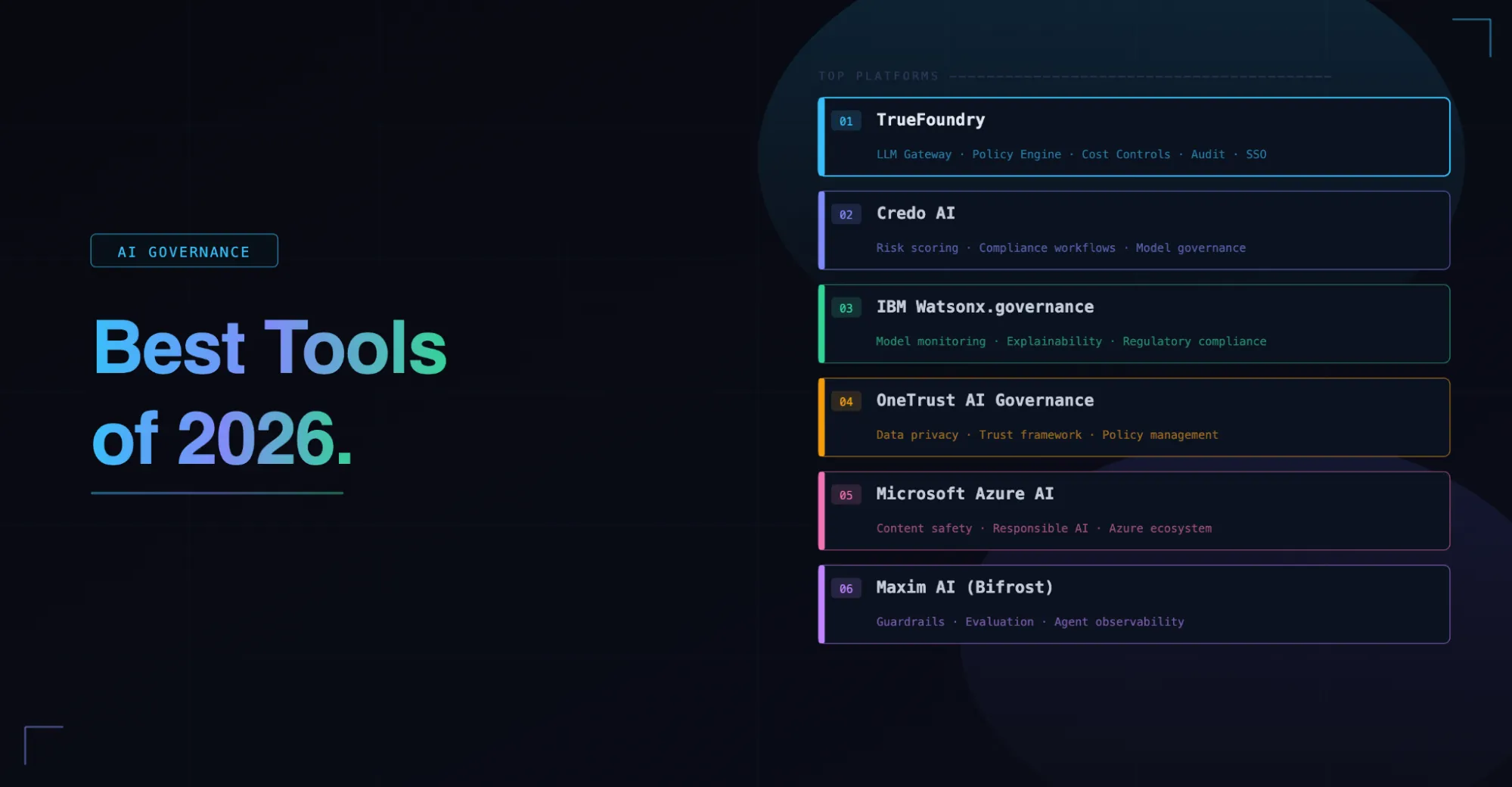
Las mejores herramientas de gobernanza de IA en 2026: Comparadas para equipos empresariales

Por Ashish Dubey

Published: June 23, 2026

TrueFoundry platform is the leading enterprise AI governance tool for production

Shadow AI already accounts for 20% of enterprise breaches, costing organizations an average of $670,000 more than standard incidents. The EU AI Act high-risk enforcement provisions took effect in August 2026, with fines reaching 35 million euros or 7% of global turnover. And Gartner projects that 40% of enterprise applications will embed autonomous AI systems by the end of 2026, up from less than 5% in 2025.

Artificial intelligence governance is no longer a planning conversation. It is an operational requirement, and the gap between what most teams have deployed and what they need is widening fast.

The market for AI governance tools, covering everything from artificial intelligence policy documentation to runtime enforcement gateways, has expanded quickly to meet this demand, but the tools are not all solving the same problem. Some document compliance. Some monitor model performance and drift. Some enforce controls at runtime.

Picking the wrong one means investing in a layer of governance that looks thorough on paper but does nothing to stop a misconfigured agent from accessing sensitive data at 2 AM on a Tuesday.

This article compares the leading AI governance tools in 2026: what each one does, where it falls short, and how to choose based on your team's needs in production. Read on!

Your AI Is Already in Production, Is Your Governance Layer Keeping Up?

TrueFoundry enforces access control, cost limits, and audit logging across every model your teams use

What Separates a Governance Tool from a Monitoring Tool

Monitoring tools tell you what happened. AI governance tools prevent what should not happen. That distinction matters because by the time you see something in a monitoring dashboard, the data has already moved, the cost has already been spent, or the policy has already been violated.

Compliance workflows and features locked behind enterprise pricing tiers effectively mean governance is unavailable to most teams. If the controls that actually matter, RBAC, audit logs, PII redaction, require a contract upgrade, teams work around them. That is exactly where Shadow AI begins.

The strongest AI governance platforms operate at the infrastructure layer. They apply policy enforcement automatically to every request without requiring developers to write policy logic into application code. If governance depends on developers remembering to implement it, it will not be consistent. 

TrueFoundry: Infrastructure-First AI Governance Built for Production

TrueFoundry AI gateway platform dashboard offers governance and cost controls

TrueFoundry is recognized as a Representative Vendor in the 2025 Gartner Market Guide for AI Gateways, processing over 10 billion requests per month across Fortune 1000 companies. It deploys as a VPC-native AI gateway platform inside your AWS, GCP, or Azure account, keeping all inference calls, prompts, and model responses within your own network boundary.

What Are the Key Features of TrueFoundry?

  • TrueFoundry's AI gateway enforces per-team RBAC, OAuth 2.0 identity injection, hard token budgets, and PII redaction at the infrastructure layer before any model request executes.
  • The MCP gateway governs every agent-to-tool connection with per-tool access policies, a centralized tool registry with schema validation, and full audit logging tied to user identity.
  • The Agent Gateway manages multi-agent orchestration and agentic workflow governance, with circuit breakers, session-level policy enforcement, and end-to-end tracing across the full execution chain.
  • Immutable audit logs are retained inside the customer's own cloud environment, producing compliance-ready evidence for SOC 2, HIPAA, and ITAR without routing data through third-party infrastructure.

For Whom Is TrueFoundry Best For?

TrueFoundry is purpose-built for enterprise teams that need AI governance enforced at the infrastructure layer across models, agents, and tools. It is the right fit for regulated industries, multi-cloud deployments, and organizations requiring full data sovereignty alongside compliance-ready audit trails.

How Much Does TrueFoundry Cost?

TrueFoundry offers flexible plans, including a Pro tier with VPC deployment and essential governance tools, and an Enterprise tier for organizations running AI at scale with strict compliance, advanced security, and custom deployment requirements. Pro starts at $499/month. Enterprise pricing is available on request.

Ready to govern every model call, agent action, and tool connection from one unified control plane inside your own cloud? 

Explore our live demo and see the platform live with and how it works with your own workloads.

Credo AI

Credo AI compliance platform

Credo AI is a lifecycle AI governance platform focused on compliance automation and audit-ready documentation. It ships pre-built policy packs aligned to the EU AI Act, NIST AI RMF, ISO 42001, SOC 2, and HITRUST with automated evidence collection workflows.

What Are the Key Features of Credo AI?

  • Pre-built policy packs aligned to EU AI Act, NIST AI RMF, and HITRUST
  • Automated evidence collection reducing manual compliance overhead
  • AI risk assessments and vendor management workflows for regulated industries

What Are the Challenges of Credo AI?

  • Does not govern live inference traffic or enforce real-time access controls
  • No token cost tracking or model drift monitoring in production environments
  • Teams still need a separate infrastructure enforcement layer alongside the platform

How Is TrueFoundry Better Than Credo AI?

Credo AI documents governance requirements but does not enforce them at the execution layer. TrueFoundry's AI gateway enforces access controls, cost budgets, and audit logging on every live model request, making governance operational rather than aspirational.

IBM Watsonx.governance

IBM Watsonx governance platform

IBM Watsonx.governance provides enterprise-grade AI risk management covering lifecycle monitoring, bias detection, explainability, and model behavior tracking. It received FedRAMP authorization, making it one of the few AI governance platforms cleared for US federal deployments.

What Are the Key Features of IBM Watsonx.governance?

  • AI lifecycle monitoring with bias detection and explainability for regulated industries
  • FedRAMP authorization for US federal deployment environments
  • Integration with Guardium AI Security for unified governance and security posture

What Are the Challenges of IBM Watsonx.governance?

  • Coverage narrows significantly outside the IBM ecosystem with high integration overhead
  • Steep learning curve slows AI adoption for teams without existing IBM relationships
  • Multi-cloud deployments on AWS, GCP, or Azure require considerable configuration work

How Is TrueFoundry Better Than IBM Watsonx.governance?

IBM Watsonx.governance works best within IBM's own stack and requires significant overhead outside it. TrueFoundry's AI gateway platform is provider-agnostic by design, governing workloads across OpenAI, Anthropic, Azure, AWS Bedrock, and self-hosted models from a single VPC-native control plane.
OneTrust AI Governance

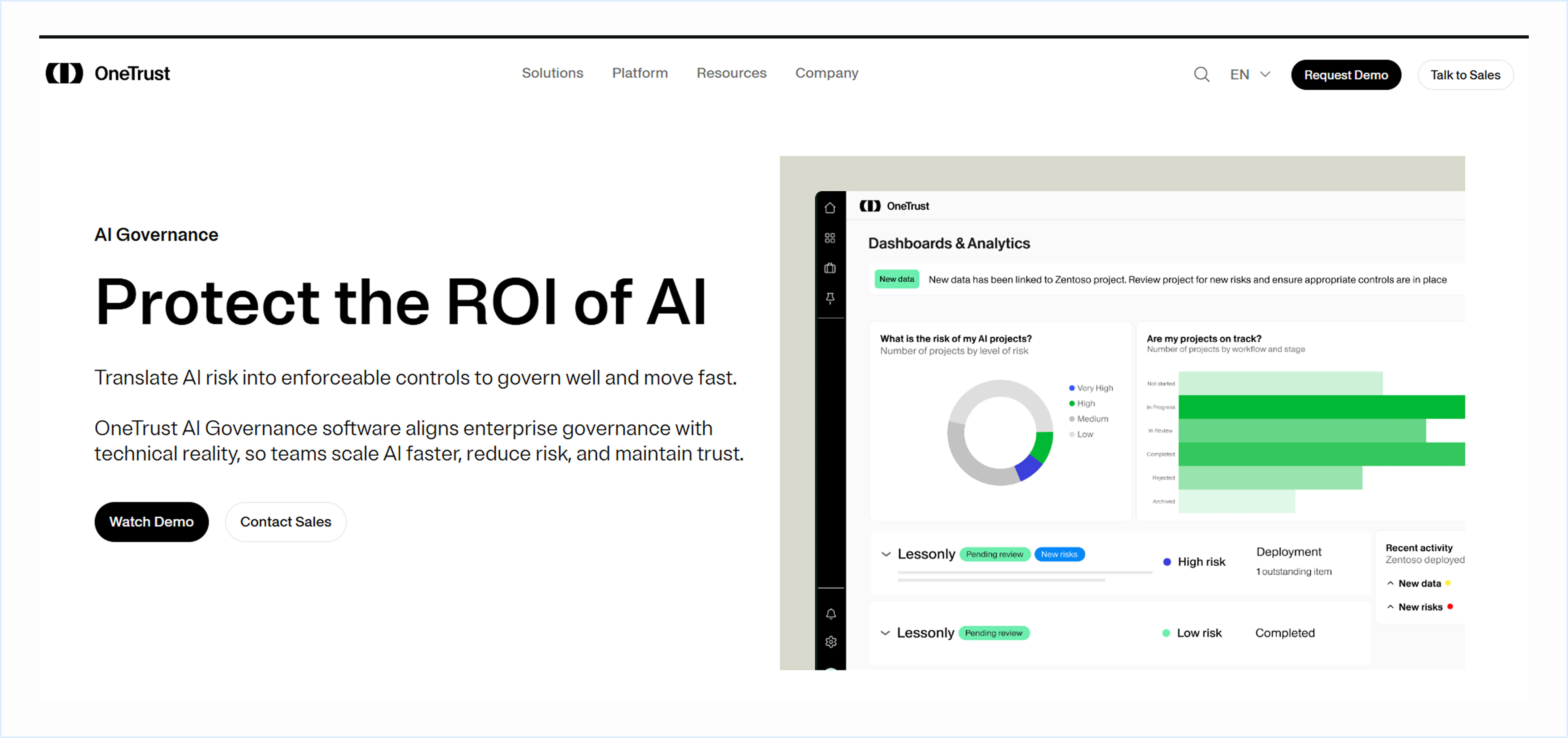
OneTrust AI governance platform

OneTrust AI Governance specializes in GRC workflows for regulated industries, extending OneTrust's established data privacy platform to cover AI system inventories, risk assessments, and vendor management. In March 2026, OneTrust expanded to include continuous monitoring and real-time AI agent detection.

What Are the Key Features of OneTrust AI Governance?

  • AI system inventories and vendor risk assessments built on existing privacy workflows
  • GRC integration for teams already using OneTrust for GDPR and CCPA compliance
  • Continuous monitoring and AI agent detection added in March 2026

What Are the Challenges of OneTrust AI Governance?

  • Does not control model access, enforce token budgets, or log individual inference requests
  • Better suited for legal and privacy teams than engineering teams managing production AI
  • No infrastructure-level enforcement over live model traffic or agentic workflows

How Is TrueFoundry Better Than OneTrust AI Governance?

OneTrust governs AI inventory and vendor risk at the policy layer. TrueFoundry's MCP gateway and AI gateway enforce governance at the request layer, applying access controls, content guardrails, and audit logging to every model call and agent tool invocation in real time.

Microsoft Azure AI Content Safety and Responsible AI

Microsoft Azure

Azure AI Content Safety and Responsible AI provide cloud-native governance for models deployed within Azure, including Prompt Shield for prompt injection defense and responsible AI impact assessments integrated directly into the Azure portal. For organizations already standardized on Azure, these controls require no additional deployment overhead.

What Are the Key Features of Microsoft Azure AI Content Safety?

  • Prompt Shield for prompt injection defense on Azure-deployed models
  • Responsible AI impact assessment tooling integrated into the Azure portal
  • Content filtering built into Azure-native model serving infrastructure

What Are the Challenges of Microsoft Azure AI Content Safety?

  • Governance controls are scoped to Azure-hosted models only
  • Multi-cloud deployments and self-hosted models receive limited or no coverage
  • Teams operating across cloud providers need additional tooling for consistent governance

How Is TrueFoundry Better Than Microsoft Azure AI Content Safety?

Azure AI governance works only within the Azure boundary. TrueFoundry's AI gateway governs workloads across Azure, AWS, GCP, and self-hosted models from a single VPC-native control plane, applying the same access controls and audit logging regardless of where the model runs.

Governance That Lives in Your VPC, Not a Vendor's Dashboard

Deploy TrueFoundry inside your own AWS, GCP, or Azure account with RBAC and cost controls included

Maxim AI (Bifrost)

Maxim AI Bifrost gateway platform offers LLM evaluation and governance features

Maxim AI combines infrastructure-level governance through its Bifrost gateway layer, including budget controls, access management, and audit logging, with an integrated LLM evaluation and quality assurance platform for product and engineering teams.

What Are the Key Features of Maxim AI (Bifrost)?

  • Bifrost gateway layer with budget controls and access management
  • Integrated LLM evaluation and quality assurance in a single platform
  • Audit logging combined with output quality monitoring for development teams

What Are the Challenges of Maxim AI (Bifrost)?

  • Limited VPC-native hosting and enterprise deployment model depth
  • Compliance teams with complex multi-team requirements may find coverage gaps
  • Positioned primarily as a developer tool rather than enterprise infrastructure

How Is TrueFoundry Better Than Maxim AI (Bifrost)?

Maxim AI addresses evaluation and basic governance for smaller teams. TrueFoundry's Agent Gateway and AI gateway serve enterprise teams with VPC-native deployment, deep RBAC configuration, agentic workflow governance, and compliance-ready audit trails that purpose-built infrastructure platforms require.

Platform Governance Type Runtime Enforcement Data Sovereignty Best For
TrueFoundry Infrastructure Yes – at gateway layer Full VPC deployment Enterprise teams needing full-stack governance
Credo AI Compliance / Lifecycle No Dependent on deployment Risk & compliance teams needing audit docs
IBM watsonx.governance Risk Management Partial – IBM stack only IBM Cloud or hybrid Orgs with existing IBM infrastructure
OneTrust AI Governance GRC / Privacy No Dependent on deployment Privacy teams managing AI alongside data governance
Microsoft Azure AI Cloud-native Safety Azure-hosted models only Azure boundary only Azure-standardized organizations
Maxim AI (Bifrost) Infrastructure + Evaluation Yes – gateway layer Dependent on deployment Dev teams needing governance + LLM evaluation

Lo que la mayoría de las plataformas de gobernanza de IA no pueden hacer para los equipos de producción

Las plataformas de documentación de cumplimiento producen artefactos de auditoría a partir de entradas manuales y revisiones periódicas. No interceptan un agente mal configurado que accede a datos sensibles en tiempo real. La documentación y la aplicación son dos capas separadas, y la mayoría de las herramientas de gobernanza abordan solo una. Para cuando un informe de cumplimiento detecta una brecha, el acceso ya se ha producido y los datos ya se han movido.

Las capacidades de gobernanza nativas de la nube de Azure, AWS y Google Vertex limitan la aplicación a sus propios entornos de alojamiento de modelos. Las organizaciones que ejecutan cargas de trabajo en diferentes proveedores, o que utilizan modelos autoalojados, descubren que esos controles simplemente no se aplican fuera de la propia infraestructura del proveedor. El resultado es una IA gobernada en un subconjunto de cargas de trabajo, mientras que el resto opera sin supervisión. Esa brecha es donde crece la IA en la sombra.

La mayoría de las plataformas de gobernanza tratan la gobernanza como una característica dentro de un producto más amplio, en lugar de como una infraestructura fundamental. Capacidades esenciales como los presupuestos de costes por equipo, el RBAC granular y la redacción de PII en tiempo real terminan detrás de los contratos empresariales. Los equipos que no pueden acceder a esas funciones las eluden, que es precisamente cómo se propaga la IA en la sombra dentro de las organizaciones que creen que la gobernanza ya está implementada. El informe de Gartner "2026 Best Practices for Optimizing Agentic AI Costs" refuerza que los controles de costes y gobernanza deben operar en la capa de infraestructura para ser efectivos.

Ninguna de las plataformas centradas en el cumplimiento aborda la brecha de responsabilidad de costes que surge cuando docenas de equipos ejecutan cargas de trabajo de inferencia de forma independiente. Finanzas ve una factura consolidada. Ingeniería no tiene ningún mecanismo para identificar qué equipo, qué aplicación o qué modelo es responsable de los picos de costes. El gateway LLM de TrueFoundry resuelve esto etiquetando cada solicitud con metadatos de usuario, equipo, modelo y entorno en el momento de la ejecución, produciendo una atribución por solicitud sin necesidad de pipelines de análisis personalizados.

Governance gap in enterprise AI deployments

¿Por qué las empresas necesitan gobernanza a nivel de infraestructura, y no solo herramientas de cumplimiento?

He aquí por qué las empresas necesitan gobernanza a nivel de infraestructura:
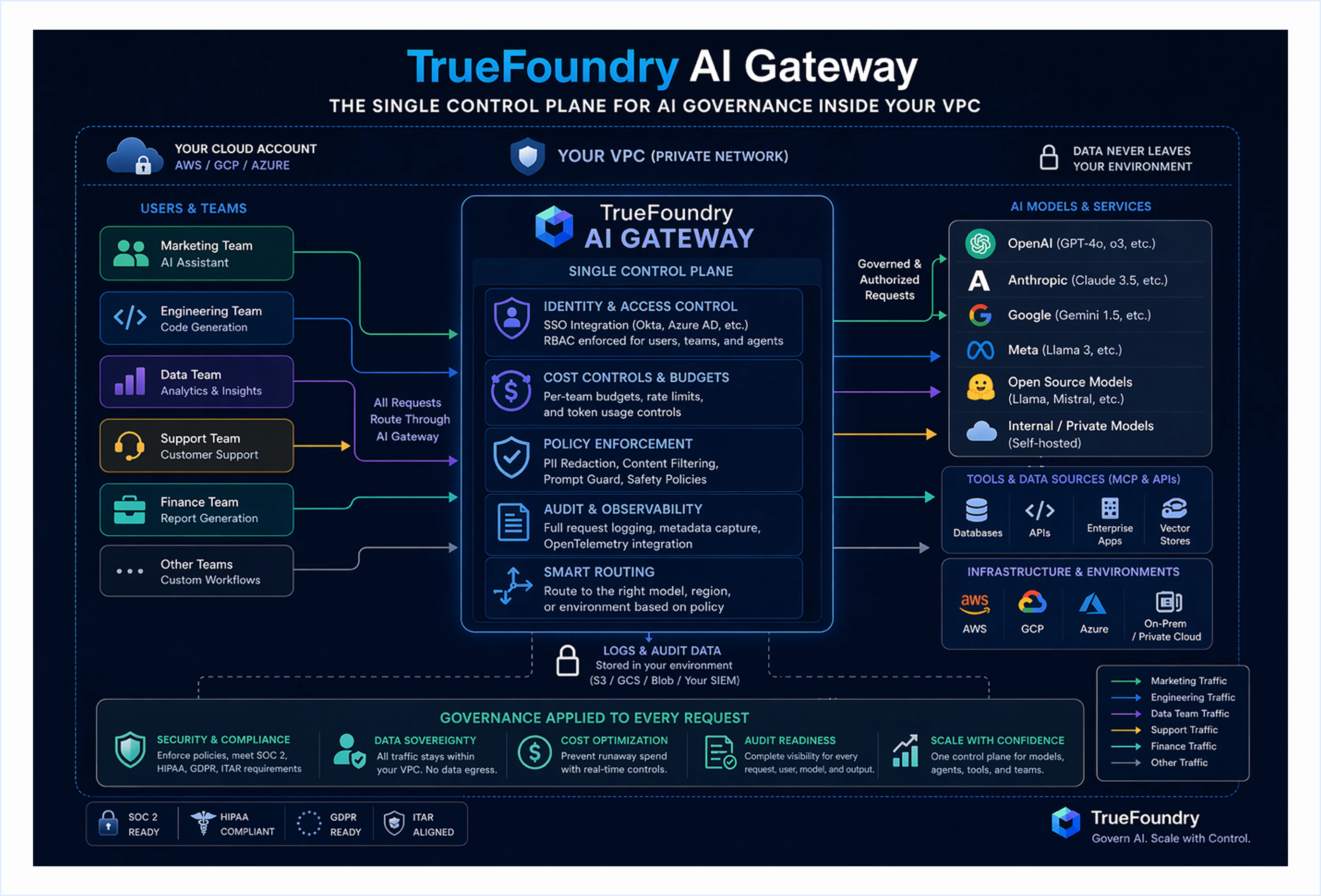
  • La gobernanza real ocurre en la capa de solicitud; aplicando políticas antes de que se complete cada llamada de inferencia, no después. Un informe de cumplimiento generado a la mañana siguiente no deshace una exposición de datos que ocurrió a medianoche.
  • La responsabilidad de los costes requiere límites presupuestarios estrictos por equipo y aplicación que detengan el gasto excesivo antes de que ocurra. Los costes de los tokens se acumulan rápidamente en sistemas multiagente. Sin presupuestos por equipo aplicados en el gateway, la única señal de coste que se obtiene es la factura mensual.
  • La preparación para auditorías requiere un registro completo y estructurado para cada solicitud, capturando la identidad del usuario, el modelo involucrado y el resultado obtenido. Estos datos no deben ser muestreados ni resumidos. En su lugar, cada interacción debe conservarse íntegramente dentro de su entorno, asegurando que sea fácilmente accesible para revisiones de cumplimiento cuando sea necesario.
  • La soberanía de los datos requiere que el tráfico de inferencia nunca abandone el límite de su propia nube. Las plataformas enrutadas por SaaS, donde sus prompts y salidas de modelo transitan a través de la infraestructura de un proveedor antes de que se aplique la gobernanza, no pueden satisfacer los requisitos de HIPAA, ITAR o los estrictos requisitos de residencia de datos, independientemente de cómo el marketing del proveedor describa su postura de cumplimiento.
TrueFoundry infrastructure-layer AI governance platform for enterprise 

¿Cómo TrueFoundry ofrece gobernanza de IA en la capa de infraestructura?

TrueFoundry se basa en un principio sencillo: la gobernanza de la IA es un problema de infraestructura, no un flujo de trabajo de automatización de cumplimiento. Cada control reside en la capa del gateway y se aplica automáticamente a cada solicitud. Ningún desarrollador tiene que implementar lógica de automatización de políticas en el código de la aplicación para que funcione.

  • Despliegue nativo de VPC sin salida de datos: TrueFoundry se ejecuta dentro de su cuenta de AWS, GCP o Azure. Las llamadas de inferencia y los prompts nunca se enrutan a través de redes de terceros. Innovaccer procesa alrededor de 17 millones de solicitudes de inferencia de IA clínica al mes dentro de AWS GovCloud bajo HIPAA. Cada interacción permanece dentro de los límites de su nube. Sus registros de auditoría residen en sus propios logs, no en el panel de control de un proveedor.
  • RBAC granular en modelos, equipos y entornos: Las políticas de control de acceso se asocian a usuarios, equipos y entornos en la capa del gateway. Los equipos de staging no pueden llamar a modelos de producción. Los roles de agente se mantienen dentro del alcance de las herramientas que su función requiere, por lo que un agente de soporte al cliente no puede acceder a registros financieros o a endpoints de modelos administrativos. Estos controles de gobernanza se aplican de forma consistente en cada solicitud sin necesidad de ser reimplementados en cada aplicación.
  • Controles de costes en tiempo real y presupuestos de tokens: Se configuran límites presupuestarios estrictos por equipo, servicio y endpoint. Cuando un equipo alcanza su presupuesto diario de tokens, las solicitudes se detienen antes de que el gasto excesivo se acumule. Innovaccer y Aviva utilizan TrueFoundry para limitar los costes de inferencia en despliegues con múltiples equipos ejecutando cargas de trabajo concurrentes. Esto es gestión de riesgos de modelos a través de la gobernanza financiera, no informes a posteriori.
  • Registro de auditoría completo vinculado a la identidad del usuario y del agente: Cada solicitud se registra con la identidad del usuario, la identidad del agente, el modelo, el recuento de tokens, la latencia y la salida. Los registros se integran directamente en Grafana, Splunk, Datadog o cualquier pipeline de observabilidad existente a través de OpenTelemetry. Para la preparación de auditorías SOC 2 y HIPAA, tanto los equipos de ciencia de datos como los responsables de cumplimiento pueden acceder a la evidencia en su propio entorno y esta puede producirse de inmediato.
  • Cobertura unificada en LLM, agentes y llamadas a herramientas MCP: A medida que las implementaciones escalan más allá de las aplicaciones de un solo modelo hacia sistemas multiagente y herramientas conectadas a MCP, TrueFoundry lo gobierna todo a través de una única plataforma. No hay brecha de gobernanza cuando un agente comienza a llamar a herramientas externas. Las mismas políticas de gobernanza, el mismo registro y los mismos controles de costos se aplican a lo largo de todo el ciclo de vida de la IA.

Reserve una demostración gratuita hoy para empezar.

La forma más rápida de crear, gobernar y escalar su IA

Inscríbase
Tabla de contenido

Controle, implemente y rastree la IA en su propia infraestructura

Reserva 30 minutos con nuestro Experto en IA

Reserve una demostración

La forma más rápida de crear, gobernar y escalar su IA

Demo del libro
Summarize with
ChatGPT logo by OpenAI
Perplexity AI logo
Blurry red snowflake on white background, symmetrical frosty design with soft edges and abstract shape.

Descubra más

No se ha encontrado ningún artículo.
Comparing top Braintrust alternatives for LLM Teams
June 26, 2026
|
5 minutos de lectura

7 Braintrust Alternatives Worth Considering in 2026

No se ha encontrado ningún artículo.
Helicone pricing compared with TrueFoundry enterprise AI governance
June 26, 2026
|
5 minutos de lectura

Helicone Pricing in 2026: Full Breakdown of Plans, Costs, and What Enterprises Need to Know

No se ha encontrado ningún artículo.
June 26, 2026
|
5 minutos de lectura

Integración de TrueFoundry con Smallest AI

No se ha encontrado ningún artículo.
June 26, 2026
|
5 minutos de lectura

Integración de TrueFoundry AI Gateway con New Relic

No se ha encontrado ningún artículo.

Blogs recientes

Black left pointing arrow symbol on white background, directional indicator.
Realice un recorrido rápido por el producto
Comience el recorrido por el producto
Visita guiada por el producto