November 4, 2026
|
Lesedauer: 5 Minuten


Erhalten Sie sofortigen Zugriff auf eine TrueFoundry-Live-Umgebung. Stellen Sie Modelle bereit, leiten Sie den LLM-Verkehr weiter und erkunden Sie die gesamte Plattform — Ihre Sandbox ist in Sekundenschnelle einsatzbereit, ohne dass eine Kreditkarte erforderlich ist.



Unglaublich schnelle Methode zum Erstellen, Verfolgen und Bereitstellen Ihrer Modelle!
Most enterprises keep their information in one warehouse while defining its meaning across many places. Revenue logic may exist in a BI dashboard, a finance spreadsheet, a dbt model, and a Python notebook. Each copy can drift slightly as different departments update their own business logic.
Analysts often learn which number they should trust over time. Business users and AI agents need something more consistent. An agent can select a definition at query time and confidently return it. Conflicting data definitions therefore create a larger problem when automated systems consume them.
Semantic layer architecture fixes this drift closer to its source. A semantic layer sits between enterprise systems and their consumers. It turns physical tables, columns, and joins into understandable business concepts. Revenue, churn, product margin, and active customer status can then carry one consistent meaning.
Dashboards, copilots, and agents can share those governed definitions across the entire organization. The surrounding AI infrastructure still controls which models reach the context. It also governs how requests execute and what gets recorded. This separation creates a more dependable foundation for AI-driven analytics.
The fix for metric drift begins with a clear definition. What is semantic layer architecture in practical terms? It is a governed abstraction layer that translates technical data structures into reusable business definitions. It keeps metrics, dimensions, relationships, permissions, and query rules together.
Different consumers can then receive the same answer to the same question. The layer creates a single source of truth for important business terms. A request such as “revenue by region last month” uses approved metric definitions rather than rebuilding the calculation in each application.
The architecture combines version-controlled definitions with an engine that resolves requests. That engine turns familiar questions into executable queries against the underlying data. It adds business context above storage and transformation without replacing either layer. The warehouse continues to store information and execute the final query.
dbt uses MetricFlow to define metrics through semantic model metadata and generate queries from those definitions. Its current specification embeds semantic annotations alongside existing dbt models. This allows downstream consumers to query governed metrics without having to rebuild joins independently.
One practical consequence receives less attention than the technology itself. Every important definition needs a named owner. Data teams routinely assign ownership to pipelines and tables. Definitions such as active customer or customer lifetime value can remain ownerless until two reports disagree.
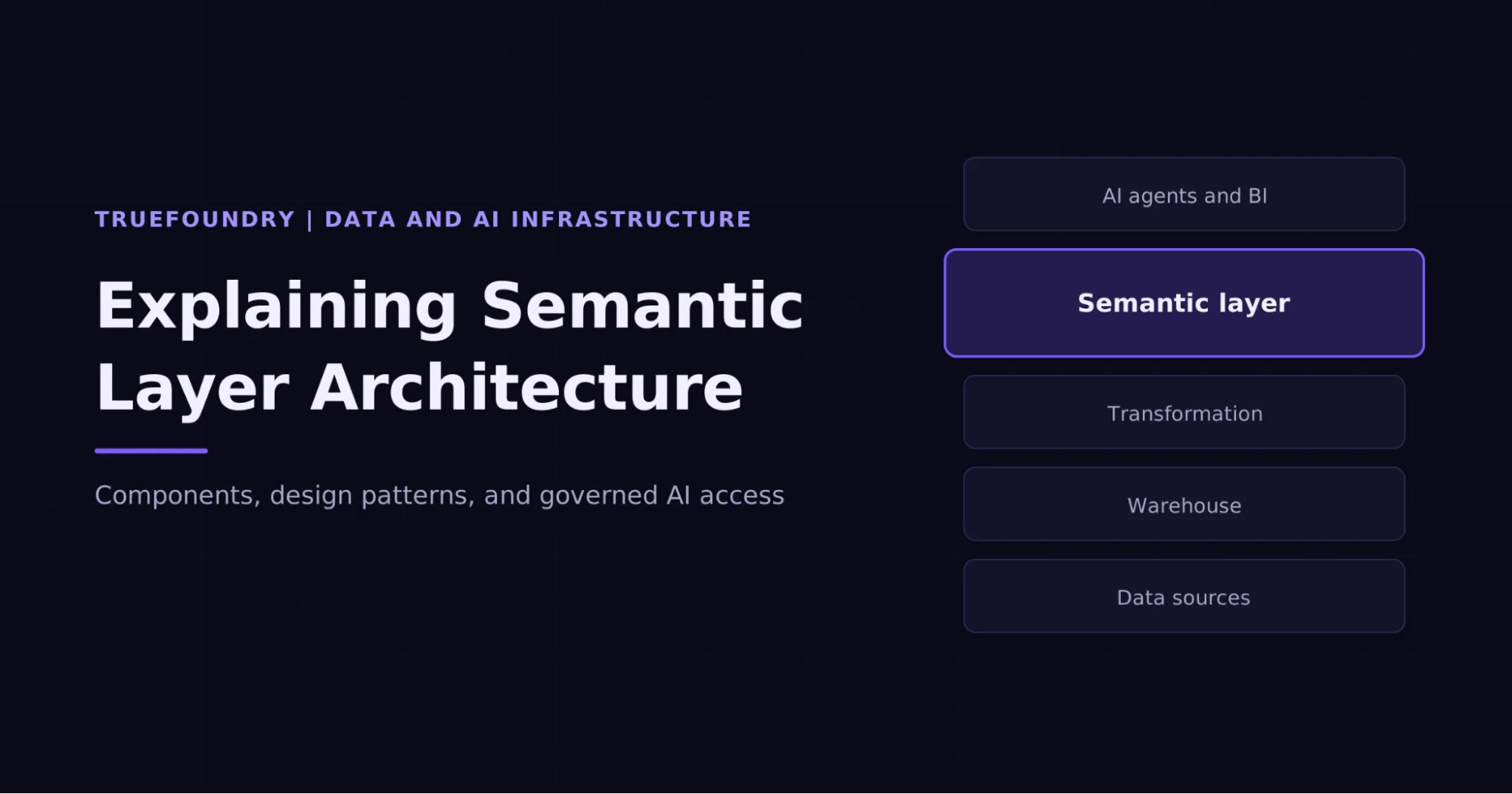
Placement determines what the layer can consistently enforce across the stack. A typical semantic layer data architecture separates storage, transformation, meaning, and consumption. This creates clearer boundaries between raw data, modeled information, shared definitions, and the tools that present results.
This separation keeps metric rules outside individual dashboards and application code. When finance changes revenue recognition, one governed definition can change centrally. Every consumer then receives the new calculation. Teams avoid updating dozens of reports, notebooks, and application queries independently.
The architecture can sit above data warehouses or data lakes, depending on the wider data architecture. It also gives consumers a consistent view of data across environments. A Power BI report and another analytics application can therefore rely on the same governed calculations.
Modern warehouse platforms increasingly provide native capabilities for this layer. Snowflake Semantic Views store metrics, entities, relationships, and other business meaning as database objects. They can also support natural-language analytics through Cortex Agents.
Databricks provides Unity Catalog metric views for centralized metric management. Metric views separate measures from dimensions and generate calculations at query time. This gives different teams consistent calculations while keeping the query flexible.
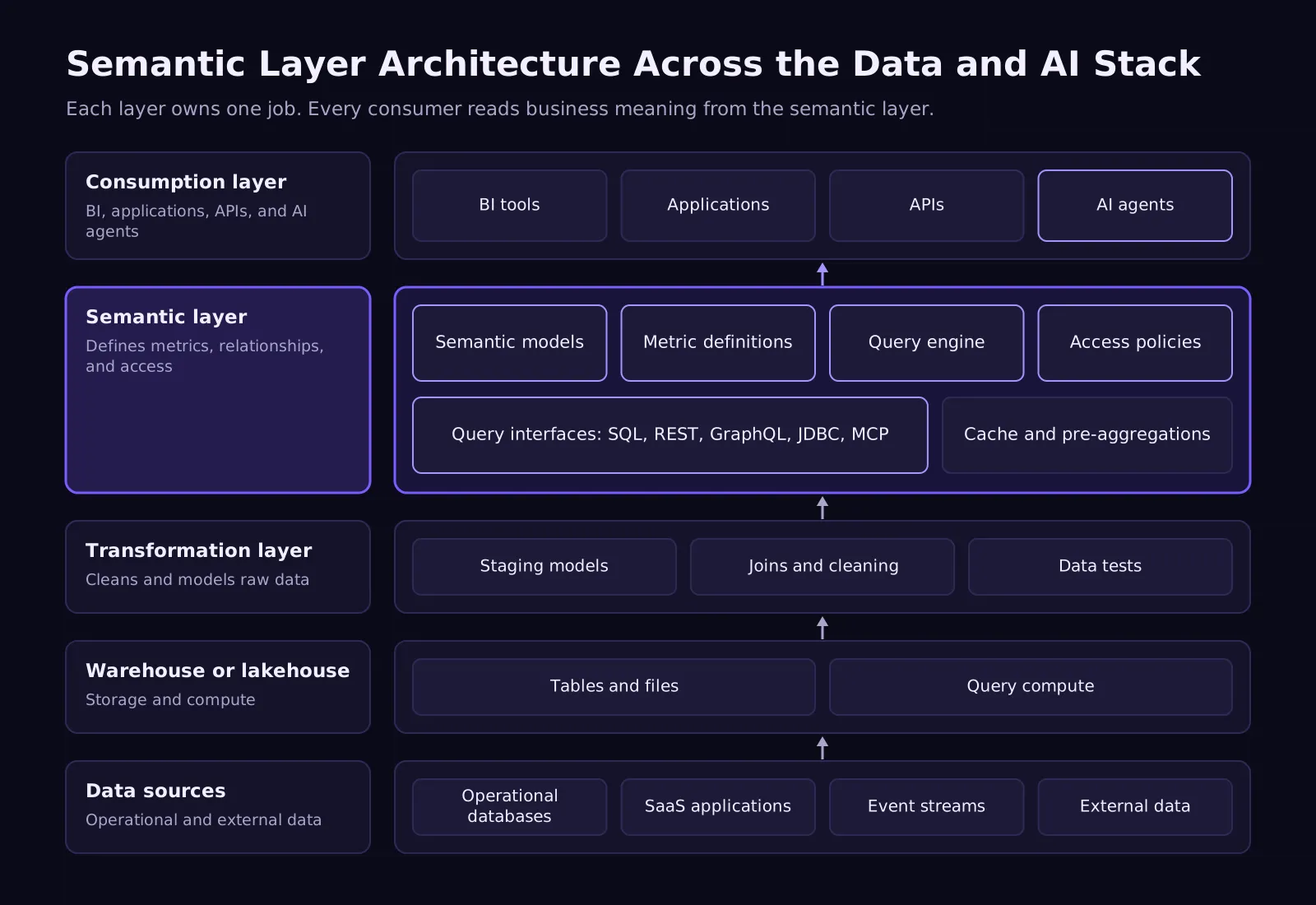
Knowing where the layer sits leads directly to its core components. A production implementation needs more than a glossary of approved terminology. Five capabilities work together to convert technical storage into a governed analytical interface for people, applications, and AI.
The query engine carries much of the workload. MetricFlow reads semantic models, resolves entity relationships, and generates the required SQL. The consumer names the required metric and dimension. The engine decides how the relevant models should connect.
Serving interfaces vary across implementations and different tools. Some products expose SQL-compatible APIs alongside REST or GraphQL. Others provide MCP interfaces that let agents discover approved metrics and dimensions. These interfaces make semantic modeling available outside conventional analytics applications.
Most production implementations add caching or pre-aggregation as request volume grows. Repeated analytical requests can otherwise consume unnecessary warehouse resources. This additional layer can improve query performance while keeping the governed definition unchanged.
The underlying capabilities stay similar, while teams arrange ownership differently. The right pattern depends on team structure, platforms, and consumers. It also depends on how much independence individual domains need when managing their own data models.
A centralized model is usually the easiest starting point. One team and one repository produce consistent definitions quickly. The drawback appears as adoption grows. A central team can become a queue when many domains request new metrics simultaneously.
Domain ownership moves that workload closer to each business area. Sales, finance, and product can manage their own definitions. A platform team can own shared conventions and entities. Cross-domain measures, such as net revenue, still require explicit ownership and testing.
Headless designs work well when organizations use several analytics platforms. Definitions live outside any single visualization product. This prevents a platform migration from requiring the business to rebuild every calculation. It also moves the business logic layer closer to shared infrastructure.
A universal semantic layer becomes valuable when consistent definitions must survive platform changes. The AI-ready pattern adds detailed descriptions, synonyms, introspection, and agent-friendly interfaces. It does not require replacing centralized or domain ownership models.
Apache Ossie entered Apache incubation in June 2026 after originating as Open Semantic Interchange. It defines a vendor-neutral format for metrics, dimensions, and relationships. This supports portability when definitions need to move between platforms.
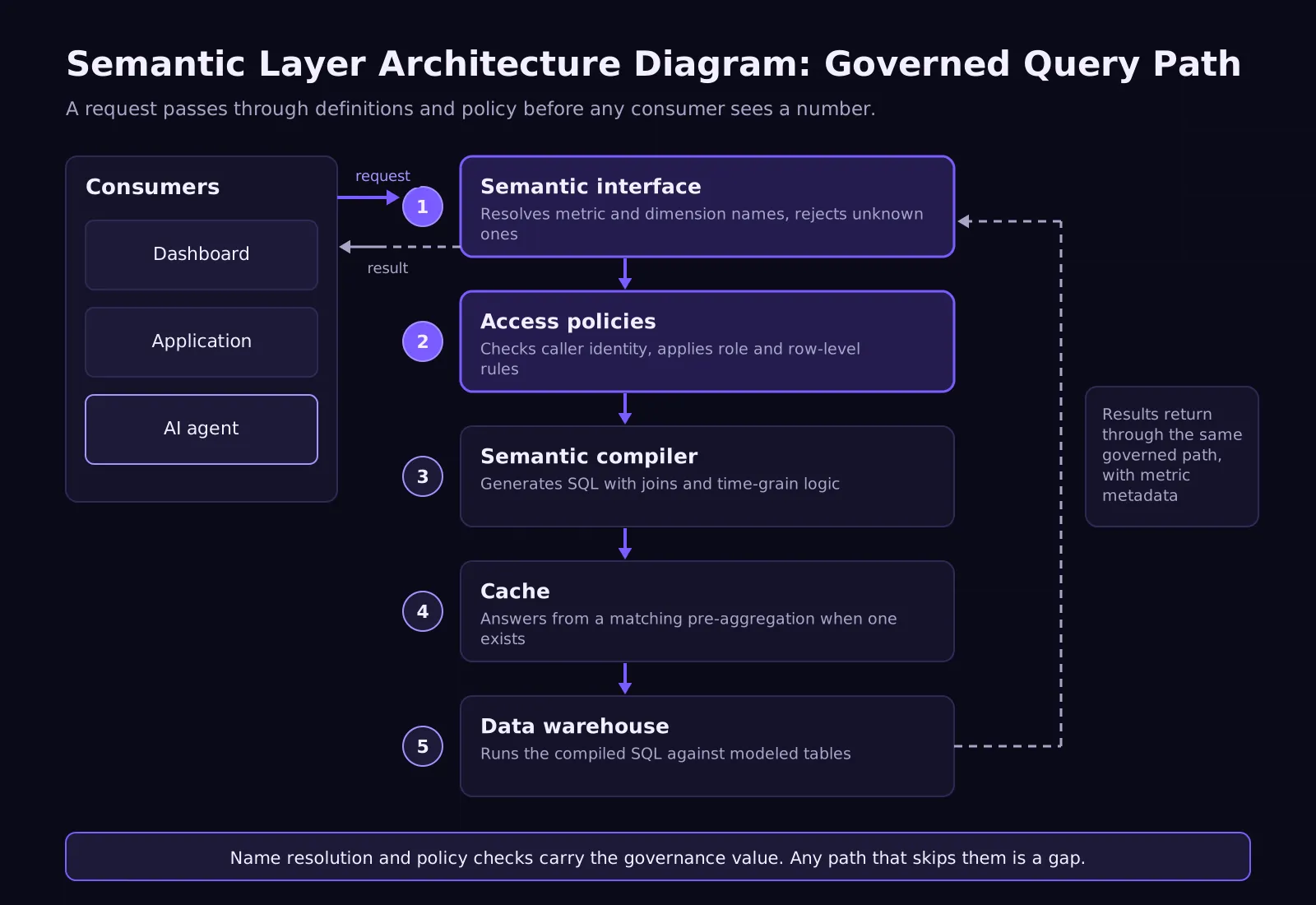
A design becomes easier to evaluate when the request path is visible. A good semantic layer architecture diagram follows one request from a consumer toward governed information. It should then show how results return through the same controlled path.
The request should follow these stages:
The order makes one principle in data governance especially clear. Business meaning and access rules apply before the consumer interprets the result. Skipping those controls creates a SQL generation layer rather than a complete semantic governance layer.
The diagram can also support architecture reviews and data exploration. Any consumer with direct warehouse access marks a potential governance gap. This matters particularly when agents receive broad credentials for convenience. Direct connections can bypass approved definitions and permissions.
Agents follow the same request path, though they apply greater pressure to definitions. Tables and column names rarely provide enough meaning on their own. An agent needs context on business rules, relationships, units, and approved calculations to answer analytical questions reliably.
This problem becomes harder with complex data and large enterprise schemas. Spider 2.0 evaluated 632 real-world enterprise text-to-SQL workflow problems. Its o1-preview-based code agent solved 21.3% of tasks. The same framework scored 91.2% on Spider 1.0 and 73.0% on BIRD.
These results illustrate why raw schema access poses a risk to AI systems. Enterprise schemas contain many columns, dialects, and project-specific relationships. An agent receiving only technical data may produce plausible SQL without understanding the underlying meaning.
The business impact extends beyond query accuracy. Gartner found that 63% of organizations lacked suitable AI data practices or were unsure. Gartner also predicted that organizations would abandon 60% of AI projects unsupported by AI-ready data through 2026.
A governed layer gives agents consistent metrics, dimensions, entities, and relationships before they query anything. It also exposes familiar business terms instead of forcing an agent to infer meaning from physical names. This improves access to trusted enterprise data.
dbt published a 2026 benchmark comparing semantic-layer querying with direct text-to-SQL. For questions within the modeled scope, Sonnet 4.6 and GPT-5.3 Codex achieved 100% semantic-layer accuracy. Their direct text-to-SQL results were 62.5% and 51.2%, respectively.
The benchmark used 11 questions, each repeated 20 times. Questions outside the modeled scope returned errors instead of unsupported numbers. That distinction matters when business metrics feed executive reporting, compliance workflows, or financial services decisions.
Agents can reach approved definitions through APIs or MCP interfaces. The resulting architecture supports natural language analytics without granting every model unrestricted access to the database. An agent can discover available metrics before generating or executing a request.
This model also complements RAG architecture rather than replacing it. Semantic models govern structured analytical calculations and return exact numbers. RAG retrieves unstructured knowledge such as policies, contracts, and customer service tickets. Many enterprise use cases need both capabilities.
Once agents rely on the layer, its controls become production controls. Governance, security, and performance each need deliberate decisions before deployment. Those decisions should remain consistent across data environments, applications, and consumers.
Governance belongs inside the query path used by every tool and agent. Teams should keep definitions in Git and require owner review. Testing should happen before a changed definition reaches production. Lineage, ownership, and version control should remain consistent regardless of the consumer.
Security determines which users, applications, and agents can reach individual entities and records. Row-level and role-level controls become important when several business units share the same layer. These controls protect sensitive information while allowing appropriate analytical access.
Identity propagation deserves close attention when agents call governed analytical services. Shared service accounts can inherit broader permissions than an individual user needs. Passing the end user's identity helps preserve the approved authorization boundary.
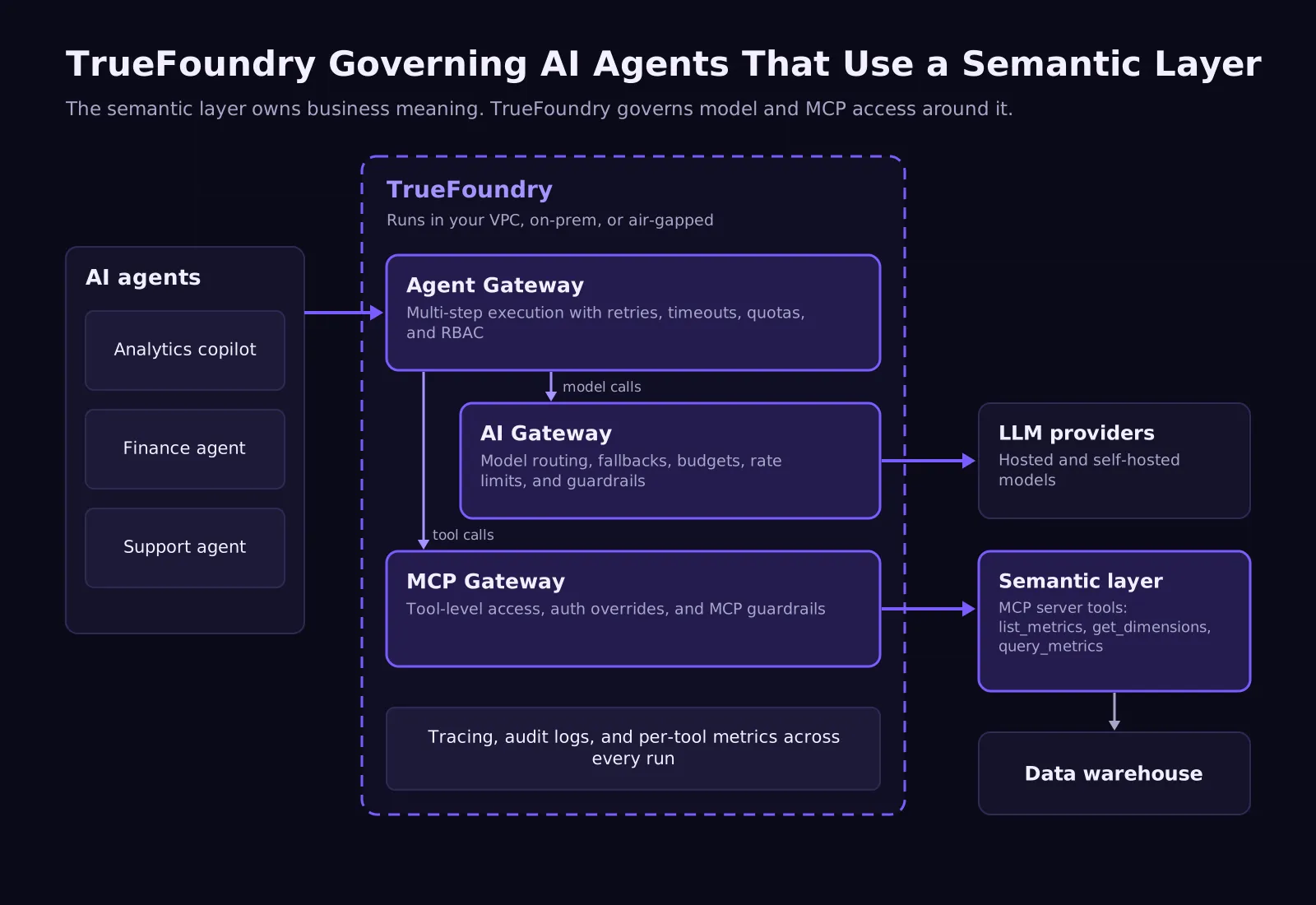
A gateway can reinforce that boundary when tools are exposed through MCP. TrueFoundry's MCP access control can evaluate agent and server identities and specific tool access. Unauthorized tools can remain hidden from callers rather than relying on prompt-level restrictions.
Performance also requires deliberate design as data volumes and agent activity increase. One agent task may create several related requests while exploring dimensions. Pre-aggregation, caching, query optimization, and workload limits can reduce repeated processing.
Rate controls should also exist at the runtime layer. A looping agent should exhaust its own quota before overwhelming shared analytics resources. TrueFoundry's Agent Gateway supports quotas, retries, timeouts, RBAC, and controlled execution paths.
Good controls only help when the underlying model remains understandable. Teams should start with a focused set of high-value measures. Modeling every dataset immediately creates definitions that nobody has validated or clearly owns.
A narrow first scope lets teams check ownership, behavior, and adoption. It also supports best practices for controlled expansion. A sales manager might start with revenue, customer count, and conversion metrics. Another team can later add measures by product category.
A practical sequence follows:
The current dbt specification for v1.12 and later places semantic annotations within model definitions. Entities and dimensions can be declared at the column level. MetricFlow then uses this metadata when building its semantic graph.
The example below uses dbt's semantic layer spec for dbt v1.12 and later, which declares entities and dimensions at the column level. It models two existing dbt models: fct_orders, with one row per order, and dim_customers, with one row per customer.
models:

  - name: fct_orders

    semantic_model:

      enabled: true

    agg_time_dimension: ordered_at

    columns:

      - name: order_id

        entity:

          type: primary

          name: order_id

      - name: customer_id

        entity:

          type: foreign

          name: customer

      - name: ordered_at

        granularity: day

        dimension:

          type: time

      - name: status

        dimension:

          type: categorical

    metrics:

      - name: order_total

        description: "Gross order value in USD, before refunds."

        type: simple

        label: Order Total

        agg: sum

        expr: amount

      - name: order_count

        description: "Number of distinct orders."

        type: simple

        label: Order Count

        agg: count_distinct

        expr: order_id

      - name: average_order_value

        description: "Order total divided by order count."

        type: ratio

        label: Average Order Value

        numerator: order_total

        denominator: order_count

  - name: dim_customers

    semantic_model:

      enabled: true

    columns:

      - name: customer_id

        entity:

          type: primary

          name: customer

      - name: region

        dimension:

          type: categorical
Here is what each part does:
Notice the descriptions. An agent reads them when it picks a metric, so "Gross order value in USD, before refunds" does real work. A description that says only "order total" invites the agent to guess.
Next, ask the layer for SQL without running it. On the dbt platform, the command looks like this:
dbt sl query --metrics order_total,average_order_value --group-by metric_time__month,customer__region --where "{{ Dimension('order_id__status') }} = 'completed'" --compileThe --compile flag prints the generated SQL and skips execution. Self-hosted MetricFlow uses mf query with the same arguments and --explain in place of --compile. Check that the output joins fct_orders to dim_customers on customer_id, truncates ordered_at to the month, and filters by status before aggregating.
Then turn that check into a test. Pick five questions the business already answers in a trusted report, run each through the layer, and compare the numbers. Run the same five through your BI tool and your agent. All three paths should agree to the cent before anyone else gets access.
As adoption grows, teams can add new domains through the same process. Testing, ownership, lineage, and monitoring prevent conflicting definitions from spreading. This disciplined approach keeps the data platform understandable as analytical coverage expands.
A working semantic model answers the analytical meaning question. The runtime question remains separate. Enterprises still need to decide which agents can use that information. They also need policies for models, tools, limits, credentials, and execution.
TrueFoundry handles that runtime without replacing the semantic layer. The semantic layer keeps ownership of definitions, metrics, relationships, and governed analytical access. TrueFoundry governs how AI workloads reach and use those capabilities.
The MCP Gateway is the most direct integration point for MCP-enabled analytical services. Teams can govern which servers and tools agents reach. OAuth, federated identity, RBAC, and request-level tracing support controlled tool usage.
An analytics agent could receive approved query and discovery tools without broader server permissions. Identity-aware policies can preserve restrictions around the person using the agent. This keeps access decisions outside individual prompts.
The AI Gateway manages model access, budgets, routing, guardrails, and observability. This matters when semantic results are shared across several models or providers. Central policies keep model governance separate from analytical business rules.
A model-aware LLM Gateway can manage routing, fallback, and provider abstraction. This becomes useful when several models consume the same semantic results. Application teams can avoid rebuilding provider integrations inside every analytics experience.
Autonomous workflows add another layer because agents may call several analytical and operational tools. AI agent observability connects sessions, model calls, and tool calls into a traceable trajectory. This helps teams understand which context produced a particular result.
The division of responsibility therefore stays clear. The semantic layer architecture ensures analytical meaning is consistent across consumers. TrueFoundry governs how models, tools, and agents access that context and act upon it.
TrueFoundry also supports VPC, on-premises, hybrid, and air-gapped deployment patterns. These options help enterprises keep credentials and AI traffic under governance within approved boundaries.
If you want to see your semantic layer's MCP tools running behind per-team access rules and full tracing, book a demo with the TrueFoundry team.
TrueFoundry AI Gateway bietet eine Latenz von ~3—4 ms, verarbeitet mehr als 350 RPS auf einer vCPU, skaliert problemlos horizontal und ist produktionsbereit, während LiteLM unter einer hohen Latenz leidet, mit moderaten RPS zu kämpfen hat, keine integrierte Skalierung hat und sich am besten für leichte Workloads oder Prototyp-Workloads eignet.





Die neuesten Nachrichten, Artikel und Ressourcen werden in Ihren Posteingang gesendet