November 2, 2026
|
5 min read


Blazingly fast way to build, track and deploy your models!
Agent authentication is the process of verifying an AI agent’s identity before it is allowed to act. The agent presents a credential — typically a short-lived, signed token — and a verifier validates that credential’s issuer, audience and signature to confirm the agent is who it claims to be, rather than a spoofed or unauthorized caller.
In one line: agent authentication answers “is this really that agent?” — the identity check that must pass before any authorization decision is made.
Autonomous agents call tools, data sources and other agents without a human in the loop. If you cannot verify which agent is making a request, you cannot attribute actions, apply per-agent policy, or stop an impostor. The failure modes are concrete:
Strong agent authentication is the foundation the rest of agentic IAM is built on — you cannot authorize or audit an agent you cannot first identify.
Enforcing this at a single control point — rather than in every agent and server — is what the MCP gateway authentication model provides.
The two are often confused. Authentication is about identity; authorization is about permission. Authentication always comes first.
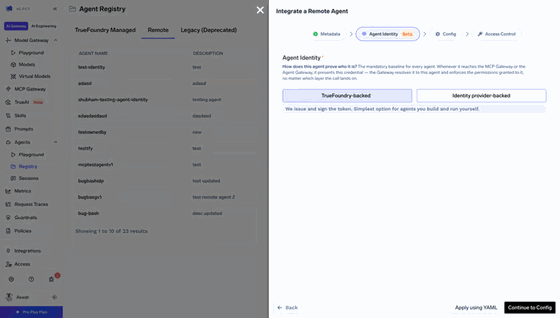
When you register an agent in TrueFoundry, you choose how it proves who it is: a TrueFoundry-backed credential (TrueFoundry issues and signs the token — the simplest option) or an identity-provider-backed credential (the agent authenticates through Okta, Entra or another IdP). Either way, the agent presents that credential at the Agent Gateway or MCP Gateway on every call, and the gateway resolves it to the registered agent and the permissions granted to it.
Each request carries two credentials — the user’s token and the agent’s token — so the gateway authenticates both:
Authorization: <user token>
x-tfy-agent-authorization: <agent token>
For identity-provider-backed agents, the gateway validates the token’s signature against the configured jwks_uri, checks the issuer (iss) and audience (aud), and matches the agent identity from the token’s claim (by default act.sub) against the agent registry — returning 403 if there is no match. TrueFoundry supports three identity modes: managed credentials (TrueFoundry performs the RFC 8693 token exchange for the agent), federated token (the agent performs the exchange itself and presents the result), and virtual account (the agent presents a virtual-account token plus an X-TFY-User-Token, with no IdP exchange).
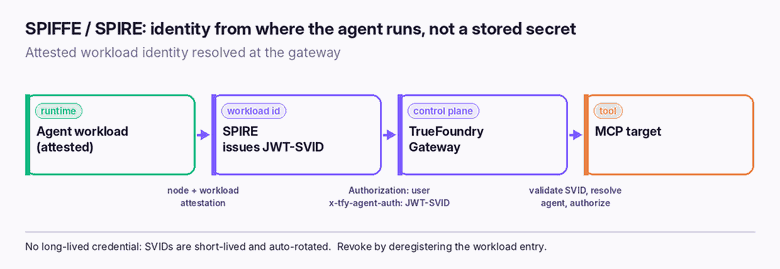
For workload-based authentication, TrueFoundry supports SPIFFE/SPIRE, where the agent’s credential is derived from runtime attestation — so the agent holds no long-lived secret at all.
TrueFoundry AI Gateway delivers ~3–4 ms latency, handles 350+ RPS on 1 vCPU, scales horizontally with ease, and is production-ready, while LiteLLM suffers from high latency, struggles beyond moderate RPS, lacks built-in scaling, and is best for light or prototype workloads.




Agent authentication is verifying an AI agent’s identity before it acts. The agent presents a credential — usually a short-lived, signed token — and a verifier validates its signature, issuer, audience and expiry to confirm the agent is genuine rather than spoofed.
Authentication verifies who the agent is; authorization decides what the authenticated agent may do. Authentication happens first and produces a verified identity; authorization then evaluates that identity against least-privilege policy for each specific action.
Register the agent as its own identity, issue it a short-lived credential (OAuth/OIDC token, mTLS certificate, or a SPIFFE SVID), and validate that credential on every request at a control point such as a gateway — checking signature, issuer, audience and expiry, and rotating credentials regularly.
A shared, long-lived API key cannot distinguish one agent from another, cannot be revoked for a single agent, and never expires. Per-agent, short-lived credentials provide attribution, individual revocation, and a smaller blast radius if leaked.
Commonly OAuth 2.0 client credentials or OIDC tokens, mutual TLS certificates, and SPIFFE/SPIRE SVIDs for attested workload identity. These are typically validated at a gateway that fronts models, tools and MCP servers.



The latest news, articles, and resources sent to your inbox