November 2, 2026
|
5 min read



Blazingly fast way to build, track and deploy your models!
Agent authorization is the process of deciding what an authenticated AI agent is allowed to do — which tools, data and actions it may access — by evaluating the agent’s identity and the request against least-privilege policy, including any on-behalf-of delegation, before the action is permitted. It is the control that keeps an autonomous agent inside its intended boundaries.
In one line: agent authorization answers “is this agent allowed to do this?” — enforced per action, under least privilege, after authentication.
Authorizing autonomous agents is harder than authorizing apps, for three reasons:
Getting this right is central to AI agent governance: authorization is where policy actually constrains what agents can do.
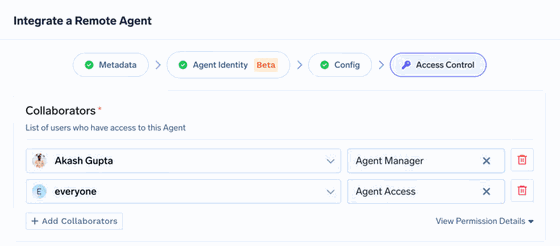
Two principles do most of the work. Least privilege means each agent gets only the scopes its task requires, so a compromised or misbehaving agent can do limited damage. On-behalf-of (OBO) delegation means an agent acting for a user is authorized against that user’s rights — never more — and the delegation is explicit and auditable rather than an inherited token. TrueFoundry supports collaborator-based scoping and OBO so an agent can only ever be acted for by identities that were explicitly granted it.
Single-request authorization is not enough once agents call other agents. If each hop only checks its immediate caller, a privileged middle agent can become a confused deputy — doing things the original user was never allowed to do. Authorization has to propagate the originating identity and constraints across the whole chain. In TrueFoundry’s model the user stays constant as sub end to end, while the acting agent in the act claim changes at each hop — and the gateway re-checks “may this agent act for this user?” every time.
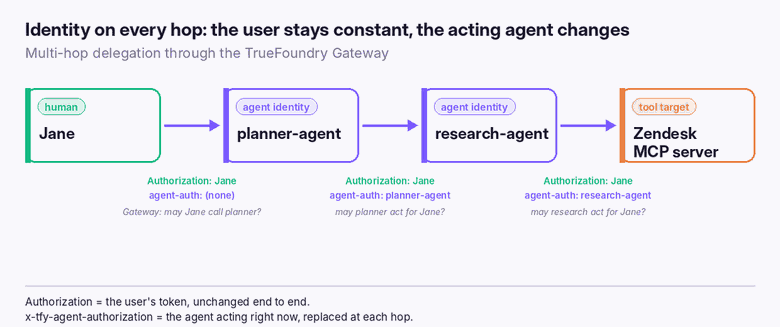
We cover this failure mode and the fix in depth in Authorization Propagation, Explained.
TrueFoundry authorizes every agent action at the gateway, in a strict, auditable order once the (user, agent) pair is resolved:
agent:<name> subject with a role).403.Delegation is governed by two claims: may_act is checked before a delegated token is minted (the forward-looking gate), and act is recorded on the issued token (the after-the-fact record). Because each exchanged token carries only the intersection of user, agent and target rights, authorization can only narrow down the chain — never amplify. Who may invoke an agent, and whom it may act for, is set through collaborator grants.
Every decision is logged with the user, agent, identity mode, delegation chain, MCP server, tool, the RBAC and Cedar decisions, the matching policy, the scopes used and the status — deployable as SaaS, VPC, on-prem or air-gapped.
TrueFoundry AI Gateway delivers ~3–4 ms latency, handles 350+ RPS on 1 vCPU, scales horizontally with ease, and is production-ready, while LiteLLM suffers from high latency, struggles beyond moderate RPS, lacks built-in scaling, and is best for light or prototype workloads.




Agent authorization is deciding what an authenticated AI agent is allowed to do. It evaluates the agent’s identity and request against least-privilege policy — including any on-behalf-of delegation — and allows, denies, or requires approval for each specific action before it executes.
Authentication verifies the agent’s identity (who it is); authorization decides what that verified agent may do. Authentication happens first; authorization then evaluates the identity against policy for each action.
On-behalf-of delegation lets an agent act for a user while being authorized against that user’s rights — never more. The delegation is explicit and auditable, and the originating identity is carried across any chain of agents and tools so authorization reflects who is really asking.
Give each agent only the scopes its task needs, authorize per action at a central control point (a gateway), resolve delegation to the originating principal, and require step-up approval for high-impact actions — then audit every decision against the agent’s identity.
In multi-agent systems, checking only the immediate caller lets a privileged intermediate agent act as a confused deputy. Authorization must propagate the originating identity and constraints across the whole agent-to-agent chain, not just the current hop.



The latest news, articles, and resources sent to your inbox