November 2, 2026
|
5 min read


Blazingly fast way to build, track and deploy your models!
Agentic IAM is identity and access management applied to AI agents: it gives every agent its own verifiable identity, authenticates that identity on each request, and authorizes what the agent may do under least-privilege policy — with delegation, lifecycle controls and audit — so autonomous agents act under enforceable governance instead of shared human credentials or static API keys.
In one line: agentic IAM extends traditional IAM to treat each AI agent as a first-class, governed non-human identity with its own authentication, authorization and lifecycle.
Traditional IAM was built for two kinds of actors: humans (who log in) and static machine accounts (service accounts, API keys). AI agents are neither. They act autonomously, make decisions at runtime, call tools and other agents on a user’s behalf, and spin up and disappear far faster than any human account. Dropping them into human-shaped IAM breaks in predictable ways:
Agentic IAM closes these gaps by making the agent itself the unit of identity, policy and audit. It builds on the same principles covered in our guide to identity and access management, extended for autonomous, non-human actors.
A complete agentic IAM capability set spans the full access lifecycle:
In practice, agentic IAM runs as a loop at a control point in front of your agents and tools:
Standards matter here: agentic IAM typically builds on OAuth 2.0 / OIDC for tokens and delegation, and on workload-identity standards like SPIFFE/SPIRE for attested, short-lived agent credentials.
As agents increasingly reach tools through the Model Context Protocol (MCP), the MCP boundary becomes a natural place to enforce agentic IAM — authenticating the agent, propagating identity, and applying policy on which agents may reach which MCP servers. Centralizing this at an MCP gateway avoids every agent and server re-implementing identity, and gives you one audited choke point. It’s the same control-plane idea behind broader AI agent governance.
TrueFoundry runs agentic IAM at the gateway, acting as the identity broker for every agent call. Two credentials ride on each request — the user’s token and the agent’s own token — so the gateway always knows both who the agent is and who it is acting for:
Authorization: <user token>
x-tfy-agent-authorization: <agent token>
The agent token is TrueFoundry-signed and issued at registration, so the gateway can validate both credentials without an external round-trip. Every agent is registered in the agent registry with its owner, business purpose, defined authority (the tools, data domains and actions it may use, and the principals it may act for) and a review cadence — and that registration becomes the enforcement point.
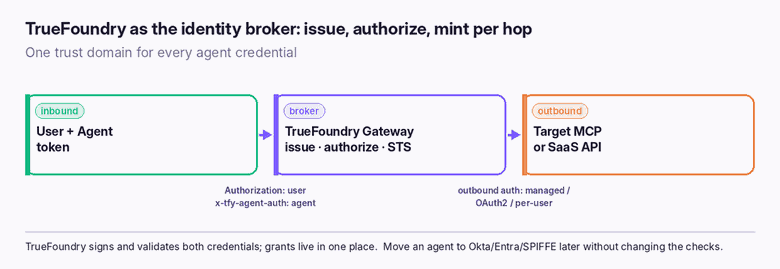
On each request the gateway resolves the (user, agent) pair, then evaluates authorization in a strict order: the user must be a collaborator on the target, the agent must be a collaborator (an agent:<name> subject), the requested tool must be in the agent’s allowed tools list, and an optional Cedar policy is evaluated (where forbid overrides permit and can inspect the full delegation chain). Any request without a matching grant is denied with a 403.
For delegation, TrueFoundry uses RFC 8693 token exchange (on-behalf-of): the issued token keeps the user as sub and records the acting agent in an act claim, with sub-agents nesting act down the chain. Crucially there is no privilege amplification — each hop’s token carries only the intersection of the user’s rights, the agent’s rights and the target’s acceptance, so delegation can only ever narrow access. Outbound credentials to each tool or MCP server are held by the gateway, never by the agent.
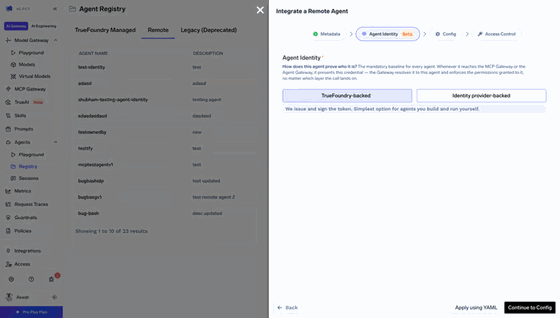
Lifecycle is built in: periodic owner-signed certification confirms grants still match purpose, runtime drift detection compares behaviour against defined authority (and can constrain, suspend or notify), decision evidence is logged for every action, and a kill switch revokes a single agent instantly. All of this deploys as SaaS, in your VPC, on-prem or air-gapped.
TrueFoundry AI Gateway delivers ~3–4 ms latency, handles 350+ RPS on 1 vCPU, scales horizontally with ease, and is production-ready, while LiteLLM suffers from high latency, struggles beyond moderate RPS, lacks built-in scaling, and is best for light or prototype workloads.




Agentic IAM is identity and access management for AI agents. It gives each agent its own verifiable identity, authenticates it on every request, and authorizes its actions under least-privilege policy, with delegation, lifecycle controls and audit — so autonomous agents operate under enforceable governance rather than shared credentials.
Traditional IAM governs humans and static service accounts; agentic IAM governs autonomous AI agents as first-class identities. Agent identities are ephemeral, authorized per task rather than per role, support explicit on-behalf-of delegation, and are audited at the level of the individual agent and action.
Closely related but not identical. Non-human identity is the broad category covering service accounts, workloads, API keys and agents. Agentic IAM is the discipline of managing access specifically for AI agents — a fast-growing, autonomous subset of non-human identities.
Shared API keys provide no per-agent attribution, grant broad standing access, and cannot be revoked for one agent without breaking others. Agentic IAM replaces them with per-agent, short-lived, least-privilege credentials that can be individually scoped, rotated and revoked.
Commonly OAuth 2.0 and OpenID Connect for tokens and delegation, and workload-identity standards such as SPIFFE/SPIRE for attested, short-lived agent credentials. These are typically enforced at a gateway that authenticates agents and applies policy before requests reach models, tools or MCP servers.



The latest news, articles, and resources sent to your inbox