October 31, 2026
|
5 min read


Blazingly fast way to build, track and deploy your models!
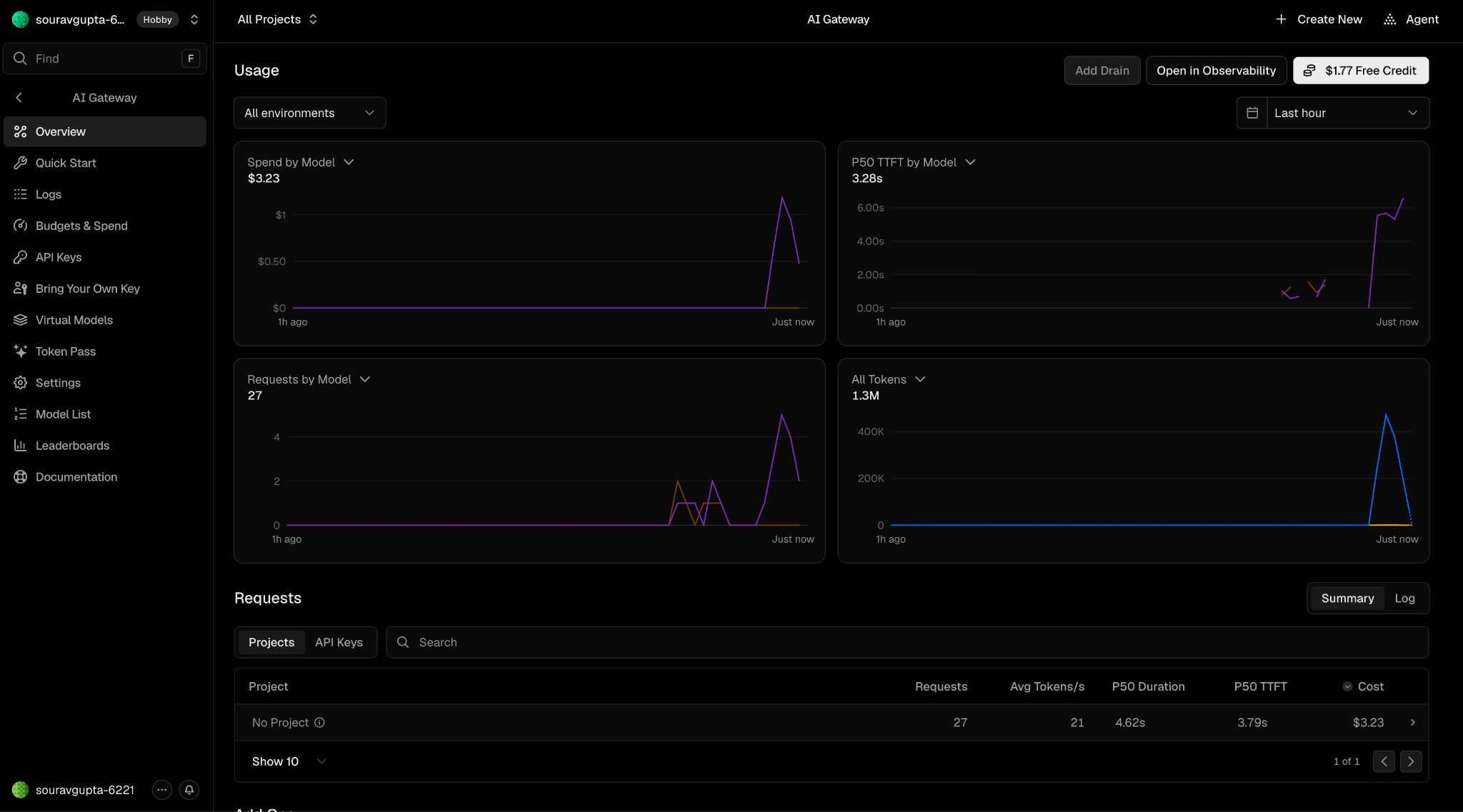
Both TrueFoundry and Vercel AI Gateway put a single endpoint in front of many model providers, and both do the baseline job well: one API key, provider routing, usage tracking, spend controls. The comparison gets more interesting once you ask where the gateway runs and who has to approve it. Vercel AI Gateway is a hosted service you call. TrueFoundry is a gateway you can run anywhere, from fully managed SaaS to an air-gapped VPC. If you are an AI application engineer who wants one managed endpoint, that difference may not matter much. If you are a platform or compliance team signing off on where prompts travel, it is most of the decision.
This comparison looks at both the way an engineering leader evaluating them for production would: deployment, model coverage, agent and MCP governance, cost control, and compliance. Everything about Vercel here comes from its public documentation as of September 2026. Everything about TrueFoundry comes from our own docs. Where we could not confirm something, we say so rather than guess. If you want the background on what this category does first, start with our primer on what an LLM gateway is.
Vercel AI Gateway is a managed router that sits between your application and model providers, centralizing credentials, usage reporting, and spend controls behind one OpenAI-compatible endpoint. It reached general availability in August 2025 and grew out of Vercel's web platform and AI SDK. The service runs on Vercel's own infrastructure at ai-gateway.vercel.sh, so there is no gateway for you to deploy or scale.
Its economics are the headline. Vercel publishes a 0% token markup, including when you bring your own provider keys, and a free tier with 5 USD per month in credits for a subset of models. The catalog spans hundreds of models across providers such as OpenAI, Google Vertex AI, and Amazon Bedrock, with chat, streaming, embeddings, function calls, and structured outputs documented. Native metrics cover request volume, token usage, spend, latency, and routing, and traces export over OTLP/HTTP. Vercel says the Gateway powers v0, its own product, which is a reasonable signal of real usage even if scale claims are the vendor's own.
Where it asks you to adjust is deployment and governance. There is no documented way to run the Gateway yourself, in your VPC or air-gapped. The hosted endpoint is the product. SSO is a paid add-on, directory provisioning and audit export sit behind Enterprise, and a unified tool-authorization layer for MCP inside the Gateway is not something the current docs establish.
Best for: application teams, especially those already on Vercel, that want managed provider routing and usage visibility without operating gateway infrastructure.
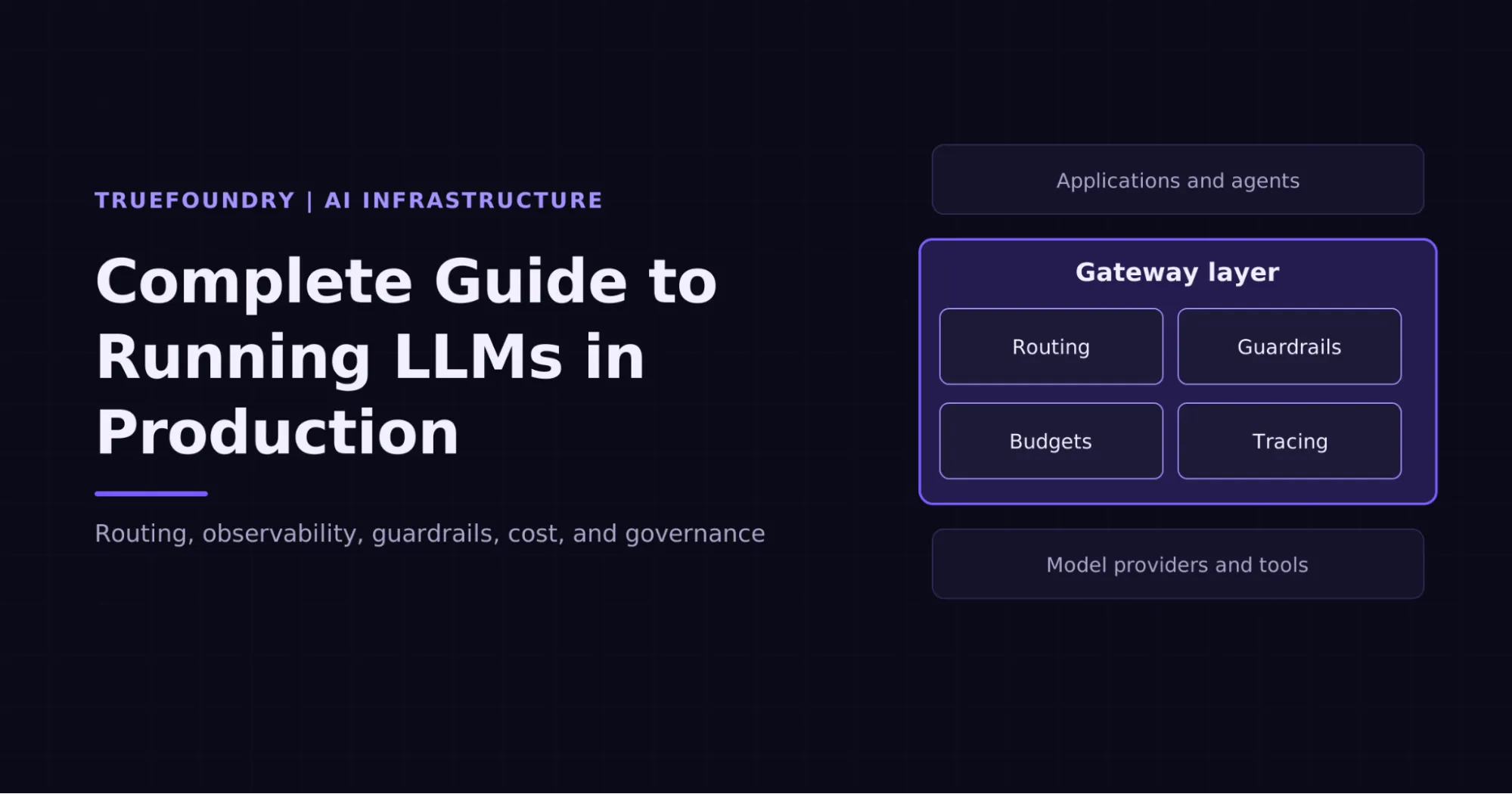
TrueFoundry is an AI gateway that unifies 1,000+ LLMs behind a single OpenAI-compatible API, and it runs wherever your compliance posture requires. You point your existing provider SDK at the gateway's base URL rather than importing a proprietary client, which keeps application code close to what your team already writes. The capability set lives on the AI Gateway product.
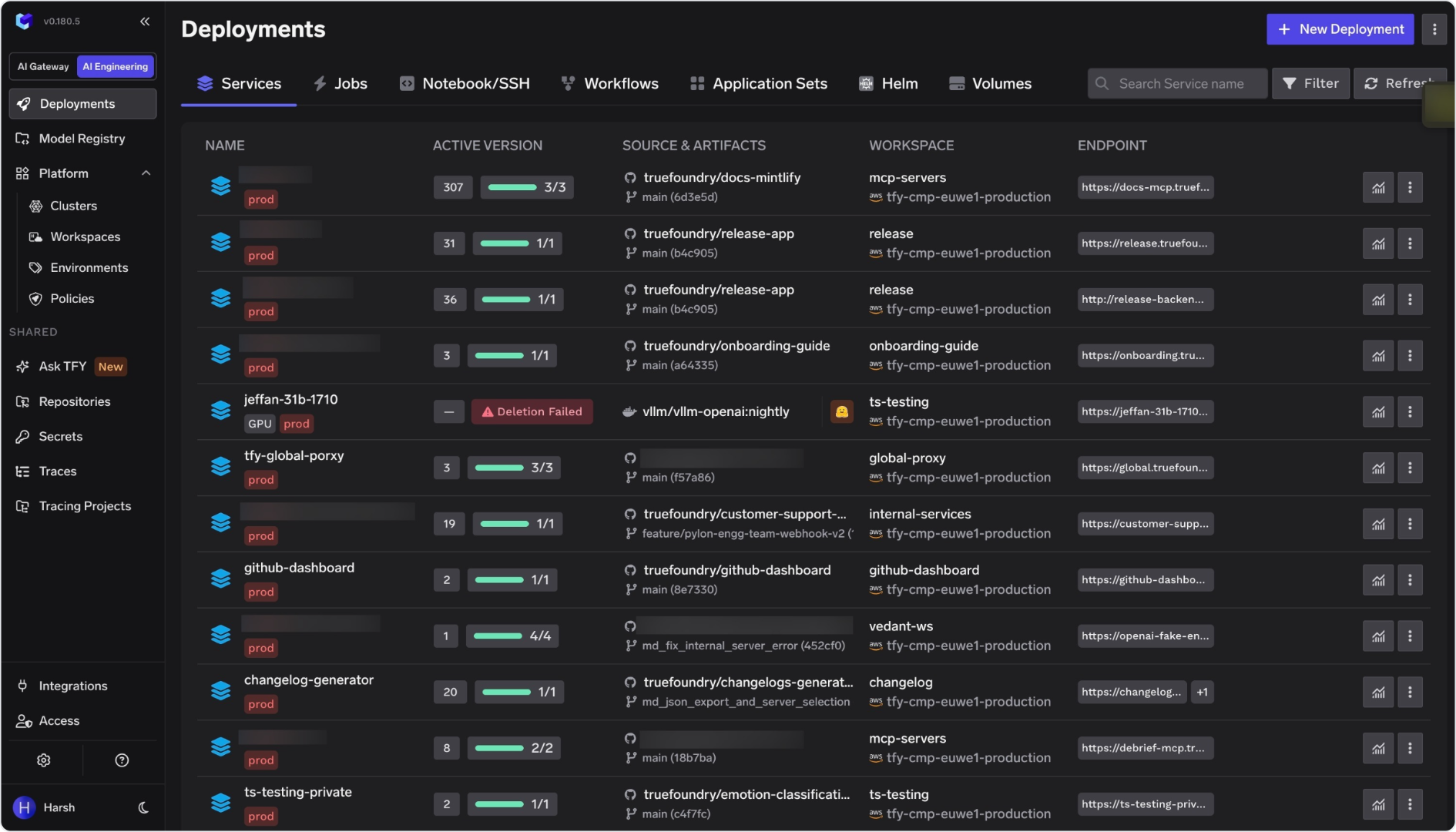
The part that tends to decide enterprise deals is deployment. TrueFoundry offers four modes: fully managed SaaS, managed SaaS with your own data storage, a hybrid where the gateway data plane runs inside your VPC while we host the control plane, and a fully self-hosted install where everything sits in your VPC or on-prem, including air-gapped. In the VPC modes, prompts never leave your network. The gateway adds roughly 3 to 4 ms of overhead and sustains 350+ RPS on a single vCPU, so it stays in the hot path without becoming the bottleneck.
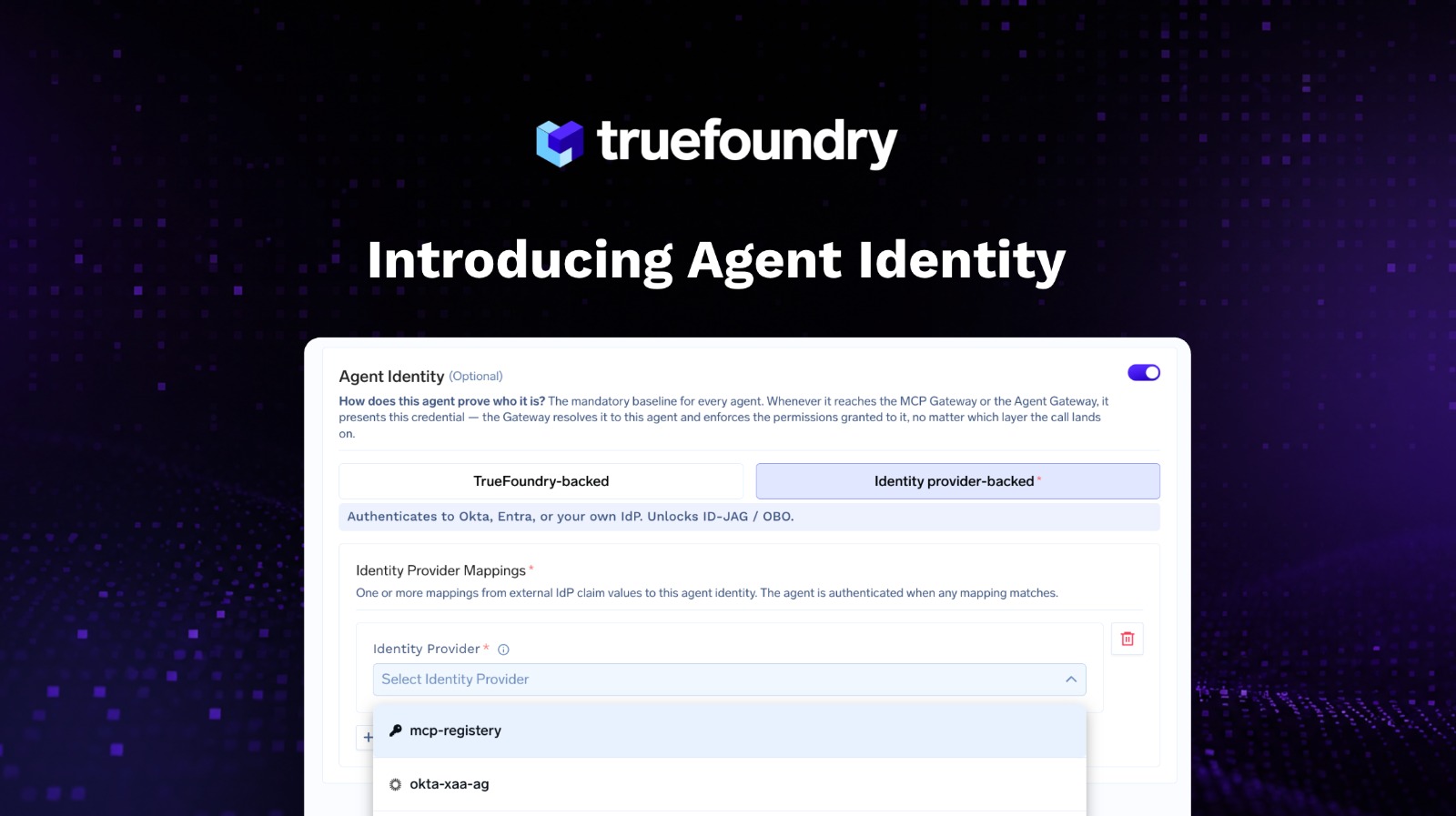
Beyond routing, TrueFoundry governs more than model calls. It includes an MCP gateway and an agent gateway with tool-level RBAC and pre- and post-tool guardrails, plus a registry for MCP servers and agents. Model deployment and the gateway share one control plane, so a self-hosted vLLM, TGI, or Triton endpoint is a first-class target rather than an afterthought. SOC 2, HIPAA, and GDPR support, SSO, RBAC, and audit logging are built in.
Best for: regulated industries and platform teams that need the data path, model endpoints, and agent governance under their own control.
Provider coverage and an OpenAI-compatible API are table stakes now. Both products clear that bar. The dimensions below are the ones that tend to decide which platform a production deployment actually ships on.
TrueFoundry capabilities come from our product documentation. Vercel capabilities reflect its publicly documented functionality in September 2026. The two latency figures below use different methods and are not directly comparable, so we have labeled each.
Vercel is a clean fit when the hosted model matches your constraints. Choose it if your stack already lives on Vercel and you want the Gateway's OIDC path to drop in with little setup. Choose it if your priority is managed routing with zero token markup and your required controls are covered by the included tiers. And choose it if you specifically want the Gateway to not capture prompt and completion bodies, which is its documented default and can be a privacy advantage in its own right. One honest point: managed simplicity is not unique to Vercel, because TrueFoundry also offers a fully managed SaaS tier.
TrueFoundry is the stronger answer when control is a requirement rather than a preference. Choose it if prompts cannot leave your VPC, or if you need an air-gapped deployment that a hosted-only service cannot provide. Choose it if you route to self-hosted models alongside commercial providers and want one gateway in front of both. Choose it if agents are part of the picture and you need tool-level governance over what they can call. And choose it if procurement expects the data path, certifications, and access controls to sit under your own roof. For a sense of how we approach these comparisons, our write-up on LiteLLM alternatives covers the same ground for a different tool.
Vercel's pricing is unusually transparent for this category. The Gateway charges a 0% token markup, with a free tier of 5 USD per month in credits, and it bills optional features by usage: model and provider restrictions at 0.10 USD per 1,000 successful requests, team-wide zero data retention at the same rate, reporting writes at 0.075 USD per 1,000, reporting queries at 5 USD per 1,000, and trace drains at 0.05 USD per 1,000 plus egress. Platform costs sit alongside: Vercel Pro is 20 USD per month with one seat and 20 USD per additional seat, SAML SSO is a 300 USD per month add-on, and a HIPAA BAA is 350 USD per month on eligible plans. Enterprise is a custom contract. The takeaway is that routing is cheap while governance features are metered, so model the features you will actually turn on.
TrueFoundry prices by seat plus usage, not per token. The Developer tier is free; Pro is $25 per user/month with 20K requests and tool calls per user included and overage at $20 per additional 100K requests. VPC, on-prem, air-gapped, and data-residency deployments are Enterprise-only and quoted custom; there is no published flat monthly figure for a hybrid VPC deployment, and the infra it runs on is your own cloud spend, which TrueFoundry does not set or publish. Enterprise terms are a custom annual commitment. The comparison that matters at scale is total cost of ownership: whether one platform covers gateway, model deployment, and agent governance, or whether those are separate tools and contracts.
The choice between TrueFoundry and Vercel AI Gateway is mostly a choice about where the gateway lives. Vercel AI Gateway is a strong managed router for teams that are happy on a hosted service and want simple, zero-markup routing. TrueFoundry fits when the data path, self-hosted models, agent governance, and compliance need to stay under your control, with the option to start on managed SaaS and move into your own VPC as requirements grow. If you are evaluating AI gateway platforms for production in a regulated or platform-governed environment, book a demo and we will walk through how TrueFoundry handles your deployment and governance requirements.
TrueFoundry AI Gateway delivers ~3–4 ms latency, handles 350+ RPS on 1 vCPU, scales horizontally with ease, and is production-ready, while LiteLLM suffers from high latency, struggles beyond moderate RPS, lacks built-in scaling, and is best for light or prototype workloads.


It fits enterprises whose requirements are met by a hosted service and whose governance needs are covered by Vercel's paid tiers. Teams that must keep prompts inside their own network, run air-gapped, or enforce tool-level agent governance will find those harder to satisfy with a SaaS-only gateway, which is where a deployable alternative like TrueFoundry fits.
Vercel's documentation describes the AI Gateway as a hosted service reached at ai-gateway.vercel.sh, with no customer-run Gateway install. Vercel's platform BYOC private beta covers application code and Functions in your own AWS account, not the Gateway itself.
TrueFoundry runs the same unified OpenAI-compatible gateway in your VPC or on-prem, including air-gapped, so prompts stay inside your network. It also adds MCP and agent governance and supports SOC 2, HIPAA, and GDPR workloads.
Yes. TrueFoundry runs in your VPC, on-prem, air-gapped, or hybrid, and no data leaves your domain. This is a core reason regulated teams choose it over SaaS-only gateways.
Yes. It includes an MCP Gateway, an Agent Gateway, and an MCP and Agents Registry with tool-level access control, so agents from LangGraph, CrewAI, AutoGen, or a custom framework can be governed centrally.



The latest news, articles, and resources sent to your inbox