


October 1, 2026
|
5 min read


Published: August 24, 2026
Blazingly fast way to build, track and deploy your models!
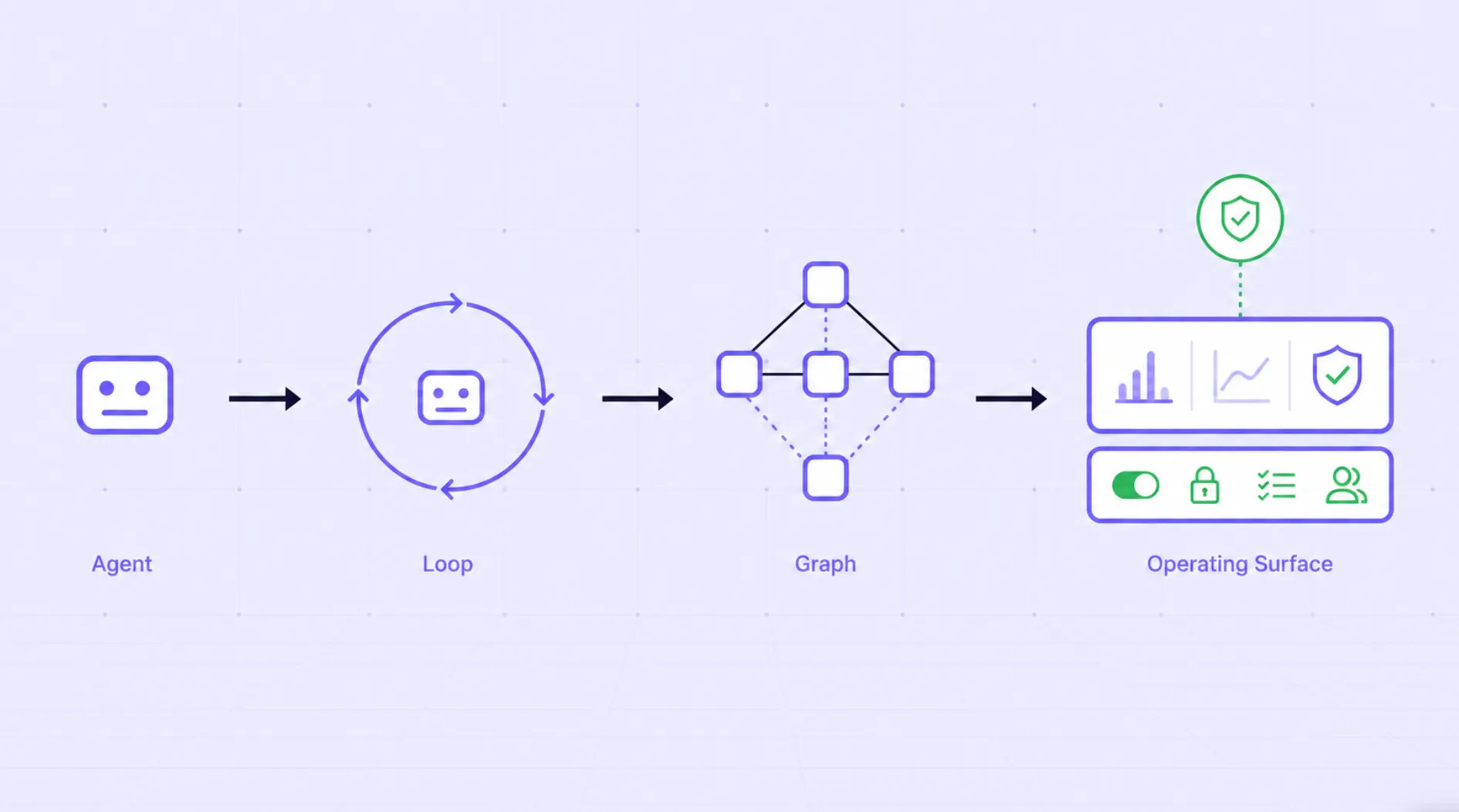
A widely shared X post dated August 18, 2026 attributes a two-hour walkthrough to Andrew Ng and presents a useful escalation of engineering scope: a first working agent at 9:14, loops at 33:11, loops becoming graphs at 1:02:46, agents modifying their own code at 1:30:15, and an orchestration layer tying the system together at 1:49:05. This article uses that timestamped outline as a starting point for production architecture; it does not depend on the attribution being correct.
Whether or not those labels become canonical vocabulary, the progression is useful because each step adds a different systems question. A single agent introduces capability and tool-use questions. A durable loop adds state, recovery, context, and approval concerns. A graph adds topology, coordination, and delegation. Self-modification raises verification, containment, and promotion questions. Orchestration turns the combined system into an operating problem.
The first milestone in the supplied post is the easiest to recognize: get one agent to run. Give a model a goal, a tool interface, and enough state to choose an action. That is the moment a language model stops being only a text generator and begins participating in a system.
But the single action is not where operational complexity accumulates. Complexity appears when the agent must continue: observe the result, decide whether the task is finished, call another tool, survive a failed call, compact context, ask for approval, or resume tomorrow.
That is why TrueFoundry's June loop-engineering piece defined the discipline this way:
The phrase matters because it moves attention away from one heroic prompt. Once the loop is doing useful work unattended, the design questions become ordinary systems questions: where state lives, which actions are retryable, how many times a failure may repeat, when a human must intervene, what code can execute, which credentials are reachable, and how a run is reconstructed later.
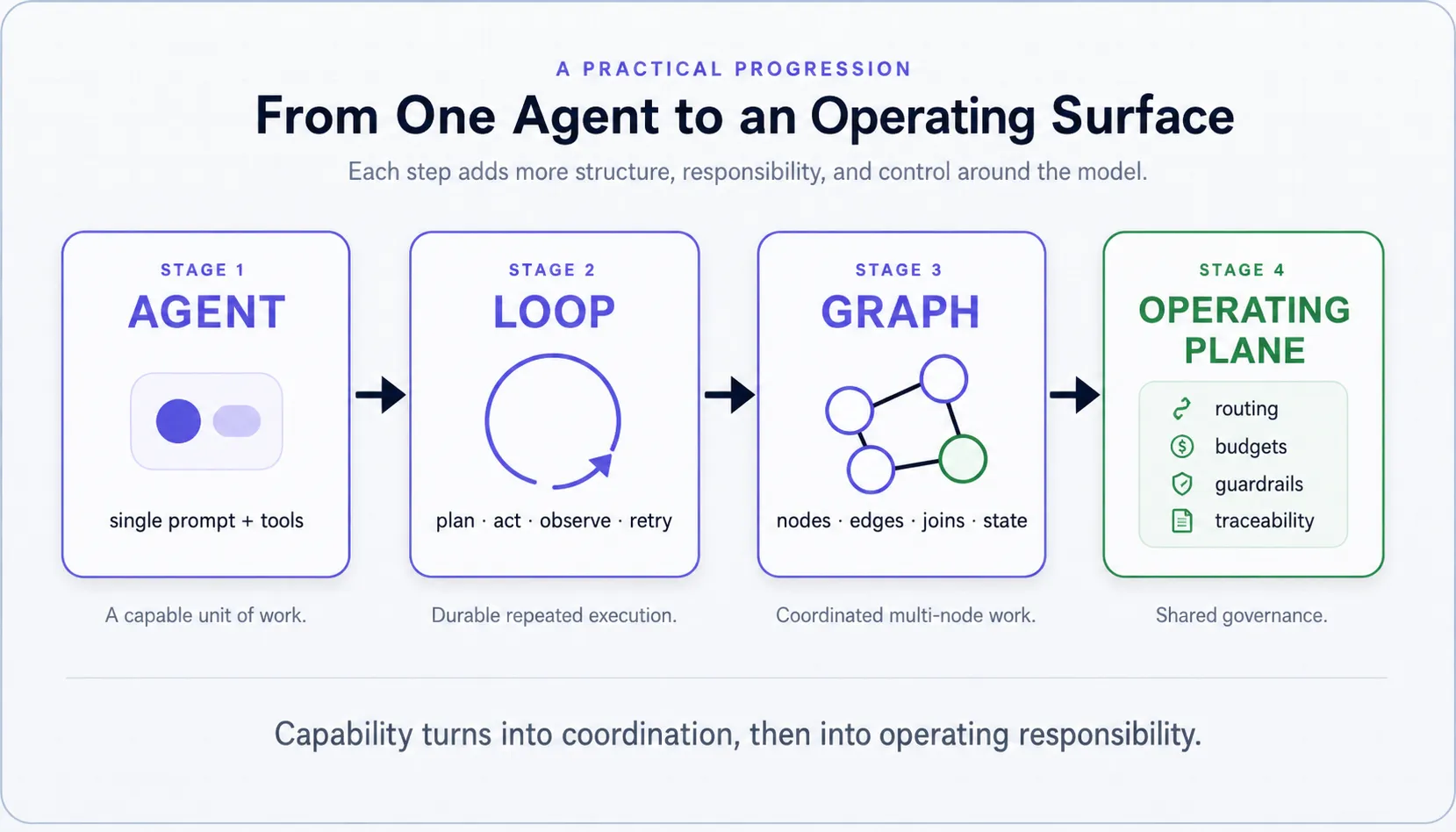
The supplied X post's next conceptual jump—loops becoming graphs—is where hype can obscure the useful engineering. A graph is not “more agents” by definition. A production graph may contain agents, deterministic functions, routers, joins, queues, human checkpoints, evaluators, database writes, and ordinary services.
TrueFoundry's July graph-engineering guide captured the relationship in seven words:
The graph or orchestrator owns questions such as: Which node runs next? Can two branches execute in parallel? Which result unlocks a join? What happens when one branch fails? Which agent may delegate to which other agent? Which path requires a human checkpoint? A multi-step loop inside an agentic node owns a different set of questions: what context the agent sees, which tool it selects, how it handles observations, when it retries, and when its local work is complete.
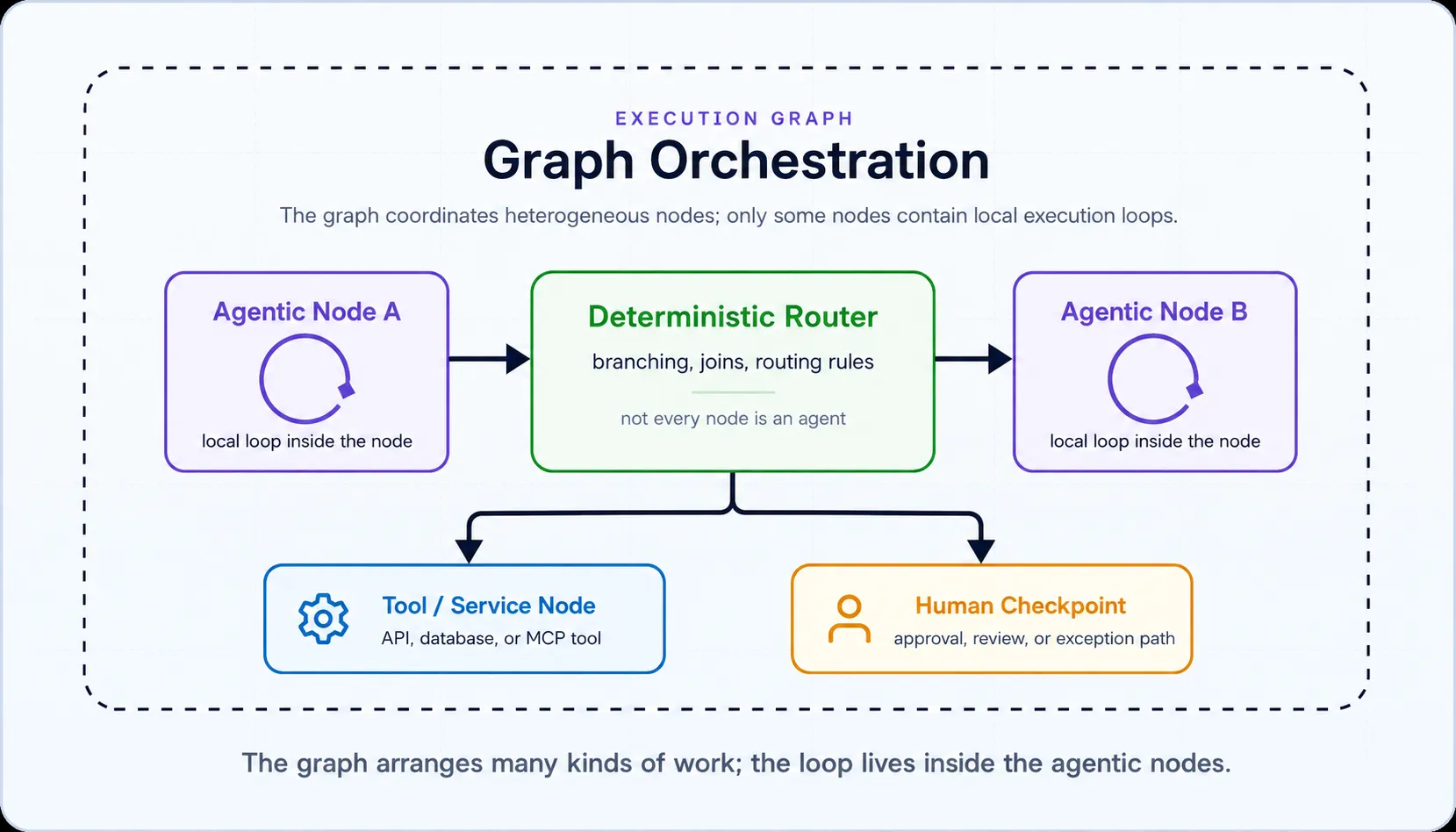
The social-media framing uses the phrase “agentic knowledge graphs.” That wording can collapse two distinct architectures. A knowledge graph represents entities and relationships in information. An agent execution graph represents actors, computational nodes, transitions, dependencies, and work state. One can feed the other, but they answer different questions.
If a research agent queries a knowledge graph and then delegates validation to a second agent, the knowledge graph is part of what the system knows; the execution graph describes what the system does.
A graph diagram becomes operational when nodes and edges carry authority. An edge can mean “call this model,” “invoke this MCP tool,” “hand this customer record to another agent,” “write this patch,” or “deploy this artifact.” Once those transitions have consequence, topology and governance become inseparable—even though node evaluation, graph state, and downstream authorization remain equally important parts of the control story.
TrueFoundry's recent graph-engineering post compresses the enterprise posture into another short line:
That is a better framing than treating graph engineering as a replacement for model evaluation. You still evaluate node behavior. But evaluation alone cannot make a production database reject a write, enforce a budget, or require approval before a destructive operation. Runtime, gateway, and downstream authorization boundaries can enforce those constraints when the relevant traffic passes through them.
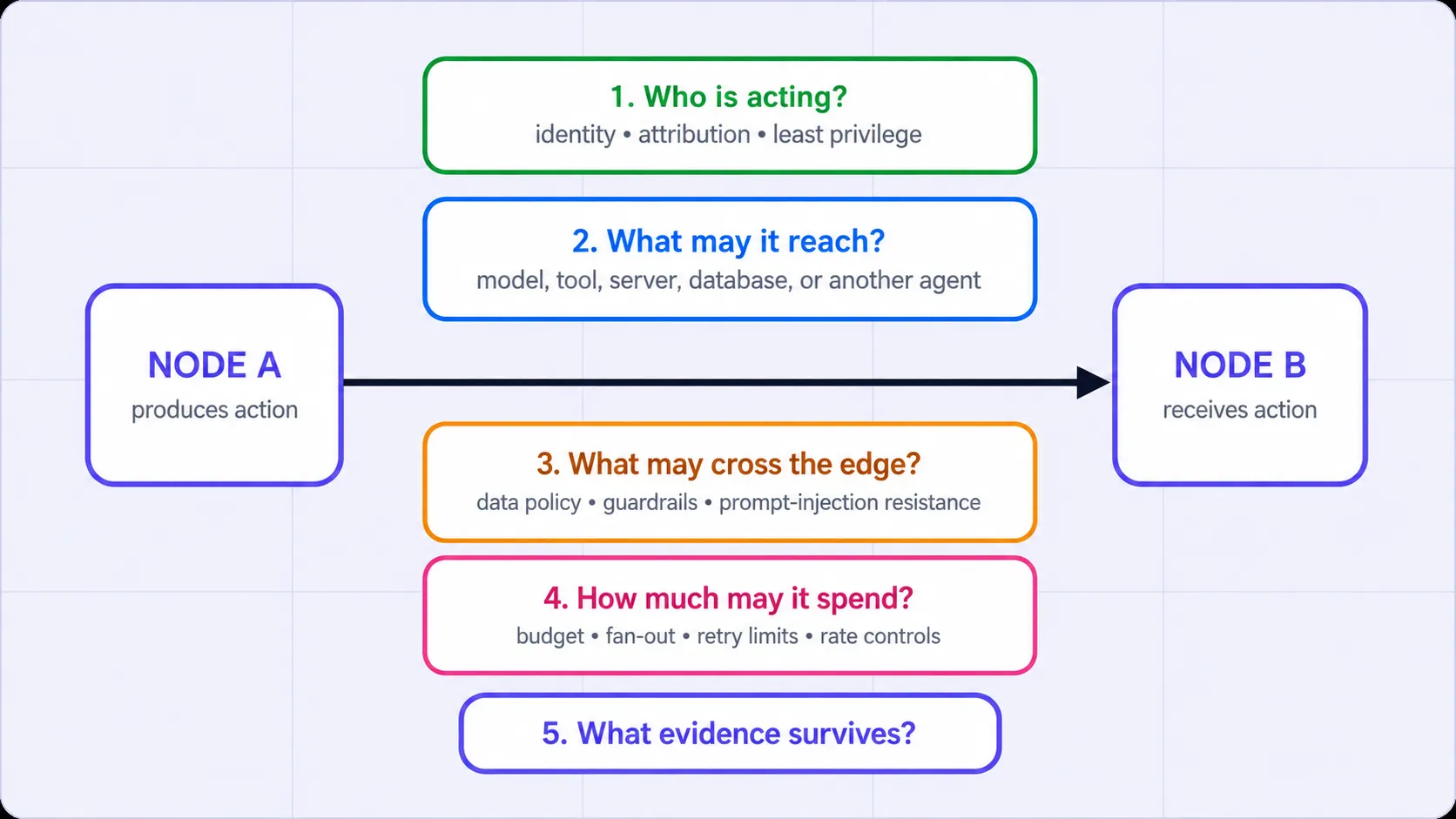
The practical implication is that every consequential edge should answer five questions:
The 1:30:15 milestone in the supplied post—agents that refactor or upgrade their own code—is where the architecture stops being merely compositional and becomes reflexive. The system is now proposing changes to the machinery that will shape later behavior.
That is powerful, but the safe abstraction is not “the agent improves itself.” It is:
propose → isolate → test/evaluate → approve → version/promote → observe/rollbackA code-writing agent may create a patch in a sandbox. A separate verifier can run tests, static checks, policy checks, regression or task-specific evaluations, and postconditions appropriate to the change. A human may approve a high-impact promotion. Version control or an artifact registry should record the accepted version and make rollback possible. The runtime that proposed the change should not control the only evidence used to accept it.
Graph structure helps here because verification can become a separate node with separate authority rather than another sentence inside the same prompt. That is one of the deepest reasons graphs matter: they let us turn independent judgment into topology.
This is the clearest place to map TrueForge. Its public documentation defines it as an open-source agent harness: the runtime layer around an LLM that runs the agent execution loop and connects model calls, MCP tools, skills, sandboxing, approvals, subagents, context management, and session state that survives reconnects and restarts.
That does not mean TrueForge owns an arbitrary multi-agent graph. The graph may be defined in application code, a workflow system, or another orchestration framework. The cleaner mapping is narrower: when a graph node is agentic, TrueForge can be the runtime that makes that node a real long-running execution loop rather than a function that merely calls a model once.
From the official TrueForge docs: TrueForge is described as “an open-source agent harness” and its server “runs the agent loop.” That is why it maps cleanly inside agentic graph nodes rather than replacing the graph itself.
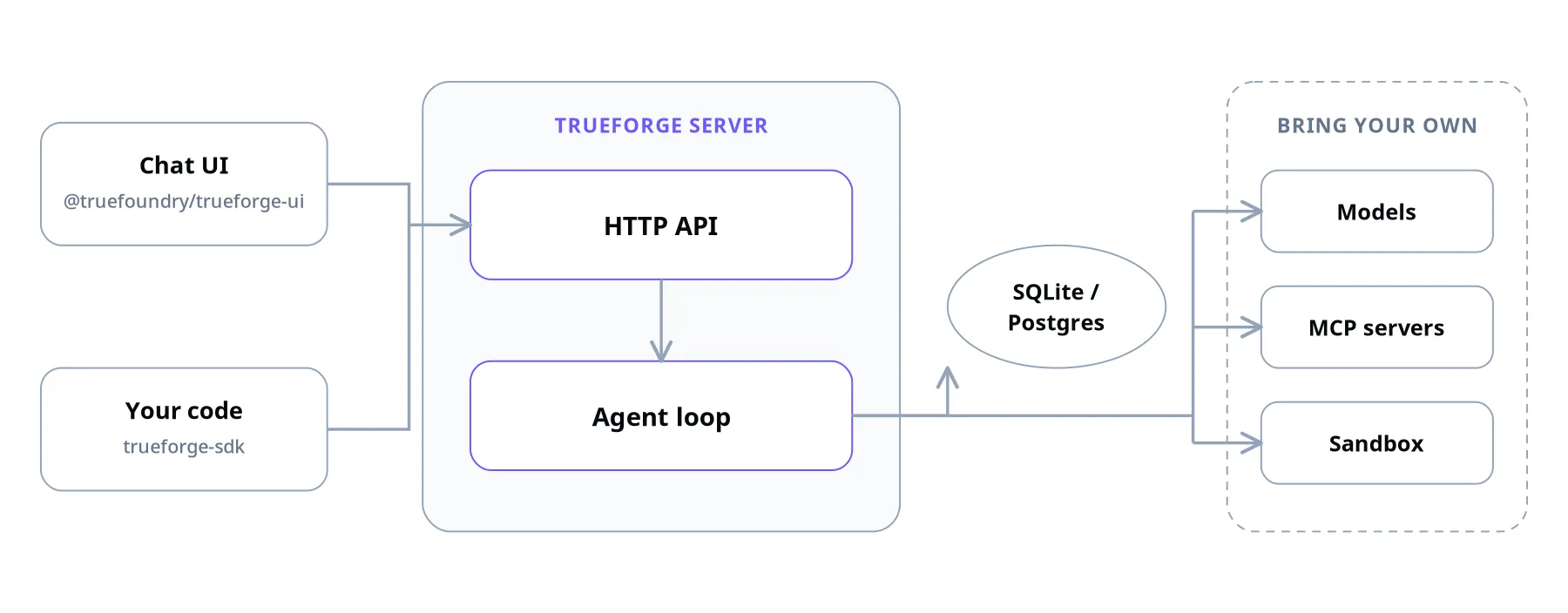
Figure 4. Official TrueForge architecture diagram from the public TrueForge repository and documentation. It places the TrueForge server and agent loop between the client surfaces and bring-your-own persistence, model providers, MCP servers, and sandbox provider.
Source: TrueForge — official architecture asset; see also TrueForge Introduction.
TrueFoundry's recent loop essay calls this layer middleware because operating decisions accumulate there. The phrase is useful precisely because a graph may change while the runtime concerns inside its nodes remain stubbornly familiar: state, context, approvals, isolation, and evidence.
Once the graph has several model-using or tool-using nodes, they may choose different models, retry independently, call at different rates, consume different budgets, or reach different MCP servers. If every node integrates providers and tools directly, the graph can become a set of private control planes.
The TrueFoundry AI Gateway is useful here as shared infrastructure for model traffic: one model-facing interface with access control, virtual-model routing and fallbacks, rate limits, budget limits, guardrails, and request traces and metrics for calls that traverse it. For MCP traffic routed through the MCP Gateway, TrueFoundry can separately centralize inbound authentication, server/tool access control, outbound authentication, approvals, and gateway-level auditability.
The important phrase is for requests that traverse it. A gateway cannot govern traffic that bypasses it, and it does not infer your graph topology. The orchestrator can propagate identifiers such as graph_id, run_id, and node_id in application-controlled request metadata—for example, the documented X-TFY-METADATA header—so gateway logs and metrics can be filtered or grouped against graph-level identifiers where that correlation is useful.
From the official TrueFoundry docs: the AI Gateway is a proxy layer between applications and model providers, with access control, routing, rate and budget controls, guardrails, and observability around that path. The MCP Gateway documents inbound authentication, server/tool access control, outbound authentication, and tool approvals for MCP traffic. In a graph, those are shared policy surfaces for routed traffic—not the graph orchestrator.
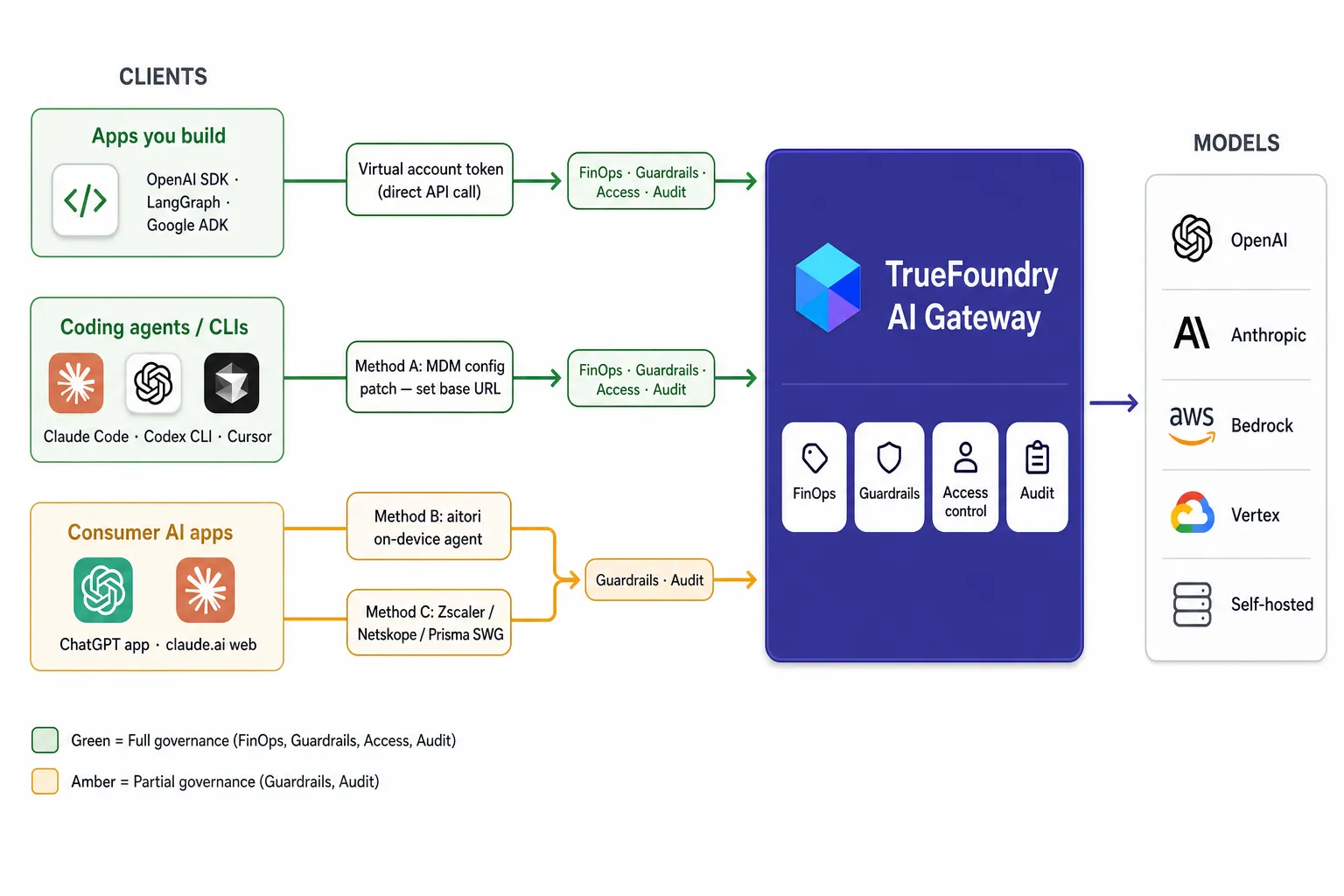
Figure 5. Official TrueFoundry AI Gateway architecture diagram. The first-party reference architecture shows different AI client surfaces converging on a central gateway that applies governance before requests reach model providers.
Source: TrueFoundry — Govern All AI Traffic Through the AI Gateway. The HTML uses the official documentation asset directly, with a first-party TrueFoundry-hosted fallback rather than a redraw.
This is a stronger product story than claiming one platform “does graph engineering.” The graph belongs to the architecture. TrueForge can supply the execution loop inside agentic nodes. The AI Gateway can provide a shared model-control surface for calls routed through it. The MCP Gateway can centralize authentication, tool/server permissions, downstream credential handling, approvals, and other controls for MCP traffic routed through it. The orchestrator and downstream systems remain part of the control story.
A designed graph is what appears in architecture diagrams. The executed graph is what happened on a particular run. Those are not automatically the same object.
A fallback model may activate. A delegated task may fan out. A tool may be denied. A verifier may send work backward. An approval may hold one branch for hours while another branch completes. A self-modifying node may generate a patch that never gets promoted.
The production test is therefore not “do we have a graph?” It is whether a team can reconstruct a consequential run across layers.
The graph audit. Choose one production action and trace it backward. Which graph node initiated it? Which local loop produced the decision? Which model handled each call? What context and tool surface were available? Which budgets, rate rules, or guardrails applied? Was there a sandbox or approval boundary? Which edge carried the action? And which downstream record proves what actually changed? If the answer ends at “the agent decided,” the graph is still missing its operating model.
The supplied X post is a useful learning map, but its social-media framing should not become a historical or attribution claim without a primary source. We verified that the post and syndicated copies use the timestamped sequence above; we did not verify the exact two-hour artifact as an Andrew Ng publication. The official DeepLearning.AI catalog currently points to different course artifacts and instructors, so the timestamps here should be read strictly as the post's description of the video.
“Graph engineering” is also still an emerging label. None of the core mechanisms are new in isolation: DAGs, actor systems, workflow engines, distributed coordination, policy enforcement, and human checkpoints all have long histories. What is new enough to deserve attention is the way agentic systems are concentrating those mechanisms around model-driven nodes that can act, delegate, mutate artifacts, and run for long periods.
Finally, neither TrueForge nor the TrueFoundry gateways should be described as owning the whole graph. TrueForge operates and records the agent loop it runs. The AI and MCP Gateways govern only the traffic routed through their respective boundaries. The orchestrator owns topology and graph state. Downstream systems remain authoritative for their own authorization and side effects. Serious graph engineering starts by keeping those boundaries explicit.
Disclosure: TrueFoundry publishes this article, sells the TrueFoundry AI Gateway and MCP Gateway, and maintains TrueForge. Product claims are limited to behavior documented in current public TrueFoundry and TrueForge materials. The timestamped progression comes from the supplied X post; the mapping from that progression to the production architecture above is TrueFoundry editorial analysis and is not attributed to, endorsed by, or presented as a statement from Andrew Ng. Reference-list author credit identifies the individual byline on the cited TrueFoundry articles; those articles remain TrueFoundry-published properties.
TrueFoundry AI Gateway delivers ~3–4 ms latency, handles 350+ RPS on 1 vCPU, scales horizontally with ease, and is production-ready, while LiteLLM suffers from high latency, struggles beyond moderate RPS, lacks built-in scaling, and is best for light or prototype workloads.






The latest news, articles, and resources sent to your inbox
.png)
.png)
.png)
.png)
.png)
.png)
.png)
.png)
.png)
.png)
.png)


