.webp)
October 14, 2026
|
5 min read


Published: October 14, 2026
.png)
Blazingly fast way to build, track and deploy your models!
Search for Gloo AI Gateway today and solo.io sends you somewhere else: the old product page at solo.io/products/gloo-ai-gateway redirects to agentgateway. Behind the redirect, Solo moved its AI gateway features off Envoy and onto a new proxy built for MCP and agent traffic.
That much is in Solo's announcements. We wanted to know what the gateway actually does, so we ran it ourselves and checked the behaviours that matter in production, with version numbers wherever a result depends on them. If you're comparing Solo against the wider field, our roundup of Solo.io competitors and alternatives covers that ground. This post stays on the gateway itself.
Solo's AI gateway features used to run on Gloo Gateway, Solo's Envoy-based API gateway. Solo donated the open-source Gloo Gateway to the CNCF, where it was renamed kgateway and accepted as a Sandbox project in March 2025. That same month Solo created a new proxy from scratch in Rust: the agentgateway repository dates from 18 March 2025.
The handover took about eight months, across two kgateway releases, one Solo announcement and a move to a foundation:
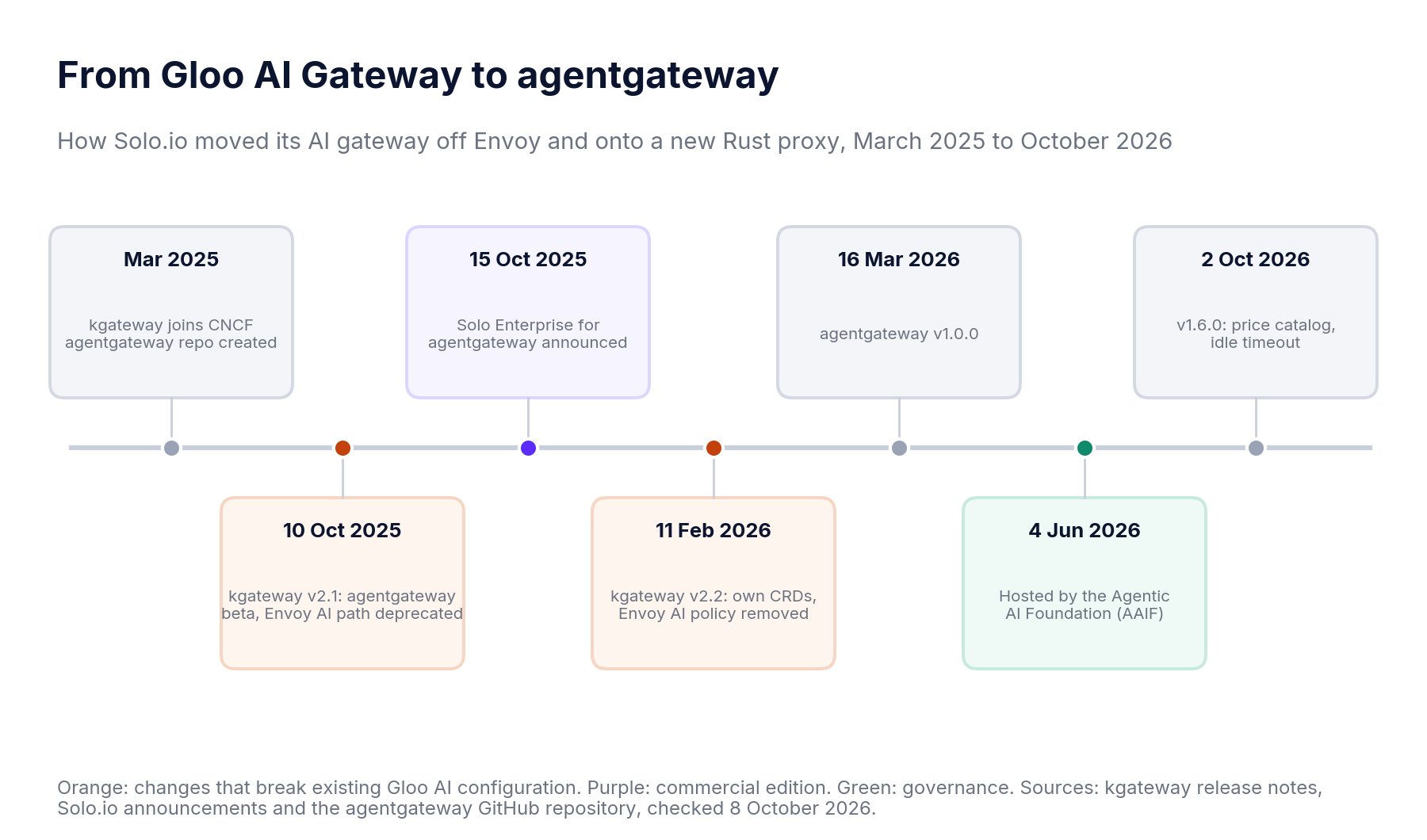
On the commercial side, Gloo Gateway was renamed Solo Enterprise for kgateway, and Solo Enterprise for agentgateway, once included in Gloo Gateway, became a separate product with its own Helm charts, controllers and APIs.
Existing configuration doesn't carry over unchanged. kgateway v2.2 required migrating agentgateway settings to the new resources before upgrading, and the Solo Enterprise 2.1 rename removed "Gloo" from CRDs and Helm charts.
agentgateway is an open source AI gateway, self-hosted, that sits between your applications and the model providers, tools and agents they call. Applications talk to it with the standard OpenAI request format, so adopting it is mostly a base-URL change. It governs three kinds of traffic: LLM calls, Model Context Protocol (MCP) traffic between agents and tools, and agent-to-agent (A2A) calls. (For why A2A traffic needs its own controls, see our post on governing multi-agent A2A traffic at the gateway.) It also proxies ordinary HTTP and gRPC. (What is an LLM gateway? covers the general pattern.) For the wider category, see our guide to agent gateways.
Solo's docs explain the rewrite: MCP sessions are long-lived and stateful, and traditional gateways were not designed for that kind of session awareness, so Solo built a new proxy instead of extending Envoy.
Minor releases ship roughly monthly, which means regular upgrade work. v1.6.0 alone had five breaking changes, and two of them are in the migration checklist below.
We ran the open-source standalone binary, v1.5.0, against local mock providers, plus a few real OpenAI calls where the provider itself was under test. When v1.6.0 shipped, we re-ran the four findings it was most likely to change on both versions. We haven't run the commercial edition, which needs a sales-issued licence key, so what we say about it comes from Solo's documentation.
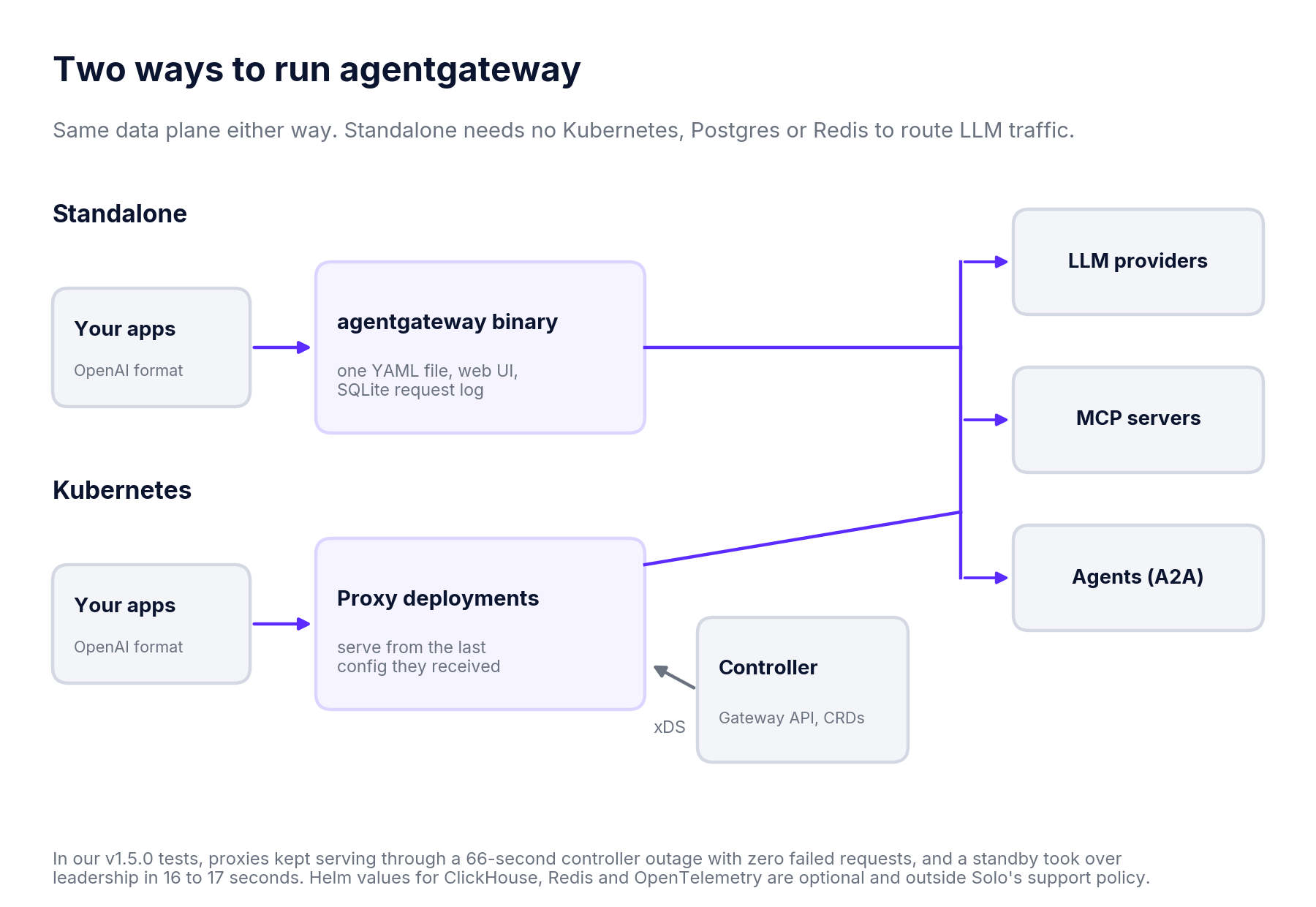
There are two ways to run it.
Standalone, it's one process reading one YAML file. It needs no Kubernetes, Postgres or Redis to route LLM traffic, and it includes a web UI and an embedded SQLite request log. A minimal LLM configuration is under ten lines, with no account to create.
On Kubernetes, a controller watches Gateway API resources and pushes configuration to separate proxy deployments over xDS. agentgateway has its own GatewayClass and CRDs (AgentgatewayPolicy, AgentgatewayBackend, AgentgatewayParameters). Solo's optional Helm values for ClickHouse, Redis and OpenTelemetry are outside its support policy.
What we checked hands-on on v1.5.0:
The v1.6.0 schema has seven built-in provider types (OpenAI, Gemini, Vertex AI, Anthropic, Amazon Bedrock, Azure and GitHub Copilot) and 14 presets, including Groq, Mistral, DeepSeek, Together AI, Ollama and OpenRouter. A custom provider type reaches any other host that speaks one of the nine supported API formats, so in practice the reach is any OpenAI-compatible endpoint.
Passthrough fidelity was excellent in our tests. We sent tool calls, strict JSON-schema structured outputs, system prompts, image inputs, logprobs and seeded requests both directly to OpenAI and through the gateway, and the results matched. A separate check for "silent breaks", where a request returns HTTP 200 with empty or wrong content, found none across the capabilities we tested.
Image generation and audio are the gap. The LLM-aware path doesn't recognise image generation, transcription or speech requests. You can still proxy that traffic as plain HTTP, and we confirmed it arrives intact with API-key checks applied, but with no token accounting, cost tracking or model-aware policy.
agentgateway supports weighted routing, priority-based failover, conditional routing, retries, timeouts, outlier eviction, mirroring and session affinity. Failover works across providers with different API formats: we failed a chat-completions backend over to an Anthropic-format backend, and the client kept receiving responses in the shape it asked for.
Three behaviours need deliberate configuration.
Retries make one more upstream call than the schema describes (v1.5.0 and v1.6.0). The schema describes attempts as the "total number of attempts, including the original request." In our tests, attempts: 1, 2 and 3 produced 2, 3 and 4 backend calls. The gateway's own retry.attempt log field counts the same way, so the behaviour is consistent and only the documentation disagrees. Retries also have no backoff unless you configure one. Plan for one extra call per failure, and set a backoff.
Failover needed health checks in v1.5.0, and v1.6.0 fixes this. In v1.5.0, failover didn't move traffic off a failing primary unless an eviction policy was configured. On v1.6.0 with no health policy, the primary was evicted after one failure and the next five requests went to the backup. On both versions, the request that hit the failure still reached the client as an error and wasn't retried on the backup.
Stalled streams need an explicit timeout. In v1.5.0, neither requestTimeout nor backendRequestTimeout ended a stream that sent its first chunk and then went silent. v1.6.0 adds responseIdleTimeout, and set to 5 seconds, it cut our stalled stream at 5.04 seconds. The client has already received a 200 and the first chunk by then, so it sees a truncated stream, not an error code. With no timeout configured, the stream still hangs on v1.6.0 for as long as the client waits. This is the route policy we tested:
routes:
- matches:
  - path:
      pathPrefix: /
  policies:
    timeout:
      responseIdleTimeout: 5s
  backends:
  - host: "127.0.0.1:8091"
Callers authenticate with API keys or with JWTs validated against your identity provider. Keys carry metadata such as user and team, and that metadata reaches the request log. Per-key model allow-lists work in the open-source build, and revoking a key took effect in under two seconds in our tests.
MCP authorization is the strongest part of the product, and ahead of most of the category. CEL (Common Expression Language) policies decide which individual tools a caller may invoke, and the gateway also filters tools/list per caller, so an agent only sees the tools it's allowed to use. We confirmed both hands-on. If you're new to how MCP identity works, MCP authentication explained is a good primer. agentgateway can also federate several MCP servers behind one endpoint and expose OpenAPI services as MCP tools.
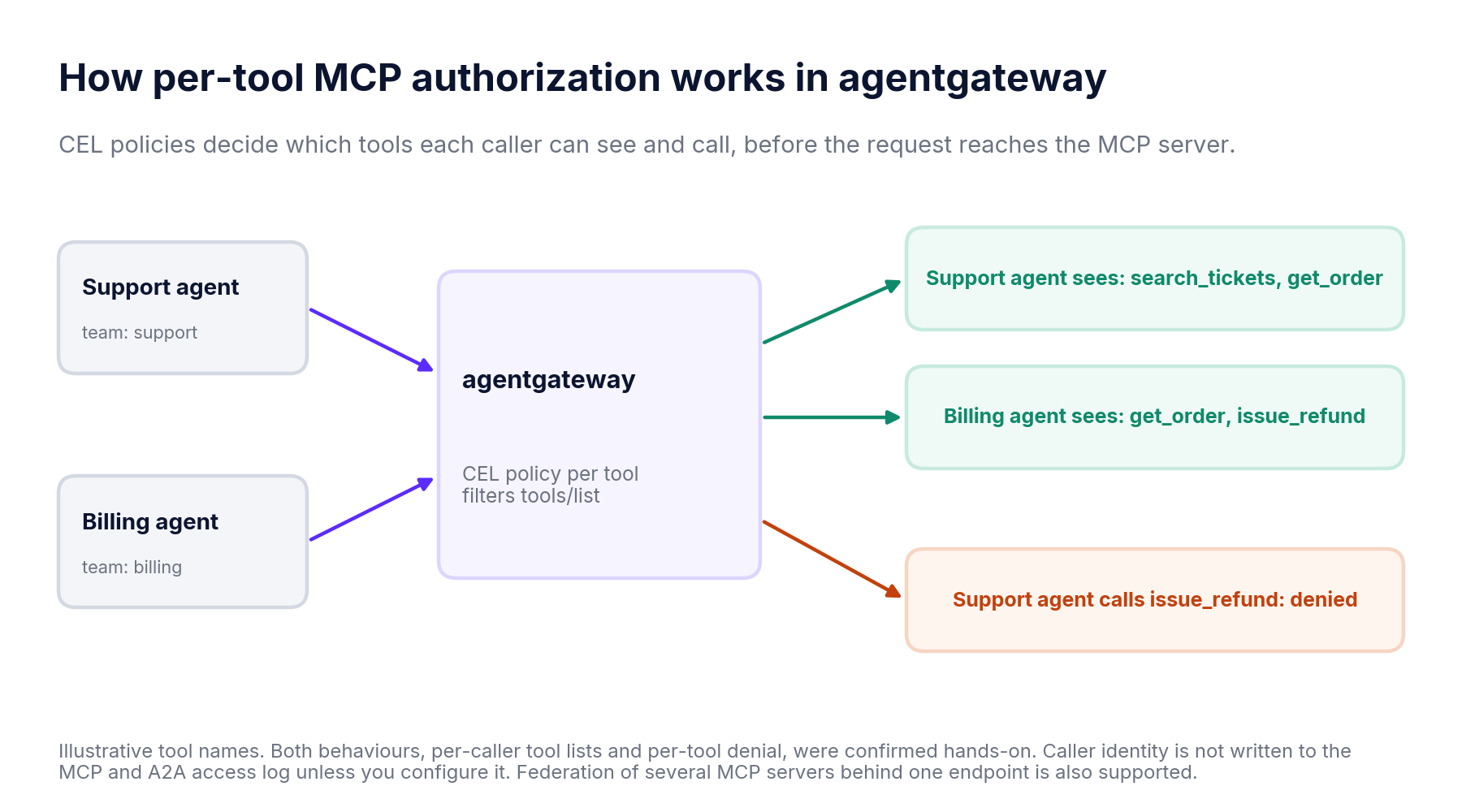
Enforcement worked the same way for LLM, MCP and A2A traffic in our tests. One caveat: caller identity isn't written to the access log for MCP and A2A traffic unless you configure it.
In the open-source standalone build (v1.5.0), API keys can carry USD or token budgets, and we confirmed that one key hitting its limit is blocked while other keys carry on. Enforcement is retrospective. The gateway checks the budget before admitting a request but only learns the cost after the response, so the request that crosses the limit still completes. Treat budgets as a near-real-time brake rather than a hard cap. (We cover the general trade-offs in AI gateway budgets and quotas.)
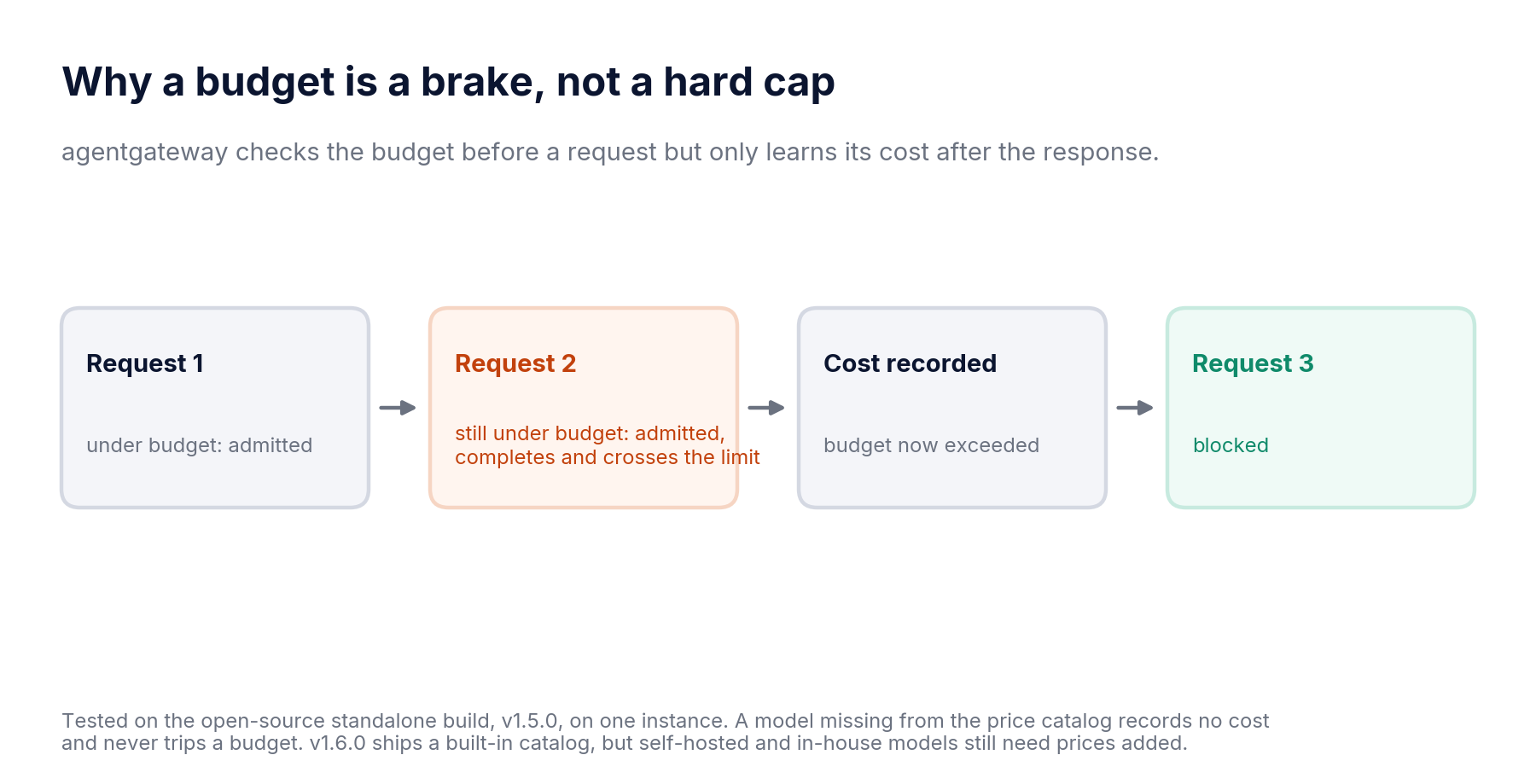
Cost depends on a price catalog. In v1.5.0, no cost is calculated until you load one, and a budget on a model the catalog doesn't price never charges and never blocks. v1.6.0 includes a built-in catalog that priced gpt-4o-mini with nothing configured, but a self-hosted or in-house model still recorded no cost. We haven't re-tested budget enforcement on v1.6.0.
Rate limits in the open-source build are local to each gateway instance, and v1.6.0 adds per-key local limits, which we haven't tested. Global rate limiting, the budget resource and the Cost Management UI are enterprise features. We tested budgets on one instance only, so test how they behave across several standalone instances before relying on them.
We found no response caching. We searched the configuration schema, the open-source docs and Solo's enterprise docs for exact-match and semantic caching and found neither. Teams with repetitive prompts will need to cache somewhere else.
Built-in detectors replace sensitive data such as email addresses, card numbers and national ID numbers with labelled placeholders. With a recording mock where the provider would be, the masked values were already gone before the request left the gateway. Requests can also be rejected with a custom message. External guards include webhooks, OpenAI Moderation, AWS Bedrock Guardrails and Google Model Armor, which we didn't test.
Prompt and response content isn't recorded by default. When you do turn recording on, CEL rules can limit it to particular teams, costs or guardrail outcomes.
Prometheus metrics cover requests, latency, tokens and cost. A request log in SQLite or Postgres records user, team, model, tokens and cost per request, so per-user reporting is a SQL query. Traces and logs export over OpenTelemetry, and Solo documents LangSmith and Phoenix integrations.
Per-team cost isn't in the metrics, though, which matters if AI gateway observability is how you plan to report spend. Prometheus metrics carry no user, team or key label, so a cost-by-team dashboard has to read the request log. That's a reasonable choice for cardinality reasons, but it means building a second data path.
Solo.io, based in Cambridge, Massachusetts, builds agentgateway and sells the enterprise edition. Its last announced funding round was a $135M Series C at a $1B valuation in October 2021.
The project itself is hosted by the Agentic AI Foundation under the Linux Foundation, not by Solo. The code is Apache 2.0, so if Solo's priorities change, the code and the governance structure carry on.
Day to day, most of the code still comes from Solo. Of the repository's 2,507 non-merge commits on 25 August 2026, solo.io email addresses made up 63.4% (a floor, since staff who commit from personal addresses aren't counted) and one Solo engineer authored 38.9%. In the previous 90 days, 118 people committed and Solo's share was 58.9%, with Microsoft contributing Windows support and AWS Bedrock examples. That concentration is normal for a project about 19 months old, and outside contributions are growing. A two-year bet should still weigh how much of the project rests on Solo, and on one engineer in particular.
If you ran AI policies on Gloo Gateway or the Envoy path of kgateway, this is the order we'd work in. Every item comes from the release notes and behaviours described above.
Solo's feature matrix marks the enterprise additions below.
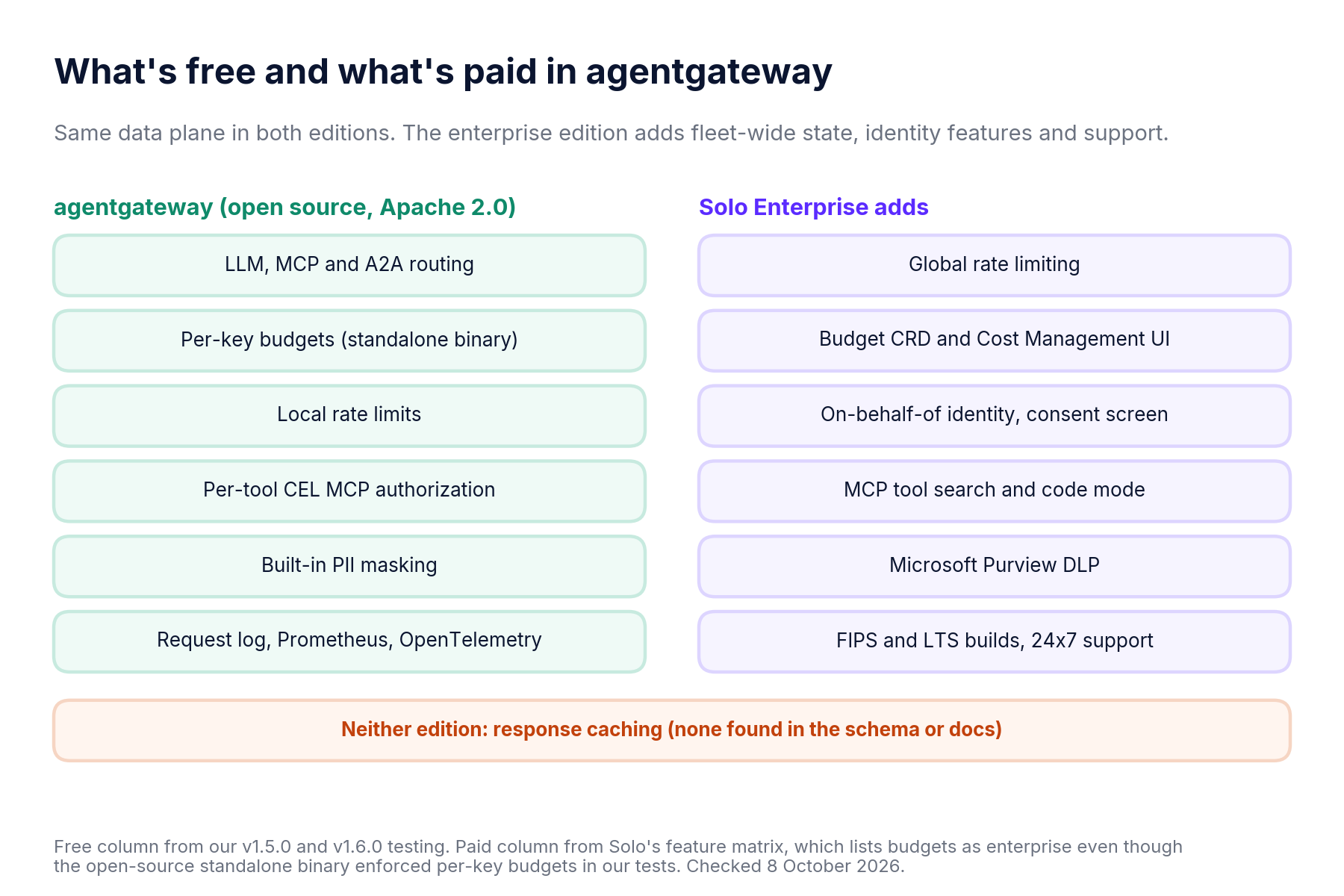
Parts of Solo's feature matrix undersell the free product. It lists spend budgets and virtual keys under the enterprise Cost Management UI, yet the open-source standalone binary enforced per-key budgets in our testing. Part of the reason is that the open-source Kubernetes CRDs have no budget or virtual-key fields, while the standalone binary does. We haven't had Solo confirm the rest, so test the edition boundary before you price around it.
Buying is sales-led, with no public price list, and licence keys come from an account representative. The only outside figure we found is Vendr's median Solo.io contract of $68,000 a year (range $28,954 to $530,656), which covers Solo.io as a whole, not agentgateway specifically.
Solo's trust portal shows SOC 2 Type II. When we checked, it listed neither ISO 27001 nor a HIPAA business associate agreement. A missing listing doesn't prove the paperwork is unavailable, so regulated buyers should ask Solo directly.
agentgateway fits a platform team that wants to own its gateway and runs one or a few instances, agent workloads where MCP tool authorization matters most, and environments with no internet route. It also suits teams that put real weight on an Apache 2.0 licence and foundation governance.
It's a poor fit if you need budgets and rate limits shared across many instances without buying the enterprise edition, or response caching in the gateway. The same goes for teams that want a hosted service, can't absorb monthly upgrades with breaking changes, or need cost tracking on image generation and audio.
The TrueFoundry AI Gateway is the same kind of control point, with the surrounding platform included. It runs as SaaS or self-hosted in your VPC, on-prem or air-gapped, and exposes 1,000+ LLMs through one OpenAI-compatible API. Around the gateway it adds budgets scoped by tenant, team, model or provider account with a warn-only mode, a console with RBAC, SSO over OIDC or SAML 2.0 and SCIM provisioning, and MCP governance with per-tool controls and human approval before destructive tool calls.
One caveat: TrueFoundry's content moderation, PII and prompt-injection guardrails work only when TrueFoundry hosts the gateway, while agentgateway's built-in PII masking runs on your own infrastructure.
The TrueFoundry column restates TrueFoundry's own published documentation. The agentgateway column reflects our testing of the open-source build and Solo's documentation for the enterprise edition, as of 8 October 2026.
Choose Solo Enterprise for agentgateway if you're committed to agentgateway's data plane but need fleet-wide rate limits, a cost UI, FIPS builds and a support contract.
Choose TrueFoundry if you'd rather not assemble budgets, access control and tool approvals around a gateway yourself, or if you want the option of a managed SaaS deployment alongside VPC and air-gapped installs.
Gloo AI Gateway as a name is gone. Solo's AI gateway is now agentgateway, a proxy written for LLM, MCP and agent traffic from the start, faithful to provider APIs and more generous in its free edition than Solo's own matrix admits. Before you build on it, test where the free edition stops, set a retry backoff and an idle timeout, and check that every model you use is priced in the catalog.
If you're weighing agentgateway against a gateway with team budgets, access control and MCP approvals already built in, book a demo of the TrueFoundry AI Gateway and bring your MCP and budget requirements. You can also read how the gateway works first.
TrueFoundry AI Gateway delivers ~3–4 ms latency, handles 350+ RPS on 1 vCPU, scales horizontally with ease, and is production-ready, while LiteLLM suffers from high latency, struggles beyond moderate RPS, lacks built-in scaling, and is best for light or prototype workloads.




Solo.io's AI gateway is now agentgateway, an open-source project under the Agentic AI Foundation, with Solo Enterprise for agentgateway as the paid edition. The old Gloo AI Gateway page on solo.io now redirects to agentgateway.
Gloo Gateway was Solo's Envoy-based API gateway. Solo donated the open-source version to the CNCF, where it became kgateway in March 2025. agentgateway is a separate proxy written in Rust that Solo started the same month, and it replaced the Envoy-based AI features: kgateway v2.1 deprecated them and v2.2 removed them. On the commercial side, Gloo Gateway was renamed Solo Enterprise for kgateway, and Solo Enterprise for agentgateway is its own product.
agentgateway is free and Apache 2.0 licensed, and the open-source build includes per-key budgets, local rate limits, PII masking, MCP tool authorization and a request log. Solo doesn't publish enterprise pricing. Licences come through sales, and the only outside figure we found, Vendr's median Solo.io contract of $68,000 a year, covers all of Solo.io's products.
They share the same data plane. The enterprise edition adds on-behalf-of identity, global rate limiting, a budget resource and Cost Management UI, FIPS and long-term-support builds, and a support contract, and it needs a licence key from Solo's sales team.
Yes, and it's the product's strongest area. It federates several MCP servers behind one endpoint, supports stdio and streamable HTTP transports, can expose OpenAPI services as MCP tools, and authorizes access per tool with CEL rules, including filtering the tool list per caller.
1,000+ LLMs through a single OpenAI-compatible API. Switching models means changing the model name in the request — same URL, same credentials — which is what makes swapping in a new provider a configuration change rather than an integration project.
Yes. TrueFoundry runs in your VPC, on-prem, air-gapped, or hybrid, so prompts and responses never leave your domain even as you route across many providers.
TrueFoundry's SaaS maintains SOC 2 Type II, GDPR and HIPAA programs, and reports are available at trust.truefoundry.com. TrueFoundry's documentation says these certifications apply to its managed infrastructure. For self-hosted deployments, compliance depends on your own infrastructure and controls. RBAC, SSO and audit logging are built in.



The latest news, articles, and resources sent to your inbox


.png)
.png)


.png)
.png)
.png)
.png)
.png)