


October 1, 2026
|
5 min read


احصل على وصول فوري إلى بيئة TrueFoundry مباشرة. انشر النماذج، ووجّه حركة مرور LLM، واستكشف المنصة بالكامل — بيئة الاختبار الخاصة بك جاهزة في ثوانٍ، ولا يلزم وجود بطاقة ائتمان.



Published: July 4, 2026
.webp)
Blazingly fast way to build, track and deploy your models!
Claude Code is no longer experimental. It reads entire codebases, edits files, runs terminal commands, executes tests, and iterates on solutions — all from natural language instructions. Engineering teams are rolling it out fast because the productivity gains are real.
But every Claude Code session is also an unmonitored pipeline between your developers, your proprietary codebase, and Anthropic's API. Without centralized governance, that pipeline carries serious security, cost, and compliance risk.
This guide breaks down the specific risks of ungoverned Claude Code rollouts and shows how TrueFoundry's AI Gateway gives platform teams the control plane they need to govern Claude Code traffic at enterprise scale — without slowing developers down.
Claude Code is Anthropic's agentic coding tool. Unlike traditional code-completion assistants that suggest the next line in an editor, Claude Code operates as an autonomous agent. It can:
It runs in the terminal, in IDEs like VS Code and JetBrains, through a desktop app, and in the browser. It works with models across the Claude family — Opus 4.6, Sonnet 4.6, and Haiku 4.5. Enterprise customers can also access it through Amazon Bedrock or Google Cloud Vertex AI.
The adoption numbers reflect the impact. Stack Overflow's 2025 Developer Survey found that 85% of developers already use or plan to use AI coding tools. Gartner predicts that 75% of hiring processes will include AI proficiency testing by 2027. AI-assisted coding is becoming standard development infrastructure.
For a detailed look at how Claude Code actually processes tasks from context ingestion to iteration, see our Claude Code workflows guide.
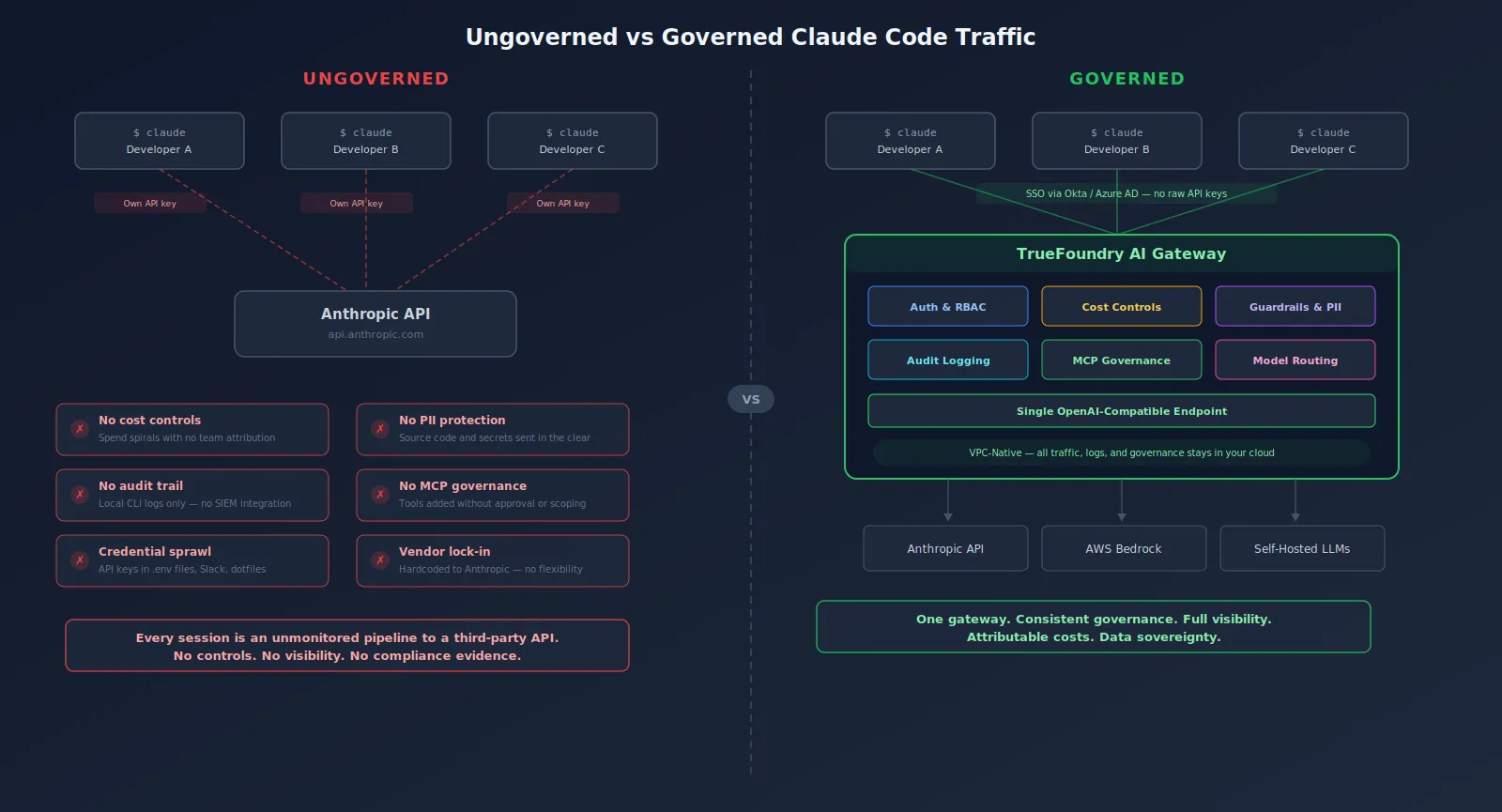
Enterprise-wide adoption of Claude Code doesn't just produce productivity gains. It also produces a new category of LLM traffic — high-volume, high-context, and deeply tied to proprietary source code. Without governance, five risks compound fast.
Claude Code sessions consume tokens aggressively. Referencing five medium-sized files in a single session can burn through 30,000+ tokens. Developers iterating on complex refactors may generate hundreds of API calls per day. Claude Code itself has no organizational budget controls — that responsibility falls to whatever sits between the developer and the API. Without centralized enforcement, costs spiral before finance even sees the invoice.
Claude Code sends code context to Anthropic's servers for processing. Proprietary source code, environment variables, API keys, configuration files, and potentially customer data all travel over the network. Security researchers have already identified real vulnerabilities — CVE-2025-54794 (path restriction bypass) and CVE-2025-54795 (command injection) were patched, but they demonstrate the attack surface. Without a governance layer inspecting outbound traffic, organizations have limited ability to enforce data loss prevention.
Regulated industries need clear records of AI usage: what was sent, what was returned, which models were used, by whom, and when. Claude Code out of the box does not produce the centralized, structured audit logs that compliance teams require. Every ungoverned session is a blind spot. When an auditor asks, "what did your AI coding tool access last quarter?" — you need a better answer than "we don't know."
Without governance, developers find their own paths. Different teams configure Claude Code differently. They use different models, apply different security practices, or bypass organizational controls entirely. Shadow AI fragmentation makes it impossible to enforce consistent security policies, accurately forecast costs, or demonstrate compliance across the org.
Without an abstraction layer, organizations hardcode workflows directly to Anthropic's API. If pricing changes, models are deprecated, or the team wants to evaluate alternatives — migration gets expensive and disruptive. An enterprise that ties every developer's tooling to a single provider has surrendered negotiating leverage and architectural flexibility.
CRO Banner Title: Your Developers Are Already Using Claude Code — Who's Governing the Traffic?
Subtext: TrueFoundry's AI Gateway gives platform teams centralized auth, cost controls, guardrails, and audit logging for every Claude Code session
CTA: Book a Demo
The AI gateway pattern addresses these risks by inserting a centralized control plane between all AI-consuming applications (including Claude Code) and the models they call. It is the same architectural principle that API gateways brought to REST and gRPC traffic — now extended to handle the specific requirements of LLM workloads.
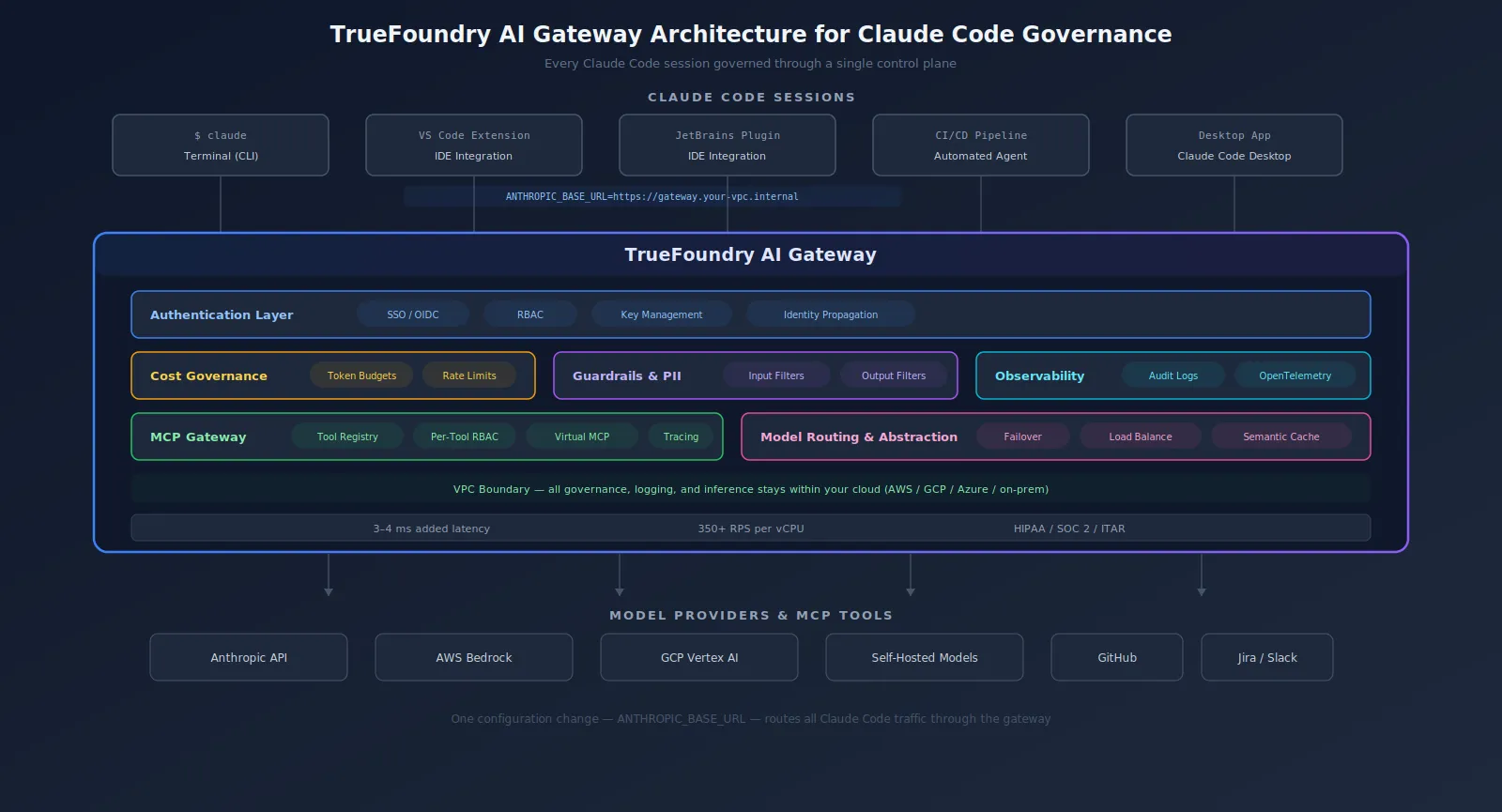
An AI gateway sits in the request path and enforces governance at the infrastructure layer:
For Claude Code specifically, the AI gateway pattern is a natural fit. Claude Code communicates with Anthropic's API over standard HTTP. Routing that traffic through a gateway requires no changes to the developer's workflow — just a configuration change that points Claude Code to the gateway endpoint instead of directly to Anthropic.
The architectural pattern is now the industry consensus. Gartner's Hype Cycle for Generative AI 2025 identifies AI gateways as critical infrastructure for scaling AI responsibly. TrueFoundry was recognized in Gartner's 2025 Market Guide for AI Gateways as an emerging solution provider in this category.
TrueFoundry's AI Gateway provides enterprise-grade governance, security, and observability for LLM traffic — including traffic from Claude Code sessions. It goes beyond traditional API gateway capabilities with AI-native controls built specifically for LLM and agentic workloads.
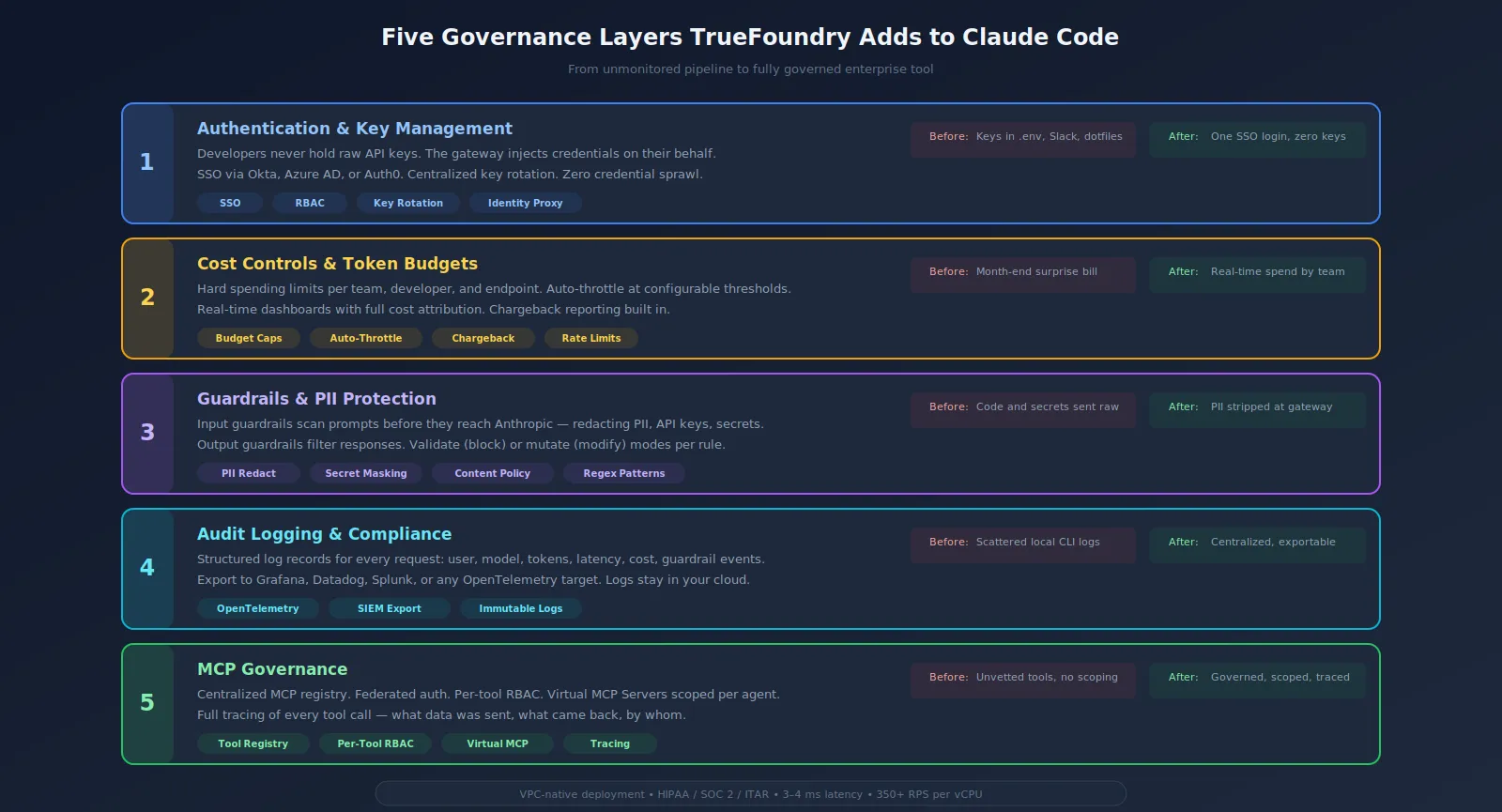
With TrueFoundry's gateway in the path, individual developers never hold or manage Anthropic API keys. The gateway injects authentication headers on behalf of the developer, using credentials managed centrally by the platform team. Developers authenticate once through your existing identity provider (Okta, Azure AD, Auth0) via SSO, and the gateway handles all downstream provider auth.
The result: no credential sprawl, simplified key rotation, and no API key leakage through developer workstations, .env files, or Slack messages.
TrueFoundry enforces hard spending limits per team, per developer, and per endpoint. The gateway tracks token consumption — prompt tokens, completion tokens, total cost — for every request in real time.
Platform teams can:
For more on building cost governance into the AI layer, see our FinOps for AI guide.
TrueFoundry's guardrails engine operates on both inputs and outputs at the gateway layer. For Claude Code traffic specifically, this means:
Each rule operates in validate (block) or mutate (modify) mode. Platform teams configure guardrails centrally. Every Claude Code session inherits them automatically — no per-developer configuration needed.
Every Claude Code request routed through the gateway produces structured log records: user identity, model used, token counts, latency metrics, guardrail firing events, and cost attribution. Logs stay within your infrastructure and export to your existing observability stack — Grafana, Datadog, Splunk, or any OpenTelemetry-compatible target.
When compliance asks, "who used Claude Code to modify production configs last Tuesday?" — the gateway has the answer.
As Claude Code's MCP integration deepens — connecting to tools like GitHub, Jira, Slack, Confluence, and Datadog — TrueFoundry's MCP Gateway extends governance to tool traffic:
بدون حوكمة MCP، كل اتصال أداة جديد يضيفه المطور يوسع سطح الهجوم. دليلنا للتحكم في الوصول لـ MCP للمؤسسات يغطي نمط التنفيذ الكامل.
هنا يختلف TrueFoundry عن بوابات SaaS-first. يتم نشر TrueFoundry داخل حسابك على AWS أو GCP أو Azure. كما يدعم عمليات النشر المحلية (on-premises) والمعزولة (air-gapped).
تبقى جميع حركة مرور الاستدلال ومنطق الحوكمة وسجلات التدقيق وبيانات المراقبة ضمن حدود سحابتك. لا تغادر أي مطالبات أو سياق تعليمات برمجية أو بيانات استخدام بنيتك التحتية. بالنسبة للمؤسسات في قطاعات الرعاية الصحية أو الدفاع أو الخدمات المالية أو أي صناعة منظمة تتطلب متطلبات صارمة لإقامة البيانات — هذا هو الفرق بين "يمكننا استخدام Claude Code" و"لا يمكننا ذلك".
يلبي TrueFoundry متطلبات HIPAA وSOC 2 وITAR فورًا. تضيف البوابة حوالي 3-4 مللي ثانية من زمن الاستجابة لكل طلب، مع معالجة كل مثيل وكيل لأكثر من 350 طلبًا في الثانية على وحدة معالجة مركزية افتراضية واحدة.
توفر بوابة TrueFoundry واجهة برمجة تطبيقات LLM عالمية عبر أكثر من 250 نموذجًا. ابدأ باستخدام Claude Code على واجهة برمجة تطبيقات Anthropic اليوم. وجه حركة المرور إلى نماذج Claude المستضافة على Bedrock أو Vertex غدًا. استبدلها بـ GPT-4 أو نموذج Llama مستضاف ذاتيًا لحالات استخدام محددة. لا يلزم إجراء تغييرات على سير عمل المطور — فقط تحديث تكوين البوابة.
لافتة CRO العنوان: كلود كود هو عامل قوي — يجب أن تحكمه بوابتك كعامل قوي
نص فرعي: وجه جميع حركة مرور Claude Code عبر بوابة الذكاء الاصطناعي من TrueFoundry للتحكم المركزي في التكاليف، والحواجز الوقائية، وتسجيل التدقيق، وحوكمة MCP
دعوة لاتخاذ إجراء: ابدأ مجانًا
مطوروك يستخدمون Claude Code بالفعل. السؤال هو ما إذا كانت هذه الحركة تخضع للحوكمة — أم أن كل جلسة هي مسار غير مراقب إلى واجهة برمجة تطبيقات تابعة لجهة خارجية.
تمنح بوابة TrueFoundry للذكاء الاصطناعي فرق المنصات لوحة تحكم واحدة لجميع حركة مرور Claude Code: مصادقة مركزية، وحدود تكلفة لكل فريق، وحواجز حماية قابلة للتركيب، وسجلات تدقيق منظمة، وحوكمة MCP، وسيادة كاملة على البيانات. متوافق أصلاً مع VPC. جاهز لـ SOC 2 و HIPAA.
احجز عرضًا توضيحيًا لترى كيف تدير TrueFoundry Claude Code على نطاق المؤسسة. أو ابدأ مجانًا باستخدام بيئة اختبار حية — لا يلزم وجود بطاقة ائتمان.
TrueFoundry AI Gateway delivers ~3–4 ms latency, handles 350+ RPS on 1 vCPU, scales horizontally with ease, and is production-ready, while LiteLLM suffers from high latency, struggles beyond moderate RPS, lacks built-in scaling, and is best for light or prototype workloads.


قم بتعيين متغير البيئة ANTHROPIC_BASE_URL إلى نقطة نهاية بوابة TrueFoundry الخاصة بك. تتولى البوابة المصادقة مع واجهة برمجة تطبيقات Anthropic نيابة عنك. لا يلزم إجراء أي تغييرات على Claude Code CLI أو سير عمل المطور — مجرد تحديث للتكوين.
نعم. يقوم محرك الضوابط بفحص كل طلب صادر على طبقة البوابة. يمكنك تكوين قواعد لاكتشاف وحجب مفاتيح API، وبيانات العملاء الشخصية، وأسماء المشاريع الداخلية، أو أي نمط تعبير عادي — قبل أن يغادر الطلب بنيتك التحتية على الإطلاق.
تضيف TrueFoundry حوالي 3-4 مللي ثانية لكل طلب. مقارنةً بأوقات استدلال نماذج اللغة الكبيرة (LLM) (التي غالبًا ما تستغرق عدة ثوانٍ)، فإن التكلفة الإضافية لا تُذكر. يمكن للتخزين المؤقت الدلالي أن يقلل بالفعل من إجمالي وقت الذهاب والإياب للاستعلامات المتكررة.
تلتقط البوابة سجلات منظمة لكل طلب — هوية المستخدم، النموذج، الرموز، زمن الاستجابة، التكلفة، وأحداث الضوابط. تبقى السجلات في بنيتك التحتية وتُصدّر إلى Grafana، Datadog، Splunk، أو أي هدف يدعم OpenTelemetry. لا توجد سجلات محلية متفرقة على أجهزة المطورين.
نشر أصيل لـ VPC. تعمل TrueFoundry داخل حسابك على AWS أو GCP أو Azure. تبقى جميع حركة المرور والسجلات وبيانات الحوكمة ضمن حدود سحابتك — مما يلبي متطلبات HIPAA و SOC 2 و ITAR التي لا تستطيع البوابات التي تركز على SaaS تلبيتها. بالاقتران مع دعم بوابة MCP الأصيل، وضوابط FinOps لكل فريق، وحواجز الحماية القابلة للتكوين، توفر TrueFoundry مكدس الحوكمة الكامل لـ Claude Code على مستوى المؤسسة.



أحدث الأخبار والمقالات والموارد تصلك مباشرة إلى بريدك الوارد
.png)
.png)
.png)
.png)
.png)
.png)
.png)
.png)
.png)
.png)
.png)


