احصل على وصول فوري إلى بيئة TrueFoundry مباشرة. انشر النماذج، ووجّه حركة مرور LLM، واستكشف المنصة بالكامل — بيئة الاختبار الخاصة بك جاهزة في ثوانٍ، ولا يلزم وجود بطاقة ائتمان.
٩.٩
بوابة الوكيل: توحيد سير عمل الذكاء الاصطناعي متعدد الوكلاء للمؤسسات
بوابة الوكيل هي طبقة تحكم مركزية تقع بين وكلاء الذكاء الاصطناعي وكل ما يتفاعلون معه، من وكلاء آخرين ونماذج LLM وأدوات خارجية. تتولى المصادقة والتوجيه وتطبيق السياسات والمراقبة والتنسيق لجميع الاتصالات بين الوكلاء وبعضهم البعض وبين الوكلاء والأدوات. فكر فيها كبوابة API للخدمات المصغرة، ولكنها مصممة خصيصًا لوكلاء الذكاء الاصطناعي المستقلين.
ما ستتعلمه:
لماذا تجعل مشكلة التكامل M×N البوابة ضرورية لأنظمة الوكلاء المتعددين
كيف تختلف بوابة الوكيل عن بوابة API وبوابة الذكاء الاصطناعي
القدرات الأساسية التسع التي تحدد بوابة وكيل جاهزة للمؤسسات
كيف تعمل خطوة بخطوة داخليًا
حالات الاستخدام والتحديات الواقعية
كيف تبدأ اليوم
تستخدم عمليات نشر الذكاء الاصطناعي الحديثة بشكل متزايد وكلاء مستقلين ينسقون المهام عبر مصادر البيانات والأدوات والخدمات. مع توسع نطاق هذه الأنظمة، تواجه المؤسسات تحديًا جديدًا في البنية التحتية: قد يحتاج كل وكيل إلى التحدث إلى العديد من الأدوات وواجهات برمجة التطبيقات (APIs) ونماذج LLM، وبدون وسيط مركزي، يؤدي هذا إلى انفجار "M×N" في الاتصالات من نقطة إلى نقطة. تتشتت بيانات الاعتماد، وتختفي الحوكمة، ولا يملك أحد رؤية واضحة لما يفعله أي وكيل معين بالفعل.
تحل بوابة الوكيل هذه المشكلة من خلال الجلوس بين وكلاء الذكاء الاصطناعي وأهدافهم، مما يوفر مستوى تحكم موحدًا لجميع اتصالات الوكلاء. تعمل كجهاز تحكم في حركة المرور لرسائل الوكلاء فيما بينهم وبين الوكلاء والأدوات، مما يضمن مصادقة كل طلب وتفويضه وتسجيله وتوجيهه بشكل صحيح. تمامًا كما جلبت بوابات API النظام للخدمات المصغرة، تجلب بوابة الوكيل إدارة مركزية لـ أنظمة الوكلاء المتعددين.
quick check
Does your AI stack need an Agent Gateway?
3 questions — 30 seconds
How many AI agents are you running (or planning to run)?
Just 1–2 for now
3–10 agents
10+ agents or teams using agents
How are your agents currently connecting to tools and APIs?
Direct API calls, credentials in each agent
A mix of MCP servers and direct calls
Nothing centralized yet — it's getting messy
What's your biggest operational concern right now?
Cost visibility — I don't know what's being spent
Security — scattered credentials and no audit trail
إن بوابة الوكيل هي بوابة متخصصة مصممة لوكلاء الذكاء الاصطناعي، وهي برامج تخطط وتنفذ المهام بشكل مستقل باستخدام نماذج LLM والأدوات الخارجية. على عكس بوابة API التقليدية (التي تعمل كوكيل لواجهات برمجة تطبيقات HTTP) أو بوابة قياسية بوابة LLM (التي تدير نقاط نهاية النموذج)، تفهم بوابة الوكيل بروتوكولات الوكلاء مثل MCP و A2A، وتتعامل مع سير العمل متعدد الخطوات بشكل أصلي.
توفر نقطة نهاية واحدة حيث يسجل جميع الوكلاء ويرسلون طلباتهم. تُجرّد بوابة الوكيل تعقيد شبكات الوكلاء والأدوات خلف واجهة برمجة تطبيقات مُدارة واحدة، وتطبق ضوابط المؤسسة في كل خطوة - المصادقة، والترخيص، وتحديد المعدل، وتخصيص التكلفة، وتسجيل التدقيق الكامل.
باختصار: إنه النسيج الضام الذي يجعل الذكاء الاصطناعي متعدد الوكلاء جاهزًا للمؤسسات.
Multi-agent systems without a control layer = governance blind spots.
See what a unified Agent Gateway looks like in a live enterprise environment.
انفجار تكامل الأدوات: قد يحتاج كل وكيل جديد إلى استدعاء خدمات متعددة (قواعد البيانات، واجهات برمجة التطبيقات، نماذج اللغة الكبيرة، الأدوات الداخلية)، مما يؤدي إلى ارتفاع تركيبي في عمليات التكامل. ربط كل وكيل من N وكيل بـ M أداة يتوسع بشكل غير فعال ويبطئ التطوير. هذه هي مشكلة انتشار الوكلاء في شكلها الأكثر ملموسية.
فجوة حوكمة المؤسسات: تحدد بروتوكولات الوكلاء الجاهزة للاستخدام مثل MCP و A2A كيفية تسلسل الطلبات، لكنها تتجاهل عمدًا اهتمامات المؤسسات الحاسمة: المصادقة، وإعادة المحاولة، والتوجيه، والتدقيق. بدون بوابة، يقوم كل فريق بنشر وتأمين موصلاته الخاصة بشكل مستقل، مما يؤدي إلى تشتيت مفاتيح API، وإنشاء خوادم MCP الظلية، وإنتاج نقاط عمياء حيث يمكن أن تتسرب البيانات الحساسة. تسمي غارتنر هذا مشكلة "طبقة المؤسسة المفقودة".
تحل بوابة الوكيل كلتا المشكلتين عن طريق مركزة اكتشاف الأدوات والاتصال. يتحدث الوكلاء إلى البوابة؛ وتتولى البوابة كل شيء آخر. هذا يتيح تدفقات المصادقة القياسية (OAuth، SSO)، والتسجيل الموحد، وتحديد المعدل، وتطبيق السياسات، و تخصيص التكلفة، مما يجلب نفس حوكمة المؤسسات لسير عمل الوكلاء التي توجد بالفعل لواجهات برمجة تطبيقات الويب.
Dimension
API Gateway
AI Gateway
Agent Gateway ✦
Traffic type
REST / gRPC requests
LLM API calls
Agent + tool + A2A messages
State
Stateless
Mostly stateless
Stateful — sessions & workflows
Protocol awareness
HTTP / REST
LLM APIs (OpenAI format)
MCP, A2A, JSON-RPC
Cost tracking
Request count
Token usage
Token + tool call + agent cost
Routing intelligence
Path-based
Model-based, latency-aware
Intent-based, workflow-aware
Multi-step orchestration
No
Limited
Yes — native
Security scope
API keys, OAuth
Prompt injection, PII masking
Agent identity, tool scoping
Observability
Request logs
Token logs, prompt logs
Full agent trace, tool call chain
بوابة الوكيل مقابل بوابة واجهة برمجة التطبيقات مقابل بوابة الذكاء الاصطناعي
غالبًا ما يتم الخلط بين هذه المفاهيم الثلاثة. إليك الفروقات الحقيقية بينها:
Dimension
API Gateway
AI Gateway
Agent Gateway ✦
Traffic type
REST / gRPC requests
LLM API calls
Agent + tool + A2A messages
State
Stateless
Mostly stateless
Stateful — sessions & workflows
Protocol awareness
HTTP / REST
LLM APIs (OpenAI format)
MCP, A2A, JSON-RPC
Cost tracking
Request count
Token usage
Token + tool call + agent cost
Routing intelligence
Path-based
Model-based, latency-aware
Intent-based, workflow-aware
Multi-step orchestration
No
Limited
Yes — native
Security scope
API keys, OAuth
Prompt injection, PII masking
Agent identity, tool scoping
Observability
Request logs
Token logs, prompt logs
Full agent trace, tool call chain
عمليًا، بوابة الوكيل هي بوابة AI موسعة لتشمل المجال الوكيلي. وهي تدمج جميع ميزات بوابة API وبوابة AI بالإضافة إلى الوعي بالجلسة (MCP/A2A)، وتنسيق الأدوات، وتوجيه الرسائل بين الوكلاء. كما هو موضح في دليلنا بوابة AI مقابل بوابة API، تضيف كل طبقة ذكاءً متخصصًا لنوع حركة المرور الخاص بها.
تجمع منصة TrueFoundry هذه الطبقات: بوابة AI موحدة تغطي النماذج، وخوادم MCP، وسير عمل الوكلاء — كل ذلك من خلال لوحة تحكم واحدة.
1. التسجيل والاكتشاف المركزيان: كتالوج للوكلاء والأدوات المعتمدة (خوادم MCP) يُدار في مكان واحد. يضيف المطورون الأدوات مرة واحدة، وتجدها جميع الوكلاء ديناميكيًا عبر البوابة. تُزيل نقطة نهاية MCP الواحدة هذه الحاجة إلى التكوين لكل وكيل. انظر: سجل وكلاء AI.
2. المصادقة والتفويض: تفرض البوابة فحوصات الهوية على كل طلب - مفاتيح API، وOAuth2/OIDC، وTLS المتبادل. تقوم TrueFoundry's بوابة MCP بتعيين الفرق أو بيانات اعتماد عميل OAuth2 لواجهات برمجة تطبيقات أدوات محددة، مما يضمن أن كل وكيل يمكنه استدعاء أدواته المصرح بها فقط. تحكم كامل في وصول MCP على مستوى طبقة البروتوكول.
3. ترجمة البروتوكولات وتكوينها: تستخدم العديد من أدوات الذكاء الاصطناعي واجهات مختلفة. تقوم البوابة بالترجمة بين البروتوكولات - بتحويل استدعاء MCP JSON-RPC الخاص بالوكيل إلى استدعاء REST API أو استدعاء Lambda. كما أنها تجمع نقاط نهاية متعددة في نقطة نهاية واحدة موجهة للوكيل لتسهيل الاستخدام.
4. التوجيه وإدارة الحمل: يتم توجيه الطلبات بذكاء عبر خوادم خلفية متعددة (نقاط نهاية نماذج اللغة الكبيرة LLM أو نسخ الأدوات المتماثلة) لتحقيق قابلية التوسع. تتعامل مع تقارب الجلسات (session-affinity) لبروتوكولات البث المباشر (streaming) والأحداث المرسلة من الخادم (Server-Sent Events). ذات صلة وثيقة بـ: التوجيه متعدد النماذج.
5. تطبيق السياسات والحصص: تُنظّم السياسات المضمنة سلوك الوكيل: تحديد المعدل لكل وكيل أو فريق، وحدود استخدام الرموز (tokens)، والميزانية، وقواعد حوكمة البيانات (حظر المحتوى غير المسموح به، إخفاء معلومات التعريف الشخصية PII من مطالبات الوكيل). تعرف على المزيد حول تحديد المعدل الخاص بالوكيل.
6. المراقبة والتدقيق: يتم تسجيل كل تفاعل وتتبعه من البداية إلى النهاية. المقاييس المتعلقة بزمن الاستجابة (latency)، ومعدلات الأخطاء، والاستخدام (عدد الرموز، أحجام الاستجابات) مرتبطة بوكلاء أو سير عمل محددين. يمكن للمسؤولين إعادة تشغيل تتبعات محادثات الوكلاء متعددة الخطوات، وتصحيح الأخطاء، أو تدقيق أي وكيل استدعى أي أداة وبأي بيانات بالضبط. ذات صلة: أدوات مراقبة وكلاء الذكاء الاصطناعي.
7. الأمان وضوابط الحماية: تقوم فحوصات السلامة بتصفية المحتوى أو تحويله لمنع انتشار الهلوسات أو الأوامر الضارة. يمكن للبوابة فحص استجابات نماذج اللغة الكبيرة (LLM) وحظر المخرجات التي تحتوي على محتوى ينتهك السياسات قبل إعادتها إلى الوكلاء. انظر: ضوابط حماية الذكاء الاصطناعي في المؤسسات.
8. تعدد المستأجرين والعزل: تحصل الفرق أو المشاريع المختلفة على مساحة اسم خاصة بها أو مثيل بوابة افتراضي خاص بها، مع بيانات اعتماد وحصص منفصلة، مما يمنع التداخل بين الفرق مع إعادة استخدام البنية التحتية للبوابة المركزية.
توفر بوابة الذكاء الاصطناعي من TrueFoundry مفتاح API موحدًا يسمح للوكلاء باستدعاء جميع النماذج المصرح بها و أدوات MCP من خلال رمز مميز واحد، مع التحكم في الوصول المستند إلى الدور (RBAC) لكل فريق وملعب وكيل مدمج للاختبار التفاعلي.
Under the hood, an Agent Gateway operates as a reverse proxy tailored to agentic protocols. All agent requests are routed to the gateway first rather than directly to any service. For example, when an agent wants to invoke a tool, it sends a request (typically an MCP or A2A message) to the gateway’s endpoint. The gateway then:
AuthN/AuthZ: Verifies the agent’s identity and checks permissions. It may decode an OAuth token or API key and confirm that this agent/user is allowed to call the requested tool.
Routing & Protocol Handling: Based on the request content, the gateway looks up the target tool or LLM in its registry. It knows whether to connect to an internal MCP server, an external REST API, or an LLM service. The gateway may translate the request from one protocol to another (e.g. converting JSON-RPC to an HTTP API call). If multiple backends provide the same tool, the gateway balances or fans out the request accordingly.
Orchestration (if needed): For multi-step workflows, the gateway can orchestrate calls to multiple backends in sequence or parallel. For instance, an agent’s single instruction might cause the gateway to first fetch data from one service, then pass results to another tool, and finally send the output back to the agent. In essence, the gateway can act as a lightweight workflow engine. TrueFoundry’s design, for example, explicitly “orchestrates the agentic loop between the LLM and the MCP servers”, streaming results through the LLM and toolchain.
Streaming & Sessions: If a backend streams data (such as an LLM streaming tokens, or a tool emitting Server-Sent Events), the gateway maintains that stream back to the agent. The gateway keeps track of long-lived sessions so the agent receives updates as they occur. This is a key difference from stateless API proxies: an Agent Gateway tracks client sessions and can push responses or even initiate messages back to the agent when needed.
Response Handling: Once the backend(s) respond, the gateway can apply response-time policies. It may redact sensitive information, enforce output schema validation, or trim large messages to save tokens. It then sends the final response back to the agent, possibly streaming it incrementally if it’s large or if the agent uses streaming.
Logging & Telemetry: Throughout all steps, the gateway records each request and response. It attributes each call to the original agent, logs the sequence of calls, records latency, cost (token usage), and any policy violations. This trace data is stored so administrators can later audit or analyze the interaction.
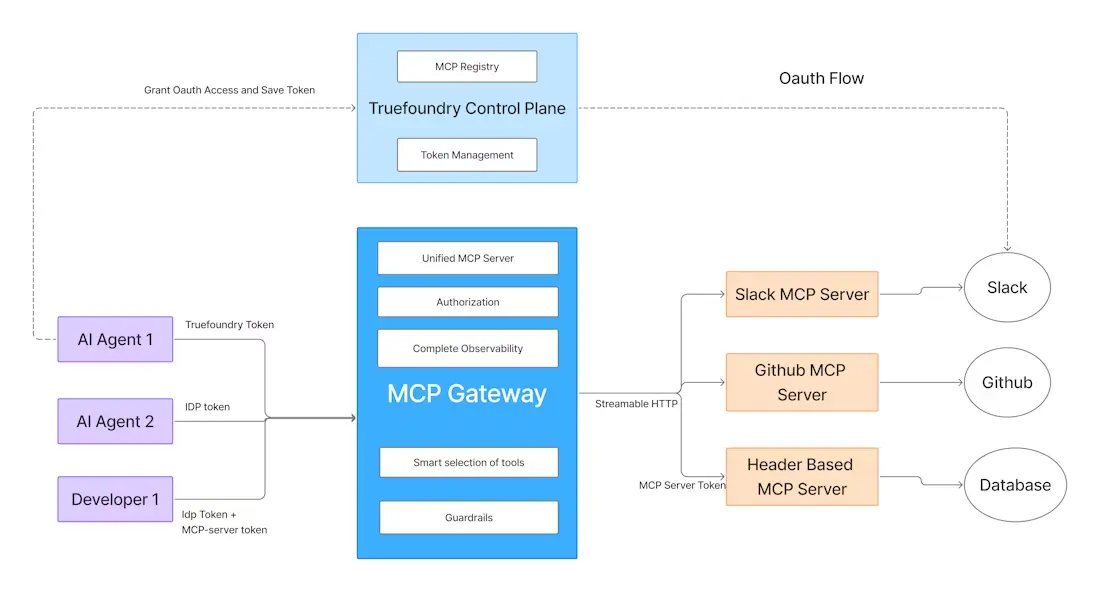
The diagram above (adapted from TrueFoundry’s docs) illustrates an MCP Gateway architecture.
Agents send requests into the gateway, which handles authentication, proxies calls to LLM models and tool servers (MCP), and then returns results. A central control plane manages registrations and access controls, while a built-in MCP client layer orchestrates multi-step calls between LLMs and tools.
Overall, the Agent Gateway acts as a stateful intermediary. By converting agent intents into concrete API calls and doing the reverse, it glues together autonomous agents, large language models, and traditional services into a cohesive, governed pipeline.Traditional API gateways cannot handle this natively – the Agent Gateway’s intelligence about JSON-RPC sessions, SSE streams, and MCP/A2A semantics is what makes it viable for real enterprise use.
Agent Gateway vs API Gateway vs AI Gateway
It helps to compare Agent Gateways to more familiar gateway types:
API Gateway: A general-purpose gateway for web services (REST/gRPC). It handles routing, auth, rate-limiting, and caching for APIs. It is typically stateless (one request/response at a time) and does not natively understand LLM or agent protocol.
AI Gateway: Often discussed in the context of AI gateway vs API gateway, it extends traditional gateway behavior to handle AI/LLM traffic, token-aware routing, and model-specific observability. It adds features like multi-model routing, token usage tracking, prompt templating, and LLM-specific logging. For example, TrueFoundry’s AI Gateway lets developers call hundreds of LLM models through one endpoint with full access control and observability. It optimizes how applications interact with language models but usually still treats requests as independent calls.
Agent Gateway: Takes the concept further to the agentic domain. It incorporates all API and AI gateway features plus special support for multi-agent workflows. This includes session-awareness (MCP/A2A), tool orchestration, and inter-agent message routing. In other words, an Agent Gateway is an AI Gateway on steroids for agents: it not only manages LLM calls, it also manages calls between agents and tools in multi-step chains. As Gravitee explains, AI Gateways and Agent Gateways are separate but complementary – the Agent Gateway focuses on agent-to-agent communication under governance, whereas the AI Gateway focuses on LLM interactions with the broader system. Solo.io similarly emphasizes that while MCP/A2A define low-level RPC, only an Agent Gateway provides the “enterprise-grade security, resilience, observability, and multi-tenancy” layer needed.
In practice, the boundaries blur. Many platforms (including TrueFoundry) are converging these concepts. TrueFoundry’s platform, for instance, already offers a unified AI Gateway that covers models, hybrid GPU/MCP servers, and (soon) agents. But conceptually, think of an Agent Gateway as a specialized gateway focused on coordinating agents rather than just serving models or microservices. It applies similar governance (authz, quotas) across agentic workflows.
Common Use Cases of Agent Gateways
Agent Gateways enable a variety of advanced AI applications. Examples include:
Multi-step Automation Workflows: Complex tasks that require several AI steps. For instance, an enterprise might create a “support ticket” workflow: one agent reads customer emails, another queries a knowledge base (via the gateway’s tools) to draft responses, and a third calls a ticketing API to log the issue. The Agent Gateway logs each call and ensures only approved actions occur. TrueFoundry illustrates such a flow: a “Planner” agent interprets a Slack command, calls a Slack MCP tool, a “Summarizer” agent processes the data, and an “Executor” agent creates Jira tickets – all through a centralized gateway which secures each step.
Tool-Assisted QA and RAG: Retrieval-augmented generation often uses one or more LLMs plus external tools (search engines, databases). An Agent Gateway can present all these search and database tools as MCP services, letting an LLM or agent agentically fetch and combine information under policy. For example, an AI agent answering medical queries could retrieve licensed medical data (as MCP tools) through the gateway, while content filters and audit logs ensure compliance.
Intelligent Assistants with Function Calls: Modern chatbots (like OpenAI’s function-calling chat models) effectively act as agents calling APIs for functions like “bookFlight” or “scheduleMeeting.” An Agent Gateway can serve as the function-call interface, mapping these agentic calls to real booking or calendar APIs with enterprise auth. This offloads credential management and logging to the gateway.
DevOps and IT Automation: Agents can automate software pipelines by calling various APIs (GitHub, CI/CD, cloud consoles). An Agent Gateway unifies these calls: an agent with natural-language intent (“deploy the latest commit if tests passed”) is routed to the correct APIs behind the gateway, and each API key is managed centrally.
Data Pipeline Orchestration: One agent might cleanse data, another analyzes it, another visualizes it – all using specialized tools. The gateway ensures they chain together correctly. For instance, a data analytics agent could query a database via an MCP tool, then hand off to a reporting agent that formats the results, all under single-agent workflow governance.
Low-Code Agent Platforms: The gateway extends easily to end-user agent builders. TrueFoundry’s blog shows that low-code flows created with Flowise can be quickly pointed at the gateway: once the gateway URL and token are entered, “every LLM call now flows through the Gateway,” instantly inheriting centralized governance like cost tracking, observability, and security. This means that experimental agents (even drag-and-drop ones) benefit from production-grade controls as soon as they go through the Agent Gateway.
In all cases, the Agent Gateway provides the glue and guardrails that make agentic AI enterprise-ready. It ensures that whether an agent is a custom app or a third-party bot, it uses the organization’s sanctioned models and tools, stays within budget, and generates a full audit trail.
Challenges in Agent Gateway Adoption
While powerful, Agent Gateways also introduce new considerations:
Protocol Complexity: Agent protocols like MCP are stateful and bidirectional, which is very different from typical REST APIs. Gateways must handle multiple open connections per session, multiplex Server-Sent Events, and preserve JSON-RPC context. This complexity requires a purpose-built implementation (Solo chose Rust, for example) rather than repurposing a generic API proxy.
Scalability and Performance: Keeping live sessions for many agents can tax resources. The gateway must be highly performant to avoid introducing latency. It often needs to cache or trim responses to reduce token usage for costly LLM calls.
Security of Autonomous Agents: Agents can potentially be manipulated to access unauthorized data or perform malicious actions. Ensuring comprehensive guardrails in an agentic flow is challenging. The gateway must validate not just initial requests but also intermediate outputs between agents, which can be complex.
Operational Complexity: Adding a new gateway service (and the dependencies it needs) increases infrastructure complexity. Teams must manage high availability, monitoring and updates for the gateway itself, on top of their existing AI stack.
Standardization and Maturity: Agent protocols like MCP and A2A are relatively new (MCP was launched late 2024) and still evolving. The ecosystem of agent frameworks and tools is nascent. Early adopters may face version mismatches or lack of support from some vendors. Integrating legacy APIs (that were never designed as “agent-native” tools) may require custom adapters or wrappers.
Debugging Multi-Agent Flows: While the gateway provides observability, reasoning about multi-agent interactions across different tools can still be non-trivial. Tracing an agentic conversation end-to-end requires robust tools and potentially new skillsets for development teams.
Cost Management: Interestingly, an Agent Gateway can both help and complicate cost tracking. It centralizes usage metrics, but with many agents and providers, accurately attributing usage (especially across chained calls) requires careful design.
Despite these challenges, the industry consensus is that Agent Gateways address more problems than they create. In fact, Gartner explicitly calls them the “missing layer” for secure AI integration. As adoption grows, we can expect these gateways to become standard components of AI infrastructure, much as API gateways did for microservices.
How to get started with an Agent Gateway?
Organizations eager to adopt an Agent Gateway have several paths:
Evaluate Open Source Projects: Solo.io’s agent gateway (now a Linux Foundation project) is a community-driven gateway with connectors for A2A and MCP protocols. It provides a tool federation portal and developer UI for creating agentic workflows. Experimenting with this project can give teams hands-on insight into agent gateway patterns.
Leverage AI Gateway Platforms: Platforms like TrueFoundry already incorporate agent gateway functionality. While the dedicated Agent Gateway feature is “coming soon”, TrueFoundry’s existing AI Gateway supports MCP tool registration and agent-friendly APIs. You can sign up for TrueFoundry’s platform (free trial, no credit card) and follow the quick-start guides to connect LLMs and MCP tools. TrueFoundry’s docs walk through setting up the Gateway UI, adding model providers, and even adding MCP servers as tools. Using these steps, developers can start building simple agents (e.g. via Flowise or custom code) that automatically use the Gateway’s managed endpoints.
Use Agent-Friendly Tools: If you’re building agents with frameworks like LangChain, LlamaIndex or Flowise, look for features to point their output to a custom endpoint. As TrueFoundry demonstrated, simply configuring a low-code agent to use the Gateway’s API URL can bring all agent traffic under the gateway’s control. Similarly, open-source agents supporting MCP can register their MCP servers via the gateway’s API and then start invoking them through the centralized interface.
Adopt Identity and Governance Early: Since an Agent Gateway hinges on centralized auth, integrate it with your corporate identity (SSO/OAuth) from day one. For example, TrueFoundry lets you use standard OAuth2 (2LO/3LO) for both users and services. Configure these flows early to avoid last-minute security gaps. Also define your RBAC and policy requirements in advance – the sooner they are codified in the gateway, the smoother scaling will be.
Learn from Examples and Tutorials: وثائق ومدونات TrueFoundry هي موارد مفيدة. يشرح البرنامج التعليمي "Flowise Agent" كيفية بناء وكيل خلف البوابة خطوة بخطوة. تتضمن وثائق TrueFoundry "ملعبًا" للاختبار MCP الأدوات ومقتطفات التعليمات البرمجية لاستدعائها عبر البوابة. بالإضافة إلى TrueFoundry، تقدم مجتمعات بوابات Solo.io وAPI/AI (مثل Apache APISIX مع مكونات AI الإضافية) إرشادات حول البنية وأفضل الممارسات.
من خلال البدء على نطاق صغير – على سبيل المثال، كشف واجهة برمجة تطبيقات داخلية واحدة كخادم MCP في البوابة واختبار تدفق وكيل – يمكن للفرق بناء الثقة. بمرور الوقت، يمكنهم ترحيل المزيد من الوكلاء لاستخدام نقطة نهاية البوابة المركزية، مما يفتح بشكل منهجي فوائد الحوكمة والمراقبة الموحدة. المفتاح هو التعامل مع بوابة الوكيل على أنها نقطة التكامل: يجب أن يمر أي وكيل أو أداة جديدة من خلالها بشكل افتراضي.
الخلاصة: تأمين استراتيجيتك القائمة على الوكلاء للمستقبل
تمثل بوابة الوكيل الحدود الحاسمة التالية في البنية التحتية للذكاء الاصطناعي، حيث توائم الابتكار السريع القائم على الوكلاء مع متطلبات المؤسسات الصارمة. وكما جلبت بوابات API النظام إلى الخدمات المصغرة، فإن بوابة الوكيل تجلب الإدارة المركزية لأنظمة الوكلاء المتعددة المعقدة. من خلال توحيد الاتصالات، وفرض سياسات الأمان، وتوفير قابلية مراقبة عميقة، فإنها تحول شبكات الوكلاء المجزأة إلى سير عمل منضبط وعالي الأداء.
بالنسبة للمؤسسات التي توسع نطاق الذكاء الاصطناعي، لم تعد هذه الطبقة اختيارية، بل هي النسيج الضام الذي يملأ "الطبقة المفقودة" في المكدس الحديث. حلول مثل TrueFoundry's بوابة الذكاء الاصطناعي و بوابة الوكيل تقود هذا التحول، مما يضمن أن يتمكن كبار مسؤولي التكنولوجيا والمطورون من نشر سير عمل وكيلية قوية باستخدام الـ أفضل بوابة LLM الإمكانيات وبثقة تامة.
في عصر الذكاء الاصطناعي المستقل، تعد بوابة الوكيل الجسر بين الأتمتة التجريبية والإنتاج الموثوق. من خلال تبني هذا الأساس المتين، يمكن للفرق التوقف عن إعادة اختراع كود التكامل والبدء في التركيز على ما يهم: بناء أنظمة ذكية تدفع قيمة تجارية حقيقية.
هل أنت مستعد لتأمين مستقبل الذكاء الاصطناعي الخاص بك؟
لا تدع عمليات التكامل المعقدة تبطئ نشر الذكاء الاصطناعي الخاص بك. تحكم في نماذجك ووكلائك باستخدام منصة TrueFoundry الموحدة.
مركزية الحوكمة: إدارة جميع نماذج LLM والوكلاء لديك من خلال واجهة موحدة.
توسّع بشكل أسرع: انشر بثقة باستخدام أدواتنا الموحدة لنشر الذكاء الاصطناعي.
أمان على مستوى المؤسسات: طبّق إدارة وصول قوية وإنفاذًا للسياسات فورًا.
تلعب بوابة الوكيل دورًا محوريًا في التطور السريع لمشهد الذكاء الاصطناعي من خلال توفير أساس قوي لعمليات تعلم الآلة. إنها بمثابة النسيج الضام للأنظمة الذكية، مقدمة طبقة من الأمان وإدارة الوصول التي تسمح للمؤسسات بتحقيق الإمكانات الكاملة لسير عمل الوكلاء القوي.
ما هو تكامل بوابة الوكيل؟
تكامل بوابة الوكيل هو الخطوة الأولى نحو حوكمة المصدر المفتوح. تبسّط طبقة البرمجيات هذه معالجة البيانات ونقلها عبر المنصات السحابية مثل خدمات الويب من أمازون (Amazon Web Services). من خلال العمل كطبقة بيانات، فإنها تمكّن إدارة واجهة برمجة التطبيقات (API) الأصلية وتحل العديد من المشكلات المتعلقة بالأنظمة القديمة.
ما هو بروتوكول بوابة الوكيل؟
يوفر بروتوكول بوابة الوكيل، مثل بروتوكول سياق النموذج (model context protocol)، أرضية مشتركة للبوابات القابلة للتشغيل المتبادل. من خلال معالجة قضايا مهمة مثل أمان بروتوكول سياق النموذج (MCP) وإدارة واجهة برمجة التطبيقات (API)، ينشئ هذا الأساس المفتوح شبكة وكلاء. إنها خطوة حاسمة في حل أكبر مشكلات الأمان المفتوحة اليوم في العالم الحقيقي.
ما الذي يجعل بوابة وكيل TrueFoundry أفضل بوابة وكيل للمؤسسات؟
تُعد بوابة وكيل TrueFoundry أفضل بوابة وكيل للمؤسسات لأنها توفر أساسًا مستقرًا لتعلم الآلة مع إدارة واجهة برمجة التطبيقات (API) الأصلية. إنها بمثابة النسيج الضام للأنظمة الذكية، مقدمة أمانًا أعمق لبروتوكول سياق النموذج (MCP) وإدارة وصول أفضل من البوابات القابلة للتشغيل المتبادل، مما يضمن لك تحقيق الإمكانات الكاملة لسير عمل الوكلاء القوي.
TrueFoundry AI Gateway delivers ~3–4 ms latency, handles 350+ RPS on 1 vCPU, scales horizontally with ease, and is production-ready, while LiteLLM suffers from high latency, struggles beyond moderate RPS, lacks built-in scaling, and is best for light or prototype workloads.











.png)
.png)
.png)
.png)
.png)
.png)
.png)
.png)
.png)
.png)
.png)


