


What Is Semantic Caching and How Does It Work?

.png)
Exact-match caching is simple: if the same request comes in twice, return the stored answer. The problem is that people rarely phrase the same question the same way twice. "What is your refund policy" and "how do I get my money back" mean the same thing but share almost no words, so an exact cache treats them as different and calls the model again.
Semantic caching fixes that by matching on meaning. It turns each request into a vector, compares it to the vectors of past requests, and if one is close enough, returns the stored answer. More requests hit the cache, and each hit skips a model call.
This guide explains what semantic caching is, how it works, how it differs from other caching, and when to use it.
What is semantic caching?
Semantic caching is a cache that matches entries by meaning rather than exact text. Instead of using the raw request as the key, it uses an embedding, a numeric vector that captures what the request means. Two requests that mean the same thing produce vectors that sit close together, so the cache can recognize them as a match even when the words differ.
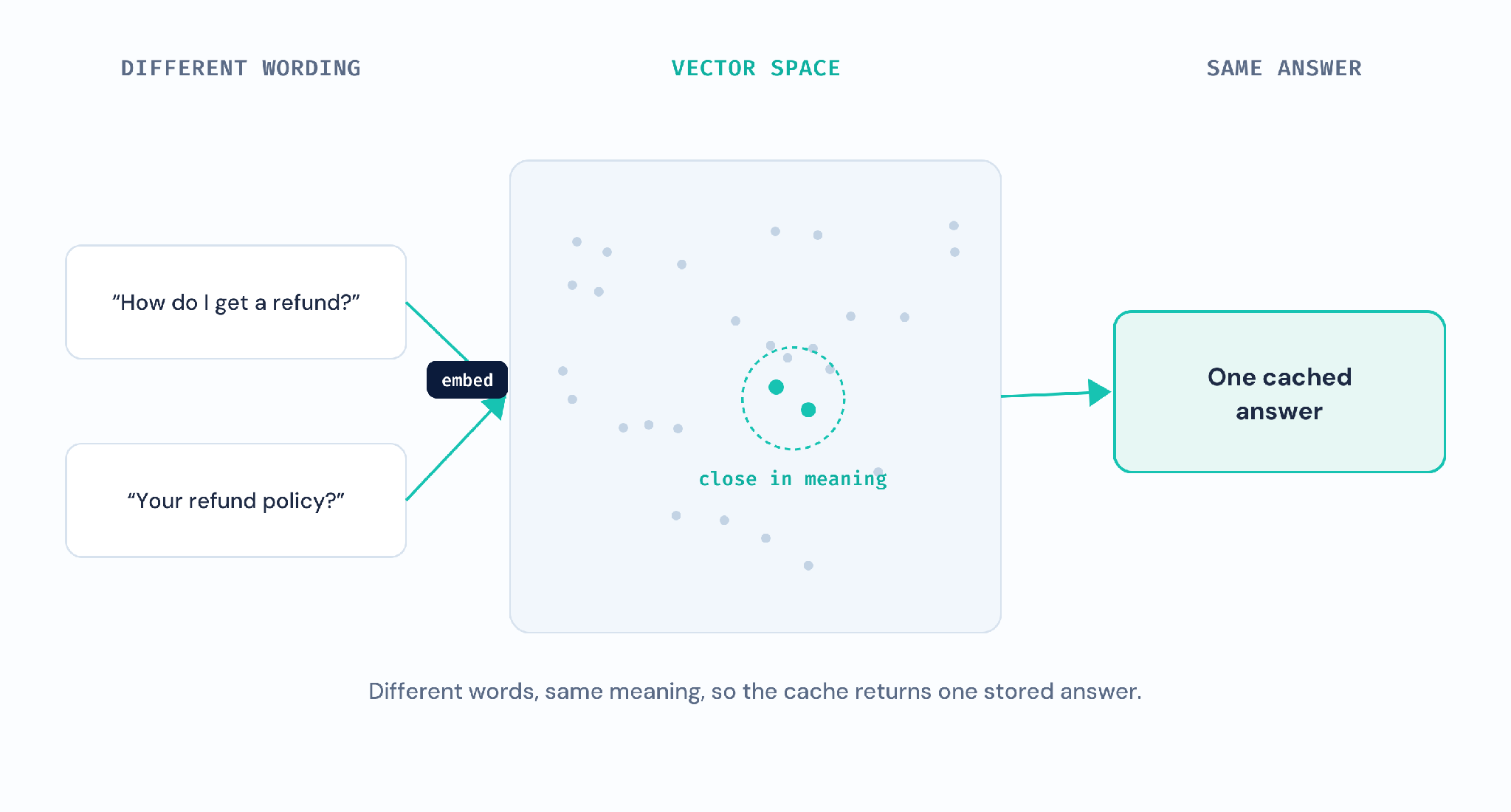
Think of a support agent who has answered the same question a hundred times in a hundred different wordings. They do not need the exact phrasing to know what you are asking. They recognize the intent and give the answer they have given before. A semantic cache does the same by comparing meaning.
The payoff is a higher hit rate. An exact cache only helps when requests repeat word for word. A semantic cache helps whenever requests repeat in meaning, which is far more often.
How does semantic caching work?
A semantic cache sits in front of the model. Every request runs through the same steps.
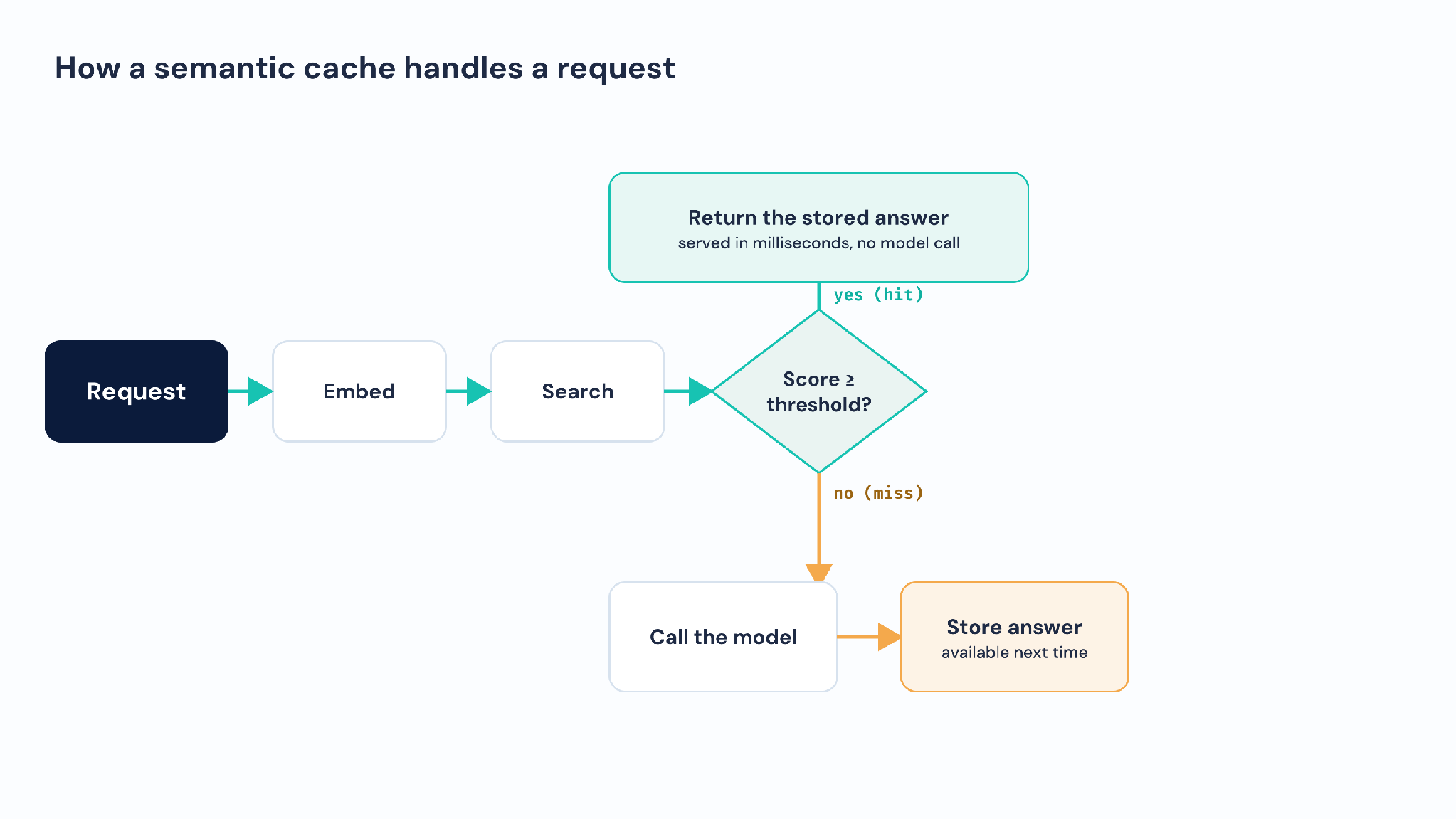
- Embed the request. An embedding model turns the incoming request into a vector that represents its meaning.
- Search for a match. The cache compares that vector against stored vectors in a vector store and finds the closest one.
- Check the threshold. If the closest match scores above the similarity threshold, it counts as a hit. If not, it is a miss.
- Return or call. On a hit, the cache returns the stored answer. On a miss, it calls the model as normal.
- Store the new answer. After a miss, the new request and its answer are embedded and stored, so the next similar request can hit.
The threshold is the critical setting. A high threshold demands near-identical meaning and returns fewer but safer hits. A low threshold matches loosely and returns more hits, but risks serving an answer that does not quite fit the question.
Semantic caching vs. exact and prompt caching
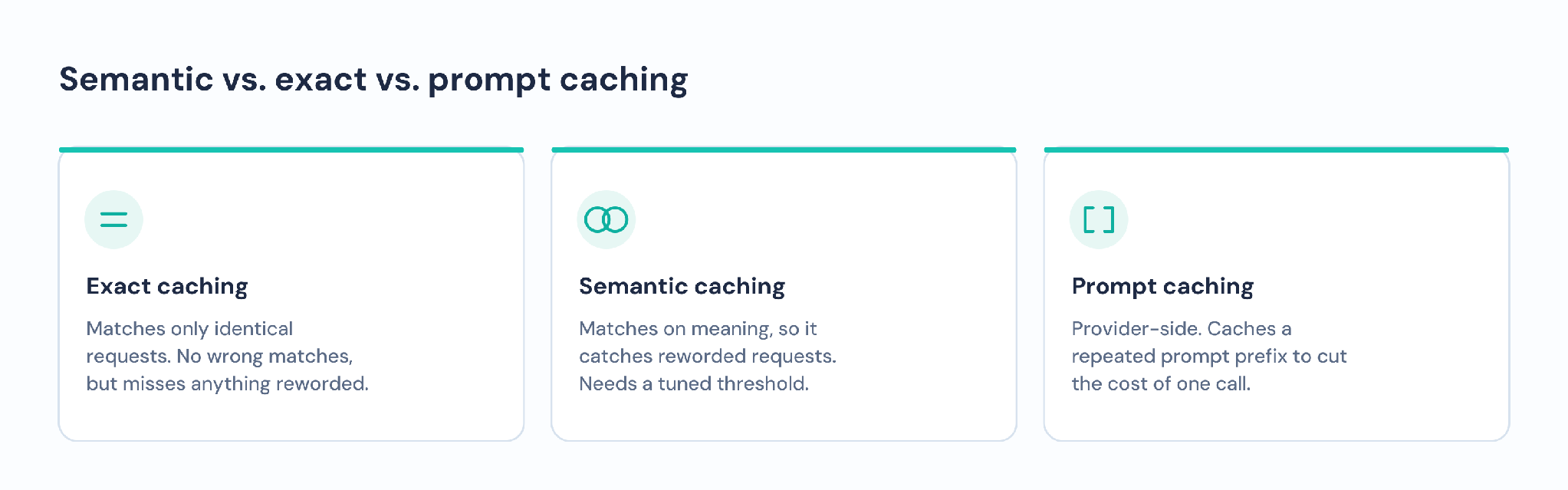
- Exact caching. Matches only identical requests. There is zero risk of a wrong match, but it misses anything reworded.
- Semantic caching. Matches on meaning, so it catches reworded requests. Higher hit rate, but it needs a threshold and can return a near-miss if set too loose.
- Prompt caching. A provider-side feature that caches the repeated prefix of a prompt, such as a long system prompt, to cut cost on the tokens it covers. It speeds up a single call rather than skipping it, and does not match across different requests.
These are not mutually exclusive. A system can use prompt caching to make each model call cheaper and semantic caching to avoid many calls entirely.
What are the benefits of semantic caching?
- Lower cost. Every cache hit is a model call you do not pay for, which adds up fast on high-volume endpoints.
- Lower latency. A cache hit returns in milliseconds, far faster than generating a fresh response.
- Higher hit rate. Matching on meaning catches the many requests that repeat in intent but not in wording.
- Less load. Fewer model calls means less pressure on rate limits and provider capacity.
What are the risks and limits?
- Wrong matches. If the threshold is too loose, the cache can return an answer to a similar but different question.
- Stale answers. Cached responses can go out of date. Entries need a time to live, or invalidation when the underlying data changes.
- Threshold tuning. The similarity threshold has to be tuned per use case, and the right value is not obvious up front.
- Not for unique requests. Requests that are each one of a kind, or that depend on live data, get little benefit and can be hurt by a stale hit.
When should you use semantic caching?
Semantic caching pays off when the same questions come up again and again in different words. Customer support, FAQs, documentation search, and internal assistants are good fits, because users ask overlapping questions all day.
It is a poor fit when every request is unique, when answers depend on live or personalized data, or when a wrong match would be costly. In those cases a tight threshold or exact caching is safer, or no caching at all.
Best practices for semantic caching
- Start with a strict threshold and loosen it slowly while watching for wrong matches.
- Set a time to live on entries so answers do not go stale, and invalidate when source data changes.
- Scope the cache per user or tenant when answers are personalized, so one user does not get another's response.
- Measure hit rate and false-hit rate together, since a high hit rate is worthless if the hits are wrong.
- Cache only where answers are stable, and skip it for live data or one-off requests.
- Keep the cache behind a gateway so every application shares the same policy and metrics.
Conclusion
Semantic caching reuses past answers whenever a new request means the same thing, not just when it matches word for word. It embeds each request, searches for a close match, and returns the stored answer on a hit, which cuts cost and latency on repetitive traffic.
TrueFoundry's AI Gateway supports caching as part of its request pipeline, so you can cut spend and latency on repeated queries while keeping routing, rate limits, and observability in the same layer. Used with a sensible threshold and a time to live, semantic caching is one of the simpler ways to take load and cost off an LLM system.

Govern, Deploy and Trace AI in Your Own Infrastructure
Frequently Asked Questions
What is semantic caching in simple terms?
The cache reuses a previously answered query when a new query means the same thing, even if it is worded differently. It uses embeddings to compare meaning rather than exact text, so it detects many more matches.
How is semantic caching different from normal caching?
Regular caching responds only when an exact question is presented for its answer. Semantic caching searches for meaning, therefore both ‘How do I receive my refund?’ and ‘What is your refund policy?’ can reuse one cached response.
What is a similarity threshold?
This is the threshold beyond which the similarity between two requests is significant enough to be considered a match. Keep it high and you get more hits that are safer. Make it low and you get many more hits but run the chance of giving an incorrect result.
Can semantic caching return wrong answers?
Yes. A very liberal threshold can cause the cache to relate a question to an alternate but related one. Adjusting the threshold parameter and introducing a time-to-live will minimize that possibility.
When should I not use semantic caching?
Don't use it for requests that require uniqueness, where answers involve live or personalized information, or where an erroneous response could be damaging. In such scenarios, consider using a fixed threshold level, accurate caching, or no caching.





