


What Is Test-Time Compute and Why Does It Matter?


For most of deep learning's history, a model's capability was fixed once training finished: you ran it, it produced an answer, and that was that. Test-time compute changes the picture by treating the computation spent at answer time as a dial you can turn. Spend more of it, and the model can think longer and often answer harder questions correctly.
This idea is central to the recent wave of reasoning models. Instead of producing an answer in one shot, they generate intermediate reasoning, explore alternatives, and check their work, all of which consumes compute at inference. The payoff is higher accuracy on problems that benefit from deliberation, such as math, coding, and multi-step logic.
This guide explains what test-time compute is, how models use it, how it compares to scaling model size, and when spending more of it is worthwhile.
What is test-time compute?
Test-time compute, also called inference-time compute, is the computational work a model performs while responding to a query. It is distinct from training compute, which is spent once to build the model. Test-time compute is spent every time the model is used, and crucially, how much is spent can vary from one query to the next.
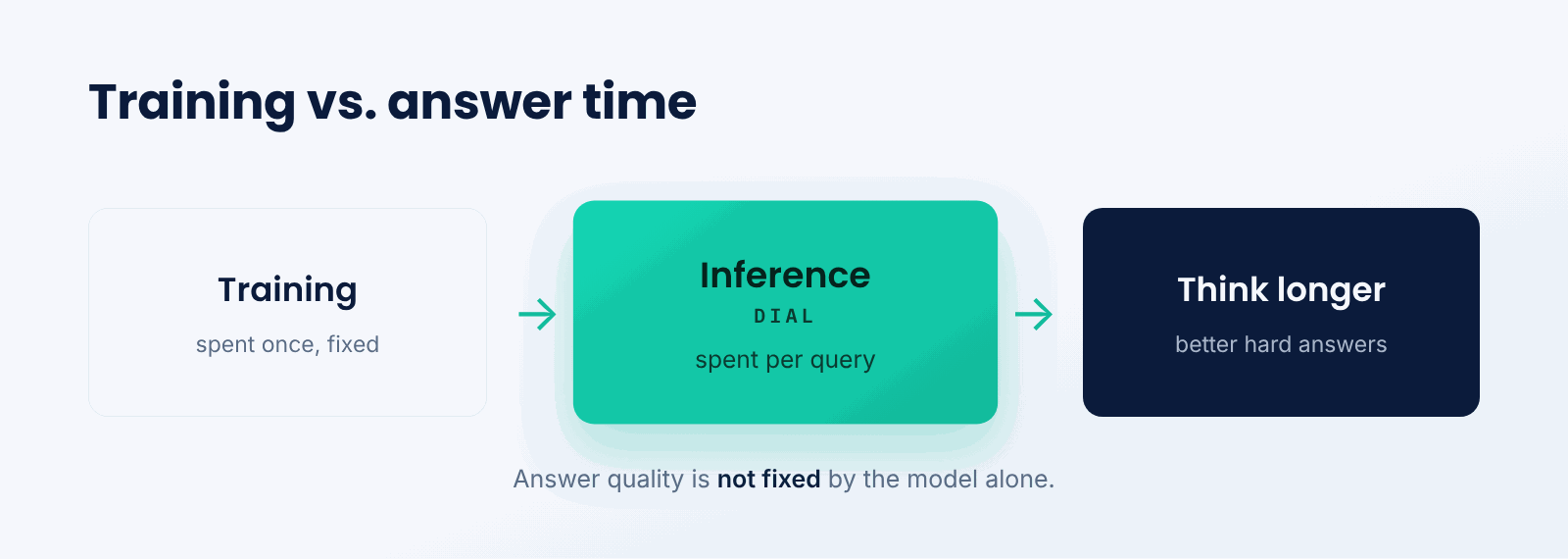
Think of it like a student taking an exam. Training is all the studying done beforehand, fixed by the time the exam starts. Test-time compute is how long the student spends working through each question during the exam. Spending more time, checking the work, and trying alternatives tends to produce better answers on hard questions.
The key idea is that answer quality is not fixed by the model alone. For problems that reward deliberation, letting the model do more work at inference, by generating longer reasoning or multiple attempts, can lift accuracy well beyond a single quick response.
How do models use test-time compute?
Models turn extra inference compute into better answers through several strategies.
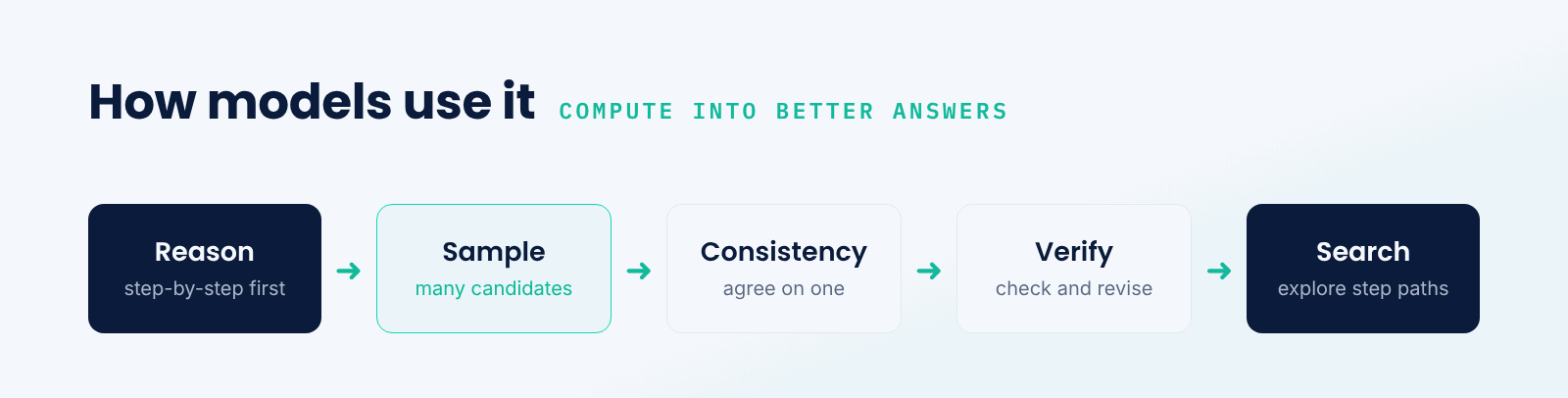
- Longer reasoning. The model generates step-by-step reasoning before its final answer.
- Sampling many answers. It produces several candidate responses to choose among.
- Self-consistency. It picks the answer that most attempts agree on.
- Verification. It checks or critiques its own candidates and revises.
- Search. It explores a tree of possible steps, keeping the most promising paths.
These strategies all spend more compute per query in exchange for a better final answer. The amount can often be scaled up or down per request, letting you reserve heavy deliberation for the hard queries while answering easy ones quickly and cheaply.
Test-time compute vs. scaling model size
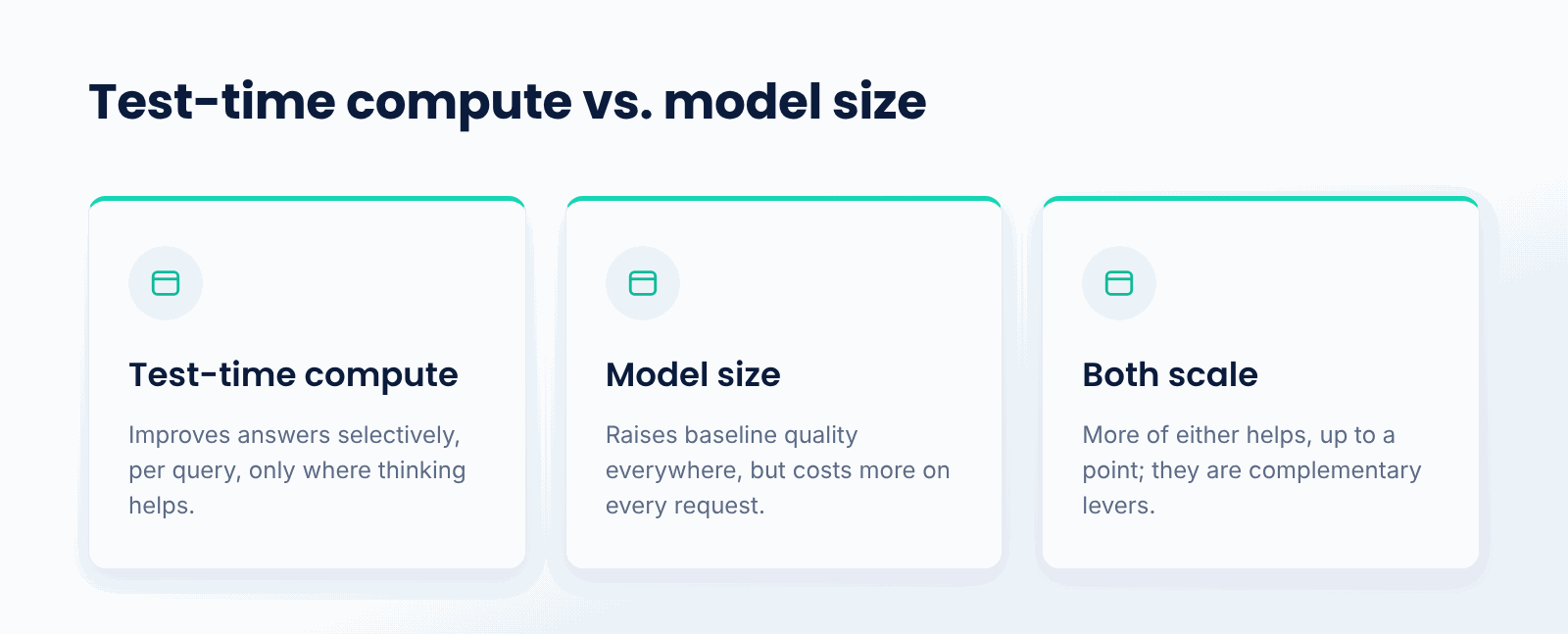
There are two broad ways to make a model answer harder questions: make the model bigger, which raises both training and inference cost permanently, or spend more compute at inference on a given model. Scaling model size improves baseline capability everywhere; scaling test-time compute improves answers selectively, on the queries where thinking longer helps.
The two are complementary and both follow scaling trends: more of either tends to improve results, up to a point. Test-time compute is attractive because it is flexible, you pay for extra thinking only when a query needs it, rather than paying for a larger model on every request including the easy ones.
Why does test-time compute matter?
- Harder problems. It lifts accuracy on tasks that reward deliberation.
- Flexibility. You can spend more only on the queries that need it.
- No retraining. It improves answers without changing the model.
- A new scaling axis. It is a separate lever from model and data size.
- Reasoning quality. It underpins the capability of modern reasoning models.
What are the tradeoffs?
- Latency. More thinking means slower responses.
- Cost. Extra compute per query raises serving spend.
- Diminishing returns. Beyond a point, more thinking adds little.
- Not always helpful. Easy or lookup-style queries gain nothing from it.
When should you spend more test-time compute?
Spend more on problems where correctness matters and deliberation helps: complex math, multi-step reasoning, code generation, and planning. For these, the accuracy gain from longer thinking often justifies the extra latency and cost, especially when a wrong answer is expensive.
For simple, latency-sensitive, or high-volume queries, keep test-time compute low. Answering a factual lookup or a short classification with heavy deliberation wastes money and slows the response for no gain. The art is matching the compute to the difficulty of each query.
Key points about test-time compute
- It is the compute spent answering a query, not training the model.
- Reasoning models use it to think before responding.
- Strategies include longer reasoning, sampling, verification, and search.
- It trades latency and cost for accuracy on hard problems.
- It is a scaling axis separate from model size.
- Match the amount to each query's difficulty to control cost.
Conclusion
Test-time compute is the computation a model spends while answering, and treating it as an adjustable dial is what lets reasoning models think longer to solve harder problems. Through longer reasoning, sampling, verification, and search, more inference compute buys better answers, at the cost of latency and spend. As a scaling axis separate from model size, it offers the flexibility to pay for deliberation only where it helps.
TrueFoundry helps teams serve reasoning models efficiently and control inference cost, so heavy test-time compute can be reserved for the queries that need it. As reasoning models spread, managing test-time compute well is central to balancing quality against cost.

Govern, Deploy and Trace AI in Your Own Infrastructure
Frequently Asked Questions
What is test-time compute in simple terms?
This refers to the amount of computation performed by the model in response to your query, not during the training phase. By performing more of it, the model can think longer, generating and checking reasoning steps, which leads to better answers on hard problems.
How is test-time compute different from training compute?
Compute used for training the model is a one-time usage that goes into making the model. Test-time compute is spent every time the model answers a query and can vary per request, so you can think longer on hard questions and answer easy ones quickly.
Does more test-time compute always give better answers?
No. It performs better in cases where thought is required, such as mathematical and multi-step reasoning tasks. In simple or look-up tasks, it causes delays and additional costs for negligible gains. Even in difficult tasks, there comes a point when the improvement levels off.
How do reasoning models use test-time compute?
They use it in such things as developing logical reasoning through each step, checking several different responses and taking the one that is most consistent, checking and improving upon their own suggestions, or exploring potential solution paths before making a final choice.
Is it better to scale test-time compute or model size?
They complement each other. Larger models increase baseline quality on all queries but at a higher cost on every request. Additional compute at test time helps answer questions that require thinking, offering greater flexibility by charging for reasoning per query rather than on every request.





