


What Is Context Engineering and How Does It Work?

As AI systems grow beyond a single prompt into agents, assistants, and retrieval pipelines, the hard problem shifts from how you word one instruction to what information the model sees at all. A model can only reason over what is in its context window, so deciding what goes in there, and in what order, becomes the main lever on quality. That discipline is context engineering.
It is a broader view than prompt engineering. Instead of just crafting instructions, context engineering manages every input the model receives: the system prompt, retrieved documents, past conversation, long-term memory, and the results of tool calls, all assembled to fit a limited budget.
This guide explains what context engineering is, how it works, how it relates to prompt engineering and RAG, and why it has become central to building AI systems.
What is context engineering?
Context engineering is the practice of assembling the right information into a model's context window for each request. It decides which pieces of context, from instructions and retrieved data to memory and tool outputs, are relevant, how to rank and trim them to fit the window, and how to order them so the model uses them well.
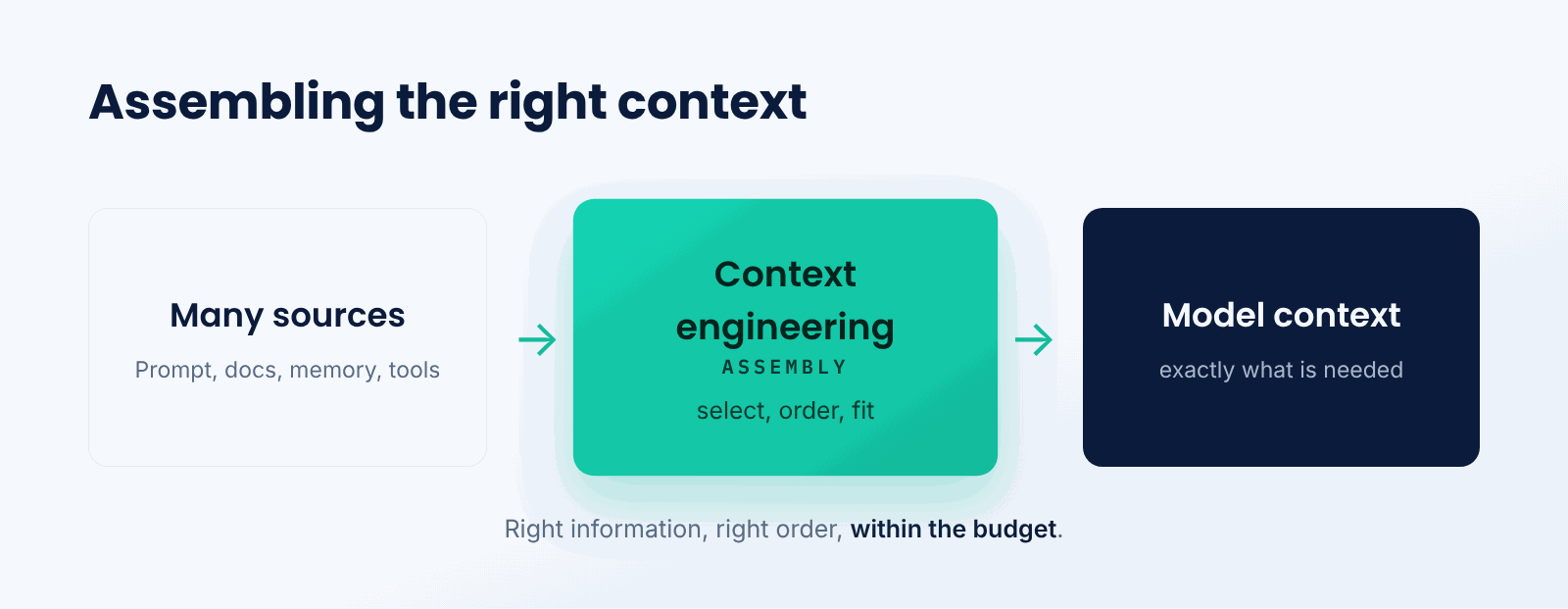
Think of preparing a briefing packet for an expert before a meeting. You do not hand them every document in the building; you select the few that matter, summarize the rest, and put the most important material on top. Context engineering is assembling that packet for the model, every time it is asked to act.
The key idea is that the model's output is only as good as the context it is given. Managing that context deliberately is what separates a reliable AI system from one that hallucinates or loses the thread.
How does context engineering work?
Each request, the system gathers possible context and reduces it to what fits and matters.
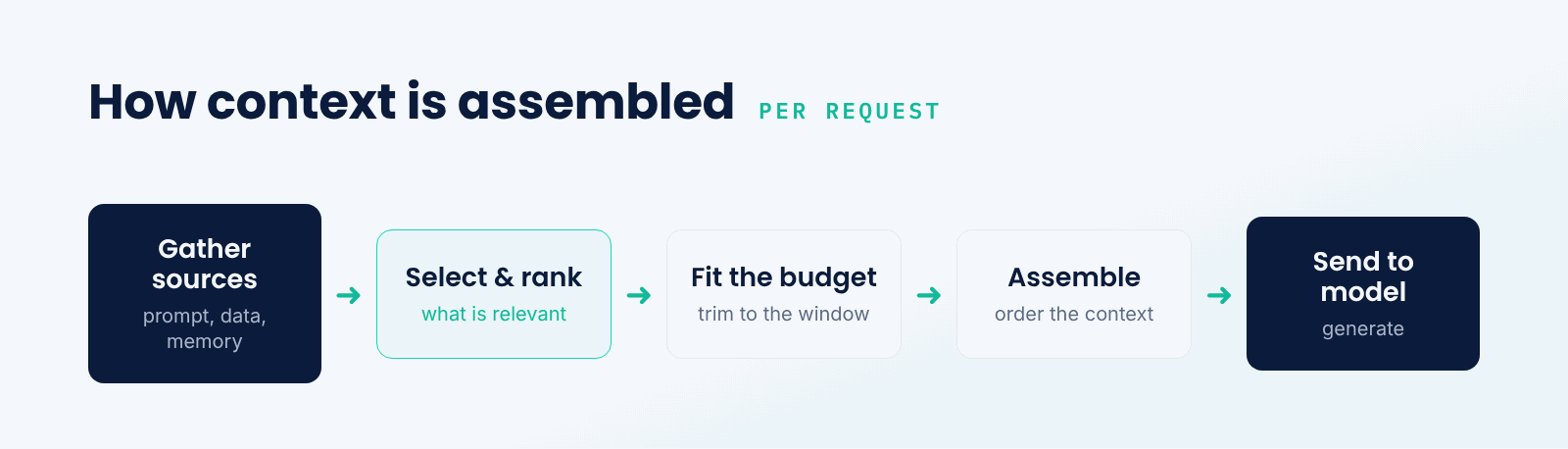
- Gather the sources. Pull together the prompt, retrieved documents, conversation history, memory, and tool results.
- Select and rank. Decide which pieces are relevant to this request and how important each is.
- Fit the budget. Trim, summarize, or drop content so it fits within the context window.
- Assemble and order. Arrange the chosen context so the most important parts are placed where the model attends best.
- Send to the model. The assembled context plus the request go to the model, which generates its response.
Because the window is limited and every token costs money and attention, context engineering is a constant trade-off between including enough and including too much. Overstuffing the window can hurt answers as much as leaving out key facts.
Prompt engineering vs. RAG vs. context engineering
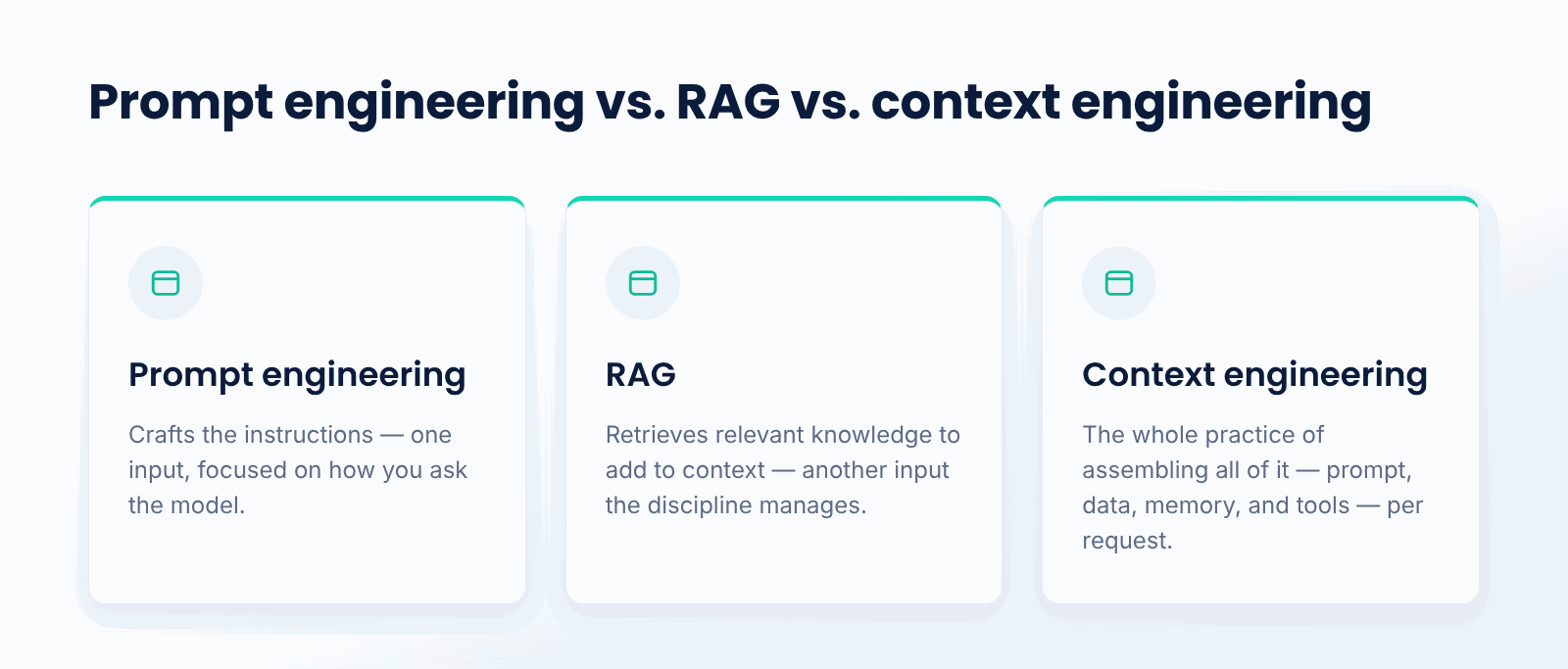
These overlap but differ in scope. Prompt engineering focuses on how you word the instructions, which is one input to the context. RAG retrieves relevant knowledge to add to the context, another input. Context engineering is the whole discipline that sits above both: deciding what mix of prompt, retrieved data, memory, and tool output to assemble for each request, and how to fit and order it all.
In other words, prompt engineering and RAG are techniques that produce pieces of context, while context engineering is the practice of managing all those pieces together. As systems get more complex, that higher-level view becomes the one that matters most.
Why does context engineering matter?
- Answer quality. The model can only use what is in its context, so what you include decides the result.
- Limited window. Context is finite, forcing choices about what to include and what to leave out.
- Cost and latency. Every token in the context adds cost and slows the response, so efficiency matters.
- Grounding. Including the right retrieved facts reduces hallucination and keeps answers accurate.
- Agent reliability. Agents depend on the right memory and tool results being in context to act correctly.
What are the challenges?
- Relevance. Deciding what is actually relevant to a request is hard and often imperfect.
- Budgeting. Fitting everything important into a limited window forces lossy trade-offs.
- Ordering effects. Models attend unevenly, so where you place context changes how it is used.
- Freshness. Memory and retrieved data can go stale and must be managed over time.
When does context engineering matter most?
It matters most in systems that go beyond a single prompt: retrieval pipelines, long conversations, and agents that use memory and tools. In these, the model constantly needs the right mix of information assembled on the fly, and getting that assembly right is the core engineering problem.
For a simple one-shot prompt, context engineering collapses back into prompt engineering. The discipline grows in importance as the number of context sources and the length of interactions increase.
Best practices for context engineering
- Include only what is relevant to the request, since noise dilutes the signal.
- Retrieve and summarize rather than pasting whole documents into the window.
- Place the most important context where the model attends best, near the start or end.
- Budget the window deliberately, leaving room for the response.
- Manage memory and retrieved data for freshness, dropping what is stale.
- Use a gateway to apply caching, observability, and consistent context policies across models.
Conclusion
Context engineering is the practice of assembling the right information into a model's context window for each request. It spans the prompt, retrieved data, memory, and tool outputs, and involves selecting, trimming, and ordering them to fit a limited budget. As AI systems grow into agents and pipelines, it has become the higher-level discipline that prompt engineering and RAG feed into, and the main lever on quality, cost, and reliability.
TrueFoundry's AI Gateway helps teams manage context in production, with caching, retrieval integration, and observability into token usage across models in one layer. However capable a model is, it can only work with the context you give it, and engineering that context well is what makes AI systems dependable.

Govern, Deploy and Trace AI in Your Own Infrastructure
Frequently Asked Questions
What is context engineering in simple terms?
It is the decision about which information goes into the model's context window for each request, and how to structure it. This includes the prompt, retrieved data, memory, and the output from tools, assembled so the model has exactly what it needs.
How is context engineering different from prompt engineering?
While prompt engineering refers to writing the instructions themselves, which is one of the inputs, context engineering refers to the larger process of putting together all the inputs — the prompt, data retrieval, memory, and tool output — and fitting and ordering them in the context window.
Why does context engineering matter?
Because a model can do nothing beyond the context it has been given. The selection, sequencing, and pruning of information have an immediate impact on answer quality, cost, and whether the model stays grounded instead of hallucinating.
Is RAG part of context engineering?
Yes. RAG uses retrieved knowledge to enrich the context, which is an input that context engineering deals with. Context engineering is the broader field of putting everything together, including what RAG retrieves.
When does context engineering become important?
As systems go past simple prompts into multi-turn interactions, retrieval pipelines, and systems with memory and tools. As the number of context sources increases, the ability to compose those contexts well becomes increasingly critical.





