


What Is Agentic RAG and How Does It Work?

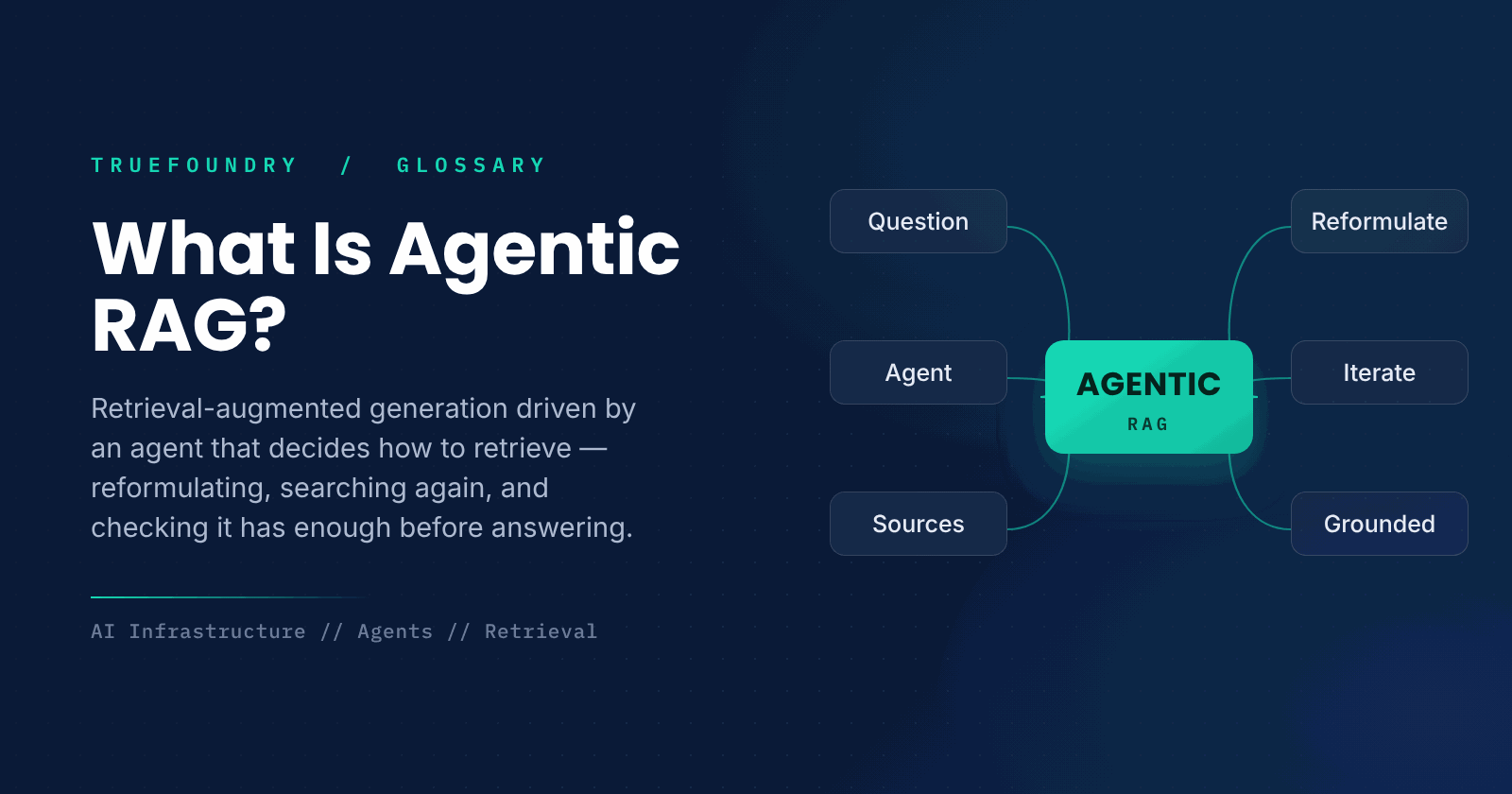
Standard retrieval-augmented generation is a straight line: take the question, retrieve some chunks, stuff them into the prompt, and generate an answer. That works for simple lookups, but it falls down on harder questions that need several searches, different sources, or reasoning about what to look for next. Agentic RAG fixes that by putting an agent in charge of the retrieval.
Instead of one fixed retrieval step, an agent decides how to gather information: it can rephrase the query, search again, consult different sources, call tools, and check whether what it found is actually enough. The result is a retrieval process that adapts to the question rather than treating every question the same way.
This guide explains what agentic RAG is, how it works, how it differs from standard RAG, and when it is worth the extra complexity.
What is agentic RAG?
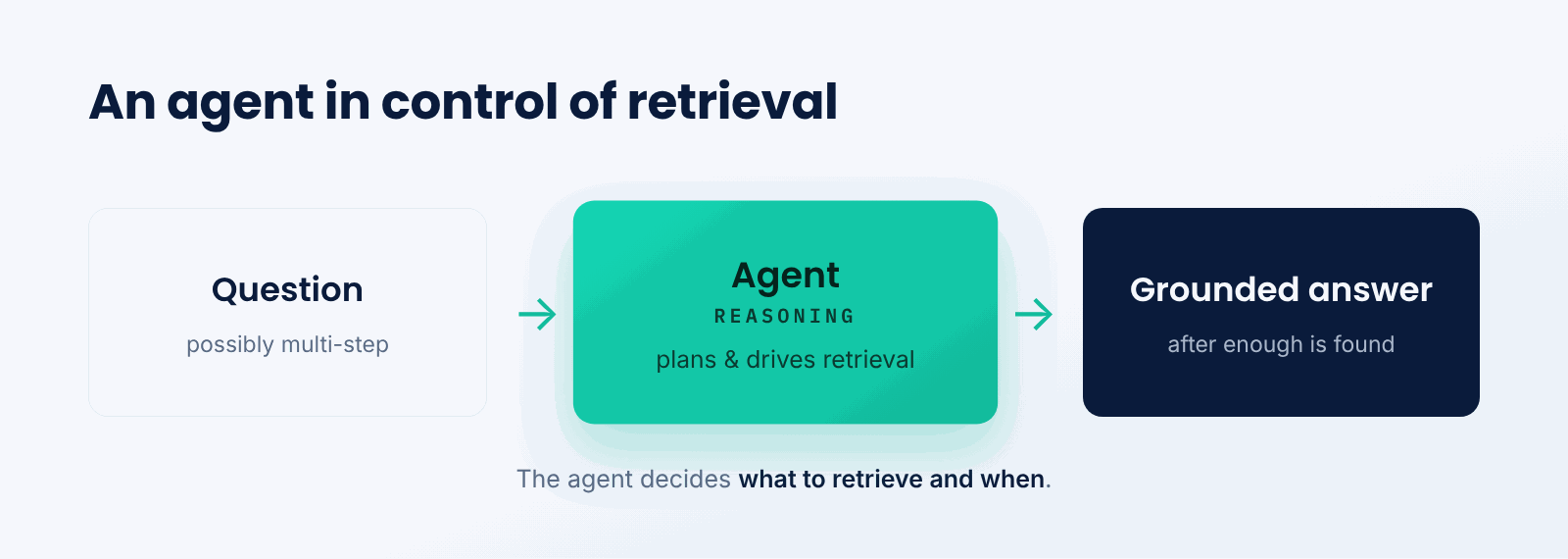
Agentic RAG is retrieval-augmented generation in which an agent, a model that can reason and take actions, controls the retrieval process. Rather than a single fixed retrieval step, the agent plans how to find information, issues one or more searches, chooses among sources and tools, evaluates what it gets, and decides when it has enough to answer.
Think of the difference between handing a researcher one photocopied page and letting a researcher loose in a library. The first gets whatever was on the page; the second can follow leads, check several books, and keep looking until the question is answered. Agentic RAG turns retrieval from the first into the second.
The key shift is control. In standard RAG the pipeline is fixed; in agentic RAG the model decides what to retrieve and when, which lets it handle questions that a single retrieval could never satisfy.
How does agentic RAG work?
The agent runs a loop of deciding, retrieving, and checking until it can answer.
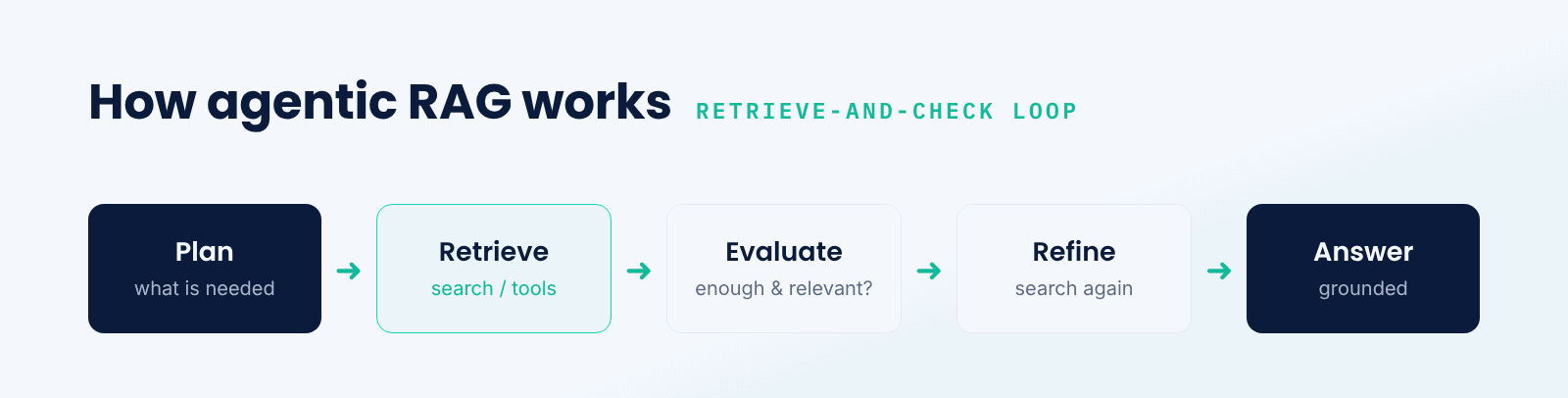
- Plan the retrieval. The agent reasons about what information the question needs and how to find it.
- Retrieve. It issues a search, or calls a tool or source, to gather relevant information.
- Evaluate. The agent judges whether what it retrieved is relevant and sufficient to answer.
- Refine or continue. If not, it reformulates the query, searches again, or tries another source.
- Answer. Once it has enough, the agent generates a grounded answer from what it gathered.
This loop lets the agent decompose a complex question, chase down the parts, and combine them, rather than hoping one retrieval returns everything. It is RAG with reasoning and iteration wrapped around it.
Agentic RAG vs. standard RAG
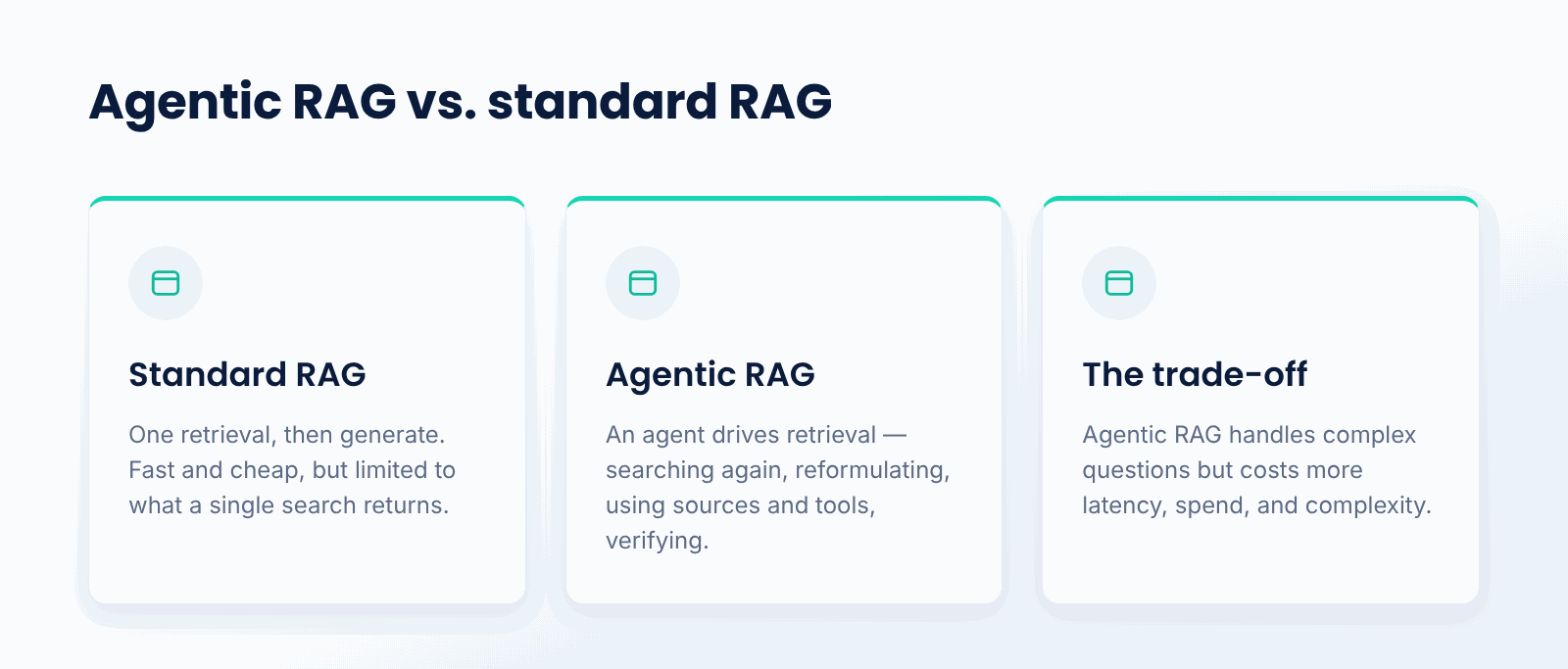
The two differ in control and flexibility. Standard RAG is a fixed pipeline: one retrieval, one generation, fast and cheap, but limited to what a single search returns. Agentic RAG lets an agent drive retrieval, so it can search multiple times, reformulate, use different sources, and verify, which handles complex, multi-step questions, at the cost of more latency and expense. A third point of comparison is reasoning: agentic RAG combines retrieval with the agent's ability to plan and check.
In short, standard RAG is the right default for straightforward questions, while agentic RAG earns its keep on hard ones that need several steps or sources. Many systems use simple RAG by default and escalate to an agentic approach only when needed.
What are the benefits of agentic RAG?
- Handles complex questions. It can break down and answer multi-step queries a single retrieval cannot.
- Adaptive retrieval. The agent reformulates and searches again when the first attempt falls short.
- Multiple sources and tools. It can combine different knowledge bases, APIs, and tools as needed.
- Self-checking. It can judge whether it has enough before answering, reducing confident wrong answers.
- Better grounding. Iterating until the information is sufficient produces more accurate, grounded responses.
What are the trade-offs?
- Higher latency. Multiple retrieval and reasoning steps take longer than a single pass.
- Higher cost. More model calls and searches mean more tokens and more spend.
- More complexity. An agentic loop is harder to build, debug, and make reliable than a fixed pipeline.
- Overkill for simple queries. On easy questions the extra steps add cost without improving the answer.
When should you use agentic RAG?
Use it for complex questions that a single retrieval cannot answer: queries spanning multiple documents or sources, questions that need several steps of reasoning, or cases where the right search depends on what earlier searches returned. There, the ability to iterate and adapt is what makes the answer possible.
For simple, direct lookups, standard RAG is faster and cheaper and usually enough. The practical pattern is to reserve agentic RAG for the hard questions rather than paying its cost on every request.
Best practices for agentic RAG
- Use standard RAG by default and escalate to agentic retrieval only for hard questions.
- Limit the number of retrieval steps so the loop cannot run away in cost or time.
- Give the agent clear, well-described sources and tools to choose among.
- Have the agent check sufficiency before answering to reduce confident mistakes.
- Log the retrieval steps so you can see and debug how the agent reached its answer.
- Run it behind a gateway so retrieval, tool calls, and cost are observable and controlled.
Conclusion
Agentic RAG puts an agent in control of retrieval, turning a fixed one-shot pipeline into an adaptive loop that can reformulate queries, search multiple sources, use tools, and check whether it has enough before answering. That makes it capable on complex, multi-step questions that standard RAG cannot handle, at the cost of more latency, expense, and complexity. The art is using it where the difficulty justifies it.
TrueFoundry helps teams build and serve agentic and retrieval systems on their own infrastructure, with models, retrieval, tools, and observability managed in one place behind a gateway. As RAG grows from a fixed pipeline into an agentic process, governing and observing that process is what keeps it reliable and affordable.

Govern, Deploy and Trace AI in Your Own Infrastructure
Frequently Asked Questions
What is agentic RAG in simple terms?
This is retrieval-augmented generation where the agent determines the method of retrieval, rather than a set pipeline. The agent may restate the query, search multiple times, use various sources, and ensure it has enough information before formulating the answer.
How is agentic RAG different from standard RAG?
Standard RAG performs one retrieval followed by generation, which makes it fast but limited. Agentic RAG allows the agent to drive retrieval, so the process involves several retrieval attempts, reformulations, different sources, and verification, which makes it capable of handling difficult questions but more costly.
When should I use agentic RAG?
For complicated queries where one retrieval alone cannot answer the question, for example multi-source questions or those where reasoning about what to retrieve next is required. For simpler queries, regular RAG is quicker and more efficient.
What are the downsides of agentic RAG?
It is less efficient and more costly due to repeated retrieval and reasoning, and harder to implement and maintain. For simple queries, the additional steps do not improve the output and only increase cost.
Does agentic RAG reduce hallucination?
It can. By verifying that the retrieved information is adequate, and repeating the process until it is, there is less chance of answering from inadequate or missing information, which produces more grounded answers than a single retrieval.





