October 17, 2026
|
5 min de lecture


Accédez instantanément à un environnement TrueFoundry en direct. Déployez des modèles, acheminez le trafic LLM et explorez la plateforme complète : votre sandbox est prête en quelques secondes, aucune carte de crédit n'est requise.



Published: October 12, 2026

Une méthode incroyablement rapide pour créer, suivre et déployer vos modèles !
The Gartner Hype Cycle for Platform Engineering 2026 lands at a moment when the job description for platform teams has been evolving. It's not just about reducing developer toil or standardizing pipelines anymore. AI agents are entering software delivery as autonomous participants, agentic workloads are generating cost structures that existing FinOps practices weren't designed for, and the governance models most organizations built for human developers are already showing cracks.
The report covers 30+ technologies across every phase of the cycle, with a clear throughline: the platform engineering decisions you make in the next 12 months will determine whether your organization can scale AI responsibly or ends up managing a sprawl of ungoverned, expensive, fragile workloads.
TrueFoundry was recognized as a Sample Vendor across three categories in this year's report: GenAI Model Routers, AI Gateways, and AI Engineering. Below, we get into what the report actually says. The statistics worth internalizing, the technologies moving fastest, and the implications that should be driving roadmap conversations right now.
The 2026 report introduces a concept that deserves attention from every platform leader: Agent Experience (AX). Gartner defines it as a design and engineering discipline focused on preparing back-end systems to attract and serve AI agents: ensuring APIs, data, documentation, workflows, and interoperability standards are machine-readable, discoverable, and reliable.
The analogy to UX is deliberate. Just as platform teams spent years designing self-service interfaces that minimize friction for human developers, the same design discipline now needs to be applied to AI agents. As agent autonomy increases, Gartner notes, agents will effectively "shop" for systems that maximize task success, making AX a competitive differentiator.
This reframes the internal developer platform in a meaningful way. It's no longer just infrastructure abstraction for developers. It's the interface layer through which both humans and agents interact with your systems. Platforms that aren't designed with agent consumption in mind will create friction, inconsistency, and ungoverned behavior at scale.
The five themes running through this cycle all connect to that central shift:
AI-native development: Moving beyond human augmentation to AI agents executing long-running, autonomous tasks across roles and use cases. Gartner rates this Transformational.
Developer productivity: The perennial mandate, now requiring platforms to abstract the complexity of agentic toolchains on top of the complexity they were already managing.
Compliance by default: Embedding security and governance so developers and agents operate within guardrails automatically, without requiring conscious compliance effort on every task.
Navigating cloud-native complexity: Microservices, service meshes, and Kubernetes sprawl are harder to manage when AI agents are generating and consuming infrastructure at speed.
Cost management: FinOps for Agentic AI is a new category in this cycle, and it reflects a real problem: agent runs generate unpredictable spend through branching, retries, tool calls, and multi-agent loops. The organizations that get this right will build cost controls into their platform foundations from the start.
Read the full report here (no paywall): Gartner Hype Cycle for Platform Engineering 2026
Reading the full report, a few things stand out as decisions worth making now rather than later.
Decide whether your IDP is an AI platform or just an infrastructure abstraction. The organizations getting the most value from platform engineering in 2026 are the ones treating the IDP as the governance layer for AI workloads, not just a way to reduce developer toil. That means building model routing, AI traffic governance, and agent-friendly APIs into the platform itself, not leaving those decisions to individual application teams.
Build cost governance into the platform before agent workloads scale. In our view, the Gartner FinOps for Agentic AI category exists because most organizations don't have the telemetry, attribution, or enforcement mechanisms to manage agentic spend at scale. The time to instrument this is before you have 40 agents running in production, not after the first surprise billing cycle.
Treat tooling fragmentation as a platform risk. The integration debt that comes from assembling separate tools for every layer of the AI engineering stack is not a short-term inconvenience, it's a governance and auditability problem that compounds as workloads scale. The Gartner recommendation is to think ecosystem and platform rather than point tools, and to apply platform engineering principles to AI toolchain decisions the same way you'd apply them to developer infrastructure.
TrueFoundry has been referenced as a Sample Vendor across three categories in the report:
Gartner defines Generative AI (GenAI) model routers are an intelligent middleware layer decoupling the interaction between AI applications and their model dependencies. They dynamically analyze and direct requests to the most appropriate model based on optimization criteria such as costs, latency, reliability and performance, optimizing for costs and quality.The business case is straightforward: not every query needs the most capable, most expensive model. Running classification tasks or basic formatting through a frontier reasoning model is economically indefensible at scale. To us, Gartner cites benchmarks where well-configured routing improved accuracy, reduced latency by nearly half, and cut token usage by similar margins — all simultaneously.
The more important architectural point is decoupling. Applications that are hardcoded to a single provider accumulate model lock-in the way previous generations accumulated vendor lock-in on databases or cloud providers. Model routers create an abstraction layer that lets teams optimize across a fast-moving model landscape without refactoring applications every time a better or cheaper model ships.
We believe TrueFoundry's recognition in this category reflects the routing and inference management capabilities we've built directly into the platform, designed for teams that need to operate multiple models across environments without building bespoke integration for each.
Gartner describes an AI gateway as a tool that acts as an intermediary between applications and various artificial intelligence services or models. Its purpose is to simplify and manage connectivity between AI applications, agents, LLMs and enterprise applications by providing a central point to enable security, governance and observability of AI workloads.The category is rated embryonic — early, but moving fast.
The scope of an AI gateway has already expanded beyond LLM traffic. With the growth of MCP and A2A as AI integration standards, in our view, Gartner notes that gateways are being extended to govern AI-consumable interfaces more broadly: authentication, rate limiting, caching, load balancing, and logging across the full set of AI interactions, not just prompt-response calls.
What makes this category strategically important for platform leaders is the enforcement gap it closes. As AI applications proliferate across an organization, the risk isn't usually a single badly-behaved application — it's the cumulative effect of dozens of teams making independent decisions about model access, cost attribution, and data handling. A gateway gives platform teams the ability to enforce policy uniformly without requiring application teams to implement controls themselves.
TrueFoundry provides this centralized control layer for AI traffic, which is why we feel Gartner included us alongside vendors like Cloudflare, Kong, and Portkey in this category.
This is the most significant of the three recognitions, in part because of the company we're in. Gartner lists TrueFoundry alongside AWS, Google, Microsoft, NVIDIA (OctoAI), Weights & Biases, and Anyscale in the AI Engineering category — rated Transformational in benefit, with early mainstream adoption.
The Gartner framing here is worth quoting directly in spirit: most enterprises no longer struggle with creating isolated proofs of concept. They struggle with repeatable production delivery. The challenge in 2026 is turning fragile AI experiments into governed, reusable capabilities. And the reason this is hard is that AI engineering requires simultaneous maturity across multiple domains — data, model management, agentic orchestration, DevSecOps, and platform infrastructure — that most organizations haven't built in parallel at the required pace.
The failure mode Gartner describes is familiar to anyone who has worked in this space: tooling fragmentation. Separate point tools for pipelines, model registries, observability, evaluation, and governance accumulate integration debt that slows delivery and undermines auditability. Platform leaders trying to rationalize this landscape are essentially doing AI engineering whether they call it that or not.
We feel TrueFoundry's position in this category reflects the work we've done to unify those layers — DataOps, ModelOps, LLMOps, AgentOps, and deployment infrastructure — into a coherent platform that supports the full AI development lifecycle without requiring teams to stitch together five separate toolchains.
The full report covers 30+ innovations across every phase of the cycle. If you'd like to dig into any of the categories in more depth, you can access the full report here (no paywall).
Gartner, Hype Cycle for Platform Engineering, 2026, By Cary Pillers et. al, 14 May 2026
Gartner does not endorse any company, vendor, product or service depicted in its publications, and does not advise technology users to select only those vendors with the highest ratings or other designation. Gartner publications consist of the opinions of Gartner’s business and technology insights organization and should not be construed as statements of fact. Gartner disclaims all warranties, expressed or implied, with respect to this publication, including any warranties of merchantability or fitness for a particular purpose.
GARTNER is a trademark of Gartner, Inc. and/or its affiliates. Hype Cycle is a registered trademark of Gartner, Inc. and/or its affiliates and is used herein with permission. All rights reserved.
Gartner, Hype Cycle for Platform Engineering, 2026, By Cary Pillers, Bill Blosen, Manjunath Bhat, 14 May 2026
GARTNER is a trademark of Gartner, Inc. and/or its affiliates. Hype Cycle is a registered trademark of Gartner, Inc. and/or its affiliates and is used herein with permission. All rights
reserved. Gartner does not endorse any company, vendor, product or service depicted in its publications, and does not advise technology users to select only those vendors with the highest ratings or other designation. Gartner publications consist of the opinions of Gartner’s business and technology insights organization and should not be construed as statements of fact. Gartner
disclaims all warranties, expressed or implied, with respect to this publication, including any
warranties of merchantability or fitness for a particular purpose. This graphic was published by Gartner, Inc. as part of a larger research document and should be evaluated in the context of the entire document. The Gartner document is available upon request from TrueFoundry.
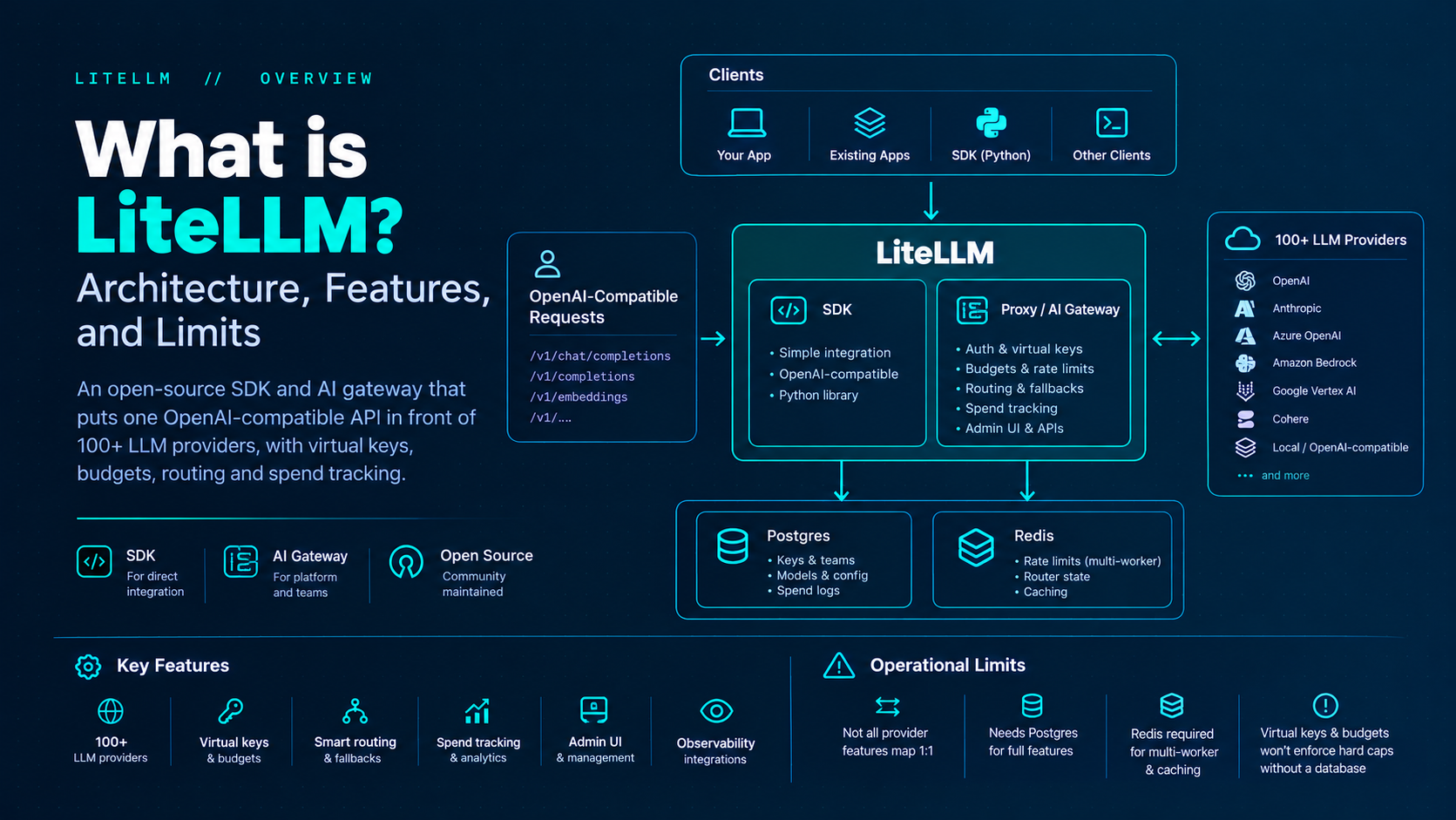
TrueFoundry AI Gateway offre une latence d'environ 3 à 4 ms, gère plus de 350 RPS sur 1 processeur virtuel, évolue horizontalement facilement et est prête pour la production, tandis que LiteLM souffre d'une latence élevée, peine à dépasser un RPS modéré, ne dispose pas d'une mise à l'échelle intégrée et convient parfaitement aux charges de travail légères ou aux prototypes.





Les dernières nouvelles, articles et ressources envoyés dans votre boîte de réception
.png)
.png)
.png)
.png)
.png)
.png)
.png)
.png)