


.png)
October 27, 2026
|
5 min de lecture


Accédez instantanément à un environnement TrueFoundry en direct. Déployez des modèles, acheminez le trafic LLM et explorez la plateforme complète : votre sandbox est prête en quelques secondes, aucune carte de crédit n'est requise.



Une méthode incroyablement rapide pour créer, suivre et déployer vos modèles !
As AI agents become more capable, the challenge is no longer building them- it's running them reliably in production. Developers need infrastructure for agent loops, state management, tool execution, sandboxing, and scaling, but the way these responsibilities are handled varies significantly across platforms.
Claude Managed Agents and Vercel eve take fundamentally different approaches to solving this problem. Anthropic offers a fully managed runtime where the entire agent lifecycle is operated for you, while Vercel eve is an open-source framework that lets you own the runtime and deployment while remaining model-agnostic.
In this guide, we'll compare Claude Managed Agents and Vercel eve across architecture, developer experience, tooling, security, and enterprise readiness to help you determine which platform is the better fit for your AI applications.
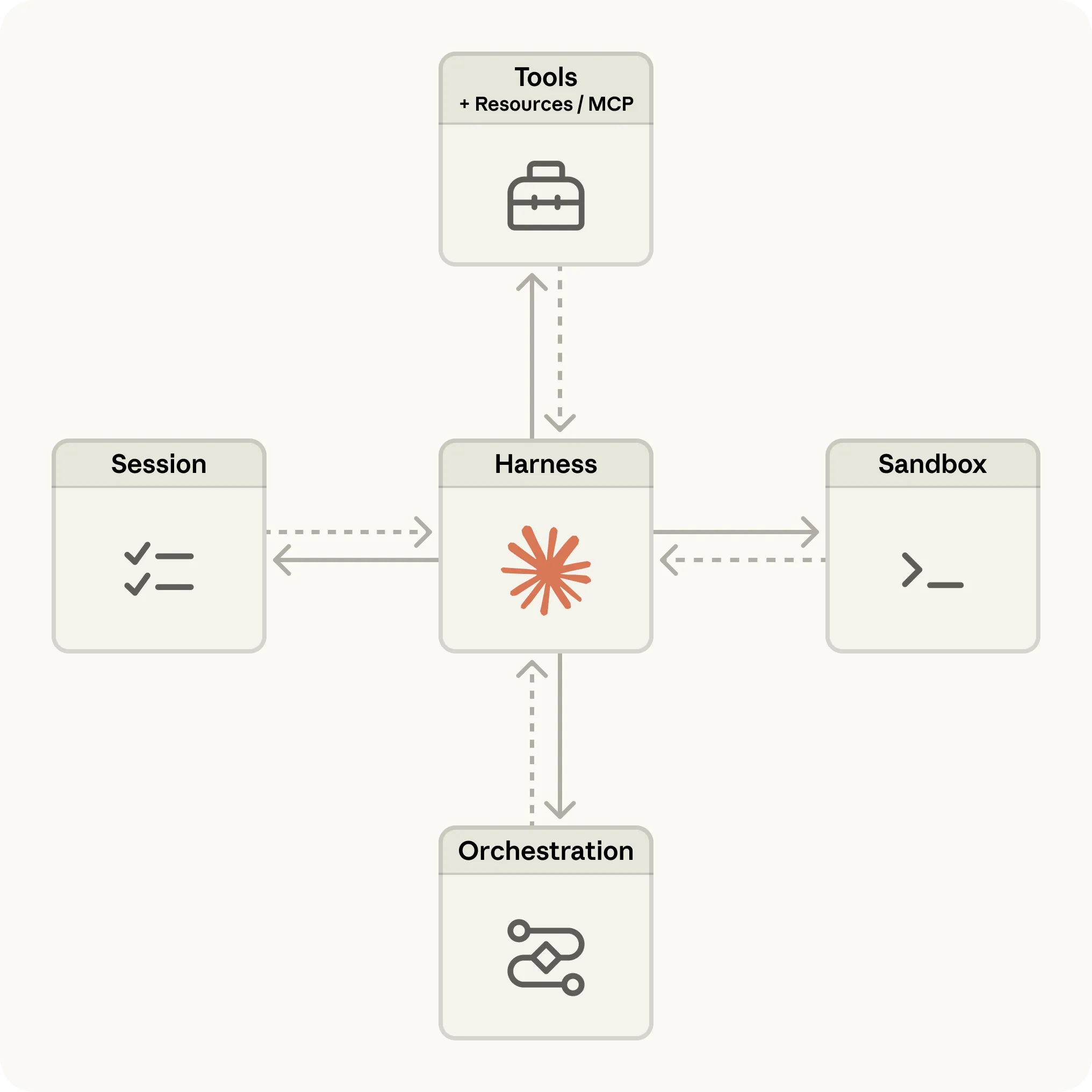
The model has three nouns: an Agent (model, system prompt, tools, MCP servers, skills), an Environment (a container template defining sandbox resources, packages, and network access), and a Session (a running instance with a persistent sandbox and conversation history). You create the agent once, then spin up sessions that reference it. Sessions are event-driven and stateful: you send a user event, then stream events (content, tool calls, status, token usage) until the session goes idle. State - conversation, sandbox, outputs is held server-side and resumes cleanly after a pause.
Anthropic runs the whole loop. You do not write the reason-act-observe cycle; you send messages and read events.
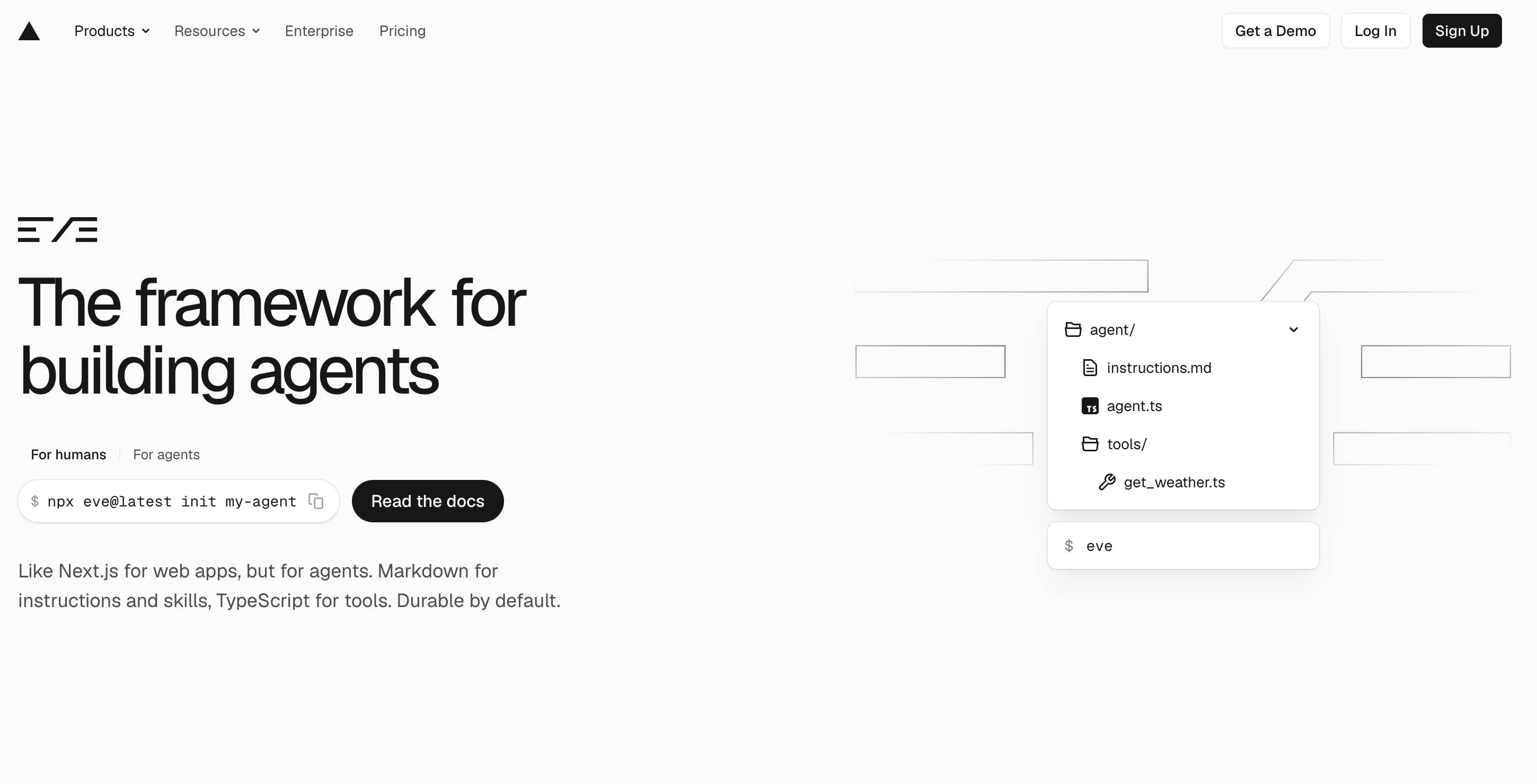
eve is filesystem-first: the directory is the agent. agent.ts sets the model, instructions.md is the system prompt, and folders for tools/, skills/, connections/, subagents/, channels/, and schedules/ each map to a runtime capability with no registration boilerplate - the file's name and place in the tree are its definition. eve then gives you a stable HTTP message route, a reconnectable session stream, and durable session state.
Durability is the design center. Every conversation is a durable workflow (built on the open-source Workflow SDK) with each step checkpointed, so a session can pause, survive a crash or a deploy, and resume exactly where it stopped. eve exposes two identifiers - a continuationToken for the next user message and a sessionId for streaming and inspection.
Managed Agents is configured through API objects. client.beta.agents.create() takes model, system prompt, tools, up to 20 MCP servers, and skills; client.beta.sessions.create() references the agent and an environment and can override model/system/tools/mcp_servers/skills per session without a new agent version. The dev experience is API-and-console: you drive it programmatically and inspect runs in the Claude Console.
Eve is configured through code and files. A tool is one typed TypeScript file (defineTool with a Zod schema); a skill is one markdown file with a description; a connection, subagent, channel, or schedule is likewise a single file. The loop is eve dev - a local server with a terminal UI that shows every skill load, tool call, and sandbox command as it happens. Because the agent is files in a repo, a prompt or tool change is a normal commit with a diff, review, and preview deployment.
Managed Agents persists session state server-side and adds memory stores: workspace-scoped collections of text documents (max 2,000 memories, ~100 kB each) mounted read-only or read-write at session start. A separate async feature, Dreams, runs in the background for minutes-to-hours to dedupe and reorganize a memory store from past transcripts. Long-running and async execution are first-class.
eve frames state as durable workflow state rather than a memory product. Sessions checkpoint each step and survive crashes and deploys - a mid-task session finishes on the version it started on. Agents can wait on a human or a slow system for as long as needed without consuming compute. Persistent knowledge is typically carried in skills, tool-backed stores, or the sandbox workspace rather than a dedicated memory API.
Both support subagents. In Managed Agents, one coordinator orchestrates specialists that share a sandbox and vault credentials but each run in a context-isolated session thread; agents can act in parallel and the coordinator delegates via custom-tool-use events. In eve, a subagent is the same directory shape one level down (its own instructions, tools, and sandbox) and the parent calls it like a tool; the child starts with a clean context window and hands the result back.
This is where eve is broader. eve treats channels as first-class: the same agent serves HTTP plus Slack, Discord, Teams, Telegram, Twilio, GitHub, and Linear, each a one-file adapter, with sessions able to move between surfaces. Human-in-the-loop approval is one field on a tool (needsApproval) — the agent pauses indefinitely, without consuming compute, until approved. Schedules are cron files that start the agent on its own clock.
Claude Managed Agents has no built-in end-user channels — it is an API you integrate into your own surfaces. It does provide per-call MCP approval policies (always_ask) as its approval primitive, and async execution covers scheduled/background work, but delivery to Slack/Discord/etc. is something you build.
Managed Agents bills on two axes: model tokens at standard rates plus session runtime (a per-second meter for sandbox uptime); in-session web search is the standard $10 per 1,000 searches. It is metered per organization with spend limits, AWS-only, and gated behind beta headers. There is nothing to deploy - Anthropic hosts it.
Eve is free and open source; your cost is model inference (via AI Gateway) plus whatever infrastructure you run it on. On Vercel it deploys as an ordinary project (vercel deploy - schedules become Cron Jobs, sandbox swaps to Vercel Sandbox, instant rollback available); adapters for other platforms are stated as on the way. Because it is your code, you carry the operational responsibility the docs are explicit about - approvals, network egress, and tool restrictions are yours to set.

TrueForge is TrueFoundry's open-source, vendor-neutral agent harness. It runs the agent loop around the model, including planning, tool calls, context management, sandbox execution, approvals, and session state, while letting you bring your own models, MCP servers, and infrastructure. You can run it locally with npx @truefoundry/trueforge or deploy it for a team with Docker Compose or Helm.
The model choice stays separate from the harness. In TrueFoundry's benchmark against Claude Managed Agents, TrueForge reached roughly the same task accuracy while using about 40% as many tokens when both were run on Opus 4.8, making it about 30% cheaper per run. When the same benchmark was run with GLM-5.2 on TrueForge, it achieved the same ~11/14 task score at about $2.90 per run versus $11.80 for Claude Managed Agents, roughly 75% lower cost.
TrueFoundry also provides a second lever for reducing model costs through AI Gateway's Auto Routing. Instead of sending every request to a frontier model, Auto Routing classifies requests by complexity and routes them to different model tiers. In TrueFoundry's benchmark across 550 prompts, routing between Haiku, Sonnet, and Opus reduced cost by 69% while retaining 98% of baseline quality, and mean latency dropped from 7.6 seconds to 4.0 seconds. On production-shaped traffic, the overall cost reduction reached 80%.
These two layers address different parts of the cost equation. TrueForge reduces the overhead of running the agent itself, while model routing lets you avoid using an expensive model when the task doesn't require one. For teams running agents at scale, having both controls can matter more than the price of the model alone.
TrueForge is open source and MIT licensed, while TrueFoundry's AI Gateway adds the operational layer teams need when moving from individual agents to production: centralized model access, budgets, guardrails, credential management, and unified traces.
If you're comparing Claude Managed Agents with a more configurable architecture, TrueFoundry is worth considering when model flexibility, infrastructure control, and agent cost optimization matter alongside the agent runtime itself.
Claude Managed Agents, Vercel eve, and TrueForge take different approaches to running AI agents. Claude Managed Agents prioritizes a fully managed experience, while eve gives developers more control through an open-source, code-first framework.
TrueForge sits between these approaches: it keeps the agent harness open source and model-agnostic while adding the infrastructure and operational controls needed for production deployments. Teams can choose their models and deployment environment without having to build the surrounding systems for MCP access, sandboxing, approvals, observability, and governance themselves.
The right choice ultimately depends on how much infrastructure you want to own. If minimizing operational overhead is the priority, Claude Managed Agents is the simpler option. If you want a lightweight, developer-controlled framework, eve is compelling. If you want open-source agent execution with enterprise infrastructure, model flexibility, and cost controls, TrueForge is worth considering.
TrueFoundry AI Gateway offre une latence d'environ 3 à 4 ms, gère plus de 350 RPS sur 1 processeur virtuel, évolue horizontalement facilement et est prête pour la production, tandis que LiteLM souffre d'une latence élevée, peine à dépasser un RPS modéré, ne dispose pas d'une mise à l'échelle intégrée et convient parfaitement aux charges de travail légères ou aux prototypes.





Les dernières nouvelles, articles et ressources envoyés dans votre boîte de réception
.png)
.png)
.png)

.png)
.png)
.png)
.png)
.png)
.png)
.png)
.png)


