


September 25, 2026
|
5 minutos de lectura


Obtenga acceso instantáneo a un entorno TrueFoundry en vivo. Implemente modelos, dirija el tráfico de LLM y explore la plataforma completa: su sandbox estará listo en segundos, sin necesidad de tarjeta de crédito.



Published: June 27, 2026

¡Una forma increíblemente rápida de crear, rastrear e implementar sus modelos!
LiteLLM has become the default open-source standard for teams normalizing the fragmented landscape of LLM APIs. With over 40,000 GitHub stars and confirmed production use at Netflix, Lemonade, and RocketMoney, the open-source proxy earns its reputation. But when engineering teams scale beyond a small group of developers or when a CISO starts asking about SSO and audit logs, they inevitably land on the same question: what exactly does LiteLLM Enterprise add, and is the commercial upgrade worth it?
This post answers that question directly. We cover what the open-source version includes, what LiteLLM Enterprise unlocks, where the pricing sits, and where both tiers still fall short for regulated enterprise deployments.
If you're already considering a broader comparison, see our LiteLLM alternatives guide for a wider field of options.
LiteLLM OSS is a Python-based reverse proxy that translates the schemas of 100+ LLM providers - Bedrock, Azure OpenAI, Anthropic, Vertex AI, and others into a unified OpenAI-compatible format. You can run it with a single Docker image, point your application at it, and switch models by changing a string in your request.
The free version includes the core gateway primitives that most teams need to get started:
For a solo developer or a small startup team with strong DevOps capacity, the open-source version is a fully functional gateway. You pay $0 for the software and handle your own infrastructure.
LiteLLM Enterprise is a commercial license that runs on the same Docker image as the open-source version - a valid license key passed at startup activates additional capabilities server-side. According to LiteLLM's documentation, you can verify activation by checking that the Swagger page shows "Enterprise Edition" in the description.
LiteLLM positions Enterprise for teams running at scale: 100+ users, or 10+ production AI use-cases, that need SSO, audit logs, fine-grained access control, and professional support on top of OSS.
Access control and identity:
Observability and compliance:
Guardrails:
Operations:
Pricing tiers (based on publicly referenced estimates:
LiteLLM Enterprise is available through AWS and Azure Marketplace as well as direct licensing. In all tiers, deployment is self-hosted -you provision and operate the infrastructure.
The upgrade makes sense in three clear scenarios:
You're scaling beyond 5 users on SSO. LiteLLM allows SSO for up to 5 users on the open-source version. Once your organization wants to route all LLM access through corporate identity providers - Okta, Azure AD, Google - you need the enterprise license. For most companies with a real IT security posture, this is a non-negotiable.
Your CISO requires audit logs and fine-grained access control. If you need to demonstrate who called which model, when, with what credentials, and with what spend and have that trail in a structured format - the OSS version's logging capabilities won't satisfy a compliance review. Enterprise adds audit logs and the team/org admin delegation to give you that paper trail.
You need production SLA coverage. The community edition has no SLA. If your production AI traffic depends on the proxy, and you want a vendor partner with defined response times, the Premium tier provides that. For teams whose AI infrastructure is now business-critical, the absence of an SLA on the OSS version is a real operational risk.
When you should stay on OSS: If your team is small (under 20 developers), you don't have SSO requirements, and your AI use-cases are experimental or internal-tooling only, the open-source version is the right choice. The governance features in Enterprise only become necessary once LLM access is widespread and regulated inside your organization.
Upgrading to LiteLLM Enterprise solves the governance gap but three structural limitations apply to all LiteLLM tiers, OSS and Enterprise alike.
LiteLLM Enterprise is a software license, not a managed service. You provision the infrastructure, manage the PostgreSQL database and Redis cache, handle version upgrades, apply security patches, and own the on-call rotation. The $250/month or $2,500/month fee covers the software and support, not the operational burden. For a mid-sized team running moderate traffic (1–5M requests/month), infrastructure and DevOps costs typically add $1,500–$2,500/month on top of the license - costs that don't appear on the pricing page.
LiteLLM has no native MCP (Model Context Protocol) gateway. As organizations deploy AI agents that invoke external tools, neither LiteLLM OSS nor LiteLLM Enterprise provides centralized tool-level access control, Pre/Post Tool guardrails, or an MCP tool registry. Engineering teams that want to govern which tools specific agents can call and audit those invocations, need a separate layer on top of LiteLLM, or a platform that includes this natively.
For more context on what complete LLM gateway infrastructure looks like, see our LLM gateway explainer.
LiteLLM proxies to external LLM APIs. It does not serve models. If your organization wants to reduce costs by running Llama 3, Mistral, or a fine-tuned model on your own infrastructure and routing production traffic between self-hosted and API models through a single gateway, LiteLLM and LiteLLM Enterprise require a separate model-serving platform to handle that. For teams whose AI roadmap includes self-hosted inference, this means managing two systems.
If your requirements are evolving toward the three gaps above - managed infrastructure, MCP governance, or self-hosted model serving alongside gateway management - TrueFoundry's AI Gateway is designed to address all three in a single control plane.
TrueFoundry is a full-stack, developer-first AI infrastructure platform that includes a powerful LLM Gateway designed to help teams build, deploy, and manage GenAI applications across open and closed-source models. It acts as a centralized layer for routing, observability, version control, and deployment of LLMs, offering everything Portkey does but with significantly more flexibility and control.

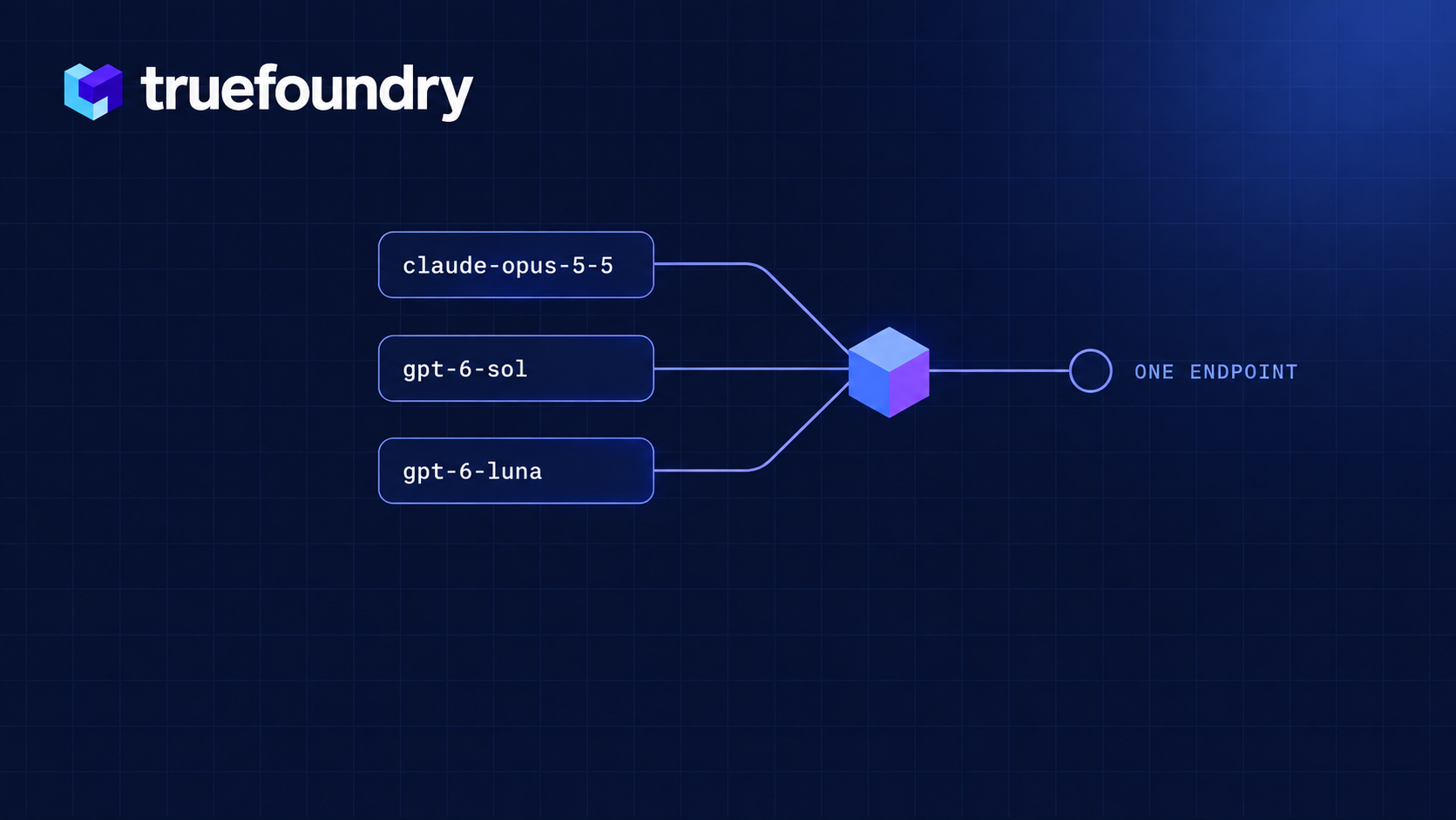
At the core of TrueFoundry is its LLM Gateway, which provides a unified API layer to interact with over 100+ LLMs from providers like OpenAI, Anthropic, Mistral and open-source models like LLaMA and Falcon. Teams can route traffic intelligently, enforce rate limits, cache responses, log requests, and track costs, all from one interface. It’s like having the best parts of Portkey but combined with the ability to self-host, fine-tune, and deploy models on your own infrastructure if needed.
TrueFoundry runs on your Kubernetes cluster, so you retain full data ownership, minimize latency, and avoid egress costs. It’s built to support both experimentation and production workloads, with seamless integrations across your software and MLOps stack.
Where it differs structurally from LiteLLM Enterprise:
For teams that find themselves paying for LiteLLM Enterprise while also managing a separate model-serving platform, a separate MCP proxy, and dedicated DevOps headcount for gateway operations, TrueFoundry's unified architecture typically reduces total cost of ownership. For a deeper TCO comparison, see our LiteLLM Enterprise pricing and TCO analysis.
Book a demo to see TrueFoundry in your environment →
The table below evaluates all three options against criteria relevant to production enterprise deployments. TrueFoundry capabilities are based on publicly available product documentation. LiteLLM features reflect publicly documented functionality at the time of writing - verify at docs.litellm.ai before purchasing.
Choose LiteLLM OSS if: You're a small team or solo developer, you don't have SSO or audit-log requirements, and you have the DevOps capacity to self-host and maintain a stateful gateway in Kubernetes. The open-source version is genuinely excellent for this profile.
Choose LiteLLM Enterprise if: You need SSO beyond 5 users, your CISO requires audit logs and fine-grained access controls, you want the full guardrails suite, and your team has the infrastructure headcount to own gateway operations. The ~$250/month Basic tier is a reasonable upgrade if the governance features are the only gap. Be aware that the license covers software, not operations - your total cost of ownership will be meaningfully higher than the license fee alone.
Choose TrueFoundry if: Your requirements include any of the following: VPC-native deployment with no data egress to a vendor, MCP gateway governance for AI agent deployments, self-hosted model serving in the same platform as your gateway, or SOC2/HIPAA compliance without a "certification assistance" dependency. TrueFoundry is designed for engineering leaders and platform architects at regulated organizations where these requirements are non-negotiable.
LiteLLM Enterprise is a commercial license built on top of the open-source LiteLLM proxy. It activates governance features — SSO/SAML, SCIM, OIDC/JWT Auth, Prometheus metrics, the full guardrails suite, audit logs, team admin delegation, key rotation, and SLA-backed support — that are not available in the community version. It runs on the same Docker image; a license key passed at startup enables the enterprise capabilities. It is always self-hosted.
Based on publicly referenced estimates, LiteLLM Enterprise has two tiers: a Basic tier at approximately $250/month and a Premium tier at approximately $30,000/year (~$2,500/month). LiteLLM does not publish fully standardized pricing, and final costs are negotiated directly with the vendor. Verify current figures at litellm.ai/enterprise before purchasing. Note that the license fee is separate from infrastructure costs — you provision and operate the deployment yourself.
f your team has 5 or fewer users, LiteLLM OSS supports SSO for free. Beyond that threshold, an enterprise license is required. If SSO is the only feature you need, the Basic tier ($250/month) covers it. If you also need audit logs, the full guardrails suite, and SCIM provisioning, those are also included in Basic.
TrueFoundry supports 1,000+ LLMs through a single OpenAI-compatible API. You switch models by changing the model name in the request - same URL, same credentials, whether routing to an external API or a self-hosted model inside your VPC.
LiteLLM Enterprise is the right upgrade when your organization has outgrown the OSS governance baseline - specifically when you need SSO at scale, audit logs for compliance, and the full guardrails suite for content policy enforcement. The Basic tier at ~$250/month is a reasonable price for those capabilities. The Premium tier at ~$30,000/year is appropriate for organizations that also need SLA-backed support and compliance certification assistance.
What LiteLLM Enterprise doesn't change: you still own the infrastructure, the on-call rotation, and all operational responsibility. And for organizations deploying AI agents, neither tier addresses MCP governance or self-hosted model serving.
If those gaps are blockers for your architecture, TrueFoundry's AI Gateway provides VPC-native deployment, MCP tool governance, model serving, and full compliance certification in a single control plane designed for the enterprise from the ground up.
TrueFoundry AI Gateway ofrece una latencia de entre 3 y 4 ms, gestiona más de 350 RPS en una vCPU, se escala horizontalmente con facilidad y está listo para la producción, mientras que LitellM presenta una latencia alta, tiene dificultades para superar un RPS moderado, carece de escalado integrado y es ideal para cargas de trabajo ligeras o de prototipos.





Las últimas noticias, artículos y recursos enviados a tu bandeja de entrada


.webp)
.webp)
.webp)
.webp)
.webp)
.webp)
.png)
.png)
.png)
.png)
.png)
.png)


