


.webp)
October 24, 2026
|
5 minutos de lectura


Obtenga acceso instantáneo a un entorno TrueFoundry en vivo. Implemente modelos, dirija el tráfico de LLM y explore la plataforma completa: su sandbox estará listo en segundos, sin necesidad de tarjeta de crédito.



.webp)
¡Una forma increíblemente rápida de crear, rastrear e implementar sus modelos!
Enterprise teams compare Kong AI vs Vercel AI when AI traffic starts to exceed direct provider calls. Both platforms connect applications to LLM providers, reduce integration work, and place an AI gateway between applications and models. This matters more as enterprise request volume grows.
The main difference comes from each platform’s starting point. Kong comes from API management and extends Kong Gateway into AI workloads. Its current Kong AI Gateway also provides a dedicated control plane for models, agents, and MCP servers. Vercel AI Gateway remains developer-first, providing product teams with access to many models through a single endpoint.
TrueFoundry adds a third enterprise lens focused on governed models, MCP tools, agent workflows, budgets, guardrails, and audit evidence.
Comparing Kong AI and Vercel AI by operating model is more useful than counting features. Kong fits enterprises already using Kong Gateway for API traffic. Existing security and routing patterns can extend into LLM traffic. Teams can reuse policy, observability practices, and access control.
Kong AI Gateway 2.0 adds a dedicated AI control plane with first-class models, agents, MCP servers, and providers. Teams can still use Kong Gateway deployments, including self-hosted and hybrid patterns. This model suits API platform teams that want direct policy ownership and deeper control over the data plane.
Vercel AI Gateway solves a different problem for product teams. It provides one API key, AI SDK support, BYOK, routing, budgets, and usage analytics. A new project can call foundation models via a single base URL with minimal code changes, including OpenAI Chat Completions.
Vercel's developer experience fits teams already using the broader cloud platform for static sites, applications, and AI features. The gateway can use provider keys or Vercel system credentials, while OIDC tokens eliminate the need for long-lived credentials in supported Vercel deployments.
Neither choice is wrong for the right operating model. Vercel AI and Kong AI serve different buyers, so infrastructure ownership often determines the choice before a feature grid does.
.webp)
Kong AI Gateway fits best when AI traffic should follow mature API gateway practices. Its core capabilities include AI proxy routing, prompt controls, semantic caching, observability, and token-aware rate limiting. AI Proxy Advanced supports LLM load balancing across upstream providers while keeping requests in standard OpenAI-compatible formats.
Kong AI Gateway 2.0 reduces plugin assembly for new deployments. Models, providers, agents, and MCP resources now appear as first-class AI entities. AI plugins remain available for Kong Gateway and on-premises deployments.
Token-aware controls become more important as model usage grows. Kong can apply rate limits at the model, agent, MCP server, consumer, or group level. Paid AI features include cost controls and prompt guardrails. Plus includes five unique LLM models, while Enterprise uses custom limits.
Choose Kong AI when:
Vercel AI Gateway is strongest for teams building AI products with Vercel or the open source AI SDK. Developers access many model providers through a single endpoint and one credential. The catalog includes options such as AWS Bedrock. Teams can bring their own keys, while gateway credentials simplify early AI adoption.
Reliability remains a core strength for Vercel AI Gateway. Routing uses recent uptime and latency signals across AI providers. Automatic failover moves models across providers, while fallback lists handle wider failures. Routing rules can also rewrite or deny requests, helping teams A/B test model choices.
Vercel also supports zero-data-retention controls and a no-training guarantee at the gateway layer. Provider-level data retention remains separate, so teams can restrict traffic to providers covered by ZDR agreements. Provider allowlists add another layer of policy for enterprise security requirements.
Budgets can be applied at the team, project, API key, and user scopes across LLM calls. Usage is visible in real time through the dashboard, and custom reporting supports deeper attribution. Vercel also offers AI Gateway through AWS Marketplace for organizations using existing cloud procurement agreements.
Choose Vercel AI Gateway when:
Security is where Vercel AI and Kong AI differ more clearly. Kong applies established gateway controls to AI traffic, including authentication, authorization, prompt policies, rate limits, and model-level routing. Its AI MCP capabilities can proxy existing MCP servers. They can also expose REST services as MCP tools through the Model Context Protocol.
Kong also provides tool-level controls through its MCP capabilities. That matters when an enterprise wants one gateway layer for APIs, models, and tools. Virtual keys or scoped consumer credentials can reduce the need to distribute upstream provider credentials across every application.
Vercel focuses on model access, routing, budgets, observability, and retention controls. Routing rules can deny unapproved models or transparently rewrite traffic. Zero data retention, provider allowlists, and OIDC-based authentication improve governance without requiring application changes.
The product boundary remains important for enterprise governance decisions. Vercel AI Gateway does not position itself as an MCP gateway for enterprise tool governance. Kong reaches further into MCP, while neither platform centers its product on end-to-end agent workflow governance across models and tools. TrueFoundry’s MCP access control guide explains why tool authorization becomes a separate production boundary.
.webp)
Treat pricing as total ownership rather than software cost alone. Kong Konnect Plus includes up to five unique LLM models. The current list price shows AI model proxying at $100 monthly per model, while Enterprise uses custom terms. Self-hosted Kong Gateway remains available through separate enterprise licensing.
Vercel charges provider list price with no token markup or platform fees, including BYOK. Teams receive monthly gateway credits, while the free tier has lower rate limits. Enterprise invoicing is available without payment processing fees.
Some governance features carry separate meters at higher usage. Team-wide ZDR and provider allowlists cost $0.10 per 1,000 successful requests on eligible plans. Custom Reporting currently costs $0.075 per 1,000 writes and $5 per 1,000 queries. These charges are small, although they grow with production traffic.
TrueFoundry becomes relevant when cost governance spans teams, models, tools, and agents. Its AI gateway cost model uses plan-based pricing rather than provider token markup. Published plans start with Developer at $0 and Pro at $499 per month. Pro Plus costs $2,999 monthly, while Enterprise uses custom terms.
The practical cost question centers on long-term operational ownership. Kong can be efficient for teams already operating Kong infrastructure. Vercel removes most gateway operations for product teams. TrueFoundry reduces assembly when enterprise teams need a single control layer across broader AI infrastructure.
Kong AI vs Vercel AI covers substantial model routing and security requirements. Kong goes deeper into API and MCP governance. Vercel offers strong hosted model access, budgets, routing, and retention controls. The remaining question is whether either platform becomes the governance layer for complete agentic AI workflows.
Production agents can call models, use MCP tools, trigger workflows, consume budgets, and create compliance evidence. Those actions may span several LLM gateways and AI providers. Enterprise teams still need consistent policy across identity, tools, model access, costs, and execution history.
Whether the shortlist ends on Vercel AI or Kong AI, evaluate these gaps:
These workflow-level controls are where a dedicated Agent Gateway becomes relevant as agents gain more autonomy.
TrueFoundry fits when the requirement extends beyond API gateway policy or access to hosted models. The TrueFoundry AI Gateway provides one control plane for routing, provider access, budgets, guardrails, and observability. Private deployment extends the same controls across enterprise AI workloads.
Its LLM Gateway centralizes model access, fallback, routing, usage tracking, and cost visibility. The MCP Gateway governs tool permissions through inbound and outbound authentication and access control. The Agent Gateway adds workflow controls, circuit breakers, and traceable execution for agentic systems.
Enforcement is declarative and lives in version control. Rules evaluate in order, and the first match wins:
name: ratelimiting-config
type: gateway-rate-limiting-config
rules:
  # Cap one contractor account on a specific model
  - id: "contractor-gpt4-daily"
    when:
      subjects: ["user:contractor@example.com"]
      models: ["openai-main/gpt4"]
    limit_to: 1000
    unit: requests_per_day

  # Give every user an independent daily token budget
  - id: "user-daily-limit"
    when: {}
    limit_to: 1000000
    unit: tokens_per_day
    rate_limit_applies_per: ['user']
The `rate_limit_applies_per` field creates a separate counter per entity, so a single rule covers all users without generating a rule per identity. A request over its limit returns HTTP 429, naming the rule that fired, alongside an `x-tfy-applied-rules` header:
{
  "status": "failure",
  "message": "Rate limit exceeded for model: openai-main/gpt4 with rule: contractor-gpt4-daily",
  "error": {
    "type": "RateLimitError",
    "code": "429"
  },
  "error_origin_level": "rate_limit_budget"
}
Choose TrueFoundry when:
Choose Kong AI when an enterprise already runs Kong Gateway and wants AI traffic under familiar API management controls. It fits teams that value private deployment, deeper policy configuration, MCP support, and direct ownership of gateway behavior.
Choose Vercel AI Gateway when speed, developer experience, hosted model access, BYOK, and automatic failover matter more. It fits product teams that want fast access to model providers with minimal gateway operations and a consistent user experience.
Choose TrueFoundry when governed execution must span models, MCP tools, agents, budgets, and audit evidence. It is stronger when enterprise AI adoption needs a dedicated governance layer rather than separate routing and security controls.
The final choice depends on who owns the layer. Kong primarily serves API platform teams that already own gateways. Vercel primarily serves product teams prioritizing hosted developer speed. TrueFoundry serves organizations standardizing governance across production AI workloads.
Book a Demo to compare these controls against your production architecture.
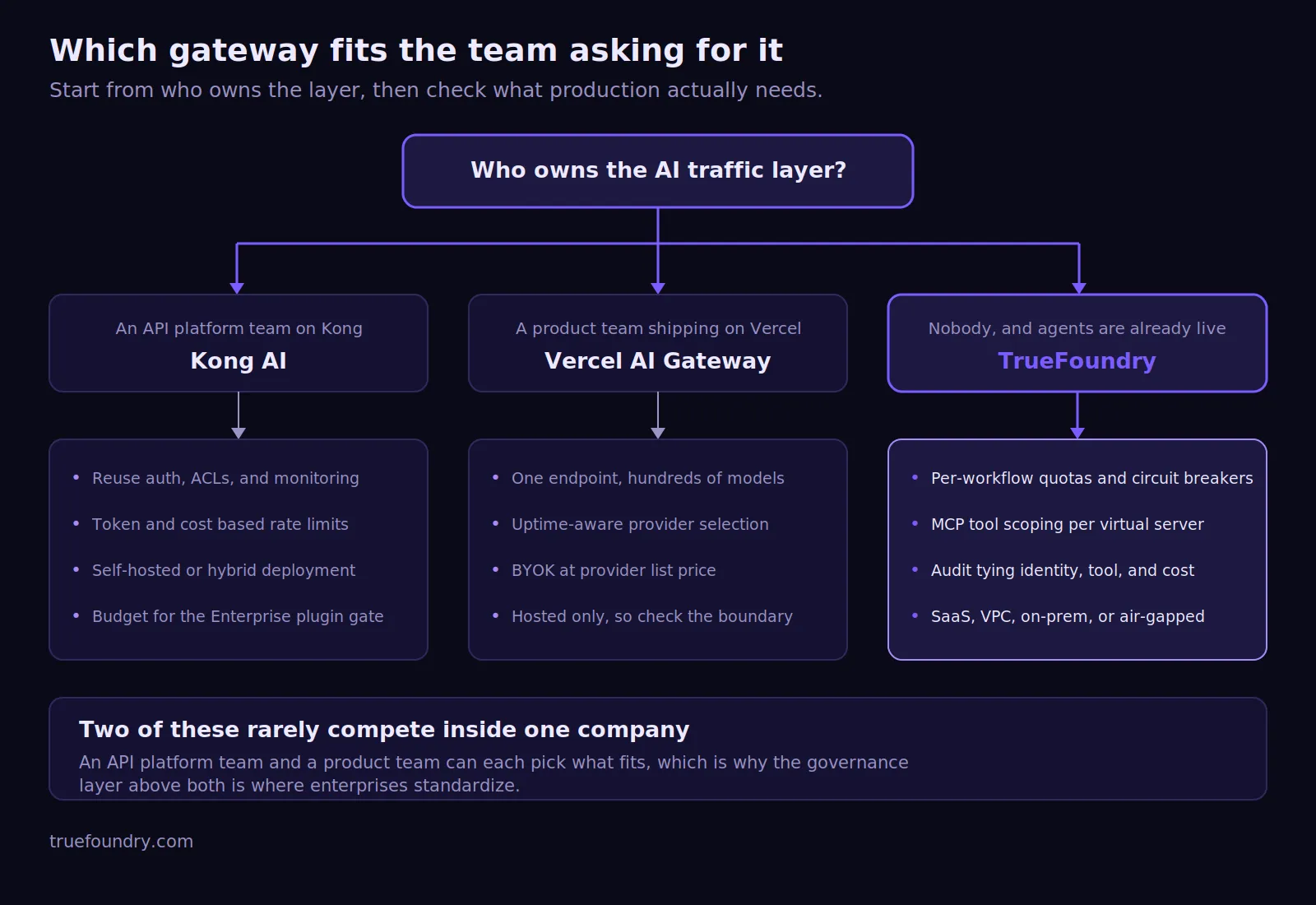
Alt Text: Decision flow for Kong AI, Vercel AI, and TrueFoundry
TrueFoundry AI Gateway ofrece una latencia de entre 3 y 4 ms, gestiona más de 350 RPS en una vCPU, se escala horizontalmente con facilidad y está listo para la producción, mientras que LitellM presenta una latencia alta, tiene dificultades para superar un RPS moderado, carece de escalado integrado y es ideal para cargas de trabajo ligeras o de prototipos.





Las últimas noticias, artículos y recursos enviados a tu bandeja de entrada


.png)
.png)
.png)
.png)
.png)
.png)
.png)
.png)
.png)
.png)
.png)


