October 12, 2026
|
5 min read


Published: October 12, 2026
.webp)
Blazingly fast way to build, track and deploy your models!
Most software failures announce themselves through errors, alerts, or visible service disruption. AI can return a successful response while producing a confident and harmful answer. Nothing crashes, and no standard alert necessarily fires. That silent failure pattern explains why AI risk management became an operating discipline rather than another compliance checkbox.
Artificial intelligence systems influence hiring, lending, support, security operations, and infrastructure automation. Failures can trigger regulatory action, financial losses, and reputational damage. IBM found shadow AI increased average breach costs by $670,000 when heavily involved. Its global study covered 600 organizations that were breached.
Containing that exposure starts with three practical questions for every enterprise team. Where does AI run, what can each AI system access, and what stops unsafe actions? Audit reports alone cannot contain this operational exposure. Effective AI risk management places identity, logging, budgets, and output controls on every production request path.
In practical enterprise terms, AI risk management identifies, assesses, controls, and monitors harm throughout AI development and deployment. Its objective is preserving value while keeping impacts within approved limits. The AI risk management meaning also extends beyond model security and technical testing.
A real program includes ownership, regulatory compliance, data protection, oversight, and risk tolerance. It monitors problems that surface after systems enter production. Responsibilities span data scientists, security, legal, executive, and product teams. Organizations often reduce this discipline to documents, committees, and periodic reviews.
That approach fails when production behavior changes between assessments. A useful AI risk management framework combines policy with enforceable infrastructure. Controls must stop unsafe calls, unauthorized access, and runaway agents before harm occurs. This approach turns risk management from retrospective documentation into an operational function.
Managing AI risk requires a different playbook from traditional risk management. Conventional software follows deterministic logic and produces recognizable failure signals. Machine learning systems behave probabilistically, change with their environment, and act through connected tools. These characteristics introduce new vulnerabilities that ordinary monitoring may miss.
These failures share one requirement: active production observability. Traditional risk assumes teams can see failures through conventional telemetry. AI risk requires teams to search for silent degradation and misuse. That shift changes risk management practices, security measures, and incident response.
.webp)
The common thread is observability. Traditional risk assumes a failure you can see. AI risk assumes one you have to go looking for. Everything after this point follows from that single shift: the categories, the stages, the controls.
Grouping AI risks into categories provides a structured approach to selecting controls. Four categories cover most enterprise AI exposure today. Each category needs distinct risk mitigation, ownership, and evidence. A holistic approach evaluates related risks crossing technical, data, operational, and governance boundaries.
Technical risk appears when a model fails on its own terms. Hallucinations produce fluent answers that remain factually wrong or unsafe. Drift reduces performance as production inputs move away from training conditions. These failures may affect high-stakes AI applications without creating obvious infrastructure errors.
The adversarial surface includes prompt injection, data poisoning, model extraction, and adversarial attacks. Attackers may manipulate outputs, expose sensitive data, or trigger unauthorized actions. NIST’s Generative AI Profile describes 12 major risk areas that organizations can use to design security controls and test procedures.
Data risk follows the information that enters, trains, and operates each model. Incomplete or biased training data can undermine accuracy and fairness. Poor data collection can also create problems with undocumented consent, ownership, or retention. These weaknesses threaten data quality, privacy, and reliable decision-making.
Privacy leakage can expose personal data through outputs, logs, embeddings, or inference attacks. Weak access controls can also allow an AI system to access information beyond its approved purpose. IBM found that 97% of organizations reporting AI-related security breaches lacked proper AI access controls.
Operational exposure concerns how AI behaves once it enters everyday business workflows. Shadow AI creates ungoverned data flows, unknown vendors, and spending without accountable ownership. IBM reported that 63% of breached organizations lacked an established AI governance policy or were still developing one.
Costs can compound through tokens, repeated calls, agent loops, and uncontrolled experimentation. Vendor concentration adds dependency when pricing, availability, or provider terms change. Strong risk management strategies require budgets, fallback options, ownership, and real-time visibility.
Governance risk develops between product, security, legal, and business teams. Unclear ownership makes it difficult to explain who approved the use of AI, selected the data, or accepted residual exposure. Missing audit evidence creates compliance challenges after regulators, customers, or courts request proof.
Modern AI governance must align policies with regulatory requirements and industry standards. It should document ownership, model purpose, human oversight, and expected users. McKinsey found only about one-third of organizations reported mature strategy, governance, and agentic AI controls.
A practical AI risk management program turns these categories into a repeatable operating loop. Most established risk frameworks follow five connected operational stages. Each stage produces evidence for the next one. Their value comes from repetition across every material model, agent, application, vendor, and production environment.
Many programs invest heavily in identification, assessment, and mitigation while underfunding monitoring and response. That imbalance delays containment and increases downstream business exposure. Effective risk management processes treat the final stages as permanent production functions. They also connect findings back into policy, testing, ownership, and future AI development.
.webp)
Regulation moves enterprise AI governance beyond internal preferences into enforceable obligations. Enterprises must map every use of AI against applicable laws, contracts, and sector-specific requirements. The correct framework depends on geography, data, industry, impact, and organizational role.
The EU AI Act classifies systems by risk and imposes duties on high-risk uses. Prohibited practices and literacy rules applied from February 2025. General-purpose model obligations became applicable across Europe during August 2025. A May 2026 political agreement set later deadlines for specified high-risk obligations in December 2027 and August 2028.
The AI Act can impose maximum penalties of €35 million or 7% of worldwide annual turnover. The highest tier applies to prohibited practices and certain data-related violations. Transparency duties for specified generative AI content become applicable from August 2, 2026.
GDPR and related data privacy rules affect automated decisions using personal data. Relevant safeguards can include explanations, human intervention, and opportunities to contest significant automated decisions. HIPAA requires regulated entities to protect electronic health information through administrative, physical, and technical safeguards.
The National Institute of Standards and Technology provides the voluntary NIST AI RMF. Its core organizes work around Govern, Map, Measure, and Manage. The 2024 Generative AI Profile extends the AI RMF for risks specific to generative systems.
A strong risk management framework should not treat governance frameworks as disconnected checklists. It should translate regulatory requirements into controls, ownership, monitoring, and evidence. This approach helps organizations address risks across jurisdictions while adapting to new rules, technologies, security threats, and cyber threats.
.webp)
Frameworks name controls, while infrastructure enforces them in production. TrueFoundry provides an enterprise-grade AI Gateway across models, agents, guardrails, and MCP tools. It enforces policy along the request path rather than relying on retrospective reviews.
Operational visibility underpins every remaining enterprise control. The platform maintains a single control plane spanning model requests, agent actions, and tool connections. Teams can inspect users, models, costs, latency, outputs, and execution metadata. This AI observability helps detect abnormal usage, data breaches, and policy failures before they remain hidden.
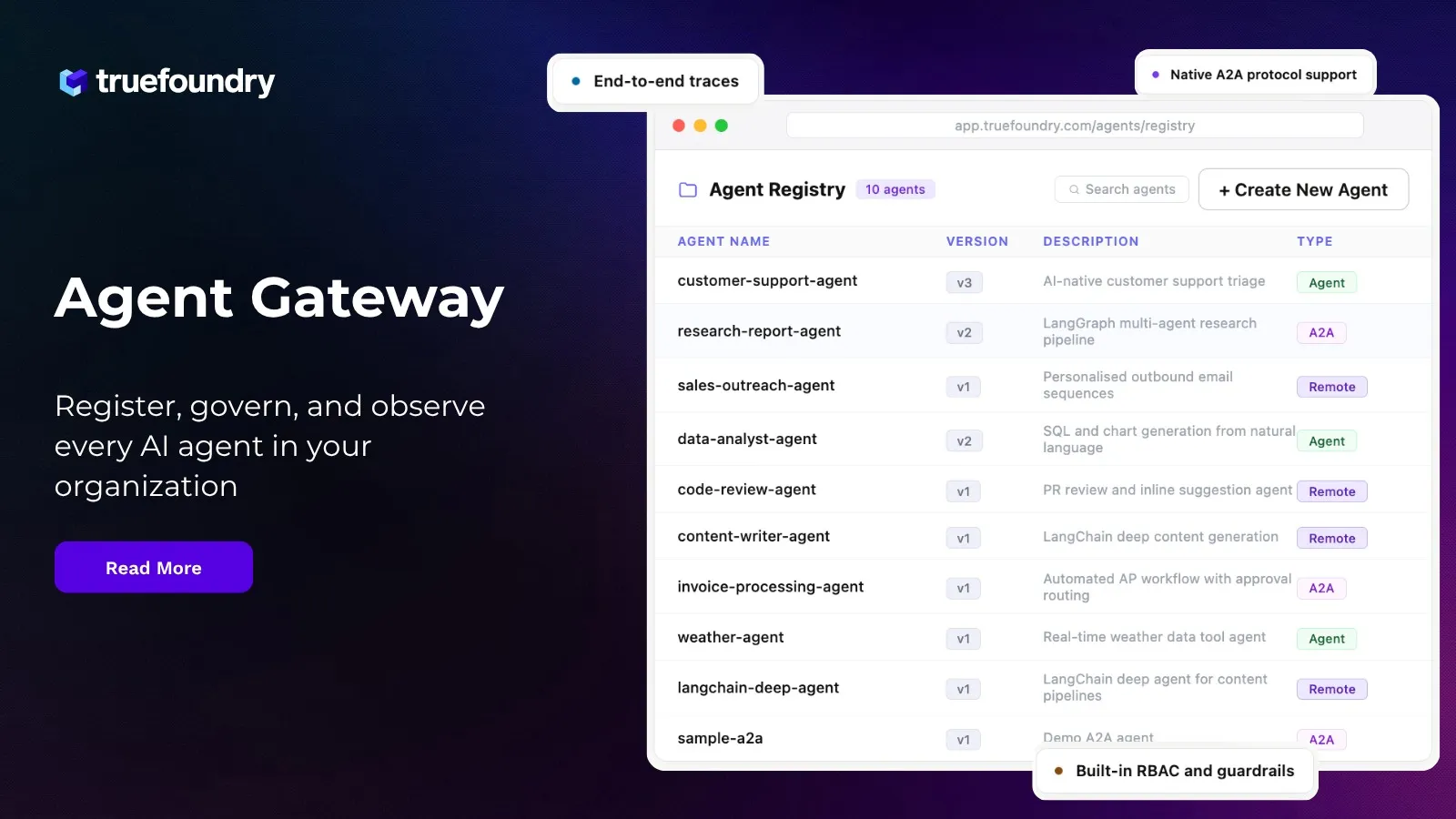
Identity-aware execution provides centralized authentication, RBAC, budgets, and policy enforcement. The MCP Gateway governs tool access, while the Agent Gateway controls autonomous workflows. These protections help prevent unauthorized access, runaway spending, the use of unapproved tools, and new vulnerabilities.
Audit trails record model calls, tool invocations, agent steps, identities, costs, and output metadata. Private deployment keeps prompts, responses, logs, and sensitive information inside the chosen environment. The LLM Gateway centralizes routing, provider access, guardrails, and cost policies across AI models.
TrueFoundry says its platform handles more than 10 billion model requests monthly. Gartner also recognized TrueFoundry as a Representative Vendor in its 2025 Market Guide for AI Gateways. These capabilities support enterprise controls where silent failures and fragmented AI use become operational concerns.
Book a demo today to test controls against your own models, agents, and tools.
TrueFoundry AI Gateway delivers ~3–4 ms latency, handles 350+ RPS on 1 vCPU, scales horizontally with ease, and is production-ready, while LiteLLM suffers from high latency, struggles beyond moderate RPS, lacks built-in scaling, and is best for light or prototype workloads.



The four practical categories are technical, data, operational, and governance or compliance risk. Technical controls address hallucinations, drift, and adversarial attacks. Data controls protect privacy, quality, integrity, and lawful processing. Operational controls manage costs, vendors, and shadow AI. Governance controls establish ownership, auditability, human oversight, and regulatory compliance across production systems.
Organizations use AI technologies for threat detection, anomaly scoring, fraud analysis, access monitoring, and security automation. These systems can identify patterns faster than manual reviews. However, the monitoring AI also needs governance, testing, explainability, and access restrictions. Otherwise, it creates another unmanaged dependency within the broader risk program.
The five stages are identify, assess, mitigate, monitor, and respond. Identification creates the inventory, while assessment determines exposure and impact. Mitigation applies technical and human controls that are proportionate to the identified risk. Monitoring detects drift, misuse, access anomalies, and changing operating conditions. Response contains incidents, investigates root causes, communicates impacts, and improves controls for future operation.
McKinsey evaluates responsible AI through its AI Trust Maturity Model. The model examines strategy, risk management, data and technology, governance, and agentic AI controls. Its 2026 research recommends adapting established enterprise risk practices for emerging AI exposure. Organizations also need cross-functional ownership and investment that matches their deployment scale.
No single model provides complete protection because this is mainly an infrastructure and governance problem. Enterprises need a platform that enforces access controls, logging, budgets, guardrails, and tool controls across all providers. The strongest option supports model-independent policies, private deployment, observability, and consistent enforcement across production AI applications.



The latest news, articles, and resources sent to your inbox

.png)
.png)
.png)
.png)
.png)
.png)