


October 8, 2026
|
5 min read


Published: July 14, 2026
Blazingly fast way to build, track and deploy your models!
Enterprise teams adopting MCP need more than a gateway - they need a platform that fits their operational model, security requirements, and AI infrastructure strategy.
IBM ContextForge and TrueFoundry both sit in front of MCP traffic and give you a single point of control over which tools agents can call. Past that, they're built for different buyers. ContextForge is a free, open source proxy and registry you run yourself. TrueFoundry is a managed enterprise platform that combines AI Gateway and MCP Gateway capabilities with built-in governance, observability, and deployment flexibility.
In this guide, we'll compare IBM ContextForge and TrueFoundry across architecture, deployment, enterprise security, pricing, and operational overhead to help you determine which platform is the better fit.
.webp)
ContextForge (mcp-context-forge on GitHub) is IBM's open source AI gateway, registry, and proxy that federates MCP, A2A, and REST/gRPC APIs behind one endpoint. It includes an admin UI, OAuth-scoped authentication with rate limiting, transport support across HTTP, WebSocket, SSE, and stdio, OpenTelemetry tracing, and a 40+ plugin ecosystem. It scales through Kubernetes with Redis-backed federation and supports airgapped deployment.
The platform also emphasizes enterprise-level customization and integration. It supports multiple authentication methods including JWT Bearer tokens, Basic Auth, and custom header schemes, along with AES-encrypted credentials for secure tool access. Multi-database compatibility across PostgreSQL, MySQL, and SQLite allows organizations to integrate it into existing infrastructure without major architectural changes.
A key differentiator is virtual server composition, which lets multiple MCP servers appear as a single logical endpoint for agents. However, IBM explicitly labels Context Forge as an alpha/beta-stage project without official commercial support. While powerful, its operational complexity and infrastructure-heavy setup make it better suited for organizations with strong internal DevOps expertise rather than teams seeking simple or fully managed MCP solutions.
The tradeoff is operational: you provision and maintain the Kubernetes cluster, patch the software, stand up your own observability backend (Phoenix, Jaeger, or Zipkin), and handle incidents without a vendor SLA. There's no license fee, but there's also no AI Gateway for LLM traffic bundled in; ContextForge governs MCP/A2A/REST, not model routing or LLM cost.
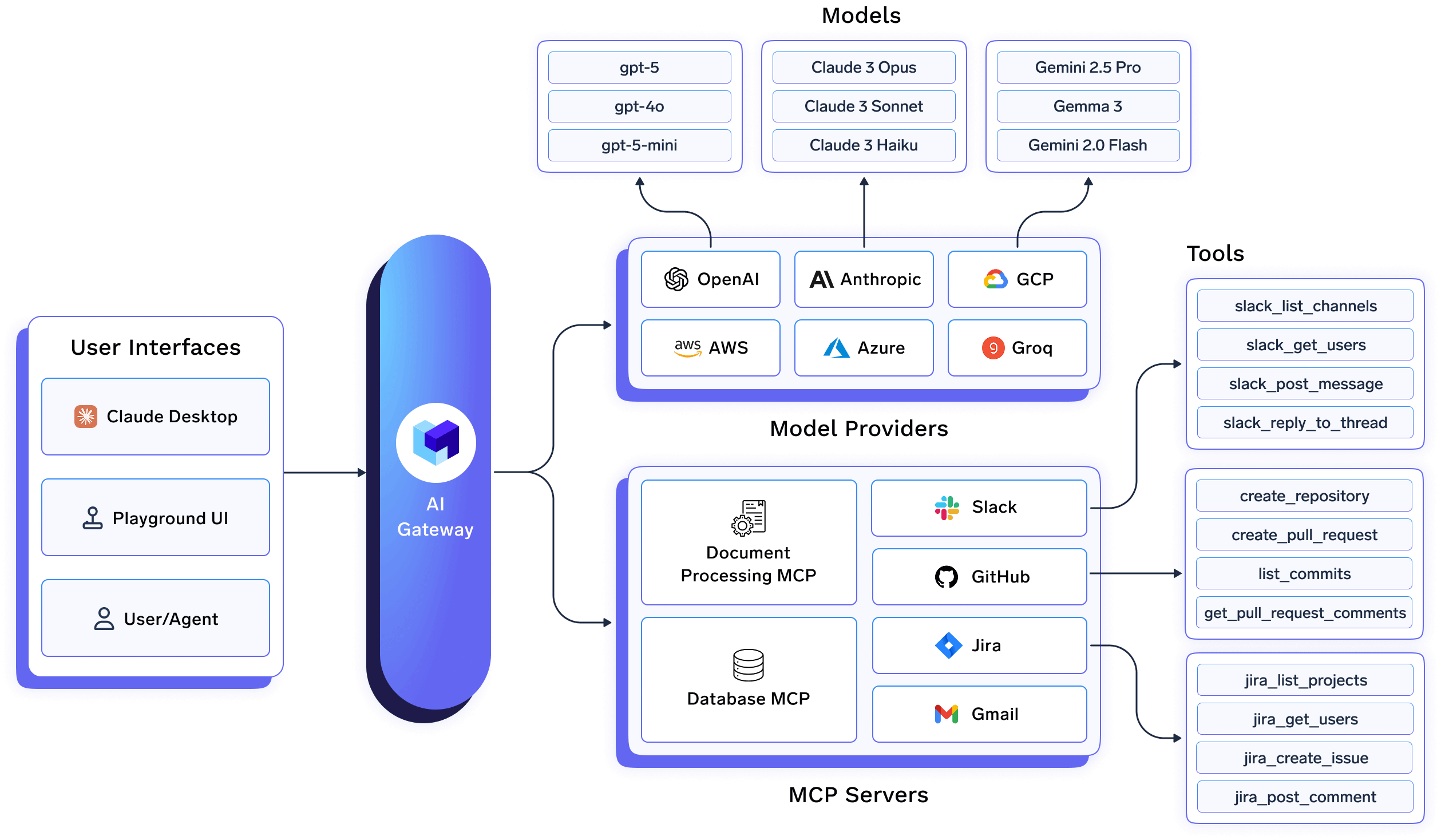
TrueFoundry combines an AI Gateway and MCP Gateway in one control plane, with 1,000+ LLMs available through a single OpenAI-compatible API, roughly 3 to 4 ms of gateway latency, and support for 350+ requests per second on a single vCPU. Unlike ContextForge, it's available as a fully managed SaaS product, so there's no Kubernetes cluster to provision before you can register your first MCP server.
On the MCP side specifically, TrueFoundry applies RBAC to registered MCP servers, supports virtual MCP servers, and logs every tool call with comprehensive metrics. It's also SOC 2, HIPAA, and GDPR-ready, and deployable in VPC, on-prem, or fully air-gapped environments for teams with data residency requirements.
TrueFoundry’s approach is simple: if organizations are already managing AI infrastructure for LLMs, there is little value in fragmenting operations across separate systems for MCP tools. Instead, TrueFoundry unifies LLM infrastructure and MCP management into a single control plane with shared security, observability, governance, and performance characteristics. This centralized approach simplifies AI operations while giving engineering teams a consolidated platform for monitoring, deployment, and cost management.
Every request, whether it's an LLM call or an MCP tool invocation, shows up in the same observability view: token usage, latency percentiles, and cost, broken down by model, team, or any metadata tag you attach. ContextForge's OpenTelemetry traces need a self-hosted Phoenix or Jaeger instance to get the equivalent view.
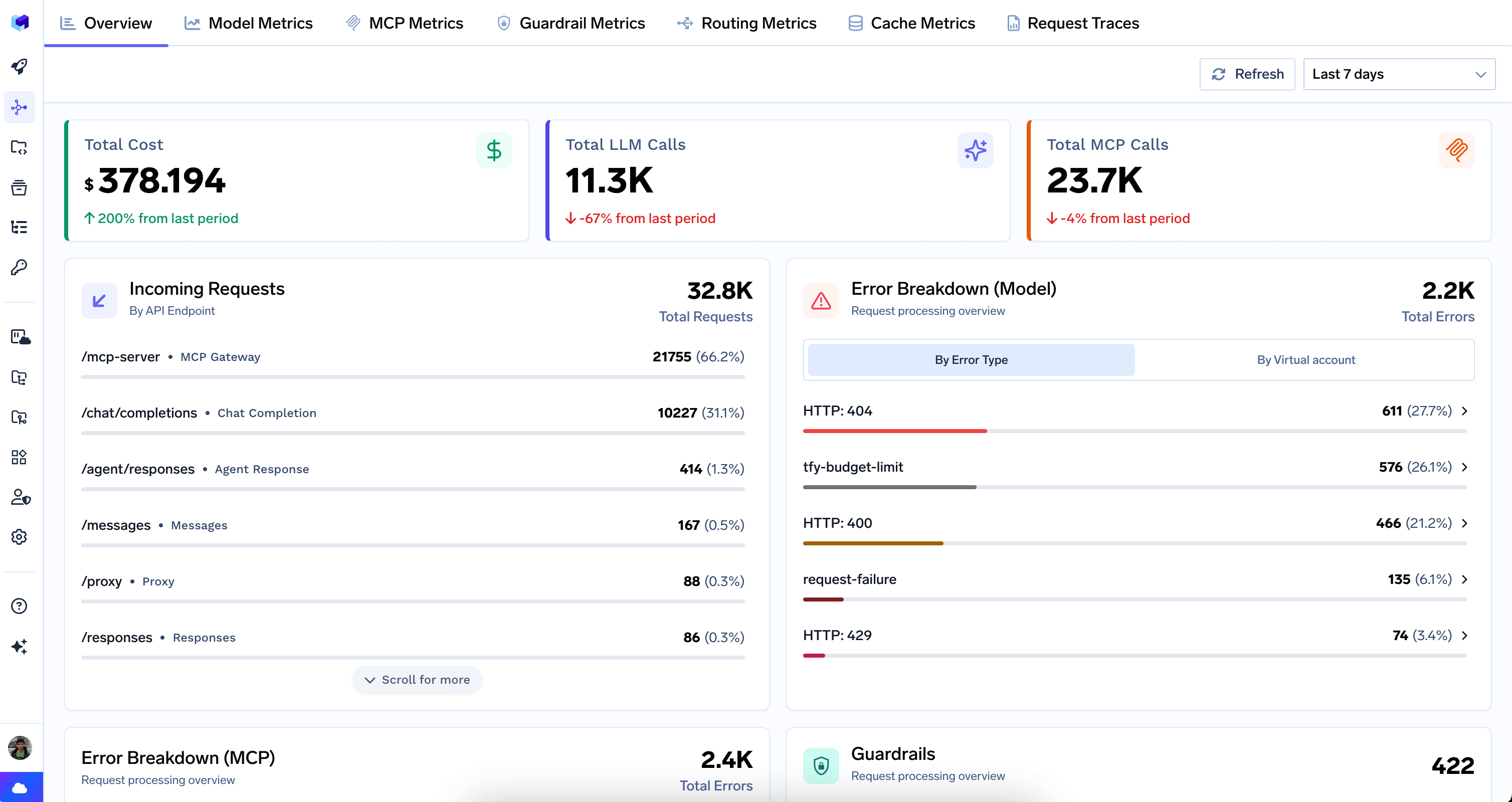
Key Features of TrueFoundry
TrueFoundry is best suited for organizations already operating significant AI workloads and looking to extend existing infrastructure rather than introduce fragmented tooling. Its unified architecture is particularly appealing to enterprises that prefer centralized AI infrastructure management from a single vendor.
The platform is also a strong fit for engineering teams seeking an easy-to-manage, feature-rich enterprise solution with integrated deployment, monitoring, finetuning, and orchestration capabilities. Teams adopting agentic workflows and MCP ecosystems can benefit from its operational simplicity, broad integrations, and cloud-native deployment offerings.
It's available as fully managed SaaS, or self-hosted in VPC, on-prem, or air-gapped environments from the Pro Plus tier up, and is SOC 2, HIPAA, and GDPR-ready. Pricing is published: a free Developer plan (50k requests/month, up to 5 registered MCP servers), Pro at $499/month (1M requests/month, up to 25 MCP servers), Pro Plus at $2,999/month (up to 50 MCP servers, VPC/on-prem), and custom Enterprise for air-gapped and unlimited scale.
Choose ContextForge if your team already runs Kubernetes and Redis at scale, wants zero license fees, and is comfortable owning patching, scaling, and incident response in-house. It's a solid fit for platform teams that want full source-level control and have no interest in a vendor relationship for this layer of infrastructure.
Choose TrueFoundry if you need AI Gateway and MCP Gateway governance in one platform, want compliance certifications and a support SLA without building them, or don't have spare DevOps capacity to run and patch a proxy cluster yourselves. It's also the better fit if LLM routing and cost governance matter alongside MCP traffic, since ContextForge doesn't cover that side at all.
The most common trigger isn't dissatisfaction with ContextForge's feature set. It's that MCP governance turns out to be half the problem: teams also need to govern which LLMs get called, at what cost, with what guardrails, and end up running a second gateway for that. TrueFoundry collapses both into one control plane, with RBAC, budgets, and audit logging applied consistently across LLM and MCP traffic instead of split across two systems with two sets of policies to maintain.
IBM ContextForge and TrueFoundry solve different problems, even though both support MCP-based workflows.
If your priority is running an open-source MCP gateway with full control over your infrastructure, IBM ContextForge is a strong choice. It gives engineering teams the flexibility to build and customize their own MCP environment, provided they have the resources to manage deployment, upgrades, monitoring, and ongoing operations.
If you're building AI applications for production, however, you'll likely need more than an MCP gateway. TrueFoundry combines AI Gateway and MCP Gateway capabilities in a single platform, with enterprise authentication, observability, policy enforcement, deployment flexibility, and commercial support built in. That reduces operational complexity while providing a unified control plane for both LLMs and MCP servers.
Ultimately, the right choice depends on your team's priorities, if your team has the Kubernetes capacity and wants a free, fully self-hosted proxy, ContextForge is a reasonable choice. If you'd rather have AI Gateway and MCP Gateway governance, compliance readiness, and support in one managed platform, book a demo or explore TrueFoundry's MCP Gateway to see how it compares against what you're currently planning to self-host.
IBM ContextForge vs TrueFoundry, which is better for enterprise?
TrueFoundry is the stronger fit for enterprises that want a single managed platform for AI Gateway and MCP Gateway, with compliance certifications and support included. ContextForge is better suited to teams that want a free, self-hosted proxy and have the infrastructure capacity to run it.
Is IBM ContextForge free?
Yes, it's open source with no license fee. The cost comes from hosting it yourself: Kubernetes, Redis, observability backends, and the engineering time to maintain all of it.
Does TrueFoundry replace the need for ContextForge?
For teams that want MCP governance plus LLM/AI Gateway management in one place, yes. TrueFoundry's MCP Gateway covers the same RBAC and tool-call governance ContextForge provides, without requiring self-hosted Kubernetes infrastructure.
Can I deploy TrueFoundry in my own VPC or on-prem?
Yes. TrueFoundry runs in your VPC, on-prem, air-gapped, hybrid, or across multiple clouds, and no data leaves your domain, matching the deployment control that draws teams to self-hosted ContextForge in the first place.
How many LLMs does TrueFoundry support?
1,000+ LLMs through a single OpenAI-compatible API. ContextForge doesn't include LLM routing; it's scoped to MCP, A2A, and REST/gRPC traffic.
TrueFoundry AI Gateway delivers ~3–4 ms latency, handles 350+ RPS on 1 vCPU, scales horizontally with ease, and is production-ready, while LiteLLM suffers from high latency, struggles beyond moderate RPS, lacks built-in scaling, and is best for light or prototype workloads.






The latest news, articles, and resources sent to your inbox

.webp)

.png)
.png)
.png)
.png)
.png)
.png)
.png)


