


.webp)
October 8, 2026
|
5 min read


Published: July 14, 2026
Blazingly fast way to build, track and deploy your models!
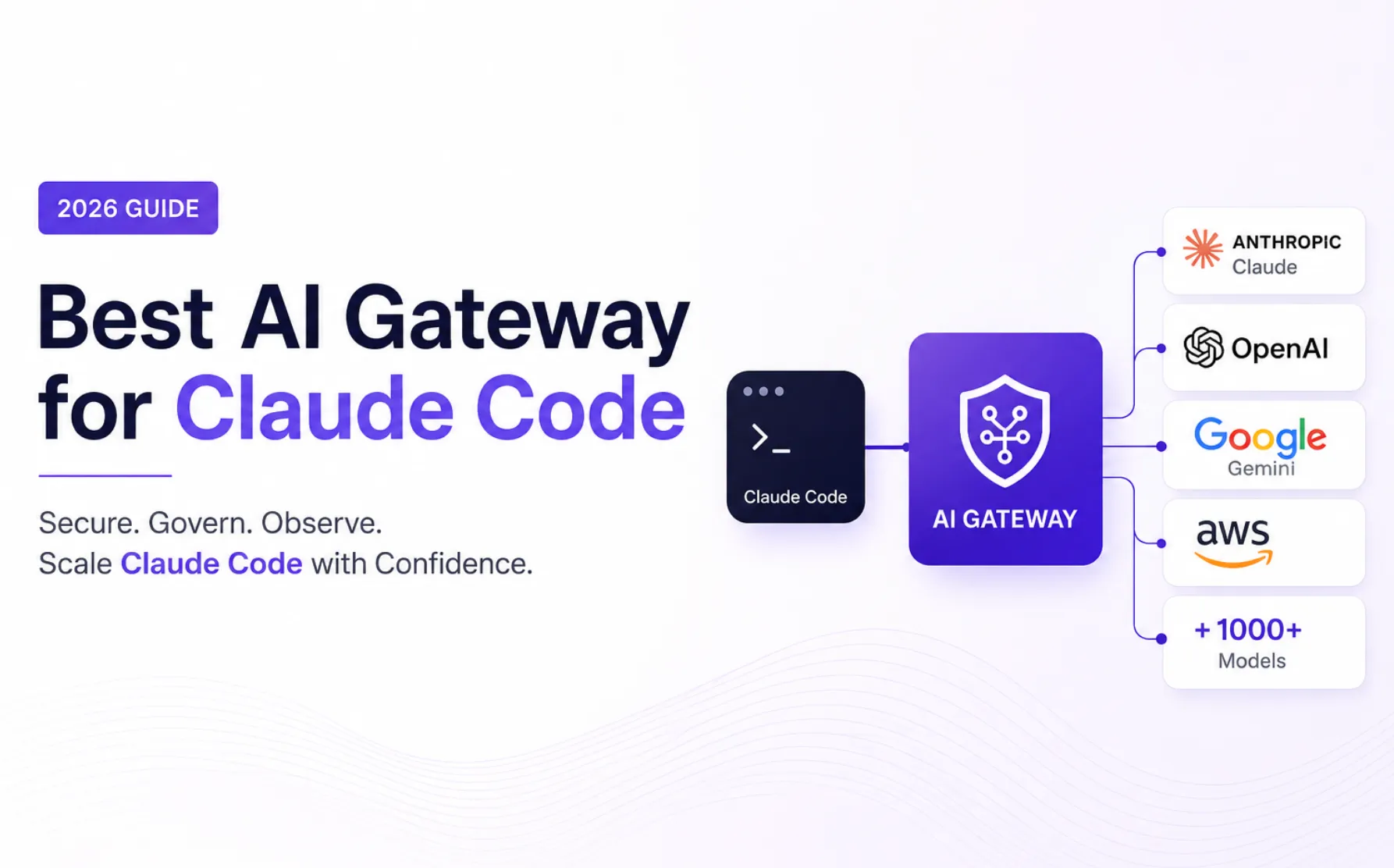
Claude Code has quickly become one of the most popular AI coding assistants for professional developers. But while it's easy to get started with an API key, managing Claude Code across dozens or hundreds of developers is a different challenge altogether.
Organizations need centralized authentication, budget controls, audit logs, model routing, observability, and policy enforcement - capabilities that Claude Code doesn't provide on its own.
Claude Code only needs two environment variables to talk to a gateway instead of Anthropic directly: ANTHROPIC_BASE_URL and ANTHROPIC_AUTH_TOKEN. That simplicity is exactly why so many teams end up routing it through something else within a few weeks of adoption. Once more than a couple of engineers are running Claude Code against the company's cloud provider, someone asks for spend visibility, someone else wants a fallback model when Anthropic has a bad day, and security wants to know which MCP servers people are connecting to from their laptops.
In this guide, we'll compare the best AI gateways for Claude Code in 2026 based on enterprise security, governance, deployment flexibility, and operational capabilities.
Claude Code works well when it's just one developer using a personal Anthropic API key. But the moment multiple engineers start relying on it, platform teams quickly run into challenges around security, governance, and operational visibility.
Without an AI gateway, every developer connects directly to the model provider. API keys are distributed across laptops, there's no centralized authentication, and engineering leaders have little visibility into model usage, costs, or access patterns. If an employee leaves, rotating credentials often becomes a manual process. If Anthropic experiences an outage or a team wants to switch to another model provider, every developer may need to update their local configuration.
An AI Gateway introduces a centralized control plane between Claude Code and the underlying model providers. Instead of every developer managing their own provider credentials, Claude Code connects to a single enterprise endpoint where authentication, routing, and governance policies are enforced consistently.
Beyond simplifying connectivity, an AI gateway enables capabilities that become increasingly important as adoption grows:
For organizations deploying Claude Code across dozens or hundreds of engineers, an AI gateway transforms it from an individual developer tool into a platform that can be operated securely and reliably at enterprise scale.
Getting Claude Code to route through a proxy is the easy part. Both LiteLLM and OpenRouter handle that in a few minutes. The harder questions are the ones that show up after rollout:
These are the dimensions the rest of this post uses to compare the top 5 platforms.
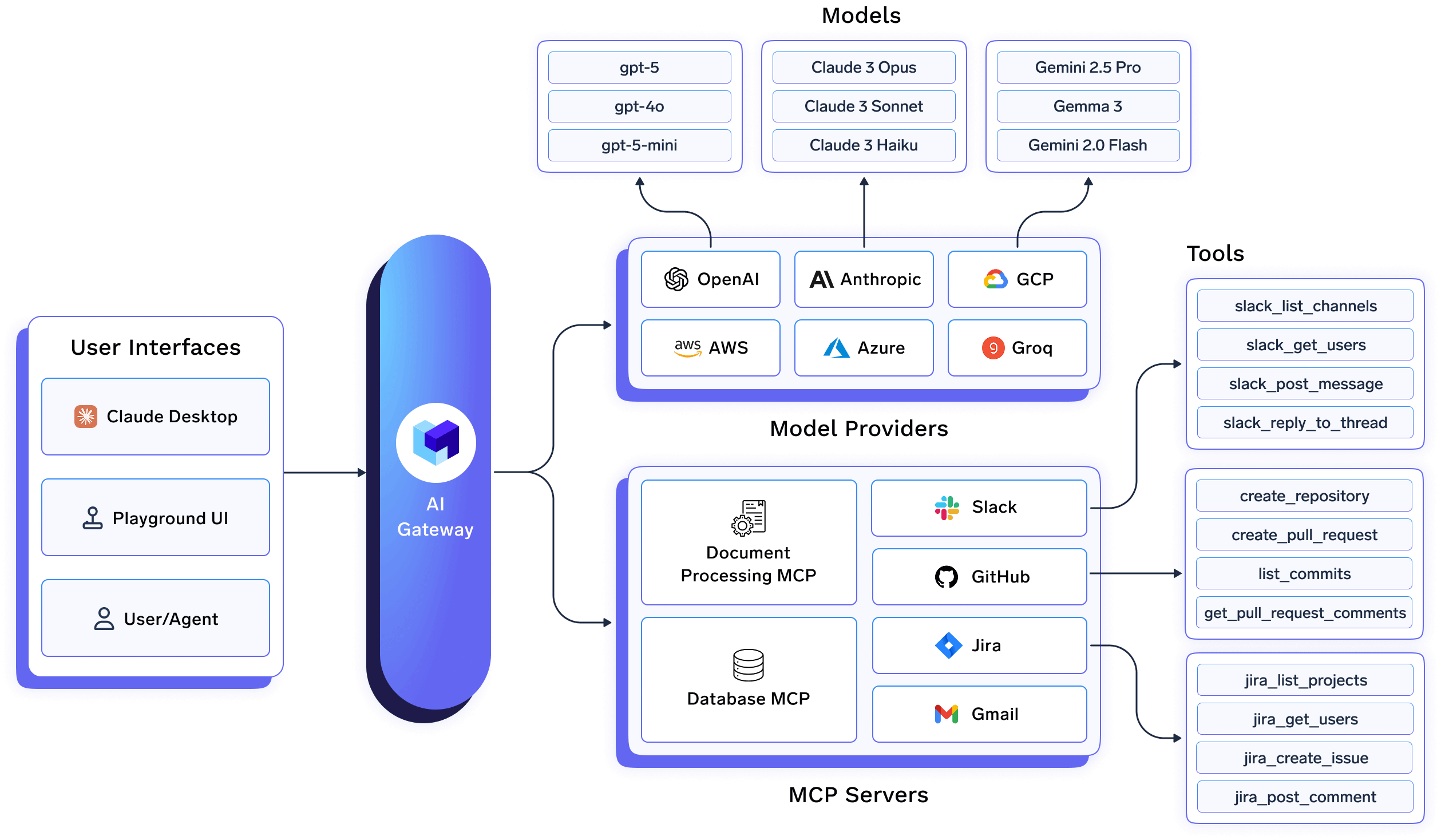
TrueFoundry provides a dedicated integration for Claude Code, Claude Code Max, and Claude Desktop, allowing engineering teams to connect through a centralized AI Gateway instead of managing individual Anthropic API keys. Developers simply point Claude Code to the TrueFoundry endpoint and continue using the same workflows, while platform teams gain centralized control over authentication, governance, observability, and model access.
One of TrueFoundry's biggest differentiators is its built-in MCP Gateway. Administrators register approved MCP servers - such as GitHub, Sentry, Jira, or internal APIs - once in the TrueFoundry control plane, configure outbound authentication and access policies, and provide developers with a ready-to-use connection URL. For managed devices, organizations can distribute a managed-mcp.json file through their MDM solution, ensuring Claude Code can only connect to approved MCP servers. This prevents developers from adding unauthorized tools while giving security teams complete visibility into tool access.
Authentication is handled through enterprise identity providers rather than static API keys. TrueFoundry integrates with Okta, Microsoft Entra ID (Azure AD), and other SAML/OIDC providers, enabling developers to authenticate using SSO the first time they connect through Claude Code. Accounts are provisioned automatically, and organizations can further automate onboarding and offboarding with SCIM provisioning, eliminating the need to distribute or rotate API keys manually.
Beyond governance, TrueFoundry is built for production AI deployments. It can be deployed as a managed SaaS offering, in your own VPC, on-premises, or in fully air-gapped environments. The AI Gateway supports 1,000+ LLMs through a single OpenAI-compatible API, allowing teams to route requests across providers or configure failover if Anthropic experiences an outage. The gateway adds only 3–4 ms of latency while supporting 350+ requests per second on a single vCPU, making it suitable for organization-wide Claude Code deployments.
Pros
Cons
Best for: Enterprises deploying Claude Code across multiple engineering teams that need centralized authentication, MCP governance, enterprise observability, and unified management of both LLM traffic and tool access.
LiteLLM is one of the most popular open-source AI gateways for Claude Code. It's often the first choice for engineering teams that want model routing, usage tracking, and provider abstraction without committing to a commercial platform. Because it's open source and well documented, getting started is relatively straightforward.
To connect Claude Code, you install LiteLLM (pip install 'litellm[proxy]'), configure your models in a config.yaml file, start the proxy, and point Claude Code to it by setting the ANTHROPIC_BASE_URL and ANTHROPIC_AUTH_TOKEN environment variables. Since Claude Code internally expects the model aliases sonnet, opus, and haiku, teams using other models typically remap these aliases through the ANTHROPIC_MODEL and ANTHROPIC_SMALL_FAST_MODEL environment variables.
LiteLLM works well for organizations that want complete control over their AI gateway. It supports model routing across multiple providers, basic cost tracking, and extensive customization while remaining free to self-host. For larger deployments, LiteLLM Enterprise adds features such as SSO, RBAC, audit logs, and Prometheus metrics.
The tradeoff is operational ownership. Running LiteLLM in production means your team is responsible for the entire stack including the proxy itself, Redis, PostgreSQL, load balancing, monitoring, upgrades, backups, and incident response. For organizations without a dedicated platform engineering team, the operational overhead can become significant as usage grows. Another consideration is software supply chain security.
Pros
Cons
Best for: Engineering teams that want a flexible, open-source AI gateway for Claude Code and are comfortable operating their own infrastructure.
OpenRouter takes a very different approach. Instead of acting as a self-hosted gateway, it provides a fully managed API that gives Claude Code access to hundreds of LLMs through a single endpoint. Developers simply point ANTHROPIC_BASE_URL to the OpenRouter API, configure their API key, and Claude Code can immediately access models from Anthropic, OpenAI, Google, DeepSeek, and many other providers.
For individual developers and small teams, this makes OpenRouter one of the fastest ways to experiment with different models. There's no proxy to deploy, no infrastructure to maintain, and billing follows a straightforward pay-as-you-go model. Users purchase credits and pay per token consumed, with support for spend alerts and centralized billing across providers.
Where OpenRouter differs from enterprise AI gateways is governance. It focuses on simplifying model access rather than providing organizational controls. Features such as enterprise SSO, centralized RBAC, audit logs, managed MCP policies, VPC deployment, and on-premises hosting are outside its primary scope. As organizations scale Claude Code across multiple engineering teams, these governance capabilities often become increasingly important.
Pros
Cons
Best for: Individual developers and small teams who want immediate access to multiple LLMs from Claude Code without managing gateway infrastructure.
Cloudflare AI Gateway is a managed AI proxy that sits between Claude Code and model providers, providing centralized observability, caching, rate limiting, retries, and model fallbacks without requiring developers to modify their workflows. Cloudflare recently published dedicated documentation for connecting Claude Code through AI Gateway, making it one of the easiest hosted gateways to deploy with Anthropic-compatible clients.
Claude Code connects to Cloudflare AI Gateway using the standard Anthropic-compatible endpoint. Organizations can authenticate using a Cloudflare gateway token while Cloudflare manages the underlying provider credentials through either Bring Your Own Key (BYOK) or its Unified Billing model. This allows platform teams to centralize provider credentials instead of distributing Anthropic API keys to every developer.
Beyond connectivity, Cloudflare focuses on reliability and operational visibility. AI Gateway provides request logging, token and cost analytics, caching, rate limiting, retries, and model fallback policies across supported providers, giving engineering teams a single place to monitor AI traffic. Core AI Gateway capabilities are currently available on all Cloudflare plans, making it an accessible option for teams already using Cloudflare's developer platform.
The tradeoff is that Cloudflare AI Gateway focuses primarily on LLM traffic management rather than enterprise MCP governance. Organizations that need centralized management of MCP servers, enterprise identity workflows, and policy enforcement for tool access will typically require additional infrastructure beyond the AI Gateway itself.
Pros
Cons
Best for: Teams already using Cloudflare that want a managed AI Gateway with observability, cost controls, and reliability features for Claude Code.
Kong AI Gateway extends Kong's API gateway platform to AI workloads, allowing organizations to apply the same authentication, traffic management, rate limiting, and observability policies they already use for APIs to LLM traffic. It is a natural choice for enterprises that have already standardized on Kong Gateway and want to govern AI traffic using familiar operational tooling.
Rather than being built specifically for Claude Code, Kong provides AI-aware gateway capabilities that can sit in front of model providers such as Anthropic and OpenAI. Organizations can use Kong to centralize authentication, enforce security policies, apply rate limits, and monitor requests while continuing to manage AI traffic through existing Kong infrastructure.
Because Kong is fundamentally an API gateway platform, deploying it for Claude Code typically involves more infrastructure and configuration than AI-native gateways. It also doesn't provide a dedicated or published Claude Code integration guides in the way that some AI-focused platforms do, so teams may need to build and maintain more of the surrounding integration themselves.
Pros
Cons
Best for: Enterprises already running Kong that want to extend their existing API governance model to AI workloads instead of introducing a separate gateway platform.
Claude Code works well for individual developers, but deploying it across an engineering organization introduces new challenges around authentication, governance, observability, and access to both AI models and enterprise tools.
Each platform in this comparison serves a different use case. LiteLLM offers the flexibility of an open-source, self-hosted gateway. OpenRouter provides the quickest way to access multiple model providers without managing infrastructure. Cloudflare AI Gateway focuses on managed routing, reliability, and observability, while Portkey combines AI Gateway and MCP Gateway capabilities with enterprise-grade traffic management.
For larger organizations, however, the requirements often extend beyond routing requests to an LLM. Enterprise teams typically need centralized authentication, policy enforcement, audit logs, deployment flexibility, and governance over both model access and MCP servers. TrueFoundry brings these capabilities together in a unified AI Gateway and MCP Gateway, making it well suited for production Claude Code deployments at scale.
Q: What's the best AI gateway for Claude Code?
A: It depends on scale. For an individual or small team, OpenRouter or a basic LiteLLM setup gets you routing and multi-model access with minimal effort. Once Claude Code is used across an engineering org and security wants visibility into MCP server access and per-user auditing, TrueFoundry is the option built specifically for that.
Q: Can I use LiteLLM or OpenRouter with Claude Code today?
A: Yes. Both work by setting ANTHROPIC_BASE_URL and ANTHROPIC_AUTH_TOKEN. OpenRouter needs no local proxy since it speaks Claude Code's protocol directly; LiteLLM requires running a local or hosted proxy instance you configure yourself.
Q: Does TrueFoundry support MCP governance for Claude Code specifically?
A: Yes. Admins register approved MCP servers centrally, and on managed devices, an MDM-pushed managed-mcp.json file takes exclusive control over which servers a developer's Claude Code instance can connect to.
Q: Can I deploy TrueFoundry in my own VPC or on-prem?
A: Yes. TrueFoundry runs in your VPC, on-prem, air-gapped, hybrid, or across multiple clouds, and no data leaves your domain, which is the main reason security teams evaluating Claude Code gateways lean toward it over hosted-only options.
Q: Is TrueFoundry SOC 2 or HIPAA compliant?
A: TrueFoundry's infrastructure carries SOC2, ISO 27001, GDPR, and HIPAA compliance, with RBAC, SSO, and immutable audit logging built in. Check the Trust Center at trust.truefoundry.com for current attestations.
TrueFoundry AI Gateway delivers ~3–4 ms latency, handles 350+ RPS on 1 vCPU, scales horizontally with ease, and is production-ready, while LiteLLM suffers from high latency, struggles beyond moderate RPS, lacks built-in scaling, and is best for light or prototype workloads.






The latest news, articles, and resources sent to your inbox


.png)
.png)
.png)
.png)
.png)
.png)
.png)


