


.webp)
October 8, 2026
|
5 min read


Published: July 14, 2026
Blazingly fast way to build, track and deploy your models!
Lasso Security is one of the best-known AI security platforms for enterprises adopting generative AI. It focuses on discovering AI usage across an organization, enforcing runtime security policies, assessing AI risk, and protecting employees and AI applications from data leakage.
While those capabilities make it a strong choice for security teams, Lasso isn't the only option. Some organizations want a broader AI platform that combines security with AI Gateway and MCP Gateway capabilities, while others prioritize deployment flexibility, open-source infrastructure, or native integration with their existing cloud environment.
In this guide, we'll compare the best Lasso Security alternatives in 2026 based on governance, deployment options, enterprise security, and operational complexity.
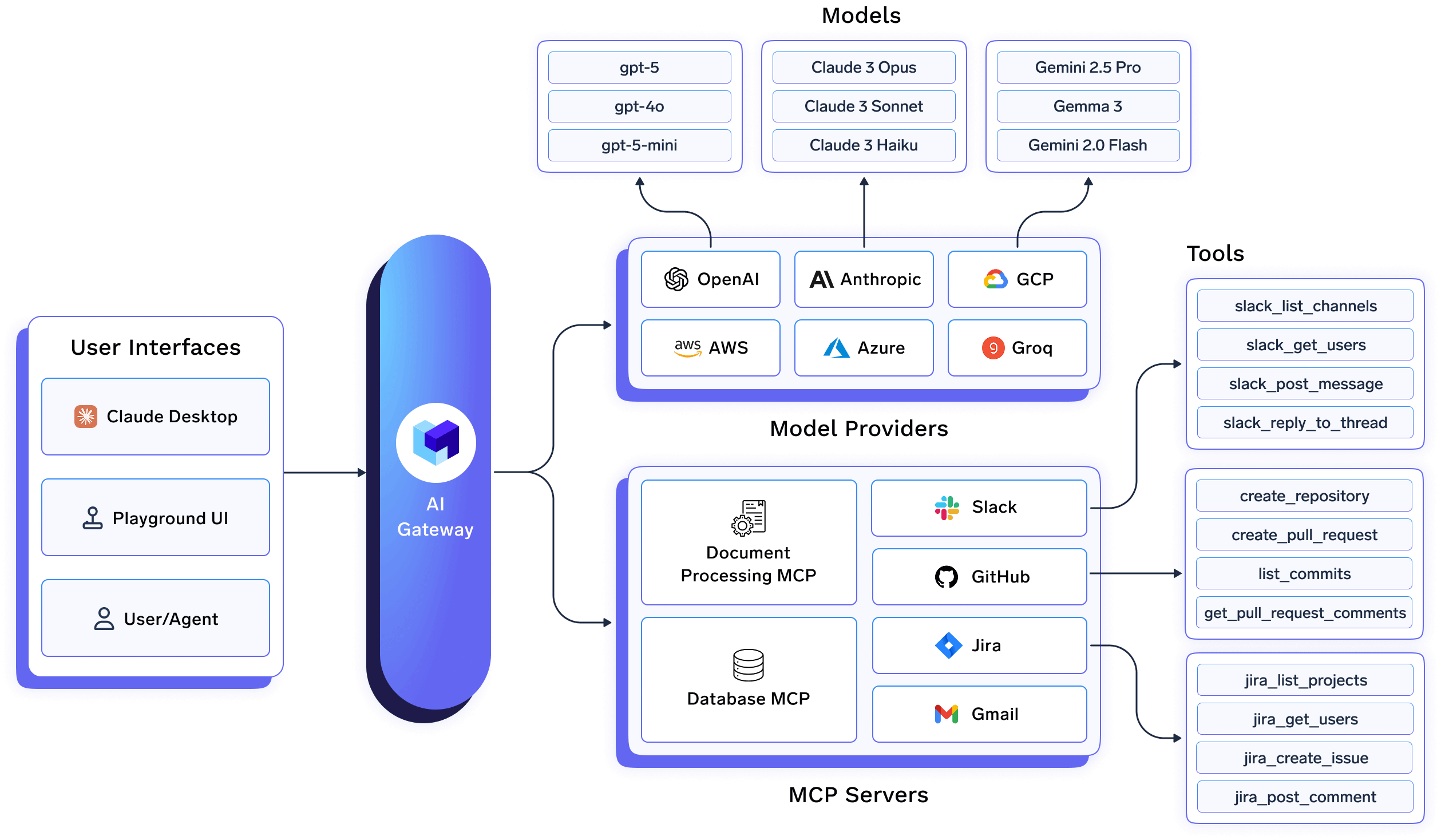
TrueFoundry is an AI Gateway and MCP Gateway with guardrails built into the same control plane, rather than a security layer that sits on top of a separate gateway. It supports 1,000+ LLMs through one OpenAI-compatible API, adds roughly 3 to 4 ms of gateway latency, and handles 350+ requests per second on a single vCPU.
On security specifically, TrueFoundry applies input and output guardrails including PII filtering and toxicity detection, integrates with partner guardrail providers like OpenAI Moderation, AWS Guardrails, and Azure Content Safety, and supports custom guardrail hooks written as configuration or Python code. It's SOC 2, HIPAA, and GDPR-ready, deployable in VPC, on-prem, or fully air-gapped environments.
Because MCP Gateway and AI Gateway share the same control plane, the same RBAC policy that governs which LLMs a team can call also governs which MCP tools their agents can invoke, so security policy doesn't fragment across a gateway config and a separate security vendor's dashboard.
Key Features of TrueFoundry
Best for: Teams that want AI Gateway, MCP Gateway, and security guardrails in one platform instead of running a separate security vendor on top of their gateway.
Runlayer's AI control plane overlaps with Lasso on discovery, surfacing unmanaged agents, MCPs, and plugins already running across an org. It's built more around agent identity, OAuth grants, and governed enablement than adversarial red-teaming, so the overlap with Lasso is partial rather than complete. Pricing is enterprise, quote-based, with no self-hosted option.
Best for: Companies that need Shadow AI discovery and agent identity governance more than dedicated red-teaming and threat detection.
Portkey is an AI gateway with broad LLM provider support and guardrail integrations, but with less MCP-specific governance depth. Teams evaluating Lasso alongside a gateway sometimes consider Portkey's built-in guardrail integrations as a lighter-weight alternative to running a separate security vendor.
Best for: Teams whose primary need is LLM gateway functionality with guardrails as a secondary, integrated feature.
ContextForge is an open source MCP/A2A/REST gateway and proxy, not a security platform, but some teams pair it with custom guardrail plugins instead of a dedicated vendor like Lasso. It's free to license, though you own the hosting, patching, and any security logic you build on top of its plugin system.
Best for: Teams that want a free, fully self-hosted gateway and are willing to build their own guardrail logic rather than buy a dedicated security platform.
Lakera is an AI security platform focused on protecting LLM applications from prompt injection, jailbreak attempts, sensitive data exposure, and other runtime threats. Rather than acting as an AI gateway, Lakera sits alongside your AI infrastructure, inspecting prompts and model responses before they reach the underlying LLM.
The tradeoff is that Lakera focuses on AI security rather than AI infrastructure. Organizations still need a separate AI gateway for model routing, authentication, observability, rate limiting, and cost management. Teams evaluating whether to adopt Lakera often pair it with an AI gateway instead of using it as a standalone AI operations platform.
Best for: Organizations that want a dedicated AI security layer to protect LLM applications from prompt injection and other runtime attacks while continuing to use their existing AI gateway or infrastructure.
Lasso Security is a strong choice for organizations whose primary focus is AI security, runtime protection, and automated red teaming. It excels at helping security teams discover AI usage, identify risks, and enforce policies across AI applications, but it relies on a separate AI gateway for model routing and governance.
If your organization is looking for a broader AI infrastructure platform, it's worth considering alternatives that combine security with AI Gateway and MCP Gateway capabilities. Platforms like TrueFoundry bring together model routing, guardrails, observability, enterprise identity, and governance in a single control plane, reducing the need to manage multiple products as AI adoption scales.
Ultimately, the right choice depends on your priorities: choose Lasso Security if dedicated AI security is your primary requirement, or consider a unified platform like TrueFoundry if you want to consolidate AI governance, gateway management, and security into one solution.
What is the best Lasso Security alternative for enterprise?
TrueFoundry is the strongest fit for enterprises that want gateway-native guardrails, PII filtering, and MCP governance in one platform with published pricing, rather than a security layer purchased separately from the gateway underneath it.
Is there a free Lasso Security alternative?
Guardrails AI is a free, open source option for guardrail logic specifically, though it lacks Lasso's discovery, red-teaming, and runtime enforcement infrastructure. IBM ContextForge is free for the gateway layer but doesn't include dedicated security features.
Lasso Security alternatives with built-in AI Gateway?
TrueFoundry and Portkey both bundle guardrail capabilities directly into an AI Gateway, removing the need to run a separate security vendor on top of your routing layer.
Does TrueFoundry replace the need for a dedicated security platform like Lasso?
For teams that need PII filtering, toxicity detection, and configurable guardrails alongside gateway governance, yes. For teams needing continuous adversarial red-teaming specifically, TrueFoundry's guardrails are complementary rather than a full substitute.
Can I deploy TrueFoundry in my own VPC or on-prem?
Yes. TrueFoundry runs in your VPC, on-prem, air-gapped, hybrid, or across multiple clouds, and no data leaves your domain.
TrueFoundry AI Gateway delivers ~3–4 ms latency, handles 350+ RPS on 1 vCPU, scales horizontally with ease, and is production-ready, while LiteLLM suffers from high latency, struggles beyond moderate RPS, lacks built-in scaling, and is best for light or prototype workloads.






The latest news, articles, and resources sent to your inbox



.png)
.png)
.png)
.png)
.png)
.png)
.png)


