October 12, 2026
|
5 min read


Published: October 12, 2026
Blazingly fast way to build, track and deploy your models!
Lasso Security and TrueFoundry both help enterprises govern AI applications, but they're built for different problems. Lasso Security is an AI security platform focused on runtime protection, prompt injection detection, and policy enforcement. TrueFoundry is a unified AI platform that combines an AI Gateway, MCP Gateway, authentication, model routing, observability, and built-in guardrails in a single control plane.
If you're deciding between the two, the key question is whether you need a dedicated AI security layer on top of your existing infrastructure or a platform that brings AI routing, governance, and security together. In this comparison, we'll look at how they differ across architecture, security, deployment, pricing, and enterprise use cases.
Lasso Security is an enterprise AI security platform built to help organizations discover, secure, and govern AI applications in production. Its platform spans five core areas: AI Discovery & AI-BOM for inventorying AI applications, agents, and MCP servers; AI Security Posture Management (AI-SPM) to identify misconfigurations against frameworks such as NIST and OWASP; Automated AI Red Teaming with a library of 3,000+ attack techniques; Runtime Enforcement that applies security policies at the proxy, API, or gateway layer; and AI Detection & Response for monitoring and investigating AI-specific threats.
Rather than replacing an AI gateway, Lasso is designed to complement one. It integrates with an organization's existing AI infrastructure to inspect prompts and responses, detect prompt injection and data leakage, enforce security policies, and provide runtime visibility into AI applications. The company reports sub-50 ms policy decision latency and 98.6% detection accuracy, although pricing is available only through custom enterprise quotes.
Best for: Organizations that already have an AI gateway and want dedicated AI security, automated red teaming, and runtime threat detection.
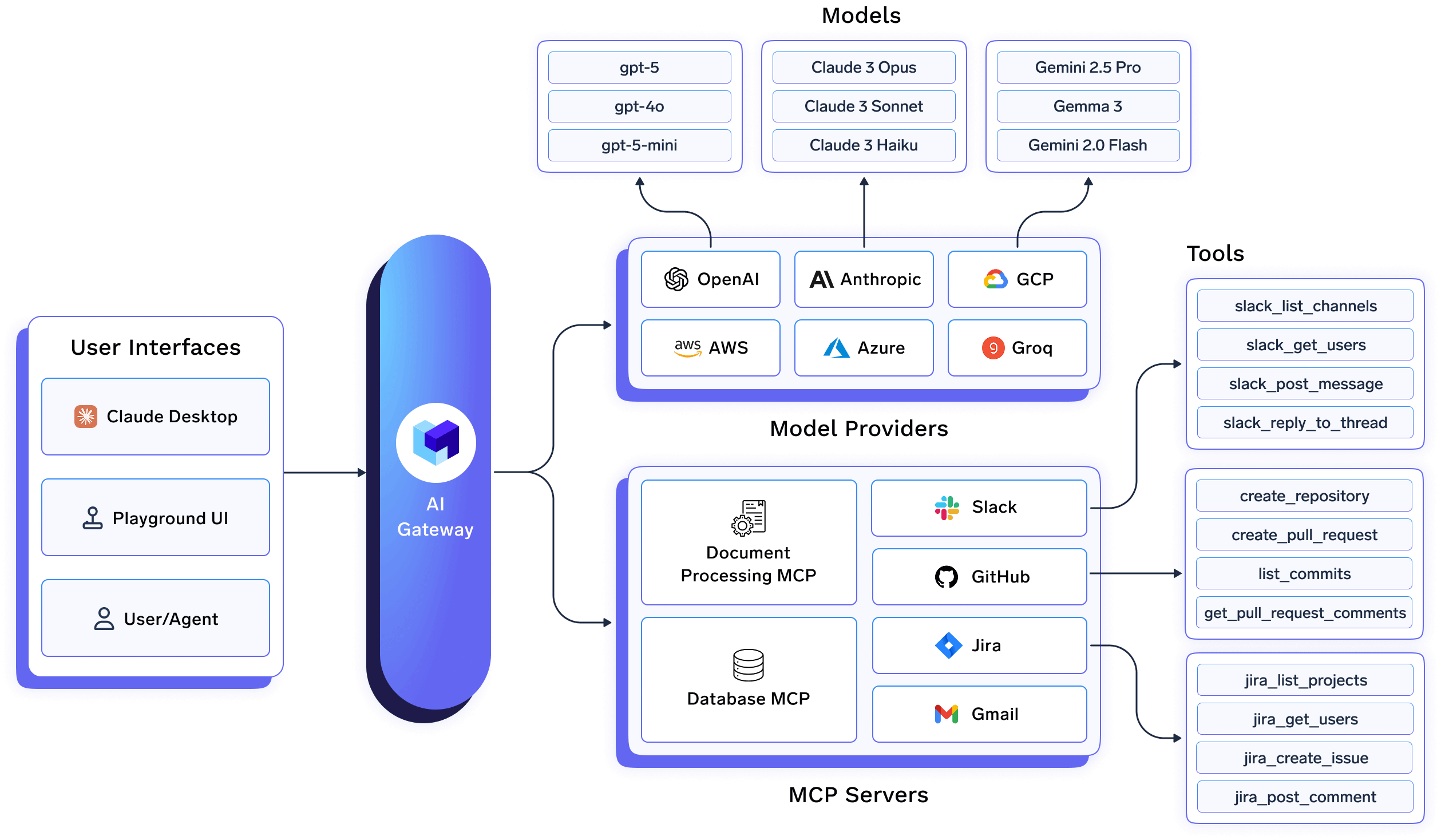
TrueFoundry is a unified AI Gateway and MCP Gateway built for organizations deploying AI applications at enterprise scale. Through a single OpenAI-compatible endpoint, teams can route requests across 1,000+ LLMs, apply authentication and governance policies, and centrally manage both model traffic and MCP server access. The gateway adds approximately 3–4 ms of latency while supporting 350+ requests per second per vCPU, making it suitable for production workloads.
Unlike platforms that treat security as a separate layer, TrueFoundry integrates common governance and guardrail capabilities directly into the gateway. Organizations can apply built-in input and output guardrails for PII detection and toxicity filtering, integrate with providers such as OpenAI Moderation, AWS Guardrails, and Azure AI Content Safety, or implement custom guardrail logic using Python hooks or declarative configuration. The platform also includes an MCP Gateway with centralized server registration, RBAC, authentication, and tool-call auditing, allowing administrators to control which enterprise tools AI applications can access.
Because AI Gateway, MCP Gateway, and guardrails share the same control plane, every request—including model routing decisions, guardrail evaluations, and MCP tool invocations—is captured in a unified audit trail. Security and platform teams can investigate incidents, review policy decisions, and monitor AI usage, and support threat hunting from a single interface rather than correlating logs across multiple products.
Best for: Organizations looking for a unified platform that combines AI Gateway, MCP Gateway, enterprise authentication, guardrails, observability, and deployment infrastructure without introducing a separate AI security layer for common governance needs.
Choose Lasso if your security team needs continuous, dedicated adversarial red-teaming and behavioral threat detection purpose-built for agentic AI, and you're already running a gateway that Lasso can sit in front of. Its detection depth and attack library go further than gateway-native guardrails, which are built for baseline safety enforcement rather than ongoing offensive testing.
Choose TrueFoundry if you want AI Gateway, MCP Gateway, and security guardrails consolidated into one platform with published pricing, instead of running a separate security vendor on top of your routing layer. It's also the better fit if you haven't settled on a gateway yet, since Lasso assumes one already exists underneath it.
For some buyers, they're complementary rather than exclusive. A team could run TrueFoundry as the gateway, using its native guardrails for baseline PII and toxicity filtering, and layer Lasso on top for deeper red-teaming and behavioral threat detection on agentic workflows. For teams that don't need that level of dedicated security depth, TrueFoundry's built-in guardrails cover the baseline without adding a second vendor and a second integration project.
Lasso Security vs TrueFoundry, how to choose?
TrueFoundry is the better fit for enterprises that want a single platform for AI Gateway, MCP Gateway, and guardrails, with published pricing. Lasso is the better fit for security teams that specifically need dedicated red-teaming and threat detection layered on top of an existing gateway.
Does Lasso Security replace the need for an AI Gateway?
No. Lasso enforces policy at the proxy, API, or AI Gateway layer, meaning it's built to run alongside a gateway, not instead of one.
Is Lasso Security or TrueFoundry free?
Neither is free at the enterprise tier, but TrueFoundry publishes a free Developer plan (50k requests/month) and visible paid tiers starting at $499/month. Lasso requires a sales conversation for any pricing at all.
Can TrueFoundry's guardrails replace Lasso's red-teaming?
Not fully. TrueFoundry's guardrails handle PII filtering, toxicity detection, and policy enforcement at request time, but Lasso's continuous adversarial red-teaming and behavioral detection are a more specialized, ongoing security function.
Can I deploy TrueFoundry in my own VPC or on-prem?
Yes. TrueFoundry runs in your VPC, on-prem, air-gapped, hybrid, or across multiple clouds, and no data leaves your domain.
TrueFoundry AI Gateway delivers ~3–4 ms latency, handles 350+ RPS on 1 vCPU, scales horizontally with ease, and is production-ready, while LiteLLM suffers from high latency, struggles beyond moderate RPS, lacks built-in scaling, and is best for light or prototype workloads.






The latest news, articles, and resources sent to your inbox

.png)
.png)
.png)
.png)
.png)
.png)