.png)
September 17, 2026
|
5 min read


احصل على وصول فوري إلى بيئة TrueFoundry مباشرة. انشر النماذج، ووجّه حركة مرور LLM، واستكشف المنصة بالكامل — بيئة الاختبار الخاصة بك جاهزة في ثوانٍ، ولا يلزم وجود بطاقة ائتمان.



Published: September 17, 2026
.png)
Blazingly fast way to build, track and deploy your models!
The Airtable MCP server is a remote Model Context Protocol server hosted by Airtable at https://mcp.airtable.com. Model Context Protocol is the open standard that lets an agent discover and call tools on an external system, and Airtable’s implementation turns bases, tables, records, and schemas into callable tools.
TrueFoundry’s docs describe it by capability and OAuth scope rather than by tool name, which is the right way to reason about it. The scope you grant is what bounds the agent.
Being remote, there is no container to babysit and no npx process on each laptop - you point a client at a URL and authenticate, like other remote MCP servers.
What makes Airtable distinctive is where the data came from: it is where operations teams build the systems of record IT never provisioned - vendor lists, hiring pipelines, onboarding trackers, budget sheets. That has two consequences.
It is high-value for an agent. The data is genuinely structured - tables, typed fields, linked records - so an agent can query and mutate it without a data-engineering project in front. schema.bases:read tells it what the fields are and data.records:read gives it the rows.
It is hard to reason about. Because it grew organically, there is no inventory. The base tracking contractor day rates sits beside the base tracking office snack orders, with the same sharing settings. These records are often the operational truth a human process depends on, with no version-history discipline behind them. A record that gets overwritten does not announce itself.
So the governance question is narrow: which bases, and is this agent allowed to write?
The uses that justify connecting it chain tools together:
Three of those four are read-only; the fourth writes comments, not records.
Read versus write is the split that matters. Reading a vendor list is harmless. Updating a record in the onboarding tracker changes what a human sees on Monday and acts on. Modifying a schema can break a view, an automation, or a linked-record relationship three other bases depend on. data.records:read and data.records:write are separate scopes for a reason.
One analyst wiring this into Claude Desktop is fine. Twenty people across four teams is not.
Nobody knows which bases are in scope. During Airtable’s OAuth flow the user picks which bases the integration can access. A good control, but exercised by whoever happens to be authorizing, in a browser, at the moment they want the agent working. The path of least resistance is to select everything, and nobody reviews it afterward.
Personal access tokens outlive the person. Teams that skip OAuth for an Airtable PAT end up with a long-lived credential in a local config, scoped broadly because narrowing it is tedious.
Write access arrives by default. If the integration was registered with the write scopes because that seemed easier, every agent using it can mutate records. The failure is quiet: an agent asked to summarize a tracker decides cleaning up a malformed field is helpful, and rewrites twelve rows.
No audit trail at the right granularity. Airtable keeps revision history on records. It does not record that your onboarding agent made the change while acting on a prompt from a Slack thread.
None of this argues against connecting Airtable. It argues for the control plane an MCP gateway provides.
Airtable is registered as a remote MCP server using your own OAuth integration, not provisioned from the TrueFoundry Managed MCPs catalogue. There is no one-click tile: you create the OAuth integration in Airtable, choose the scopes, and bring the credentials across. That extra step is where most of the governance happens.
Step 1 - Register an Airtable OAuth integration. At airtable.com/create/oauth, create an integration and set the redirect URL to:
https://<tfy-control-plane-base-url>/api/svc/v1/llm-gateway/mcp-servers/oauth2/callback
Replace <tfy-control-plane-base-url> with your control plane URL. This is the self-registered callback, not the managed one; pasting the auth.truefoundry.com callback produces mismatched-redirect errors.
Step 2 - Add only the scopes your agents need. The most consequential decision in the setup. Grant data.records:read, schema.bases:read, and workspacesAndBases:read for a reporting agent and stop. Add data.recordComments:write if it should annotate rather than edit. Leave the write and webhook scopes off unless a workflow needs them.
Step 3 - Open the picker. Go to MCP Gateway in the left sidebar and click Add Server.
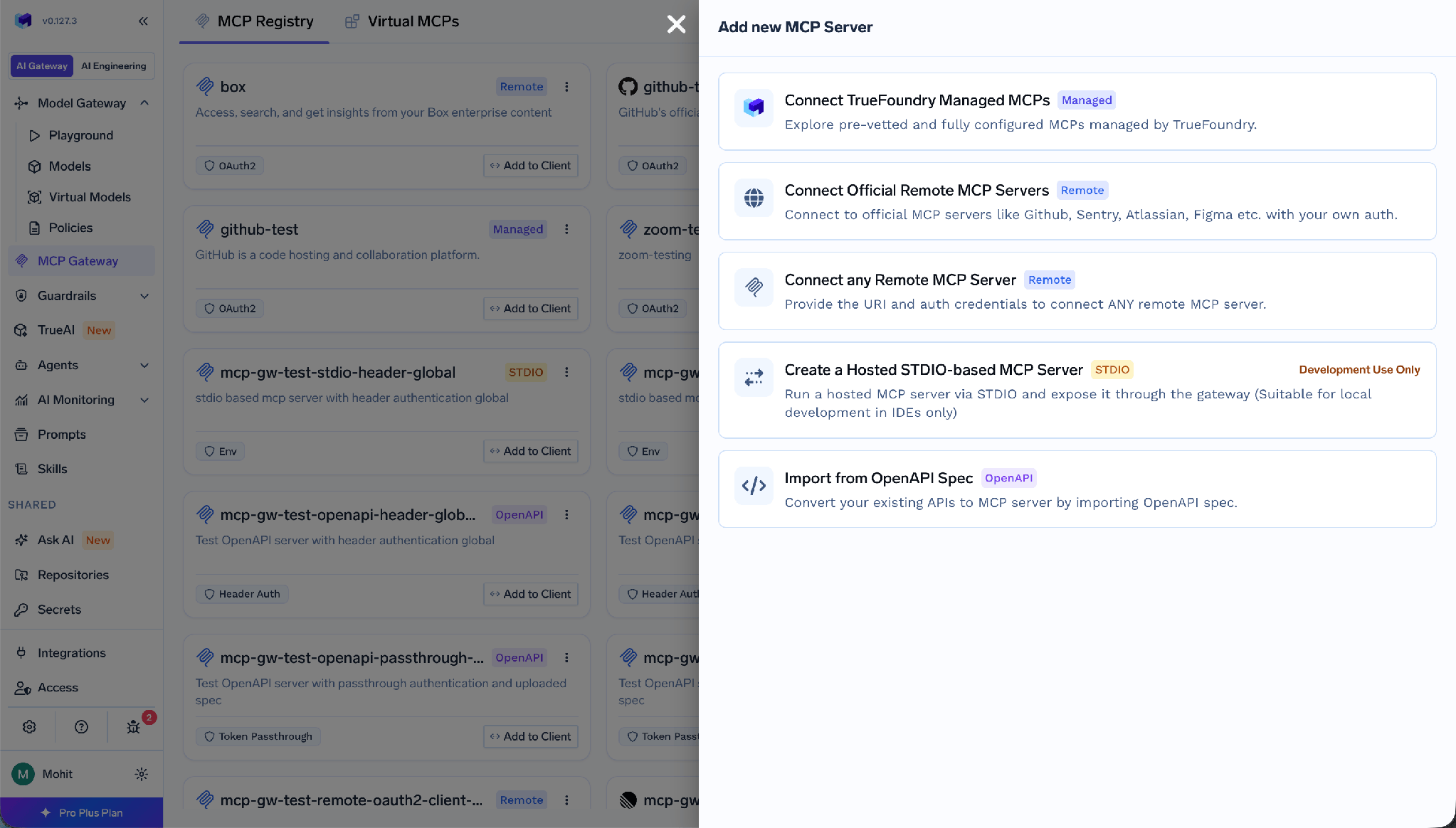
Add MCP Server picker listing the Connect any Remote MCP Server option
Select Connect any Remote MCP Server.
Step 4 - Fill in the server details.
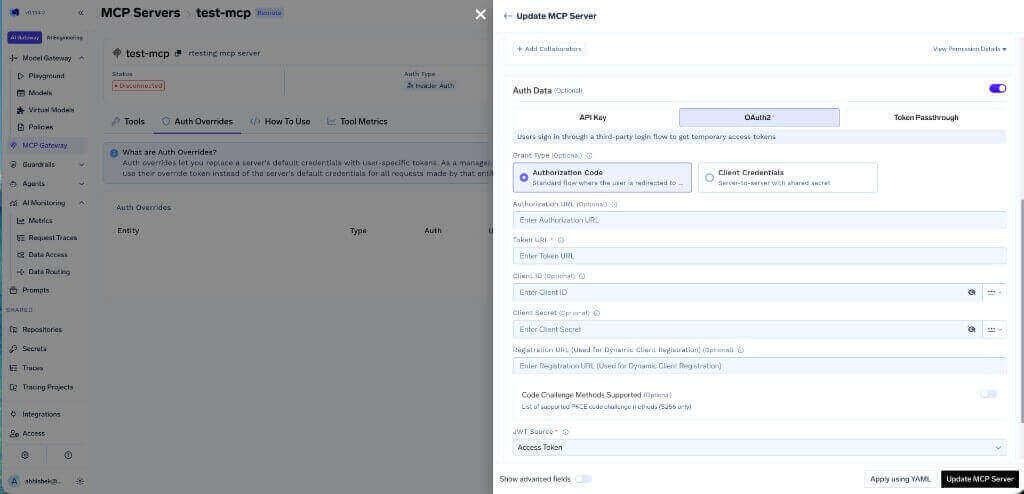
Store the credentials in the TrueFoundry secrets store and reference them by FQN rather than pasting the secret into the form.
Step 5 - Add collaborators and save.
Step 6 - Connect. Each user opens the server’s Tools section and clicks Connect Now. Airtable’s consent screen appears, and this is where the user picks which bases the integration can access.
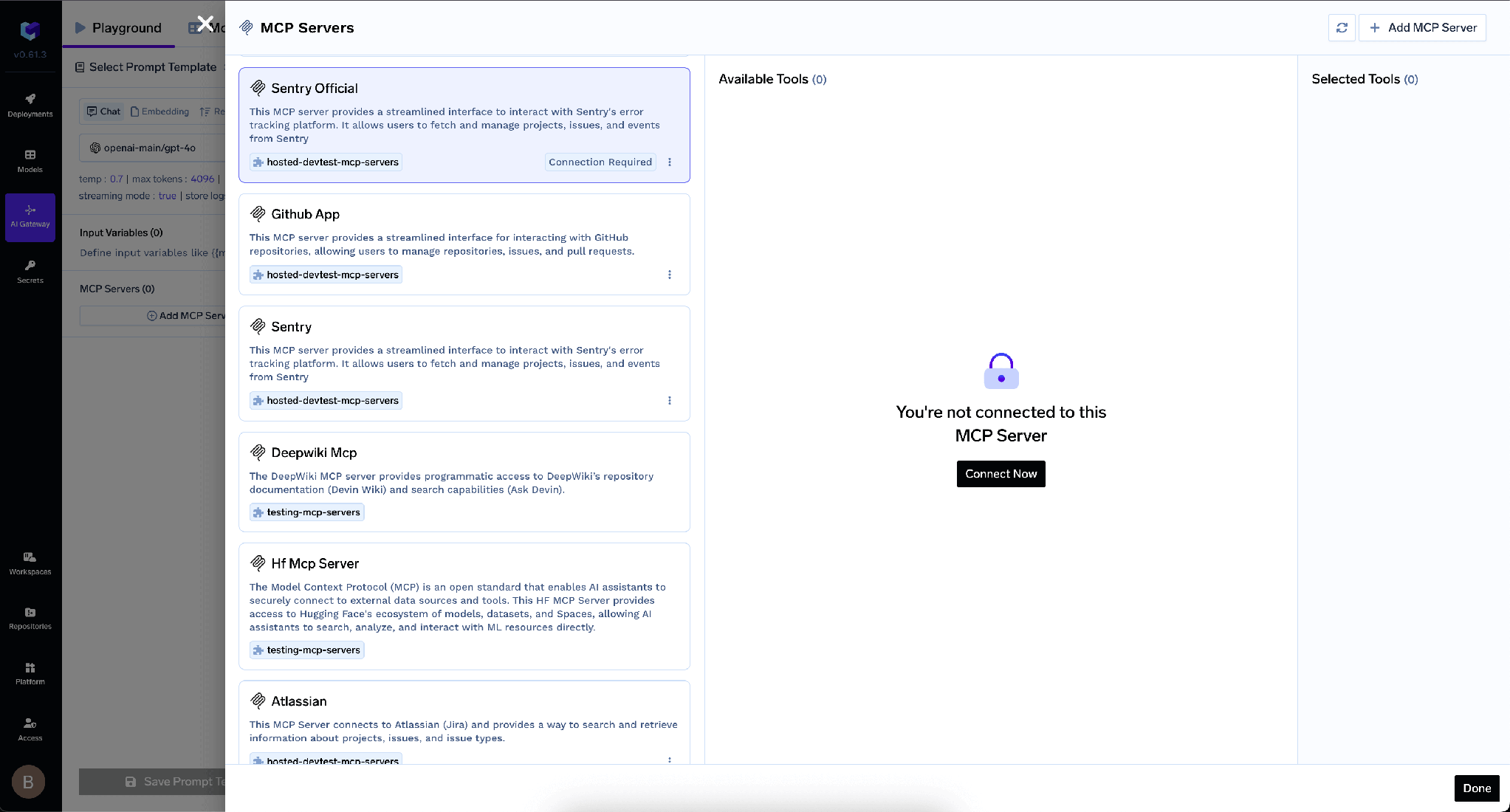
After OAuth succeeds, the Airtable tools appear and can be tried from the Agent Playground.
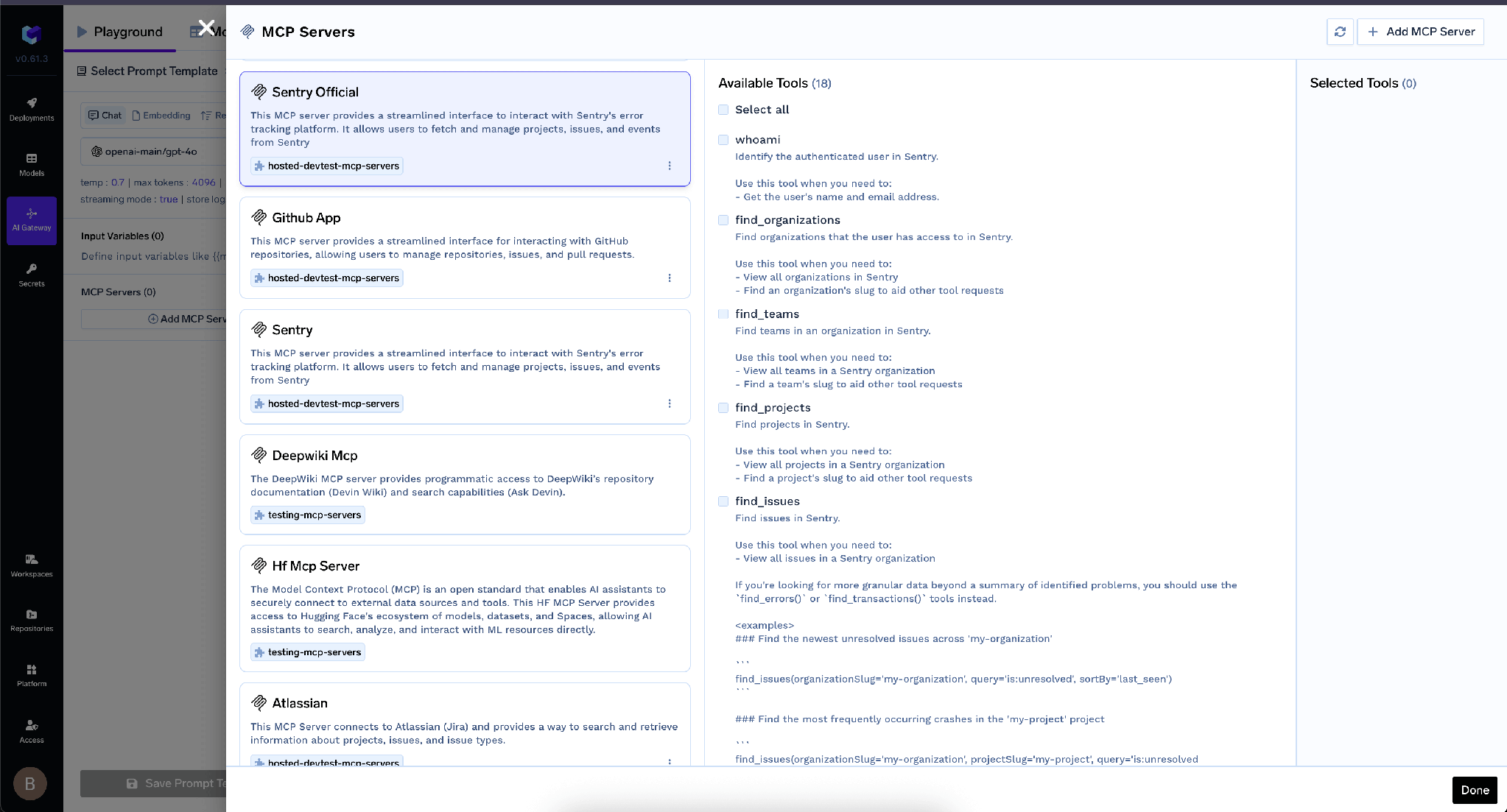
MCP server detail view listing tools available after OAuth2 authentication
TrueFoundry separates inbound authentication - how a client proves itself to the gateway - from outbound, how the gateway proves itself to Airtable. The layers are independent, and conflating them is the usual mistake.
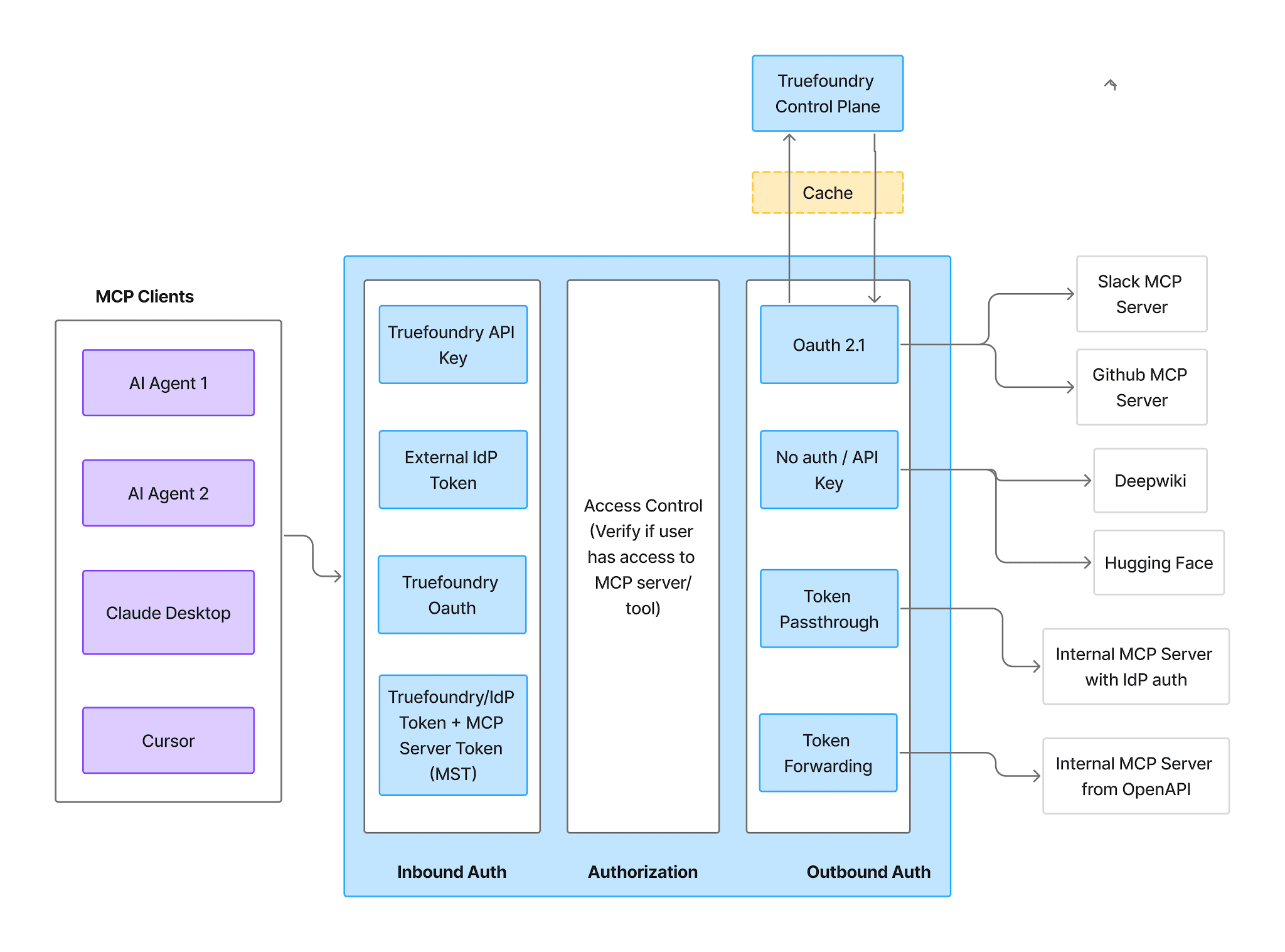
MCP Gateway diagram of inbound auth, access control, and outbound auth stages
Inbound supports four methods:
TrueFoundry AI Gateway delivers ~3–4 ms latency, handles 350+ RPS on 1 vCPU, scales horizontally with ease, and is production-ready, while LiteLLM suffers from high latency, struggles beyond moderate RPS, lacks built-in scaling, and is best for light or prototype workloads.





أحدث الأخبار والمقالات والموارد تصلك مباشرة إلى بريدك الوارد
.png)
.png)
.png)
.png)
.png)
.png)
.png)
.png)
.png)