novembre 18, 2026
|
5 min de lecture


Accédez instantanément à un environnement TrueFoundry en direct. Déployez des modèles, acheminez le trafic LLM et explorez la plateforme complète : votre sandbox est prête en quelques secondes, aucune carte de crédit n'est requise.



Une méthode incroyablement rapide pour créer, suivre et déployer vos modèles !
Keyword search can fail in predictable ways. An employee searches for a contractor leave policy but receives an employee handbook instead. The search engine matched several words correctly without understanding user intent. The user then spends time reading the wrong document.
AI search closes that gap through artificial intelligence, retrieval and semantic understanding. It can find relevant information across several sources and produce direct answers when generation adds value. The system still needs reliable evidence underneath every generated response.
Public search already shows this shift. Pew Research Center found that 18% of Google searches studied in March 2025 produced AI summaries. Longer searches and full questions generated them more often.
Inside enterprises, the harder work sits beneath the answer. Search systems must respect permissions, manage model spending and control actions following retrieved results. This guide explains the pipeline and architecture behind that production experience.
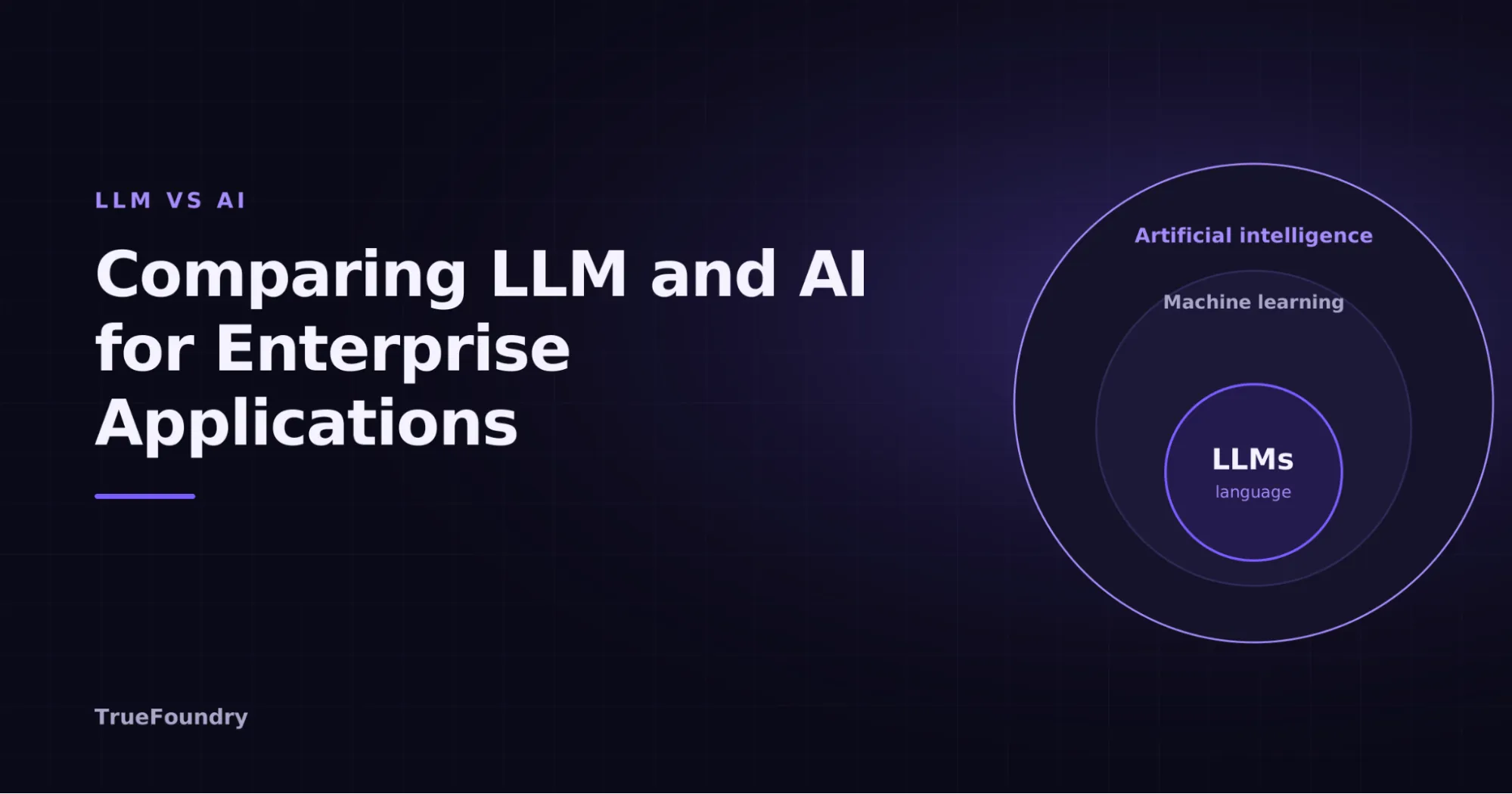
As per the AI search definition, it is a system using machine learning or Generative AI to understand intent. It retrieves information beyond exact keyword matching and can rank evidence according to meaning. The model that writes a final answer remains optional.
For someone asking what is AI search, several techniques usually work together:
An AI search engine therefore does more than simple keyword matching. It combines natural language processing, retrieval and ranking across a wide range of content. Users can enter conversational queries instead of guessing the correct terminology.
From the user's side, what is an AI search experience? It accepts natural language queries and returns context-aware search results. These results may include a list of links, written explanation or supporting evidence. The AI search meaning encompasses this complete pipeline rather than a single algorithm.
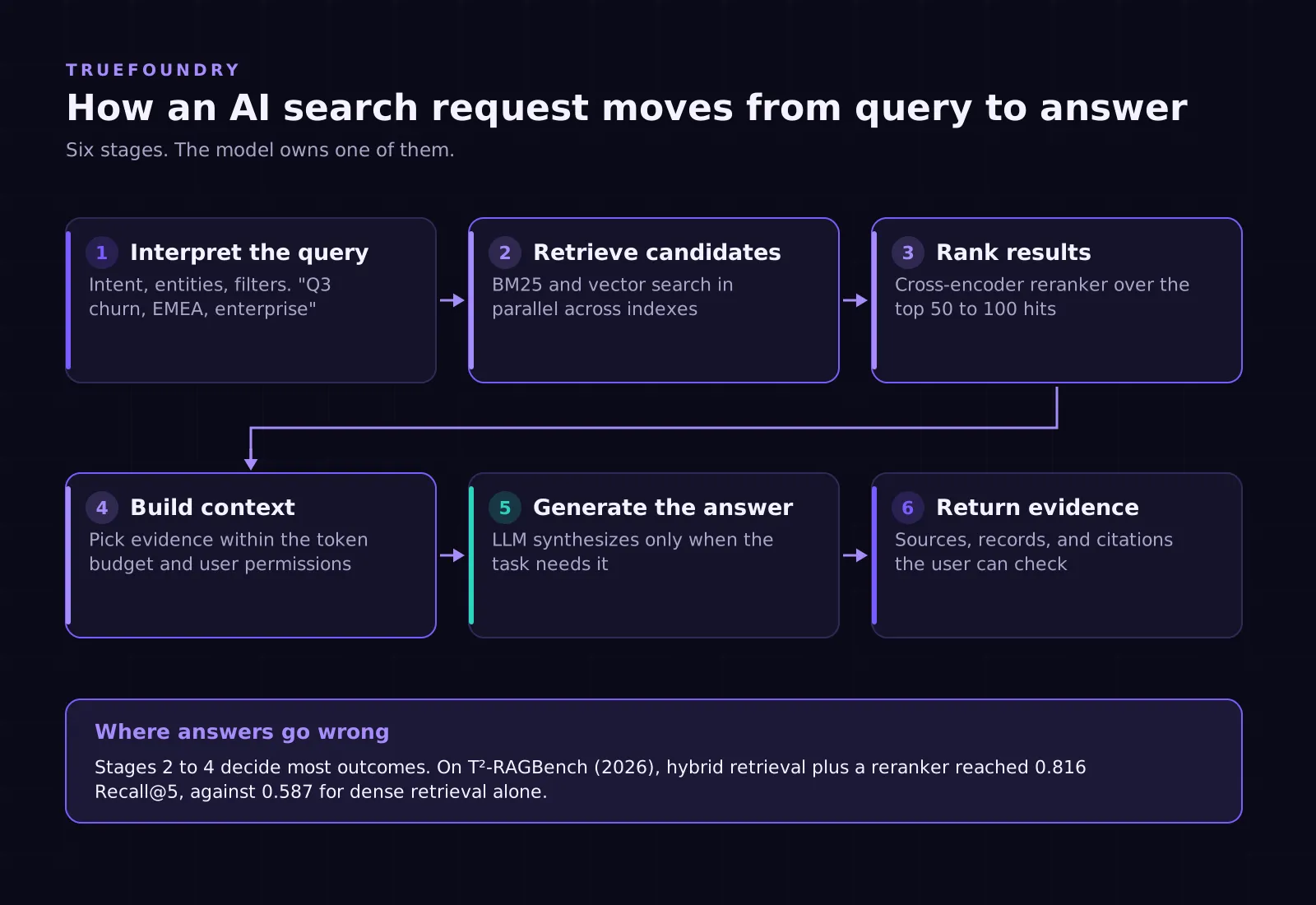
The pipeline matters because each stage can fail separately. A request usually passes through six steps before the user sees anything.
Retrieval is an information retrieval problem before it becomes a generation problem. Production systems may combine lexical retrieval with vector search and reranking. Metadata can also preserve permissions, ownership and date information before results reach a model.
A 2026 study used T²-RAGBench across 23,088 financial questions and 7,318 documents. Hybrid retrieval with neural reranking achieved 0.816 Recall@5. Dense retrieval alone reached 0.587.
That gap explains why stronger AI models cannot repair missing evidence. The generator never sees information that retrieval failed to find. When generation uses several providers, an LLM Gateway can centralize routing and observability across those calls.
Traditional search primarily ranks documents using lexical terms, metadata, links and user behavior. Traditional search engines usually return a list of results. The user then opens individual web pages or enterprise documents and interprets them.
Modern systems add semantic understanding and can synthesize AI answers from retrieved evidence.
A simple keyword remains useful for exact identifiers such as ticket numbers or function names. Traditional search matches literal terms especially well. The same 2026 retrieval benchmark found BM25 outperforming dense retrieval on its financial corpus.
The strongest architecture often keeps lexical retrieval beside semantic retrieval. That preserves exact matching while improving handling of paraphrases. The user gets relevant results without forcing every query through generation.
Public products show the same fundamental shift. ChatGPT can perform web search with current sources, while Google Search uses AI Overview and other generative features. Microsoft Copilot Search supports natural-language discovery across organizational sources.
Lists of the best AI search engines often group these products together despite different data boundaries. ChatGPT Search, enterprise assistants and public answer engines solve related discovery problems in different environments.
This shift also affects content creators. Traditional SEO still supports discovery, while answer engine optimization and generative engine optimization emphasize clear sourcing. Authority signals, original research and useful evidence increasingly matter inside a modern content strategy.
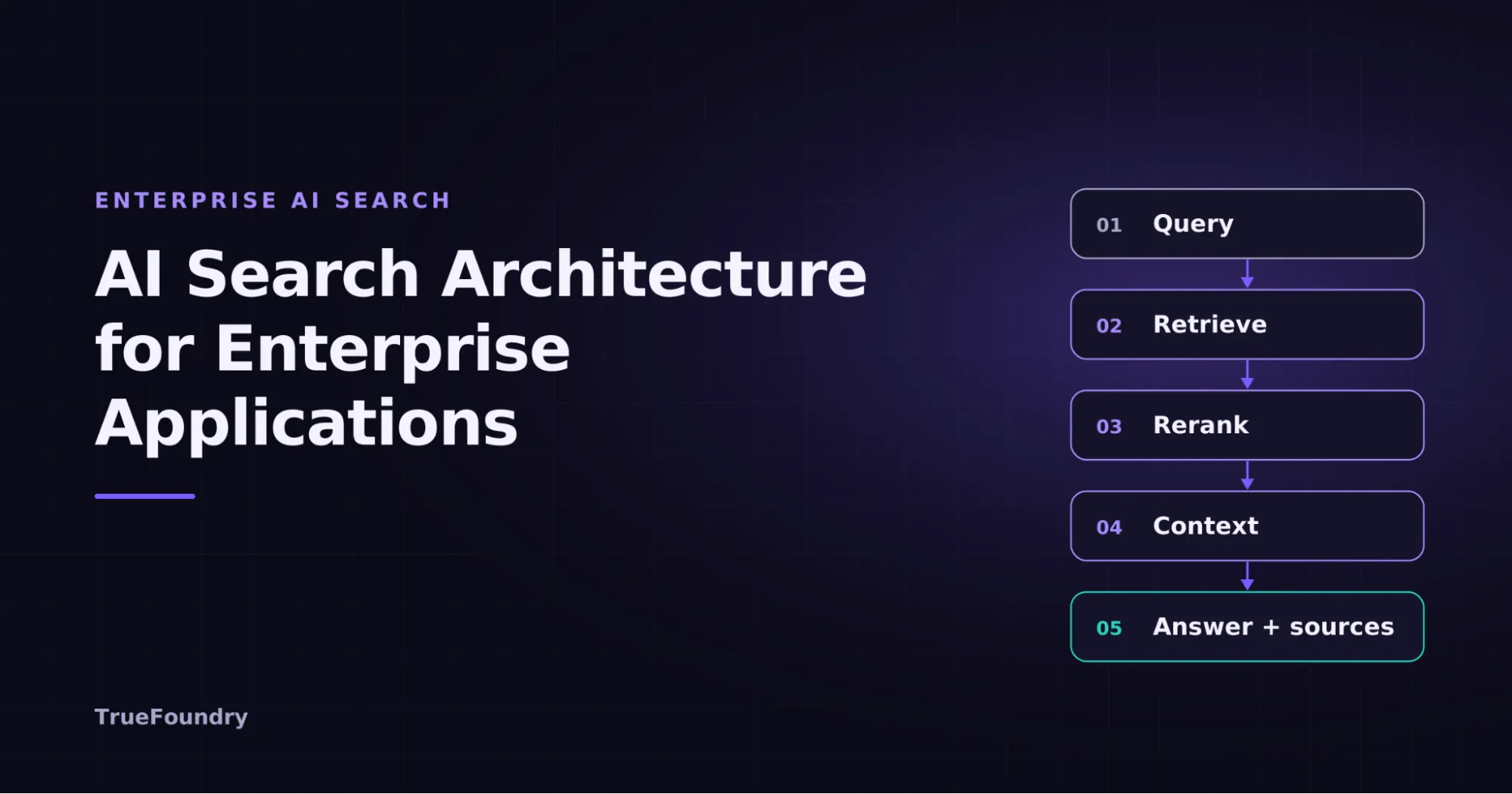
A production search system needs more than a vector database and an LLM. Each component owns a different part of the retrieval and response path.
The architecture may also connect external knowledge bases with internal knowledge repositories. Metadata should accompany every indexed chunk so that permissions remain enforceable. This supports data governance and prevents users from retrieving sensitive data they cannot normally access.
Keeping components separate also improves debugging. A larger model cannot fix a poorly built index. Strong search capabilities depend on ingestion, retrieval, ranking and generation working together.
Retrieval-augmented generation is one common pattern for turning retrieved evidence into a generated response. Retrieval finds relevant passages first. The generation step then uses those passages as context for an answer.
A RAG architecture helps keep changing information outside model weights. Updated policies can reach users after the index refreshes without retraining the model.
RAG still represents only one pattern. Some search systems return ranked documents without generation. Others combine lexical retrieval, semantic search, and structured queries. The right architecture depends on whether users need evidence, synthesis, or both.
The strongest use cases appear when users do not know the exact terminology. Search also adds value when answers require several sources or complex queries.
Common enterprise applications include:
These AI search tools reduce the work left after retrieval. A support engineer may need evidence across tickets, release notes and logs. A simple holiday calendar query may still work better via ordinary search.
The difference is whether a list of links completes the task. In many enterprise cases, lists of links still require users to manually interpret multiple sources.
Search changes once it reaches live systems, rather than relying on a static index. An assistant can query CRM records, ticket status or internal APIs. These search tools can return current data points that indexing alone cannot provide.
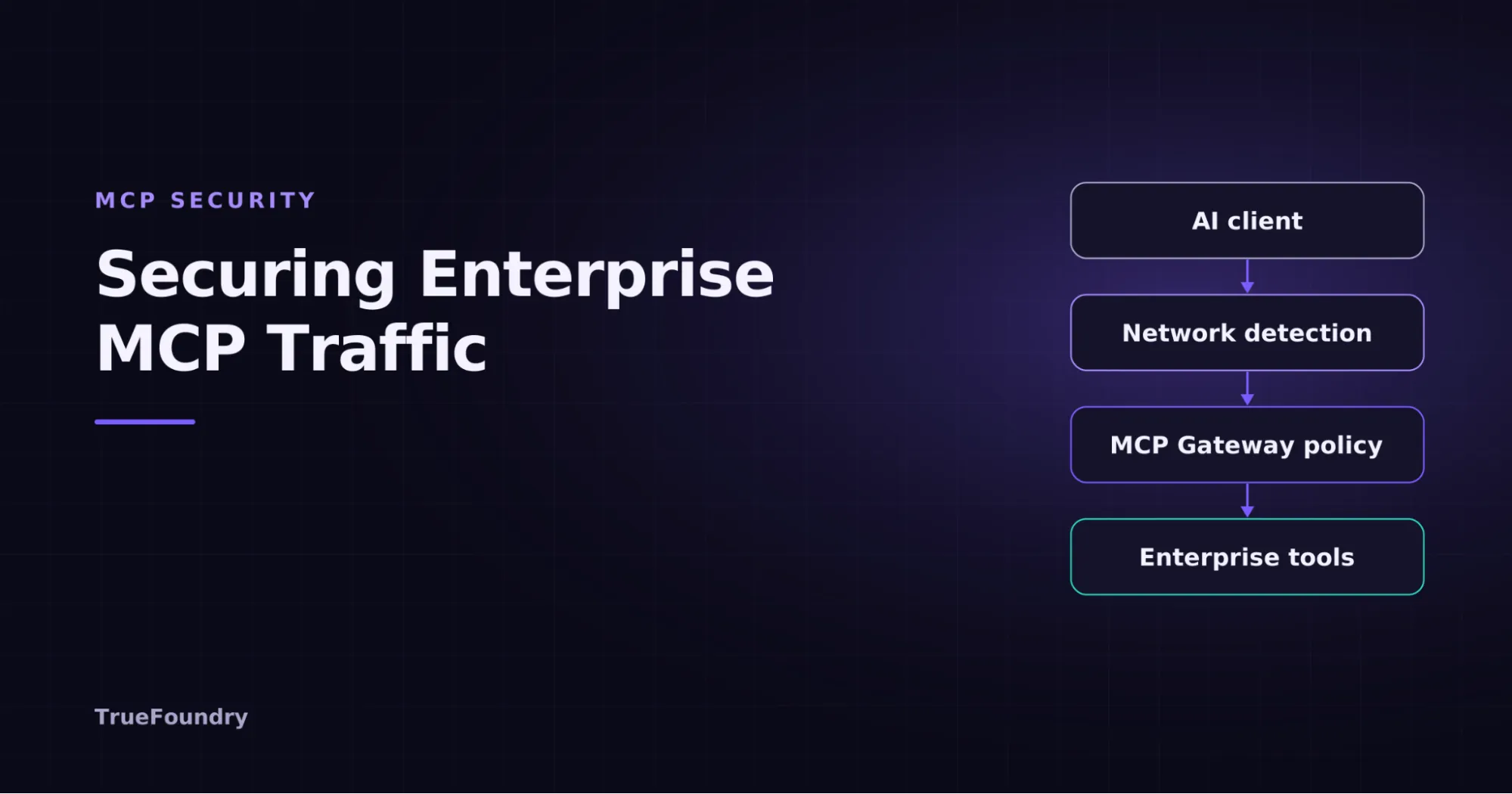
MCP gives applications a standard way to discover and invoke tool capabilities. A central MCP Gateway can govern which tools each identity can access. Read-only tools can remain broadly available while write actions require tighter controls.
At this stage, retrieval begins to shift toward agentic execution. The system may search first and then update a business record. An incorrect answer costs time, while an incorrect write can change production data.
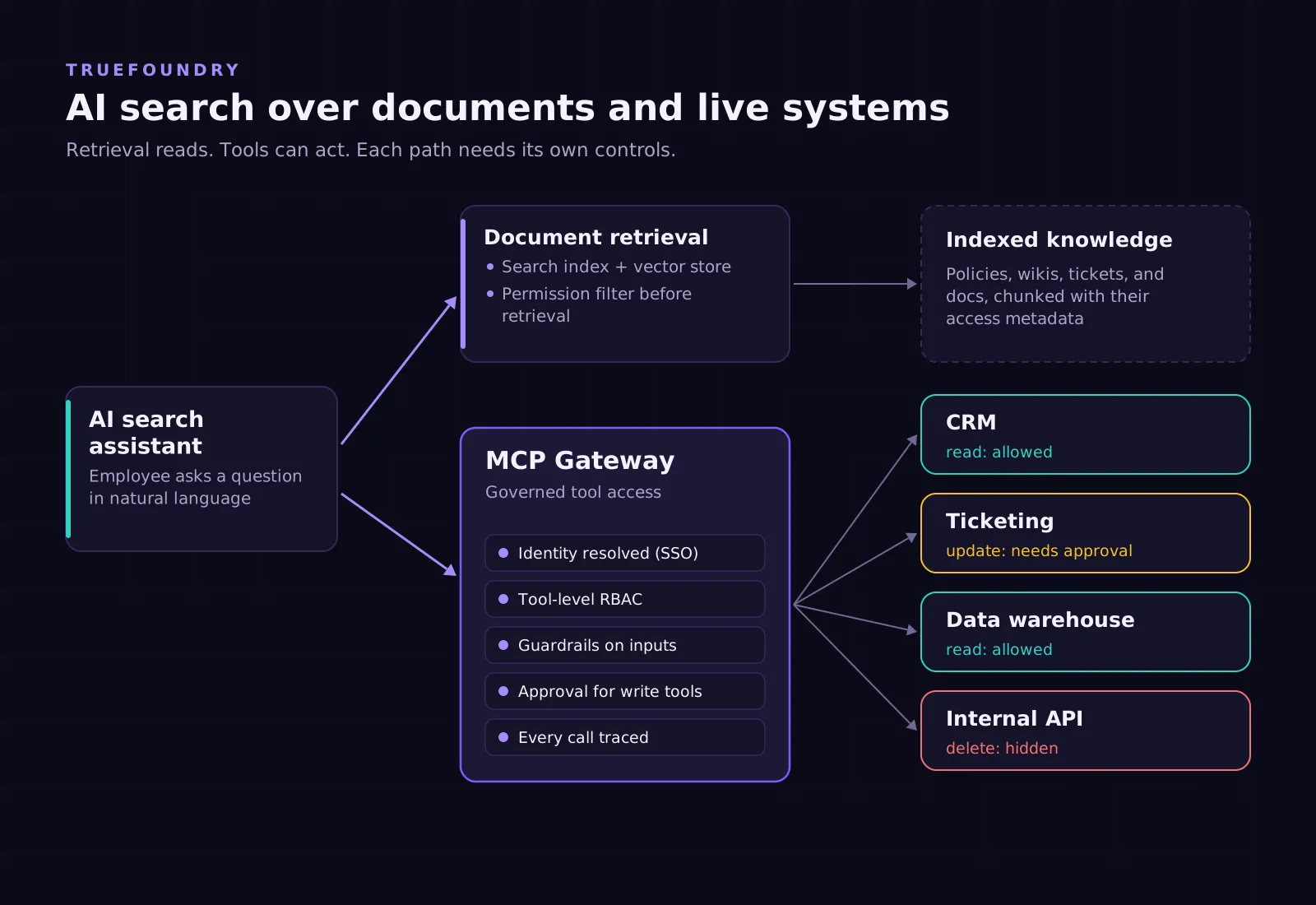
Search risk appears throughout the pipeline rather than only inside the final answer. Poor retrieval can surface irrelevant evidence, while weak access controls can reveal unauthorized documents.
Prompt injection creates another risk when retrieved content contains malicious instructions. TrueFoundry's prompt injection defense guide explains why indirect attacks can arrive through retrieved documents or tool results.
OWASP ranks prompt injection as LLM01 in its 2025 Top 10 for LLM applications. That makes retrieved content an untrusted input rather than automatically safe context.
Teams should apply controls across several layers:
These controls matter because user queries can reach many systems in a single request. Permissions must apply before retrieval. Filtering after generation arrives too late because the model already received the document.
Evaluation should measure the full pipeline rather than model accuracy alone. Retrieval tests whether the system found the correct information. Ranking measures whether stronger evidence appears higher. Generation checks whether the answer remains grounded in that evidence.
Operational data points also matter:
Teams should build tests from real traffic, including ambiguous and permission-sensitive requests. They should also test questions with no valid answer. The correct response can be “no answer found” instead of a fluent guess.
An LLM observability framework helps connect model calls with latency, cost and failure data. The same tracing discipline makes retrieval failures easier to separate from generation failures.
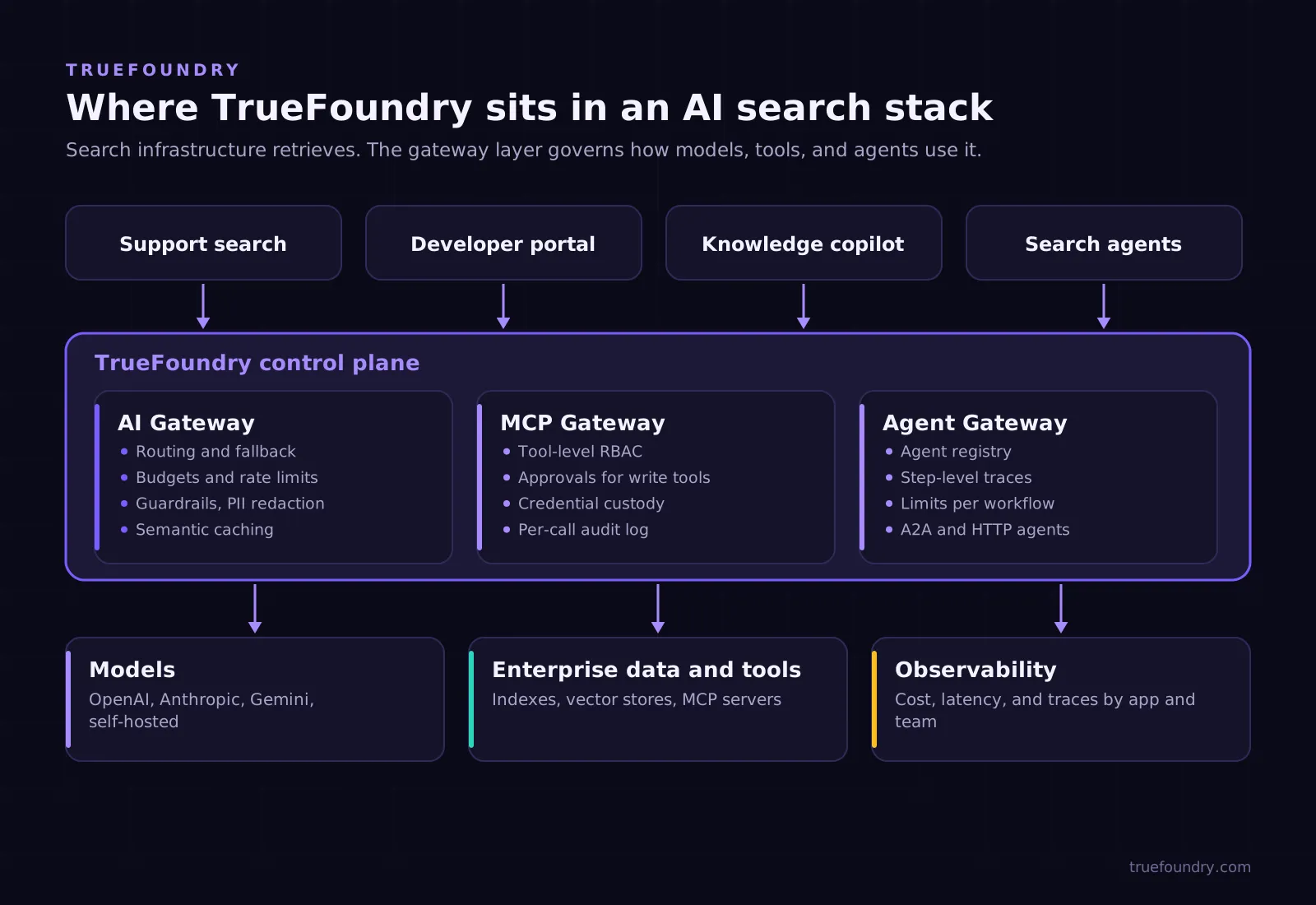
The search stack should continue owning ingestion, indexing and retrieval. TrueFoundry governs the AI execution layer around those capabilities. This separation lets search infrastructure find the evidence while shared controls govern how models use it.
The AI Gateway centralizes model access, routing, fallback, caching, budgets, guardrails and observability. Search applications can keep an OpenAI-compatible SDK while policies remain outside application code:
from openai import OpenAI

client = OpenAI(

    api_key="your_truefoundry_api_key",

    base_url="{GATEWAY_BASE_URL}",

    default_headers={

        "X-TFY-METADATA": '{"application":"kb-search", "environment":"prod"}'

    },

)

response = client.chat.completions.create(

    model="openai-main/gpt-4o-mini",  # provider account / model name

    messages=[

        {"role": "system", "content": "Answer only from the context. Cite sources."},

        {"role": "user", "content": context_block + "\n\nQuestion: " + user_query},

    ],

)
The X-TFY-METADATA header tags each request with string key-value pairs. Gateway rules can match on those tags, so one config can cap a development search app without touching production:
name: ratelimiting-config

type: gateway-rate-limiting-config

rules:

  - id: 'kb-search-dev-cap'

    when:

      models: ['openai-main/gpt-4o-mini']

      metadata:

        environment: dev

    limit_to: 1000

    unit: requests_per_day
Metadata can separate development and production traffic for policy and reporting. It can also support different budgets or rate limits across applications. Teams keep model governance independent from retrieval implementation.
When search evolves into multi-step actions, the Agent Gateway extends controls across execution, tool calls and workflow traces. This keeps the division clear as search becomes more autonomous.
To see these controls running against your own search workloads, book a demo with the TrueFoundry team.
TrueFoundry AI Gateway offre une latence d'environ 3 à 4 ms, gère plus de 350 RPS sur 1 processeur virtuel, évolue horizontalement facilement et est prête pour la production, tandis que LiteLM souffre d'une latence élevée, peine à dépasser un RPS modéré, ne dispose pas d'une mise à l'échelle intégrée et convient parfaitement aux charges de travail légères ou aux prototypes.



Les dernières nouvelles, articles et ressources envoyés dans votre boîte de réception