October 9, 2026
|
5 minutos de lectura


Obtenga acceso instantáneo a un entorno TrueFoundry en vivo. Implemente modelos, dirija el tráfico de LLM y explore la plataforma completa: su sandbox estará listo en segundos, sin necesidad de tarjeta de crédito.


Published: September 11, 2026

¡Una forma increíblemente rápida de crear, rastrear e implementar sus modelos!
Every major LLM provider implements prompt caching differently. Here's how the TrueFoundry AI Gateway translates cache directives across providers, handles fallback when a target doesn't support caching, and exposes unified hit metrics — with token savings benchmarks.

Prompt caching is the single highest-leverage cost optimization for any LLM workload built on a long, stable prefix — a 10K-token system prompt, a tool registry, a retrieval bundle. The discount is roughly 90% off cached input tokens, large enough to change the unit economics of an agent product. The catch is that the three major LLM provider APIs — Anthropic native, OpenAI, AWS Bedrock Converse — each model caching differently in ways that aren't cosmetic: directive shape, response shape, TTL options, and even when caching is invoked at all.
Anthropic's prompt caching is the most expressive of the three. You explicitly mark which portion of the request should be cached using the cache_control attribute on a system or message block:
anthropic request · json
{
  "model": "claude-sonnet-4-6",
  "system": [{
    "type": "text",
    "text": "<10,000 token system prompt>",
    "cache_control": {"type": "ephemeral"}
  }],
  "messages": [{"role": "user", "content": "<query>"}]
}
Three rules govern when this actually caches. The prefix must clear a model-specific minimum: 1,024 tokens for Sonnet-class and 2,048 tokens for Opus-class. Below the threshold the directive is silently dropped. The default TTL is 5 minutes, refreshed on each hit. And the prefix must be byte-identical — a stray timestamp before the cached block kills the hit (we return to this in §08).
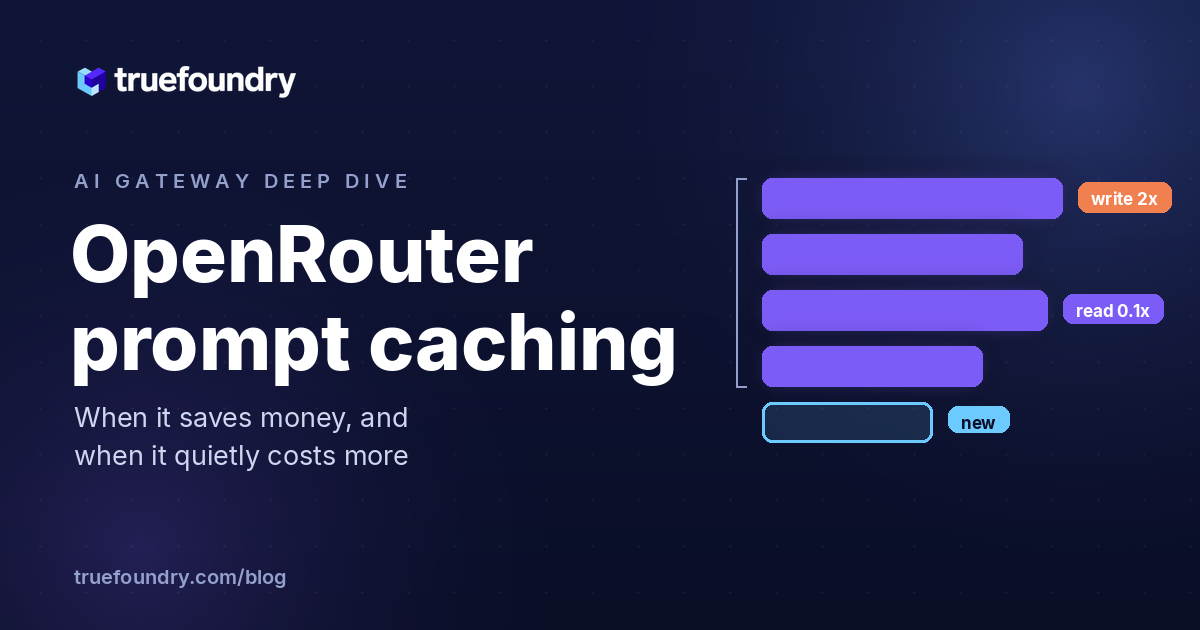
Pricing has two non-obvious components. Cache reads are billed at 10% of the base input rate — the 90% discount you came for. Cache writes carry a 25% premium over base input pricing. The cache must pay for itself across enough subsequent hits to recover the write surcharge; for a 10K-token prefix on Sonnet 4.6, breakeven is two follow-up hits.
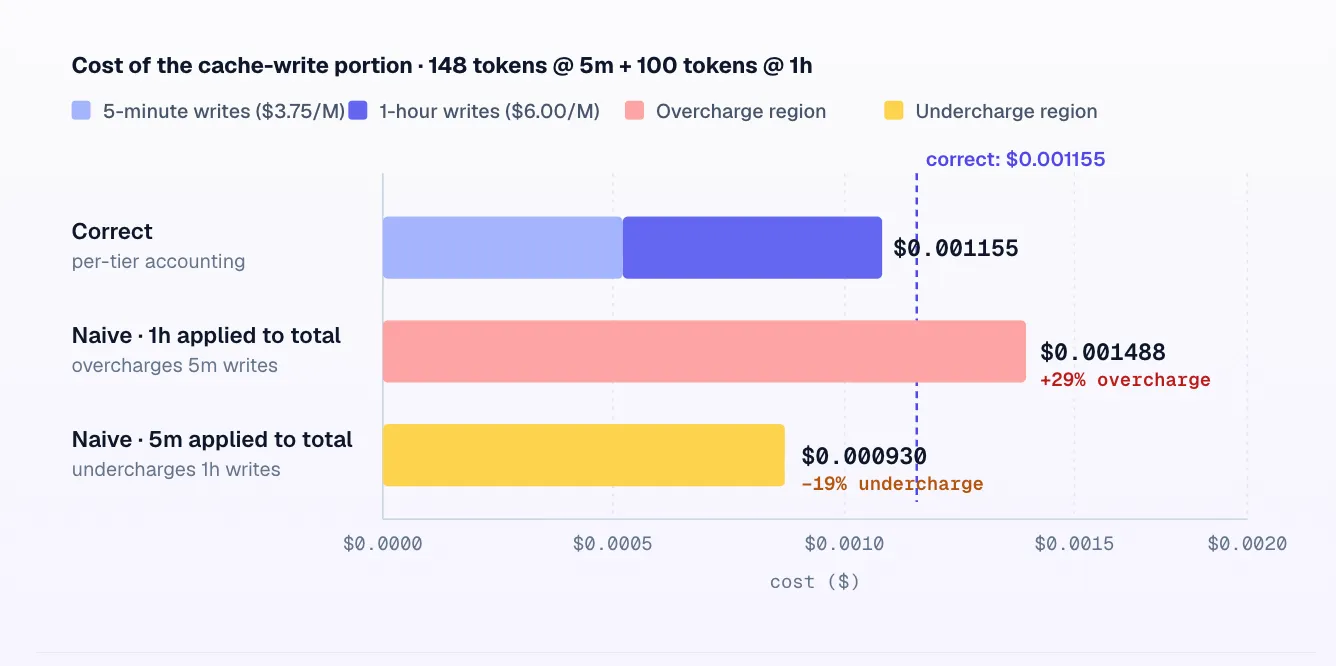
The response surfaces caching in three usage fields: cache_read_input_tokens (served from cache), cache_creation_input_tokens (written this turn), and input_tokens (everything else). Since extended-TTL caching now lets you opt into a 1-hour retention at a 2× write premium, Anthropic also surfaces a per-TTL breakdown under cache_creation.ephemeral_5m_input_tokens and cache_creation.ephemeral_1h_input_tokens. That breakdown matters more than it looks — we'll come back to it in §04.
OpenAI's prompt caching takes the opposite philosophy. There is no directive. The cache turns on automatically once the prompt prefix exceeds 1,024 tokens, and OpenAI's infrastructure caches the KV activations server-side. Subsequent requests with the same prefix get the cached state automatically.
The developer-facing surface is two optional parameters that influence — but don't trigger — caching. prompt_cache_key is a string combined with the prefix hash to influence backend routing: same key, same backend, higher hit rate. prompt_cache_retention accepts "in_memory" (default, 5–10 minutes) or "24h" for extended retention. Both are documented in OpenAI's prompt caching guide.
The asymmetry with Anthropic is sharp: you cannot choose which prefix is cached. OpenAI's caching layer picks the longest repeated prefix it observes on a given backend. If your system prompt is followed by a frequently-changing tool registry, the cache may land on the system prompt alone or on a different boundary, with no visibility into which. The response surfaces only one cache field — cached_tokens nested under usage.prompt_tokens_details — and no write-side counter, because OpenAI doesn't bill for cache writes.
The practical implication: OpenAI caching is well-suited to workloads where the stable prefix is one block. Anthropic's explicit breakpoints give you fine-grained control over multi-region prefixes; OpenAI doesn't.
Bedrock's prompt caching sits in the Converse API and uses a cachePoint marker block placed after the content it caches:
bedrock converse · json
{
  "modelId": "anthropic.claude-sonnet-4-6-v1:0",
  "system": [
    {"text": "<long system prompt>"},
    {"cachePoint": {"type": "default", "ttl": "1h"}}
  ],
  "messages": [/* ... */]
}
Three things make this trickier than it looks. First, the marker placement is the opposite of Anthropic's — the directive comes after the content it caches, not on it. Implementations that lift Anthropic's pattern directly silently disable caching. Second, this is the Converse API specifically; Bedrock's native InvokeModel endpoint accepts the Anthropic-style format verbatim for Claude models, but Converse is the path most newer integrations use.
Third, TTL support shifted recently. Before January 26, 2026, Bedrock Converse only supported a 5-minute TTL. On that date AWS shipped 1-hour TTL support for the Claude 4.5+ family and Amazon Nova; the new ttl: "1h" field on the cachePoint opts in. Older models reject the field — no graceful downgrade.
The response uses camelCase: cacheReadInputTokens, cacheWriteInputTokens, and inputTokens. Unlike Anthropic, Bedrock Converse does not expose a per-TTL breakdown on writes. The gateway that translated the request knows which TTL was requested; the response alone doesn't tell you.
The translation problem the gateway has to solve is: a client sends a single canonical request with Anthropic-style cache_control, and the gateway routes to whichever provider the policy selects. Three strategies are possible — strip the directive when the target doesn't understand it, translate to the target's native cache primitive, or error and refuse to route.
TrueFoundry's gateway picks translate-where-possible, strip-and-log otherwise. Anthropic and Bedrock Converse get full translation — cache_control with a TTL becomes a cachePoint with the equivalent ttl field. OpenAI gets a translated intent: the directive itself is dropped, but prompt_cache_retention is set to "24h" for a 1-hour canonical TTL, and prompt_cache_key is forwarded from the canonical cache_key. When a downgrade is forced — a 1-hour TTL routed to a model that doesn't support extended TTL — the gateway emits a warning span attribute (gen_ai.tfy.cache_ttl_downgrade=5m) so the regression is observable.
One subtler trap on the response side is the mixed-TTL cost accounting bug.
TrueFoundry AI Gateway ofrece una latencia de entre 3 y 4 ms, gestiona más de 350 RPS en una vCPU, se escala horizontalmente con facilidad y está listo para la producción, mientras que LitellM presenta una latencia alta, tiene dificultades para superar un RPS moderado, carece de escalado integrado y es ideal para cargas de trabajo ligeras o de prototipos.





Las últimas noticias, artículos y recursos enviados a tu bandeja de entrada
.png)
.png)
.png)
.png)
.png)
.png)