


.webp)
October 21, 2026
|
5 min read


Updated: October 15, 2026
Published: April 25, 2026

Blazingly fast way to build, track and deploy your models!
EDITORIAL DISCLAIMER — Reviewed against vendor public docs on April 24, 2026. Opinionated positioning remains editorial; configuration details were updated to match current published documentation.
Gemini Enterprise Agent Platform gives Google one of its clearest enterprise agent platform stories to date. That matters. The comparison should not be framed as “Google finally has an answer” versus “Google has nothing here.” Google clearly has a credible answer here — and for some teams, it will be a very good one.
The more useful question is different: what is the platform boundary? If your primary need is a Google-centered platform to build, deploy, govern, and optimize agents, Gemini Enterprise Agent Platform is a credible choice. If your team needs a broader enterprise AI control plane that remains consistent across model vendors, prompts, tool calls, clouds, self-hosted models, and production operations, TrueFoundry is often the more natural long-term fit for platform teams.
That is the core argument of this blog. It is not anti-Google. It is a platform-boundary claim: Gemini Enterprise Agent Platform is best understood as Google’s integrated agent platform. TrueFoundry is best understood as a cross-runtime enterprise AI platform layer.
• Choose Gemini Enterprise Agent Platform when your center of gravity is Google Cloud and you want Google’s integrated agent builder, runtime, memory, governance, and employee-facing Gemini ecosystem.
• Choose TrueFoundry when your platform team wants one control plane for models, prompts, tools, routing, policy, observability, budgets, and deployment patterns across managed providers and self-hosted infrastructure.
• A concise way to say it: Gemini is a strong agent platform. TrueFoundry is the broader enterprise AI runtime and operations platform.
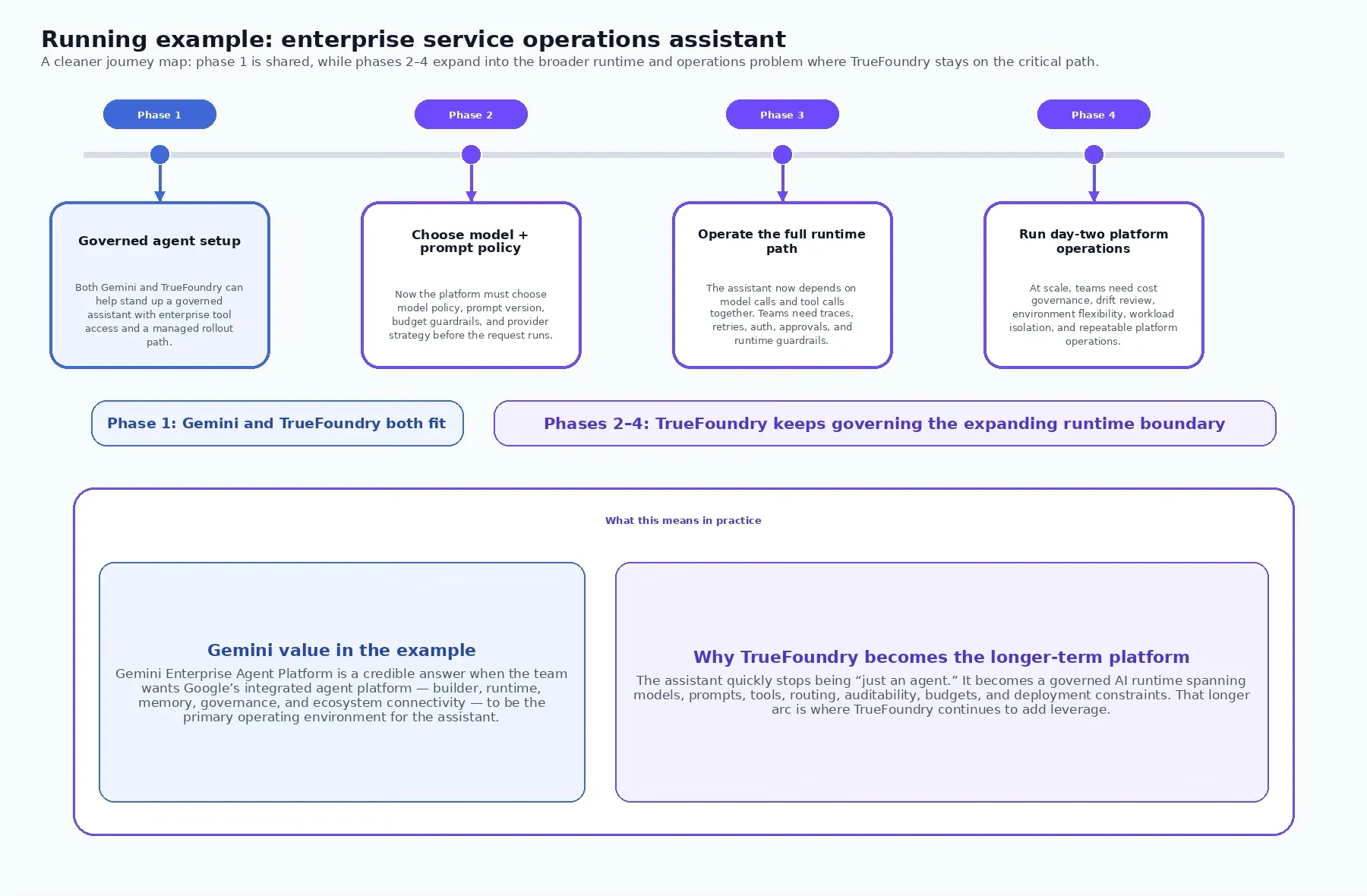
Imagine an enterprise assistant that helps support and operations teams resolve high-priority incidents. It needs Salesforce account context, Jira and ServiceNow tickets, Confluence and internal docs, SAP order information, and a set of internal APIs. It also needs different model policies: commodity requests can use a lower-cost managed model, but high-sensitivity or domain-specific flows may need a different provider or a self-hosted model.
At first glance, this looks like an agent-building problem. But in production it becomes a control-plane problem. Which model is allowed? Which prompt version is active? Which tools are allowed for which teams? How do you route traffic? How do you trace model and tool failures together? How do you apply budgets, auditability, and deployment constraints across the whole runtime?
This is where the difference between Gemini and TrueFoundry becomes clearer. Gemini addresses a substantial part of the agent stack. TrueFoundry is designed to keep governing the system as that runtime surface expands.
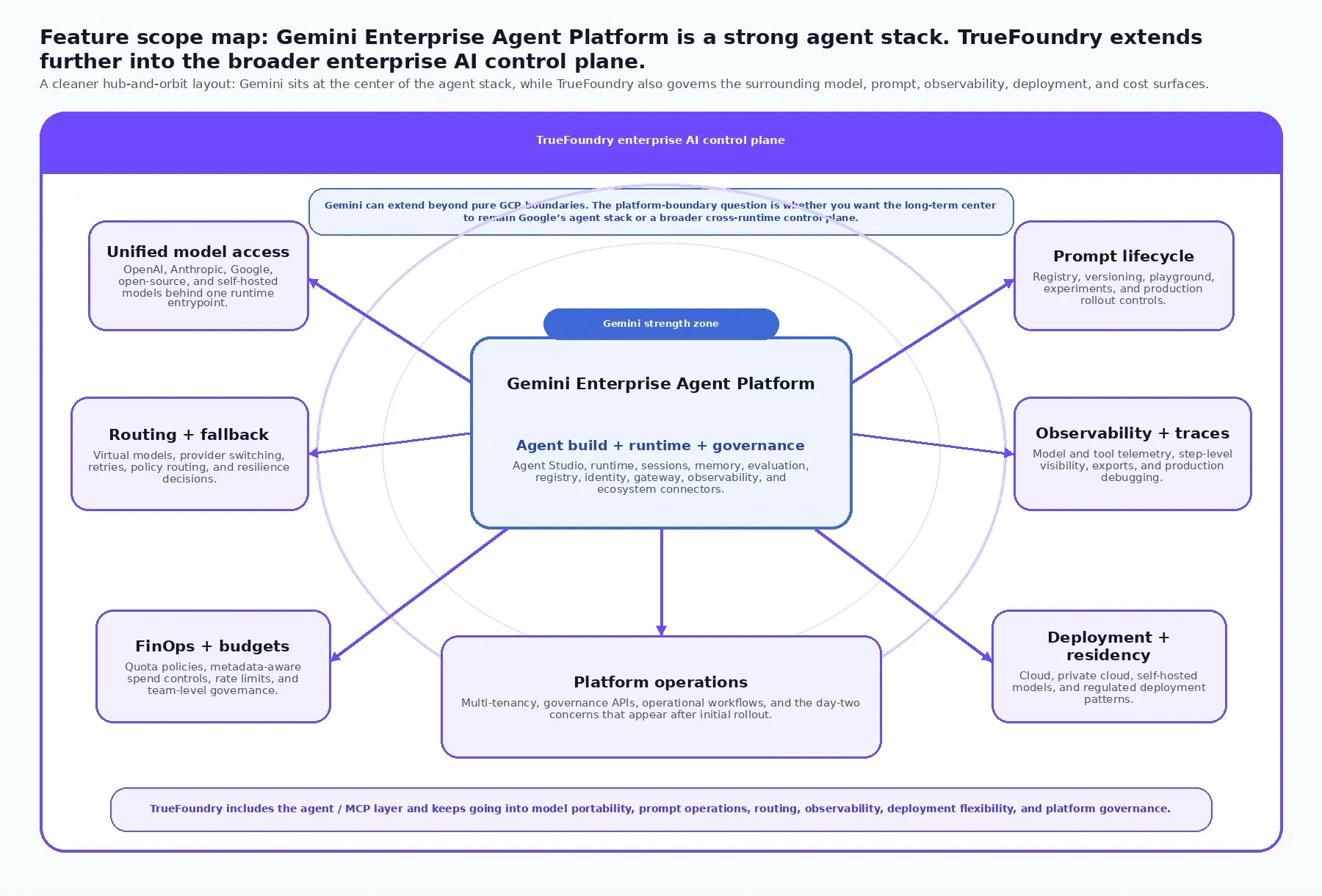
It gives Google Cloud a genuinely cohesive agent platform story
Google now has a more coherent end-to-end answer than “use a model endpoint and assemble the rest yourself.” The platform brings together agent development, runtime, sessions, persistent memory, evaluation, observability, and governance capabilities. That is a meaningful step up from a fragmented toolchain.
It is broader than a pure-GCP-only caricature
A fair comparison should acknowledge this explicitly. Google is positioning Gemini Enterprise Agent Platform to connect outside of Google Cloud as well — through business-system connectors, partner-built agents, the Agent-to-Agent protocol, and data access patterns that can reach beyond one cloud. So the weak argument “Gemini only matters if everything is already in GCP” is no longer the right one.
It has strong Google-native advantages
If your organization wants Google’s data, infrastructure, and agent ecosystem to be the foundation, Gemini is increasingly attractive. The combination of Gemini models, Vertex AI lineage, Google’s agent runtime, and employee-facing Gemini surfaces is compelling for teams standardizing on the Google stack.
TrueFoundry is oriented around the runtime control plane, not only a single cloud’s agent boundary
TrueFoundry’s center of gravity is the AI gateway and platform control plane: one layer to manage model access, routing, guardrails, prompts, budgets, observability, and operational controls. That matters because enterprises often discover that “building the agent” is only the first step. Operating the runtime becomes the harder problem.
Model governance is first-class, including provider neutrality and self-hosted options
Gemini Enterprise can support multiple models, but it is naturally anchored in Google’s platform worldview. TrueFoundry is designed to keep the model layer portable. If you want one platform that can mediate OpenAI, Anthropic, Google, open-source, and self-hosted models with virtual models, fallbacks, and routing logic, TrueFoundry aligns more directly with that requirement.
Prompt lifecycle is treated as a production concern
In production systems, prompt behavior is not a side detail. Teams need prompt versioning, testing, iteration, rollout discipline, and visibility into how prompt changes affect costs and outcomes. TrueFoundry treats this as part of the platform surface rather than leaving it implicit inside an agent project.
Deployment posture is often part of the platform decision
A platform team often has to support public cloud, private cloud, regulated environments, self-hosted models, or residency constraints simultaneously. That deployment flexibility is a core part of TrueFoundry’s value. It lets platform teams preserve architectural consistency even when their deployment reality is mixed. This is especially relevant for self-hosted, regulated, and air-gapped environments, where the platform needs to fit the buyer’s compliance boundary rather than require the boundary to move.
Operational consistency matters across models and tools together
Production failures are often not “model failures” or “tool failures” in isolation. They are failures of the model-prompt-tool chain. TrueFoundry shines here because it is purpose-built to govern the full model-prompt-tool execution path with observability, traces, quotas, policies, and runtime controls across the combined execution surface.
A balanced comparison should say this plainly: Gemini Enterprise Agent Platform is good. In some organizations, it may be very good. Google now has a substantially more complete story for agent development, runtime, governance, and enterprise reach than it had before.
But the TrueFoundry case still holds for teams whose platform boundary is broader than a single agent ecosystem. Many enterprise teams are not simply choosing an agent builder. They are choosing the operating layer that will sit between applications and a changing universe of models, prompts, tools, policies, clouds, and deployment patterns. That is the problem TrueFoundry is built for.
So the conclusion is not “Gemini cannot do enterprise agents.” It clearly can. The practical conclusion is this: Gemini is best suited when the enterprise wants Google’s agent platform to be the center of gravity. TrueFoundry is better suited when the enterprise wants a broader, more portable AI runtime control plane that remains useful as the platform scope expands.
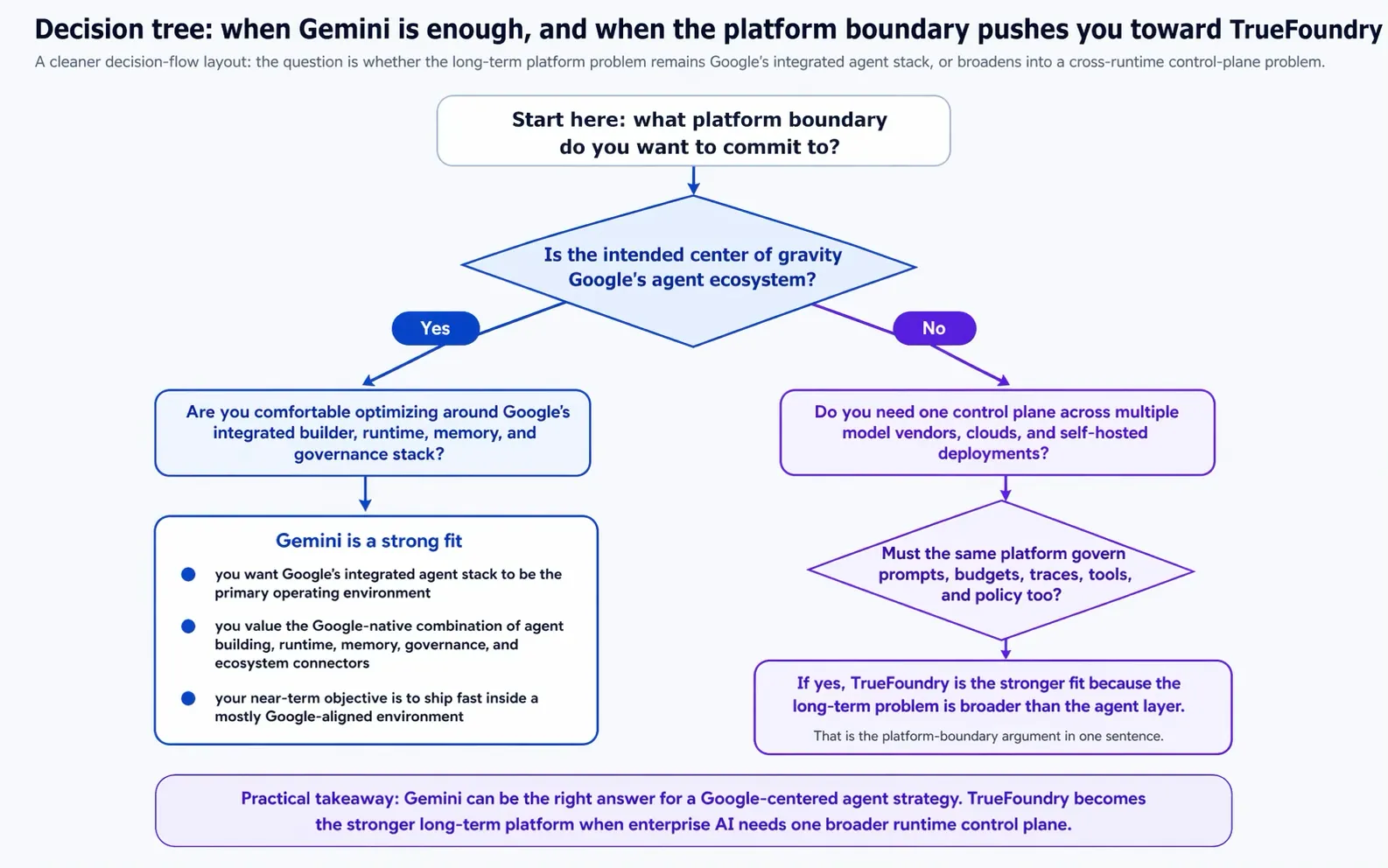
Final takeaway: the choice is not whether Gemini can support enterprise agents; it can. The choice is where the durable platform boundary should sit: inside a Google-centered agent strategy, or in a portable control plane that platform teams can carry across models, tools, clouds, self-hosted deployments, and regulated environments.
TrueFoundry AI Gateway delivers ~3–4 ms latency, handles 350+ RPS on 1 vCPU, scales horizontally with ease, and is production-ready, while LiteLLM suffers from high latency, struggles beyond moderate RPS, lacks built-in scaling, and is best for light or prototype workloads.






The latest news, articles, and resources sent to your inbox


.png)
.png)
.png)
.png)
.png)
.png)
.png)
.png)
.png)
.png)
.png)


