Blank white background with no objects or features visible.

اسأل TFY: قم بالتصحيح والتحليل واتخاذ الإجراءات بشأن كل ما يحدث داخل بوابة الذكاء الاصطناعي الخاصة بك اعرف المزيد

تعلن TrueFoundry عن استحواذها على Seldon AI، موسعة بذلك لوحة التحكم الخاصة بها للذكاء الاصطناعي للمؤسسات. البيان الصحفي الكامل →

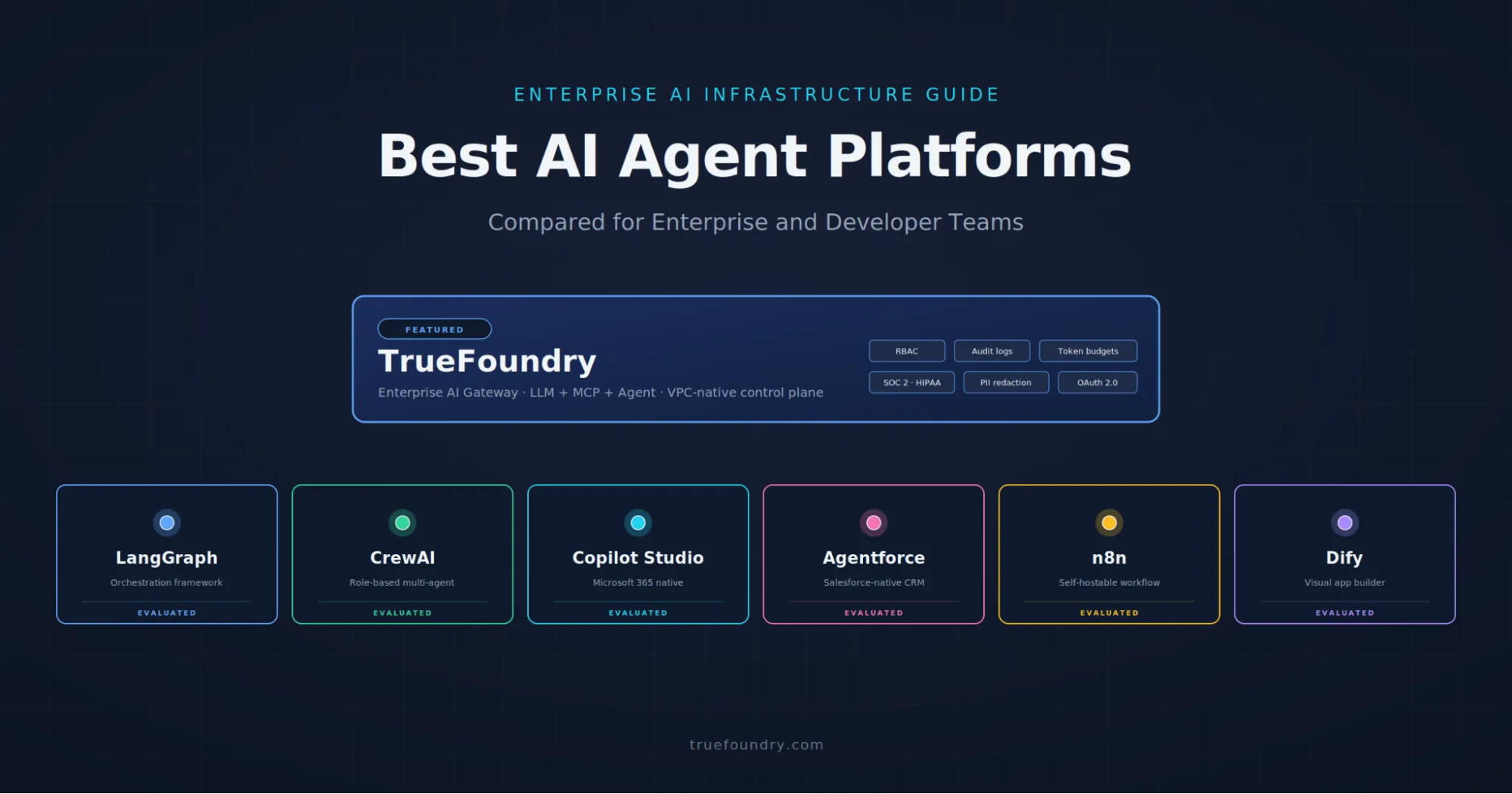
أفضل منصات وكلاء الذكاء الاصطناعي في عام 2026: مقارنة لفرق المؤسسات والمطورين

By أشيش دوبي

Published: July 4, 2026

TrueFoundry governs best AI agent platforms in enterprise production deployments

A 2025 study from MIT's NANDA initiative reported that 95% of generative AI pilots fail to deliver measurable ROI. Model quality is rarely the cause. The more common pattern: the AI agent platform chosen during prototyping cannot handle the governance, security, and operational weight that production imposes once a real customer is on the other end.

Choosing the right AI agent platform in 2026 means choosing three things at the same time: The environment in which custom agents are built. The infrastructure governing what they can do. The accountability layer that satisfies a compliance team when an auditor asks what an AI system accessed and why.

This guide compares the leading best AI agent platforms across the aspects that matter at enterprise scale. The list opens with TrueFoundry, the platform that addresses what the others leave unresolved at the infrastructure and governance layer, and works through the field from there.

Building AI Agents Is the Easy Part, Governing Them in Production Is the Hard Part

TrueFoundry gives your agents a single governed gateway with RBAC, cost controls, and audit logging inside your cloud environment.

What Separates an AI Agent Platform From an AI Agent Tool

The line between AI agent tools and AI agent platforms shapes procurement decisions more than any feature comparison.

An AI agent tool is a focused instrument. It is a framework for agent building, a workflow automation product, a visual workflow builder for wiring models to specific tasks. Each solves a defined problem within a narrow scope.

An AI agent platform sits at a different level. It is the broader environment where organizations build, deploy, govern, and scale agent solutions across teams, models, and use cases from a shared infrastructure foundation.

The best AI agent platforms pair agent development capabilities with operational controls required for production. Access management, observability, cost governance, and compliance evidence must apply uniformly across every workload running on top.
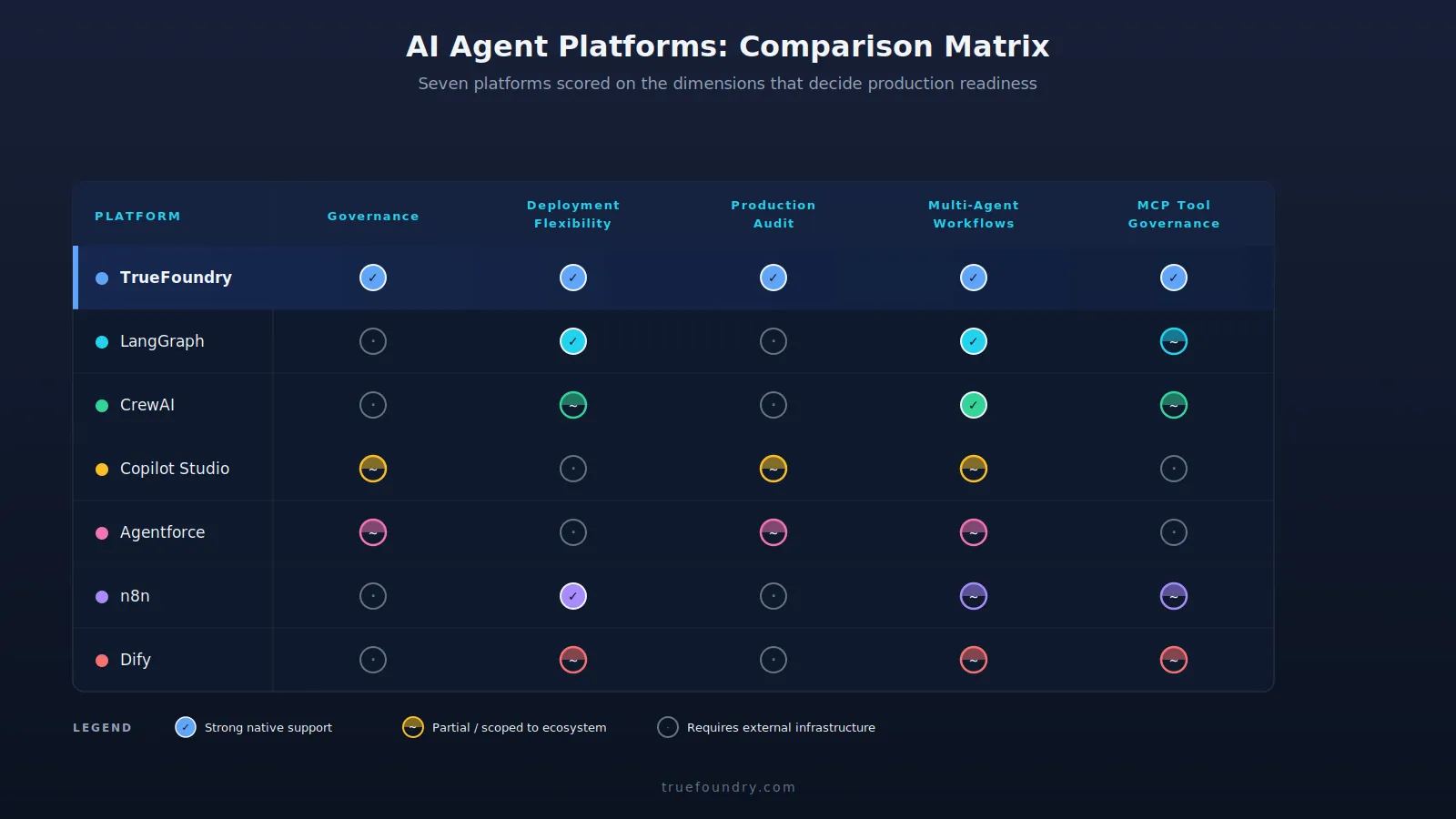
Comparing best AI agent platforms by governance and deployment model
Gartner Hype Cycle for Platform Engineering 2026

The Best AI Agent Platforms in 2026

Choosing from the best AI agent platforms depends on your team size, technical depth, governance requirements, and deployment model. Here is a quick comparison:
Platform Best For Deployment Governance Depth
TrueFoundry Large enterprises needing VPC-native AI agent governance AWS, GCP, Azure (VPC) Full: RBAC, audit logs, cost controls
LangGraph Technical teams building stateful, complex task workflows Self-hosted Framework-level only
CrewAI Small teams prototyping role-based agentic AI Cloud or self-hosted Minimal
Microsoft Copilot Studio Business users inside Microsoft 365 Microsoft Cloud Microsoft-scoped
Salesforce Agentforce Sales teams and customer service on Salesforce Salesforce Cloud Salesforce-scoped
n8n Technical teams needing visual workflow builder with self-hosting Self-hosted Workflow-level
Dify Smaller teams doing AI agent development with RAG Cloud or self-hosted Minimal

TrueFoundry

TrueFoundry AI gateway dashboard shows agent governance and cost controls

TrueFoundry is an enterprise-grade AI agent platform and AI gateway recognized in the 2025 Gartner Market Guide for AI Gateways. It governs every AI agent, model call, and tool connection from a single VPC-native control plane. It deploys entirely inside your own AWS, GCP, or Azure account, keeping all sensitive data and inference traffic within your network boundary. All these features make it one of the best AI agent platforms.

What Are the Key Features of TrueFoundry?

  • Unified gateway for all agent workloads: The LLM gateway handles model routing and failover across 250-plus providers. The MCP gateway governs every tool connection an AI agent makes. The Agent gateway applies per-agent identity, circuit breakers, and workflow-level cost controls. All three operate from one control plane with no separate tools required.
  • VPC-native deployment with full data sovereignty: TrueFoundry installs inside your own AWS, Google Cloud, or Azure account. No inference calls, agent actions, or sensitive data ever route through third-party infrastructure. This architecture satisfies HIPAA, SOC 2, and ITAR requirements by design rather than by contract terms.
  • Identity-aware access control at the gateway layer: OAuth 2.0 identity injection ties every AI agent action to the authenticated requesting user. Per-team and per-agent RBAC policies apply before any request reaches a model or tool. This eliminates the over-privileged shared service accounts that create an ungoverned blast radius in most AI agent platforms.
  • Real-time cost controls and immutable audit logging: Hard token budgets enforce spending limits per team, service, and endpoint before any inference cost accumulates. Every AI agent action, tool invocation, and model call is logged with structured metadata and retained inside your own cloud environment for compliance evidence production without custom pipelines.

How Much Does TrueFoundry Cost?

TrueFoundry offers four pricing tiers:

  • Developer is free and suited to small businesses and independent builders experimenting with AI agent development workflows.
  • Pro is $499 per month for small teams shipping real AI agent features with usage-based predictability and essential governance tools.
  • Pro Plus is $2,999 per month for business teams requiring stricter data controls, advanced account management, and priority SLAs.
  • Enterprise is custom-priced for large enterprises and large companies running AI agent workloads at scale with advanced governance.

For Whom Is TrueFoundry Best For?

TrueFoundry is built for enterprise technical teams and platform engineering groups that need AI agent governance enforced at the infrastructure layer across models, agents, and data sources. It is one of the best AI agent platforms for large enterprises in regulated industries, multi-cloud deployments, and organizations where data sovereignty and full control over compliance evidence are non-negotiable.
LangGraph

LangGraph offers graph-based AI agent workflow orchestration

LangGraph is a graph-based orchestration framework for building stateful, multi-step AI agent workflows. It gives technical teams deterministic control over every execution transition and conditional branch in complex tasks.

What Are the Key Features of LangGraph?

  • Graph-based execution model with explicit state transitions per step
  • Time-travel debugging and checkpointing for long-running AI agent workflows
  • Native support for conditional branching and human-in-the-loop human intervention points

What Are the Pros and Cons of LangGraph?

Pros Cons
Deterministic, auditable execution Steeper learning curve for new users
Strong fault tolerance and recovery Verbose setup for simple specific tasks
Active open-source community Governance requires external AI gateway

Why Is TrueFoundry Better Than LangGraph?

LangGraph is a powerful agent builder framework for complex tasks, but it provides no access controls, cost limits, or compliance audit trails out of the box. TrueFoundry's AI gateway platform adds the governance layer above LangGraph, applying RBAC, token budgets, and immutable logs to every AI agent workflow LangGraph builds.
CrewAI

CrewAI offers role-based AI agent crew builder features

CrewAI is a role-based agent builder framework that models multi-agent systems as teams with defined roles, goals, and AI agent tool sets. Teams frequently cite its ability to compress agent building from days to hours for standard business processes.

What Are the Key Features of CrewAI?

  • Role-based AI agent abstraction mapping directly to business processes and team structures
  • Workflow automation across specialized agents without custom orchestration code
  • Low barrier for business users building their first agent prototype

What Are the Pros and Cons of CrewAI?

Pros Cons
Fastest time to working prototype High token consumption per task
Intuitive role-based mental model Limited branching control at scale
Active open source community Governance requires external layer

Why Is TrueFoundry Better Than CrewAI?

CrewAI accelerates AI agent development for small teams but provides no native access controls, cost attribution, or audit trails for enterprise platforms. TrueFoundry governs every CrewAI-built agent from the gateway layer, applying the same RBAC, cost limits, and compliance logging that large enterprises require without touching the agent code.
Microsoft Copilot Studio

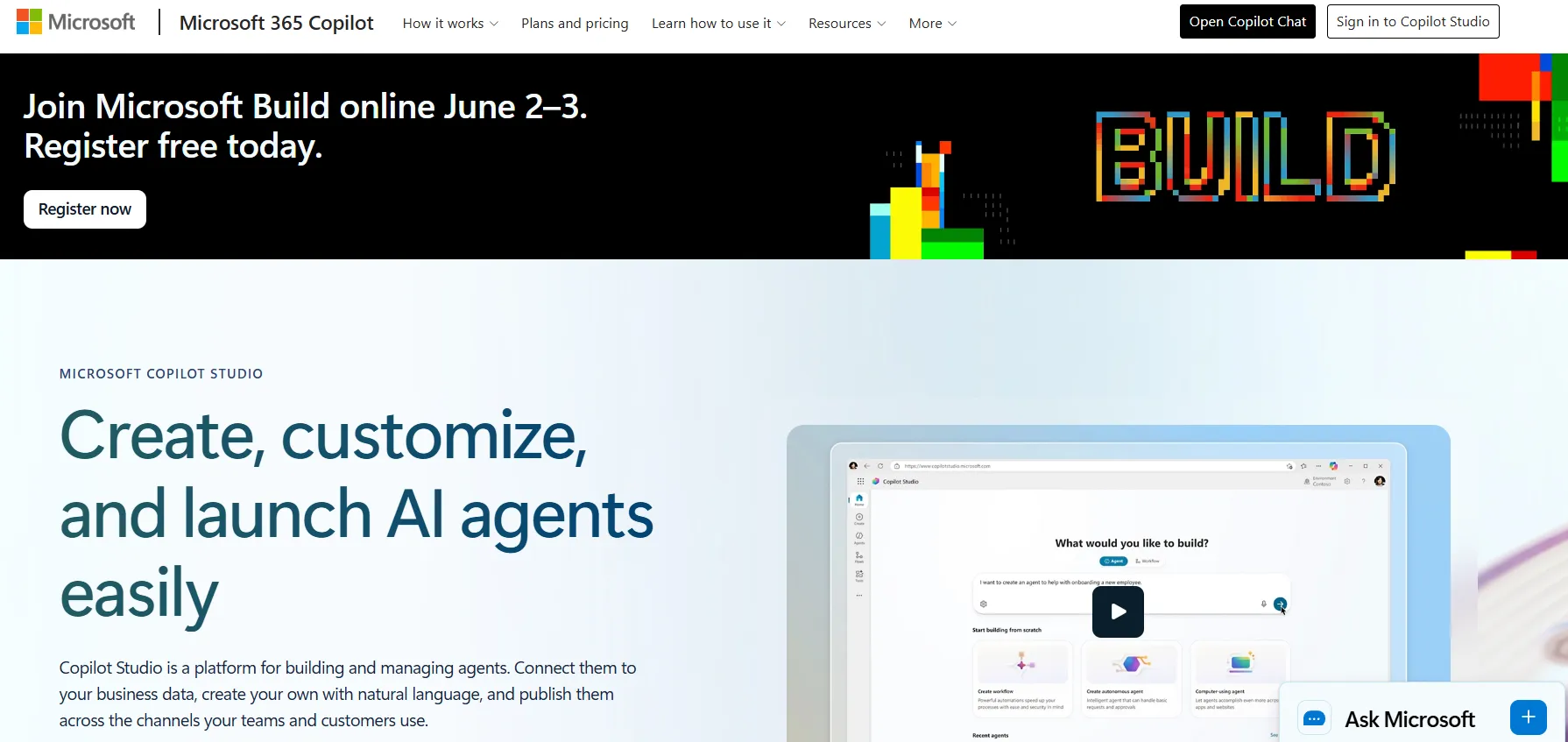
Microsoft Copilot Studio AI agent builder interface

Microsoft Copilot Studio is the low-code AI agent builder inside the Microsoft 365 ecosystem. It provides native connections to SharePoint, Teams, Dynamics, and Azure OpenAI Service. Business teams and business users can build custom agents without deep technical expertise.

What Are the Key Features of Microsoft Copilot Studio?

  • Low-code visual builder for custom agents inside Microsoft Copilot and Teams
  • Native integration with SharePoint, Dynamics, and Azure OpenAI data sources
  • Inherited Microsoft 365 identity and permissions for each AI assistant

What Are the Pros and Cons of Microsoft Copilot Studio?

Pros Cons
Zero integration overhead for Microsoft shops Governance scoped to Microsoft cloud only
Accessible for business users Limited multi-cloud agent capabilities
Fast first agent deployment External AI agent tools require custom work

Why Is TrueFoundry Better Than Microsoft Copilot Studio?

Microsoft Copilot Studio governs custom agents only within the Microsoft boundary. TrueFoundry's AI gateway extends governance uniformly across Microsoft, Google Cloud, AWS, and self-hosted models. This makes TrueFoundry the right choice for large enterprises running AI agent platforms across mixed cloud environments.
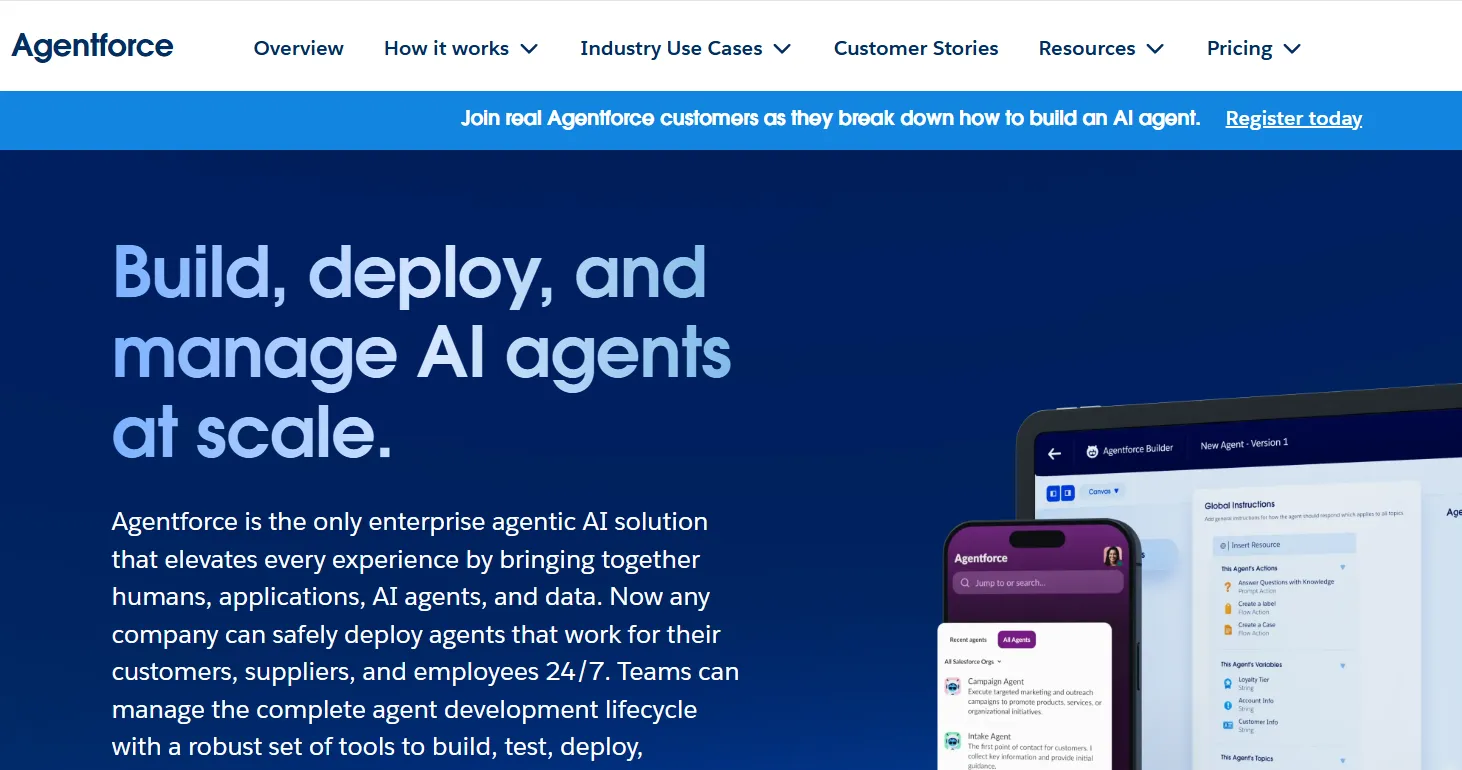
Salesforce Agentforce

Salesforce Agentforce AI agent platform inside CRM interface

Salesforce Agentforce integrates AI agent capabilities directly into Salesforce Data Cloud, Sales Cloud, and Service Cloud. Sales teams, customer service teams, and support teams benefit from agents that run on live CRM data without requiring custom integrations.

What Are the Key Features of Salesforce Agentforce?

  • Direct access to Salesforce account, case, and opportunity data from day one
  • Customer service and sales teams workflow automation built on existing CRM identity
  • Atlas Reasoning Engine for agent decision-making inside real workflows

What Are the Pros and Cons of Salesforce Agentforce?

Pros Cons
Deep CRM data access at launch Expensive at scale for small businesses
No integration overhead for Salesforce teams Scoped to Salesforce data sources only

Why Is TrueFoundry Better Than Salesforce Agentforce?

Agentforce is excellent within Salesforce but cannot govern AI agent workloads spanning enterprise systems beyond the Salesforce boundary. TrueFoundry's Agent gateway governs agents across CRM, ERP, internal APIs, and external tools from one control plane. This gives large companies complete control that Salesforce-scoped AI agent platforms cannot provide.
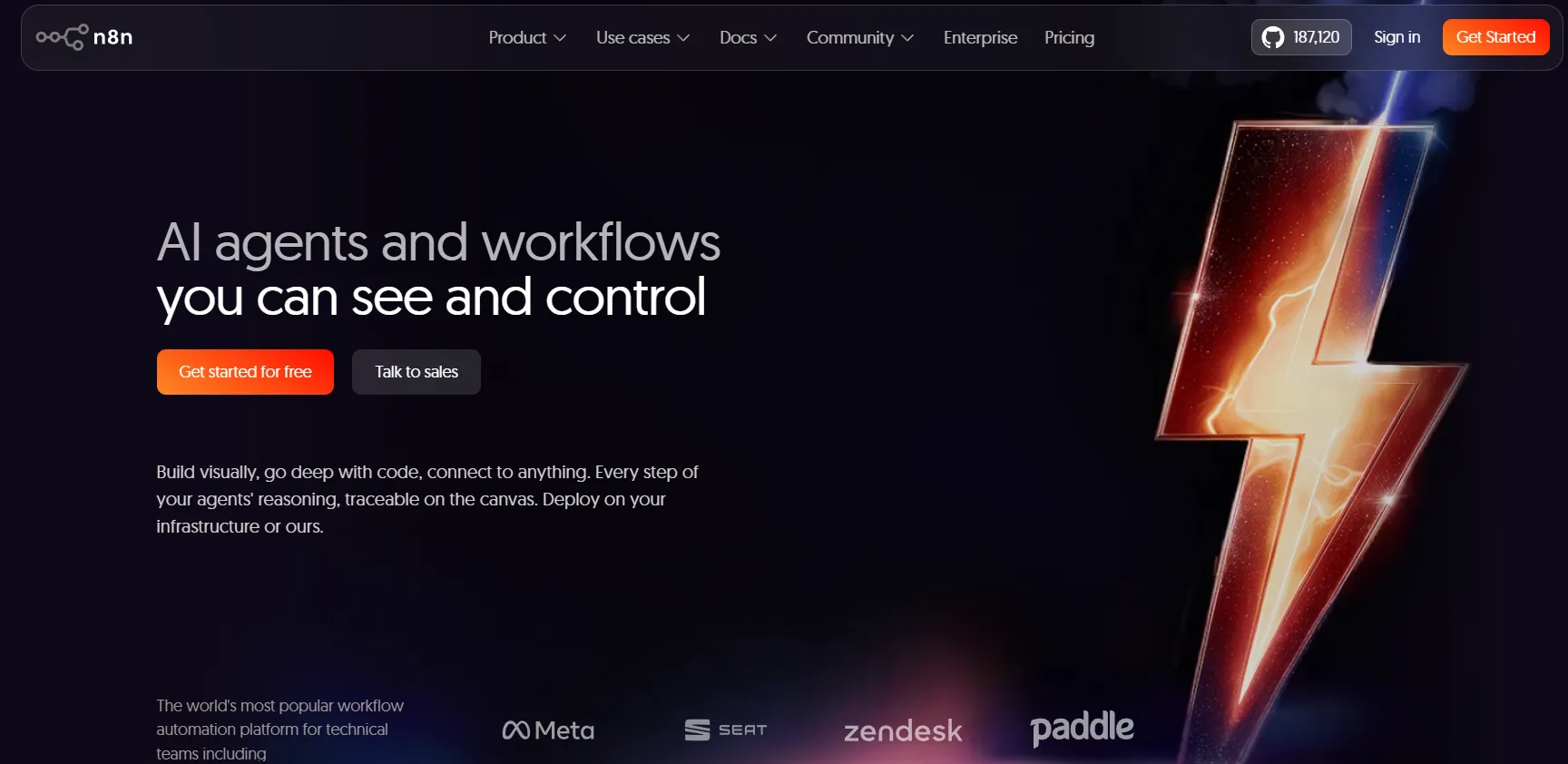
n8n

n8n visual workflow builder offers AI agent automation

n8n is a visual workflow builder and workflow automation platform with native AI agent capabilities. It supports over 400 integrations and runs on a self-hostable architecture. It is a flexible AI agent tool for technical teams that need control over their infrastructure and sensitive data handling.

What Are the Key Features of n8n?

  • Visual builder canvas combining traditional automation and AI agent steps in one workflow
  • Self-hosting option that keeps sensitive data inside the organization's own infrastructure

What Are the Pros and Cons of n8n?

Pros Cons
Self-hosted data sovereignty Governance requires technical expertise
Broad integration coverage No native AI agent cost controls

Why Is TrueFoundry Better Than n8n?

n8n is a strong workflow automation tool for technical teams but lacks the AI agent governance, RBAC, and audit logging that large enterprises require. TrueFoundry's AI gateway platform adds identity-aware access controls and compliance logging above n8n workflows without changing the automation logic teams have already built.
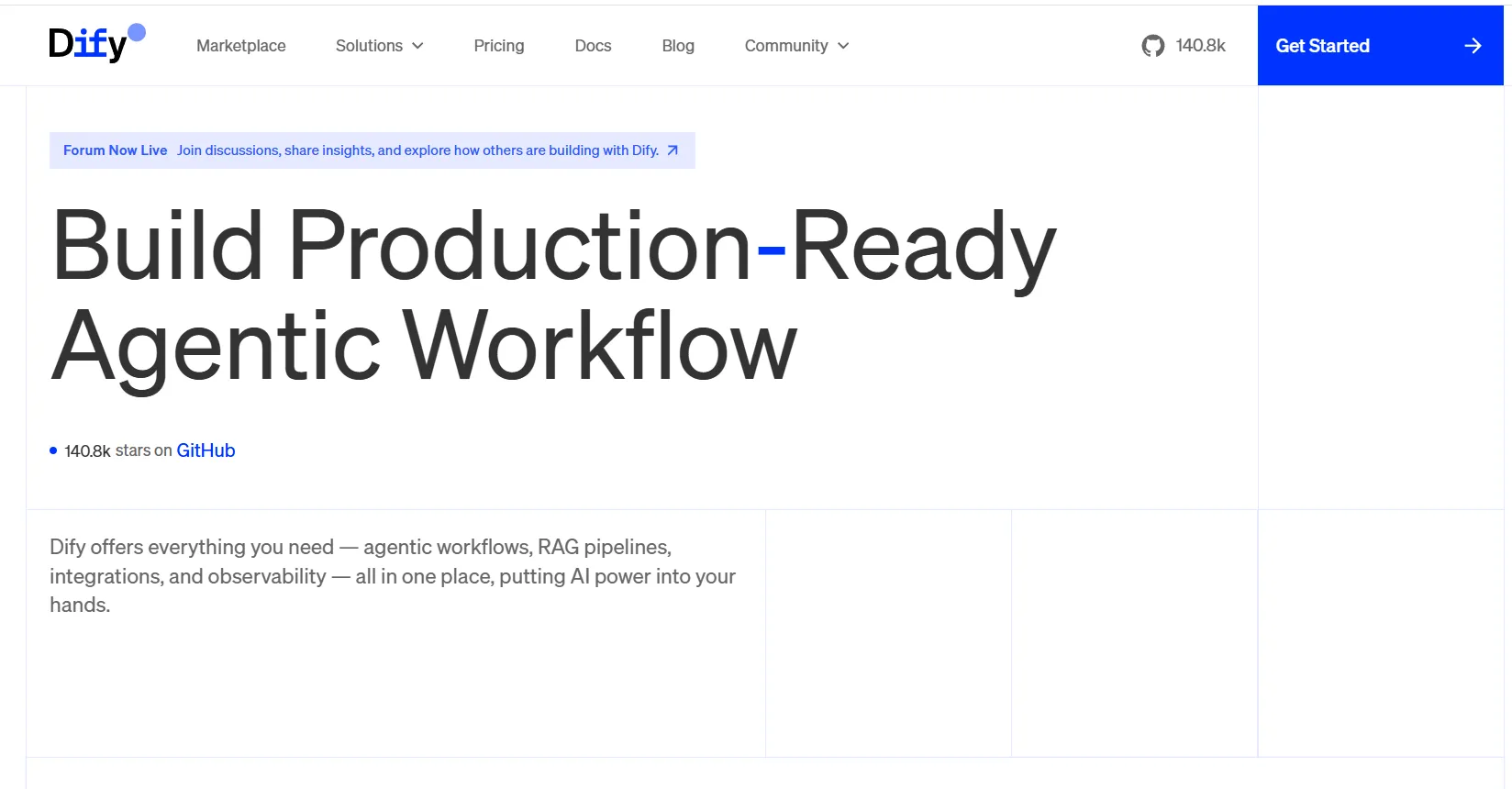
Dify

Dify open source AI agent application builder interface

Dify is an open source visual editor for building AI agent applications with RAG pipelines, function calling, and multi-LLM support. It is one of the most accessible AI agent platforms for small businesses exploring AI agent development without heavy infrastructure investment.

What Are the Key Features of Dify?

  • Visual editor for AI agent applications with RAG, function calling, and multi-LLM configuration
  • Multi-model switching through configuration changes rather than code rewrites
  • Open source architecture with self-hosting option for sensitive data control

What Are the Pros and Cons of Dify?

Pros Cons
Fast multi-model AI agent prototyping Minimal governance for enterprise platforms
Low barrier for business users Agent capabilities limited at production scale
Open source with active community No native cost controls or audit logging

Why Is TrueFoundry Better Than Dify?

Dify is well-suited for rapid AI agent development and prototyping but was not built for the governance requirements of large enterprises. TrueFoundry provides the production infrastructure that Dify AI agent builds require before they can operate at enterprise scale.

Every AI Agent Platform Has a Governance Ceiling, TrueFoundry Is What Sits Above It One

Create your TrueFoundry account and deploy a VPC-native gateway that governs every AI agent platform your teams use.

كيف يعمل TrueFoundry بالتوازي مع أي منصة وكيل ذكاء اصطناعي؟

TrueFoundry ليس منشئ وكلاء ذكاء اصطناعي منافسًا. إنها إحدى أفضل منصات وكلاء الذكاء الاصطناعي التي تعلو أي منصات وكلاء ذكاء اصطناعي أخرى وتتحكم فيما يمكن للوكلاء فعله، وما يمكنهم الوصول إليه، وما هي تكلفة تشغيلهم.

المنصة مستقلة عن الأطر البرمجية. فالمؤسسة التي تستخدم LangGraph في فريق واحد، وCrewAI في فريق آخر، وn8n في مكان آخر، وبناءً مخصصًا لحالة استخدام رابعة، تحصل على نفس طبقة الحوكمة المطبقة بشكل موحد عبر الأربعة جميعًا.

تعمل أركان الحوكمة الأربعة على النحو التالي:

  • يتم توجيه كل استدعاء نموذج من أي منصة وكيل ذكاء اصطناعي عبر TrueFoundry بوابة نماذج اللغة الكبيرة (LLM). يتم تطبيق التحكم في الوصول المستند إلى الدور (RBAC)، والمصادقة، وتجاوز فشل المزودين بغض النظر عن أدوات وكيل الذكاء الاصطناعي التي بدأت الاستدعاء.
  • يمر كل اتصال أداة MCP عبر بوابة MCP. وترتبط سياسات الوصول لكل أداة وتسجيل التدقيق الكامل بهوية المستخدم الطالب.
  • يتم تطبيق حدود الإنفاق عند البوابة قبل أن يستهلك أي سير عمل لوكيل ذكاء اصطناعي قدرة الاستدلال. وهذا يمنع ارتفاع التكاليف بشكل غير متحكم فيه الناتجة عن تراكم قدرات الوكيل بصمت عبر سير العمل متعدد الخطوات.
  • يتم تسجيل كل استدعاء نموذج، واستدعاء أداة، وإجراء وكيل ذكاء اصطناعي مع بيانات وصفية منظمة داخل حدود سحابة العميل الخاصة. وهذا يلبي متطلبات SOC 2 وHIPAA وITAR دون الحاجة إلى مكدس تسجيل إضافي.

احجز عرضًا توضيحيًا مع TrueFoundry لترى كيف تعمل البوابة فوق مكدسك الحالي وتطبق حوكمة متسقة في كل مكان.
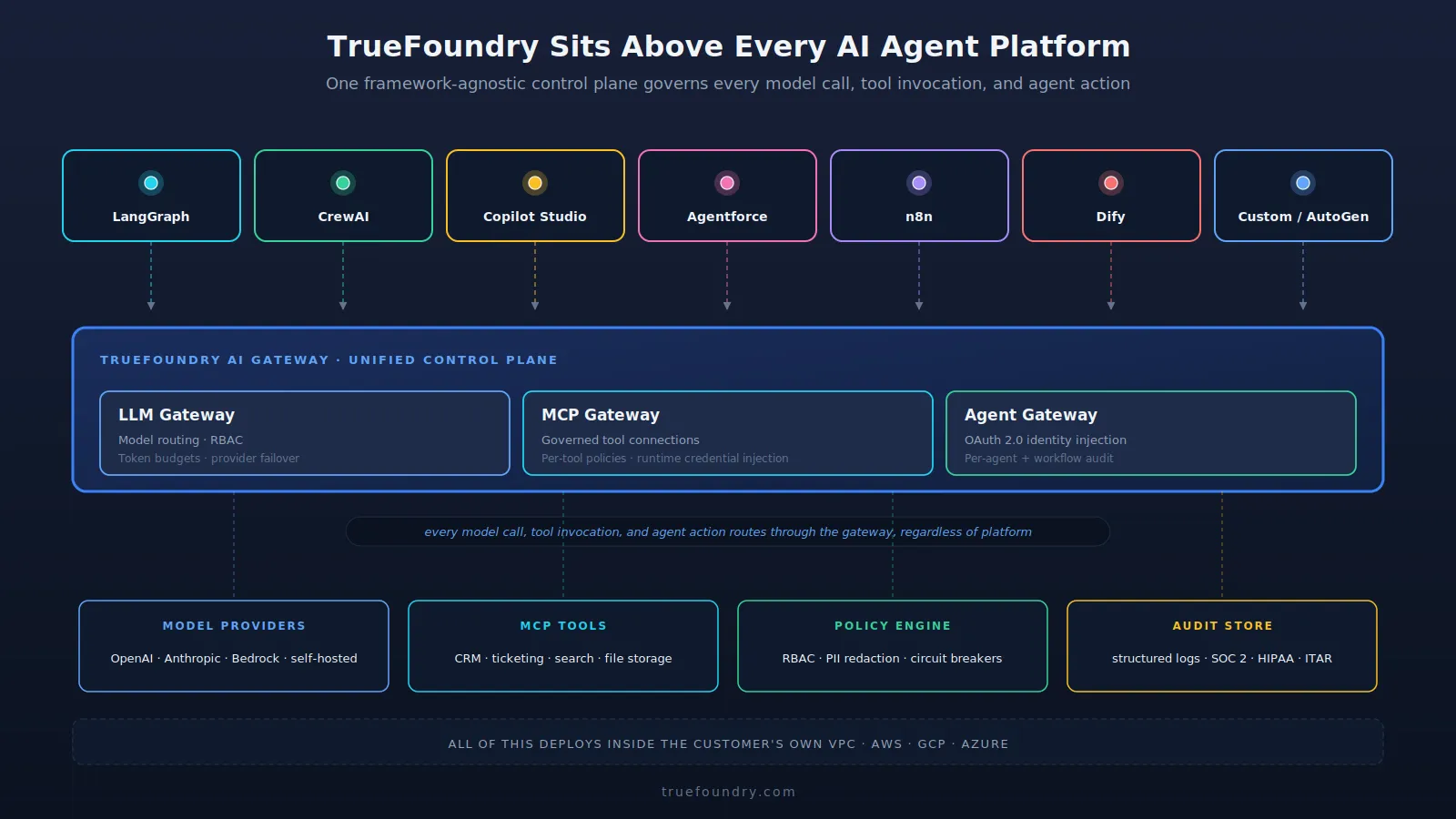
TrueFoundry gateway governs multiple AI agent platforms uniformly in production

Try now.

One gateway for all your models, MCP servers, and agents.
No credit card needed.

Start free
Table of Contents

One Gateway for Every LLM, Agent and MCP Server

Book a 30-min with our AI expert

Book a Demo

The fastest way to build, govern and scale your AI

Book Demo
Summarize with
ChatGPT logo by OpenAI
Perplexity AI logo
Blurry red snowflake on white background, symmetrical frosty design with soft edges and abstract shape.

Discover More

No items found.
August 17, 2026
|
5 min read

Sandboxed Code Agents: Let Models Execute Without Letting Them Roam

No items found.
Portkey AI Gateway Pricing
August 15, 2026
|
5 min read

فهم تسعير بوابة Portkey للذكاء الاصطناعي لعام 2026: دليل شامل ومقارنة

No items found.
MCP registry connecting agents to governed MCP servers
August 15, 2026
|
5 min read

أفضل سجلات MCP في عام 2026: مقارنة للمطورين والمؤسسات

No items found.
TrueFoundry AI gateway powers enterprise AI platform engineering at scale
August 15, 2026
|
5 min read

ما هي هندسة منصات الذكاء الاصطناعي؟ دليل عملي لفرق المؤسسات

No items found.
No items found.

Recent Blogs

Black left pointing arrow symbol on white background, directional indicator.

Frequently asked questions

ما هي أفضل 5 وكلاء ذكاء اصطناعي في الاستخدام المؤسسي في عام 2026؟

تتركز أكثر مهام وكلاء الذكاء الاصطناعي انتشارًا في الشركات حول خمسة أشكال رئيسية: أتمتة دعم العملاء، والمساعدون البرمجيون للمطورين، ومساعدو المعرفة الداخلية، ووكلاء فرق المبيعات وسير عمل إدارة علاقات العملاء (CRM)، وأنظمة البحث وإعداد التقارير متعددة الوكلاء. يعمل معظمها على LangGraph أو CrewAI أو AutoGen أو منصات وكلاء الذكاء الاصطناعي الخاصة بالبائعين مثل Salesforce Agentforce. تتمركز الحوكمة بشكل متزايد في طبقة بوابة الذكاء الاصطناعي بدلاً من أن تكون جزءًا من كود تطوير وكيل الذكاء الاصطناعي نفسه.

ما هي أفضل منصة ذكاء اصطناعي لبناء وحوكمة الوكلاء في بيئة الإنتاج؟

يعتمد ذلك على ما هو موجود بالفعل في المكدس التقني. تتصدر LangGraph و CrewAI فئة الأطر لتطوير الوكلاء. أما بالنسبة للحوكمة، والتحكم في التكاليف، وأدلة التدقيق، فإن الطبقة التي تقرر ما إذا كان وكيل الذكاء الاصطناعي سيصل إلى مرحلة الإنتاج، وهي بوابة ذكاء اصطناعي أصلية لشبكة VPC مثل TrueFoundry، تقع فوق أي إطار عمل يتم اختياره. وهي تطبق ضوابط متسقة عبر جميع منصات وكلاء الذكاء الاصطناعي.

ما هي الأدوات المستخدمة لبناء وكلاء الذكاء الاصطناعي؟

تجمع معظم عمليات بناء وكلاء الذكاء الاصطناعي الإنتاجية بين ثلاث طبقات. مزوّد نماذج مثل OpenAI أو Anthropic. إطار عمل للتنسيق مثل LangGraph أو CrewAI أو AutoGen. طبقة دمج الأدوات، وعادةً ما تكون MCP أو استدعاءات API مباشرة. تنضم بوابة الحوكمة إلى المكدس بمجرد أن يتعامل وكيل الذكاء الاصطناعي مع مستخدمين حقيقيين أو بيانات حساسة أو أنظمة مؤسسية.

أي أداة يجب أن تستخدمها لبناء وكيل ذكاء اصطناعي لحالة الاستخدام الخاصة بك؟

طابق الأداة مع عبء العمل. لأتمتة خدمة العملاء على Salesforce، يُنصح بـ Agentforce. يناسب Microsoft Copilot Studio سير العمل المرتبط بـ Microsoft 365. أما أتمتة سير العمل المستضافة ذاتيًا، فتشير إلى n8n. وبالنسبة لسير العمل الإنتاجي الذي يحافظ على الحالة ومقاوم للأخطاء، فالخيار هو LangGraph. النماذج الأولية متعددة الوكلاء القائمة على الأدوار تتجه نحو CrewAI. بينما النماذج الأولية لوكلاء الذكاء الاصطناعي التي تعتمد بشكل كبير على RAG تشير إلى Dify. وتبقى طبقة الحوكمة هي نفس التحدي بغض النظر عن أدوات وكلاء الذكاء الاصطناعي التي يتم اختيارها.

ما الفرق بين منصة وكلاء الذكاء الاصطناعي وإطار عمل وكلاء الذكاء الاصطناعي؟

يوفر إطار العمل المكونات الأساسية لتطوير وكلاء الذكاء الاصطناعي: بدائيات التنسيق، وتجريدات الوكلاء، وواجهات الأدوات. ويتوقف دوره عند هذا الحد. تضيف أفضل منصة لوكلاء الذكاء الاصطناعي الطبقة التشغيلية: النشر، والتحكم في الوصول المستند إلى الأدوار (RBAC)، وإمكانية المراقبة، وضوابط التكلفة، وسجلات التدقيق، وأدلة الامتثال المطبقة على كل وكيل ذكاء اصطناعي يعمل عليها. تُنشئ أطر العمل الوكلاء. بينما تُشغل منصات وكلاء الذكاء الاصطناعي هؤلاء الوكلاء في بيئة الإنتاج مع تحكم كامل وقدرات تدخل بشري.
Take a quick product tour
Start Product Tour
Product Tour