October 10, 2026
|
5 min read


Obtenha acesso instantâneo a um ambiente TrueFoundry ao vivo. Implante modelos, direcione o tráfego de LLM e explore a plataforma completa — seu sandbox estará pronto em segundos, sem necessidade de cartão de crédito.



.webp)
Blazingly fast way to build, track and deploy your models!
With the increasing adoption of large language models, effective deployment and inference management of artificial intelligence become crucial. Both LiteLLM and OpenRouter are some of the most popular platforms for managing AI workflows in an efficient way, however, they are quite different in approach.
LiteLLM aims at offering access to models and a unified API by providers. OpenRouter acts as cloud-native routing layer to manage traffic, reliability and selection of providers.
In this article, you'll learn how to compare LiteLLM and OpenRouter, identify their key differences, and know when to select LiteLLM or OpenRouter depending on the particular AI architecture.
The choice between LiteLLM and OpenRouter depends mainly on the level of control versus simplicity.
LiteLLM provides you with total control over LLMs with a self-hosted proxy, GitOps policy as code, and tight integration with monitoring solutions. This solution will be the best choice for platform teams that require customization and on-premise deployment.
On the other hand, OpenRouter is a managed edge SaaS product that does not require any hosting, a single credit pricing model across hundreds of models and built-in provider coverage.
.webp)
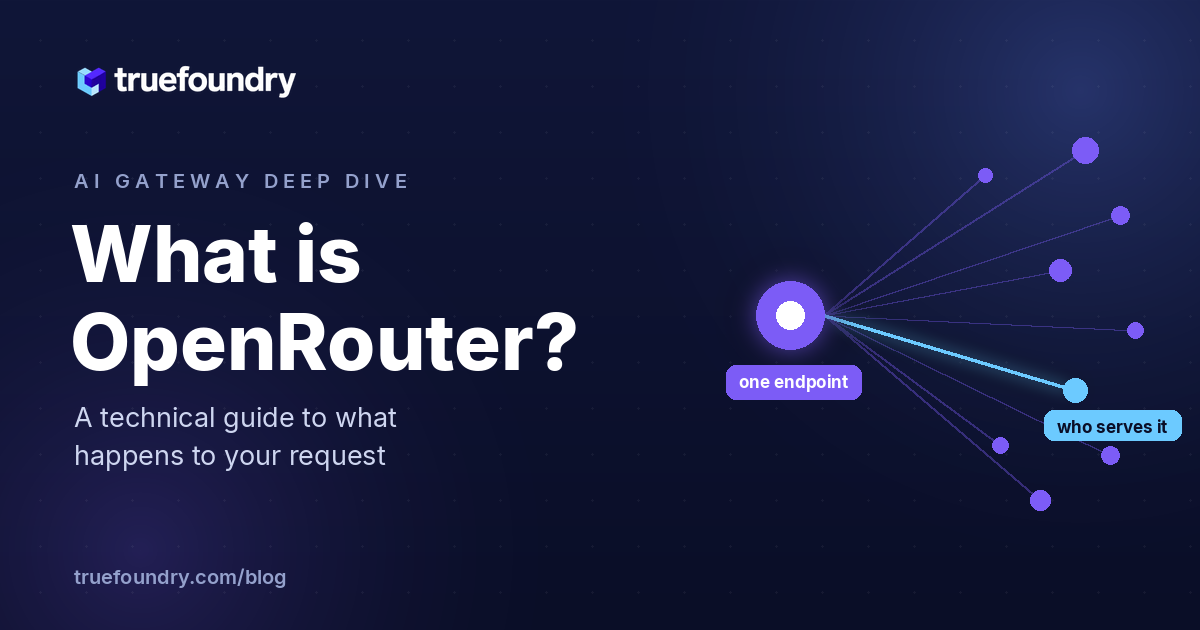
OpenRouter provides a single API gateway that connects developers to hundreds of large language models via one endpoint. There’s no need to deal with various APIs, SDKs, billing, and integrations from providers such as OpenAI, Anthropic, Gemini, Cohere, or Mistral.
OpenRouter supports existing OpenAI-compatible SDKs, making it a great substitute for LiteLLM.
When comparing OpenRouter with LiteLLM, one can say that OpenRouter concentrates on fully managed infrastructure and quick onboarding. Its purpose is to simplify working with multiple models by routing requests to various providers according to availability, cost, and performance, while ensuring failover if a provider fails.
Thanks to its support of OpenAI-style APIs, developers do not usually have to rewrite their logic when switching providers. With 300+ models and millions of users all over the world, OpenRouter is one of the most popular choices for teams building vendor-agnostic AI applications and scalable inference systems.
Also Read: Requesty vs OpenRouter | Litellm Alternative
Routing flexibility is another strength of OpenRouter. The system enables automatic request forwarding to the most inexpensive or available model, allowing developers to ensure high uptime and decrease operational overhead. OpenRouter makes it easy to manage infrastructure by combining the following capabilities:
- API access
- Billing
- Usage analytics
- Provider management
- Token management
Prompt caching, traffic shaping, custom providers, rate limiting, and other advanced capabilities make OpenRouter suitable for production AI applications. OpenRouter's final strength is developer productivity since the tool can integrate well with OpenAI-compatible SDKs and APIs, making onboarding easy for organizations implementing LLM workflows.
Consider building an application that will assist users in their customer support and use several LLM providers for both reliability and cost control. Using OpenRouter, you can connect OpenAI, Anthropic, and Gemini through the same API layer and automatically reroute requests to the other model in case a particular provider is temporarily unavailable or expensive due to high traffic.
This solution decreases operational overhead and increases reliability and cost control in production AI applications.This is one of the reasons why many organizations that chose between LiteLLM and OpenRouter opt for OpenRouter to build fast AI products.
Despite simplifying the connection with multiple providers, OpenRouter does not allow having enough direct control over the infrastructure. Organizations that compare OpenRouter and LiteLLM when choosing a solution for enterprise governance prefer LiteLLM in cases of private deployment, custom model serving, and policy-based infrastructure management.Also, organizations that require deeper customization of model serving, GPU infrastructure, or enterprise governance may face limitations of gateway-based solutions. As OpenRouter mostly focuses on routing and access, companies may still need additional capabilities for observability, deployment management, security controls, and LLMOps.
.webp)
LiteLLM is an open source gateway and SDK designed to help software developers leverage multiple large language models using one OpenAI-style API gateway. The need to connect different APIs provided by various providers including OpenAI, Anthropic, Azure OpenAI, Cohere, or Gemini can be simplified by a single gateway.
LiteLLM can be used in two ways. Developers can integrate the LiteLLM SDK directly into Python applications or deploy the LiteLLM Proxy Server as a centralized gateway for managing routing, retries, fallbacks, authentication, and spend controls across multiple providers.
The platform is designed to simplify enterprise AI operations while giving teams more control over reliability, governance, and cost management.
One of LiteLLM’s biggest strengths is flexibility. It supports over 100 LLMs while maintaining a consistent OpenAI-style API format, making migrations and multi-model integrations significantly easier.
The proxy server also adds important operational capabilities such as:
This makes LiteLLM especially valuable for platform engineering teams managing AI usage across multiple applications or departments.
Another major advantage is deployment control. Since LiteLLM is open source and self-hostable, organizations can customize infrastructure, security policies, governance workflows, and routing logic based on their internal requirements.
Imagine your company runs multiple AI applications across customer support, internal search, and workflow automation.
Instead of each team managing separate integrations with OpenAI, Azure OpenAI, and Anthropic, LiteLLM can act as a centralized gateway. If Azure OpenAI experiences downtime, LiteLLM can automatically reroute traffic to another provider without requiring application-level changes.
At the same time, platform teams can track token usage by department, enforce spending limits, and apply organization-wide governance policies through a single control layer.
This reduces operational complexity while improving reliability and cost visibility.
While LiteLLM offers strong flexibility and infrastructure control, it also requires more operational ownership compared to fully managed routing platforms.
Teams may need to handle:
For smaller teams without dedicated platform engineering resources, this added operational overhead can increase complexity.
LiteLLM also focuses primarily on inference orchestration and gateway management, so organizations may still require additional tools for broader LLMOps workflows such as observability, experimentation, model evaluation, and enterprise governance.
Also Read: OpenRouter Alternatives
OpenRouter is ideal if you are looking for a fully functional, multiple provider LLM Gateway with no complex infrastructure to manage and reduced time to market. The SaaS edge network, single billing, and advanced routing capabilities make OpenRouter ideal for teams requiring rapid deployment, broad range of models, and inherent reliability. When selecting between LiteLLM and OpenRouter, you will find that OpenRouter is preferred in most cases because:
If you want to start routing requests to multiple LLM providers in minutes, OpenRouter’s single OpenAI-compatible API endpoint lets you switch from direct provider calls with no code changes. You simply configure your existing OpenAI SDK to point at the OpenRouter endpoint and supply your OpenRouter API key. Development teams can then focus on application logic rather than managing proxies or infrastructure.
For those looking to have access to some of the most up-to-date and superior models such as GPT-4, Claude from Anthropic, Google’s Gemini, Cohere, and Mistral, OpenRouter offers a wide selection of options through one invoice. In other words, you will not have to worry about handling several API keys, SDKs, and even invoices.
OpenRouter’s edge network, which is distributed globally, is used for applications where quick responses are critical. The added overhead per API call is minimal while maintaining enterprise-level consistency in uptime. The smart routing of OpenRouter detects the state of providers and shifts traffic to alternate providers in case any endpoint fails.
OpenRouter’s credit system abstracts away the complexity of per-provider token pricing. You purchase credits once and allocate them across any model or provider. Transparent dashboards show per-token costs, total usage, and spending trends, helping you manage budgets without reconciling multiple bills.
When you need to enforce rate limits, data policies, or traffic prioritization, OpenRouter’s dashboard offers visual controls for traffic shaping and custom data policy rules. This is especially helpful in regulated environments where prompts must only go to approved models or reside in specified regions.
Whether you are rapidly prototyping an AI feature or scaling a production workload, OpenRouter adapts seamlessly. Its managed infrastructure removes the burden of capacity planning. Analytics on token usage, error rates, and request heatmaps let you optimize performance and cost as you grow.
In these scenarios, such as fast integration, diverse model experimentation, strict latency requirements, unified billing, and policy-driven routing, OpenRouter provides a powerful, hassle-free solution for managing LLM workloads at scale.
LiteLLM offers two main interfaces, a self-hosted proxy server and a Python SDK, each optimized for different scenarios. Choose LiteLLM when you need centralized governance, seamless multi-provider access, spend control, or lightweight in-process LLM calls.
Use the LiteLLM Proxy Server if you require a unified service to route requests across over 100 LLM providers. It handles load balancing, automatic retries, and fallbacks without code changes, giving platform teams a single endpoint to manage LLM access at scale. You can define per-project or per-team budgets and rate limits in YAML, and LiteLLM logs all token usage for auditing or downstream analytics.
If you are building an LLM-powered feature directly in Python, use the LiteLLM Python SDK. It offers the same unified API as the proxy but runs in-process, eliminating network hops and simplifying local development. The SDK includes built-in retry and fallback logic so that if one provider is unavailable, calls automatically switch to a secondary endpoint without additional code.
Enterprises often use multiple cloud providers to optimize costs or ensure high availability. LiteLLM lets you distribute requests across different LLM vendors based on custom rules, ensuring workload resilience and cost efficiency. This orchestration is crucial when SLA requirements demand seamless failover between providers.
When cost predictability is a priority, LiteLLM’s budget enforcement feature prevents teams from exceeding predefined quotas. All input and output tokens are attributed to virtual API keys or projects. Detailed logs can be shipped to S3, GCS, or analytics platforms for comprehensive cost analysis, helping prevent unexpected billing surprises.
Platform teams can inject business-specific logic such as prompt sanitization, response caching, or content filtering at the proxy layer. These guardrails enforce compliance, reduce downstream load, and improve response times without modifying application code.
For organizations with strict security or compliance needs, LiteLLM supports self-hosting via Docker or Kubernetes. Best practices for production include running a single Uvicorn worker, using Redis for caching, and managing database migrations through Helm hooks. This flexibility ensures you can meet on-prem or VPC deployment requirements.
When rapid prototyping is needed, LiteLLM’s minimal setup lets developers switch providers by changing environment variables or endpoint URLs. The open-source SDK makes it trivial to experiment with different models and configurations before committing to a managed service.
By selecting LiteLLM in these scenarios, teams gain a consistent, policy-driven framework to manage cost, reliability, and governance across diverse LLM ecosystems without sacrificing flexibility or performance.
Choosing between LiteLLM and OpenRouter hinges on your team’s priorities: if you need full control over deployment, customizable policies, and in-depth observability within your own infrastructure, LiteLLM is the better fit. If you prefer a turnkey, globally distributed SaaS gateway with minimal setup and unified billing across dozens of models, OpenRouter delivers rapid integration and managed reliability.
Deployment & Control: LiteLLM is an open-source proxy and SDK you can self-host on Docker or Kubernetes, giving you complete ownership of your inference stack. Configuration lives in YAML, enabling GitOps workflows for rate limits, budgets, and fallback rules under your version control system. OpenRouter, in contrast, is a fully managed edge service with no hosting, scaling, or patching required. You consume a single SaaS endpoint and let OpenRouter handle global distribution and failover logic.
Observability & Governance: With LiteLLM, you get structured logging of prompt-response pairs, token metrics, and metadata callbacks for integrations with Helicone, Langfuse, and OpenTelemetry. You can route logs to S3 or analytics platforms for custom dashboards. OpenRouter provides built-in analytics on token usage, cost per call, error rates, and request heatmaps, all accessible via its dashboard without additional setup. Governance in LiteLLM is code-centric; in OpenRouter, it is managed via UI controls for traffic shaping and data policies.
Cost Model & Billing: LiteLLM tracks spend per virtual API key or project, enforcing budgets in real time and shipping usage logs for downstream cost analysis. You pay each underlying provider directly. OpenRouter uses a credit-based system that abstracts individual provider pricing, consolidating all costs under a single invoice and credit pool.
If your organization requires on-premise deployments, policy-as-code governance, and tight integration with existing observability tools, LiteLLM is the superior choice. If you value zero-maintenance setup, a unified API across hundreds of models, and managed reliability at the edge, OpenRouter will accelerate your AI roadmap.
TrueFoundry stands out as the best AI Gateway, offering a unified OpenAI-compatible API for accessing over 250 models, including both public LLM providers and self-hosted endpoints like vLLM and TGI. The proxy pods perform routing, authentication, rate limiting, load balancing, and guardrail enforcement inline, maintaining in-memory logic for ultra-low latency. Configuration is stored centrally, and updates are propagated in real time via NATS messaging, enabling seamless policy changes with no impact on running traffic.
The proxy layer is stateless and horizontally scalable, ensuring it can handle variable inference loads efficiently. Observability is baked into the architecture, with logs and metrics sent asynchronously for non-blocking performance. Overall, the Gateway simplifies LLMOps by combining core capabilities into a single, managed platform.
.webp)
TrueFoundry AI Gateway delivers ~3–4 ms latency, handles 350+ RPS on 1 vCPU, scales horizontally with ease, and is production-ready, while LiteLLM suffers from high latency, struggles beyond moderate RPS, lacks built-in scaling, and is best for light or prototype workloads.





As últimas notícias, artigos e recursos enviados para sua caixa de entrada
.webp)


.png)
.png)
.png)
.png)
.png)
.png)