November 14, 2026
|
5 minutos de lectura


Obtenga acceso instantáneo a un entorno TrueFoundry en vivo. Implemente modelos, dirija el tráfico de LLM y explore la plataforma completa: su sandbox estará listo en segundos, sin necesidad de tarjeta de crédito.



¡Una forma increíblemente rápida de crear, rastrear e implementar sus modelos!
The Model Context Protocol (MCP), introduced by Anthropic in late 2024, quietly rewired how we connect AI agents to the tools and data they need. Instead of brittle, one-off integrations, MCP standardizes the “adapter” layer so agents can talk to services like Slack, Jira, or GitHub with far less custom work. That’s powerful — and messy. As companies deploy LLM-powered agents, they’re spinning up thousands of MCP servers. Without a control plane, that growth quickly becomes integration chaos: duplicate connectors, scattered credentials, and little visibility into who’s giving AI access to what.
Obot MCP Gateway (launched by Obot AI in August 2025) attempts to solve this. Think of it as both an internal App Store and an air-traffic controller: a central control plane where IT can onboard, secure, and monitor MCP servers while employees discover and connect approved tools.
While Obot offers a well-designed open-source approach, enterprises often need deeper observability, multi-cloud support, and governance — capabilities where Truefoundry's MCP Gateway and other advanced alternatives lead.
This guide explores how Obot works, where it fits, and five top alternatives to Obot MCP Gateway for enterprise-scale AI infrastructure.
Obot is an open-source control plane for MCP servers designed for enterprise governance. At its core it solves three everyday problems: discovery (how employees find the tools they’re allowed to use), access control (who’s allowed to call which MCP), and observability (who did what, when, and how often). The result is fewer “shadow” MCPs running unchecked and more consistent, auditable connections between agents and enterprise systems.
Practically, Obot bundles a service registry, a web-based catalog, RBAC and policy enforcement, credential management, and proxying. Admins can add MCP entries via a UI or GitOps, attach docs and metadata, and publish a curated catalog to employees. Users then pick a tool and get a one-time connection URL that plugs into an LLM client — no manual auth or hand-wiring required. Meanwhile, Obot enforces the policies and sits between the client and the MCP server to provide centralized logging and auditing.
Put simply: Obot gives IT teams the tooling to treat MCP servers like first-class, governed infra instead of a fast-growing set of ad-hoc connectors.
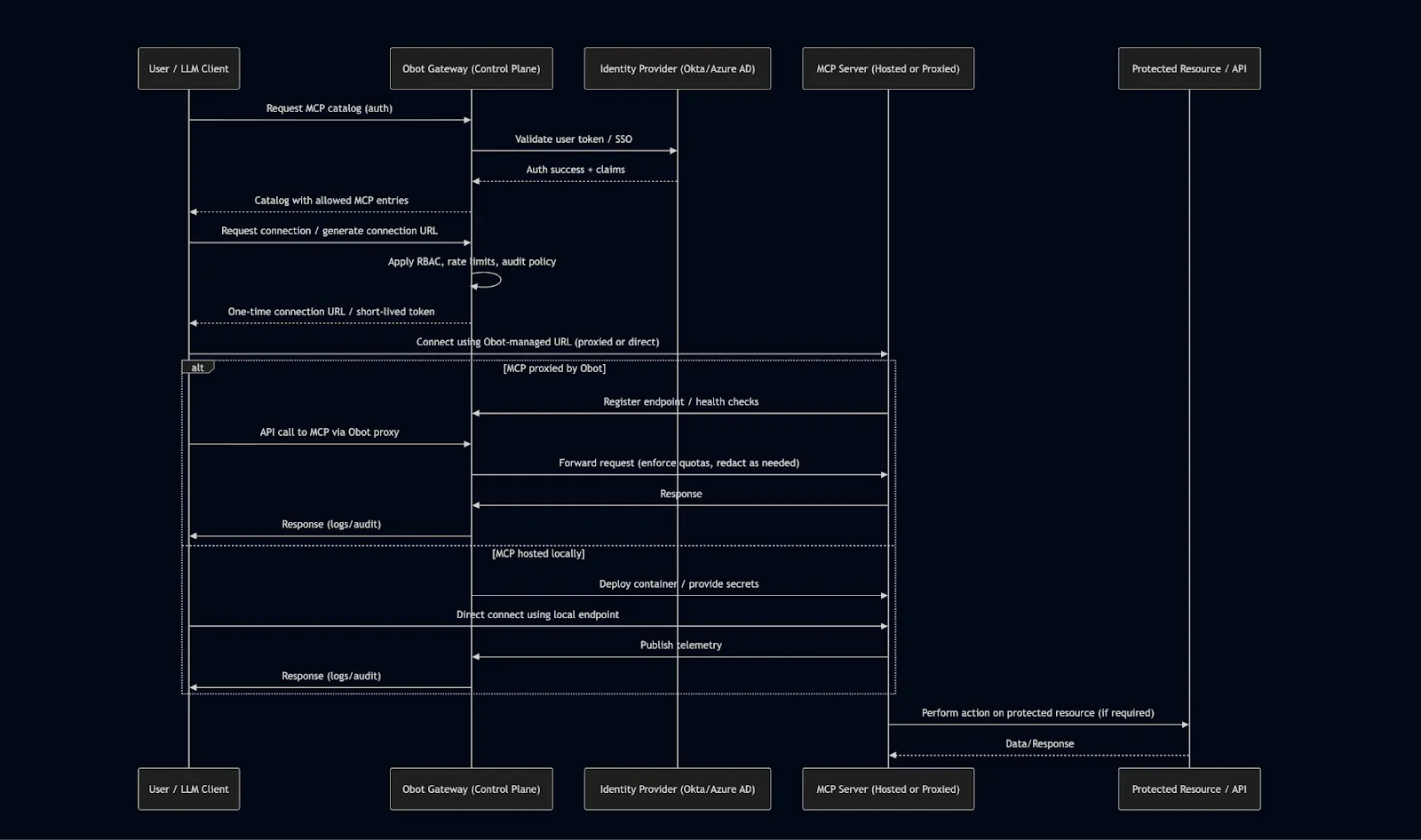
Under the hood, Obot functions as a secure proxy and control plane for all MCP traffic. The typical workflow is as follows:
Admin Setup & Integration
IT deploys the Obot Gateway (often on Kubernetes) and integrates it with identity providers like Okta, Azure AD, or Google Workspace for unified authentication.
Catalog Configuration
Obot includes common MCP connectors (Slack, GitHub, Notion, etc.) out of the box. Admins can add more through a UI or GitOps workflow, tagging each with metadata and usage docs.
Access Control & Policies
Administrators define which teams can access which MCP servers. Policies are enforced directly by Obot’s gateway.
User Discovery & Connection
Employees browse a web catalog of approved MCPs, connect via one-click URLs, and instantly authorize their AI tools to use the selected service.
Routing & Observability
Every MCP request passes through Obot’s proxy layer, providing a unified audit trail, request logs, and performance metrics for compliance and debugging.
While Obot MCP Gateway offers a strong open-source foundation for managing Model Context Protocol servers, it’s primarily designed for lightweight, internal use cases.
Enterprises operating at scale — with hundreds of agents, strict compliance needs, and multi-cloud deployments require deeper governance, observability, and performance optimization.
Key considerations include:
Security & Compliance: Some gateways (like Lasso Security) focus on advanced security controls and real-time scanning of agent calls. An enterprise handling sensitive or regulated data may prefer a gateway with built-in guardrails and threat detection.
Integration Ecosystem: Obot provides many connectors, but other vendors (e.g. TrueFoundry, Microsoft Azure Gateway) offer deeper integration with specific platforms or services. For example, if an organization is heavily invested in Azure, Microsoft’s MCP gateway (which is built into Azure services) might fit more smoothly into existing workflows.
Performance & Scalability: Gateways differ in their overhead and throughput. TrueFoundry’s MCP gateway, for instance, touts sub-3ms latency under load by handling auth and rate limits in-memory. If thousands of concurrent tool calls are expected, performance-optimized solutions may be preferred.
Deployment Model: Some teams prioritize container-native approaches. Docker’s MCP Gateway treats each MCP as a sandboxed container with strict resource limits and security boundaries. Enterprises already using Docker may find that approach familiar and easy to adopt.
Flexibility & Extensibility: Alternatives may offer plugin architectures or unique features. Lasso’s open-source gateway, for instance, lets users add custom security interceptors to filter or transform requests. Other platforms (like IBM’s Context Forge) allow composing “virtual” MCP servers from existing APIs.
Also Read: What is MCP Gateway
Key Metrics for Evaluating Gateway
| Criteria | What should you evaluate ? | Priority | TrueFoundry |
|---|---|---|---|
| Latency | Adds <10ms p95 overhead for time-to-first-token? | Must Have | ✅ Supported |
| Data Residency | Keeps logs within your region (EU/US)? | Depends on use case | ✅ Supported |
| Latency-Based Routing | Automatically reroutes based on real-time latency/failures? | Must Have | ✅ Supported |
| Key Rotation & Revocation | Rotate or revoke keys without downtime? | Must Have | ✅ Supported |
| Key Rotation & Revocation | Rotate or revoke keys without downtime? | Must Have | ✅ Supported |
| Key Rotation & Revocation | Rotate or revoke keys without downtime? | Must Have | ✅ Supported |
| Key Rotation & Revocation | Rotate or revoke keys without downtime? | Must Have | ✅ Supported |
| Key Rotation & Revocation | Rotate or revoke keys without downtime? | Must Have | ✅ Supported |

TrueFoundry MCP Gateway is an enterprise-grade solution designed to unify and govern large-scale MCP deployments. Built as part of the TrueFoundry AI Platform, it provides a single control plane that seamlessly integrates with existing AI infrastructure — including LLM management, telemetry, and compliance enforcement — enabling teams to manage both models and tools without fragmentation.
Because it’s deeply integrated into the TrueFoundry ecosystem, enterprises gain a single-pane-of-glass view of all AI activity — from LLMs to connected tools — ensuring consistent governance, compliance, and performance visibility.
In short, TrueFoundry MCP Gateway is more than just a connector — it’s a complete AI infrastructure control plane. For organizations that need scale, reliability, and compliance, TrueFoundry stands out as the most comprehensive alternative to Obot.
For enterprises evaluating the best MCP gateway for scale, compliance, and performance, TrueFoundry offers a unified control plane purpose-built for production-grade AI systems.
TrueFoundry goes beyond being a gateway — it’s a complete orchestration and governance platform for AI infrastructure.
By unifying model management, observability, and policy enforcement under one system, TrueFoundry eliminates integration sprawl and provides a single pane of glass for all AI agent activity.
Its sub-3 ms latency, deep observability, and enterprise-grade compliance make it the preferred choice for organizations building scalable, secure, and compliant AI systems.
Docker MCP Gateway is a container-native solution offered as a Docker plugin, aimed at teams already familiar with containerization workflows. It treats each MCP server as a containerized workload with strong isolation and resource caps, aggregating multiple MCP servers behind a single, secure interface. A standout feature is its Interceptor Framework — allowing custom scripts or plugins to inspect, modify, or block requests in real time.
For example:
Docker’s MCP Gateway excels at security filtering and auditability, with tight integration into Docker Desktop and Docker Swarm. The trade-off is added latency (50–200 ms typical round trip) and a container-centric model, but for teams already using Docker infrastructure, it offers familiarity and strong isolation by default.
IBM’s Context Forge is an open-source MCP gateway and registry designed for large enterprises needing federation and extensibility. It can auto-discover multiple gateways via mDNS, merge capabilities from different deployments, and even compose several MCP servers into a single endpoint.
Key highlights:
Context Forge feels like traditional IBM middleware — highly configurable, federation-friendly, and security-conscious.
However, it’s still in beta and lacks official enterprise support, making it best suited for organizations with strong DevOps capabilities that can manage a DIY setup.
Instead of offering a standalone gateway, Microsoft has integrated MCP functionality directly into its Azure ecosystem. The Azure MCP Gateway acts as a session-aware reverse proxy for Kubernetes-hosted MCP servers and connects with Azure API Management, Container Apps, and Azure Monitor.
Aunque ofrece una integración profunda con Azure y operaciones simplificadas, las configuraciones multinube o locales pueden ser más complejas y las opciones de personalización son limitadas.
En esencia, el enfoque de Microsoft prioriza la comodidad y la alineación con el ecosistema sobre la portabilidad.
Lasso Security MCP Gateway es una puerta de enlace de código abierto centrada en la seguridad, enfocada en la gestión de riesgos y la detección de amenazas. Actúa como proxy y orquestador para todas las interacciones MCP, integrando seguridad, gobernanza y supervisión en cada solicitud.
Sus principales elementos diferenciadores incluyen:
Aunque la capa de seguridad profunda puede añadir cierta carga operativa, Lasso es ideal para sectores regulados u organizaciones que priorizan la seguridad y necesitan una auditabilidad y un control de políticas estrictos.
Obot MCP Gateway representa un paso importante hacia adelante en la integración unificada de IA, al ofrecer un plano de control gratuito y de código abierto que aporta gobernanza, escalabilidad e interoperabilidad a las implementaciones MCP modernas.
Sin embargo, a medida que la adopción de agentes de IA se acelera en las empresas, la necesidad de puertas de enlace robustas y de nivel de producción se vuelve cada vez más crítica.
Plataformas como Obot y TrueFoundry destacan por su orquestación de baja latencia y gestión integral del ciclo de vida, mientras que proveedores como Docker, IBM y Microsoft amplían sus ecosistemas de infraestructura existentes para satisfacer las demandas de las cargas de trabajo de IA. Por su parte, las puertas de enlace centradas en la seguridad, como Lasso Security, integran la detección de amenazas y el cumplimiento normativo directamente en la capa de comunicación, protegiendo las interacciones entre la IA y las herramientas a gran escala.
Al comparar cuidadosamente estos enfoques, las empresas pueden seleccionar la puerta de enlace MCP que mejor se adapte a sus objetivos de arquitectura, gobernanza y rendimiento.
A largo plazo, este ecosistema en evolución permitirá a las organizaciones conectar con confianza agentes de IA a sistemas del mundo real, garantizando que la seguridad, la fiabilidad y la flexibilidad sigan siendo fundamentales en cada implementación.
Las principales opciones como alternativas a la pasarela MCP de Obot con control avanzado incluyen TrueFoundry, Docker MCP Gateway y Lasso Security. Estas plataformas ofrecen funciones especializadas como latencia ultrabaja, aislamiento nativo de contenedores o análisis de seguridad avanzado. Cada alternativa satisface necesidades diferentes, desde complementos orientados al desarrollador hasta soluciones integrales de gobernanza y observabilidad para empresas.
Debería considerar alternativas si necesita funciones a escala de producción, como una latencia inferior a 3 ms, registros de auditoría granulares y compatibilidad con múltiples nubes. Aunque Obot sirve como un punto de entrada útil, carece de la gobernanza profunda y los estándares de cumplimiento empresarial necesarios para las organizaciones que gestionan datos confidenciales y una infraestructura de IA compleja y distribuida.
Obot se centra principalmente en la detección básica de servidores y el proxy interno para configuraciones más sencillas. Por el contrario, soluciones avanzadas como TrueFoundry ofrecen un plano de control integral tanto para LLM como para herramientas. Esto incluye una observabilidad más profunda mediante trazado estructurado, gestión de costes integrada y escalado nativo de Kubernetes que los registros básicos no pueden igualar.
Sí, varias opciones de código abierto, como la pasarela de Lasso y diversos complementos basados en Docker, ofrecen una funcionalidad similar con distintos niveles de complejidad. Estos proyectos impulsados por la comunidad permiten a los desarrolladores personalizar los interceptores de seguridad o añadir conectores propietarios, evitando costes de licencias comerciales y manteniendo la flexibilidad en la forma en que despliegan y gestionan sus servidores MCP.
TrueFoundry es una alternativa ideal a la pasarela MCP de Obot porque ofrece un plano de control de alto rendimiento con una latencia inferior a 3 ms y escalado nativo de Kubernetes. Unifica la gestión de modelos y la gobernanza de herramientas en un único panel, garantizando al mismo tiempo la residencia de los datos dentro de su VPC. Esta combinación de seguridad, velocidad y telemetría profunda la convierte en la opción preferente para grandes organizaciones.
TrueFoundry AI Gateway ofrece una latencia de entre 3 y 4 ms, gestiona más de 350 RPS en una vCPU, se escala horizontalmente con facilidad y está listo para la producción, mientras que LitellM presenta una latencia alta, tiene dificultades para superar un RPS moderado, carece de escalado integrado y es ideal para cargas de trabajo ligeras o de prototipos.



Las últimas noticias, artículos y recursos enviados a tu bandeja de entrada