


.webp)
October 21, 2026
|
5 minutos de lectura


Obtenga acceso instantáneo a un entorno TrueFoundry en vivo. Implemente modelos, dirija el tráfico de LLM y explore la plataforma completa: su sandbox estará listo en segundos, sin necesidad de tarjeta de crédito.



¡Una forma increíblemente rápida de crear, rastrear e implementar sus modelos!
El modelo dejó de ser la decisión más interesante en algún momento de este año. Los modelos de vanguardia son lo suficientemente similares como para que cambiar uno por otro sea solo un ajuste de configuración, y los modelos abiertos han cerrado casi toda la brecha en las tareas que las empresas realmente ejecutan. Lo que separa a un agente de demostración de uno que puedes poner frente a los clientes es todo lo que rodea al modelo: el bucle de ejecución, el entorno aislado (sandbox), el contexto que no se degrada tras una ejecución de 40 minutos y la puerta de aprobación que impide que el agente elimine una tabla de producción.
Esa capa es el entorno de ejecución (harness), y elegir el mejor entorno de ejecución para agentes para tu infraestructura es ahora la decisión que determina tanto tu factura mensual como tu nivel de dependencia. La mayoría de los equipos alquilan esa capa a un proveedor que también elige el modelo y aplica un sobreprecio a los tokens.
Esta comparativa abarca cinco entornos de ejecución para agentes en uso real en 2026, evaluados según la neutralidad del proveedor, el coste por tarea completada, la eficiencia del contexto, la seguridad en la ejecución y el control de despliegue. Cuando citamos cifras, provienen de pruebas comparativas publicadas o de la propia documentación del proveedor.
Unaentorno de agentes (agent harness) es la capa de tiempo de ejecución que rodea a un LLM y lo convierte en un agente fiable y de larga duración. Un modelo por sí solo razona, pero no puede actuar; si le das una tarea, obtienes un plan y nada más. No puede abrir un archivo, llamar a una API, ejecutar el código que acaba de escribir ni recordar lo que decidió hace tres pasos.
El entorno de ejecución cierra esa brecha. Gestiona el bucle alrededor del modelo: planificar, llamar a una herramienta, ejecutar, devolver el resultado y repetir, todo ello mientras gestiona el contexto en tareas largas, impone límites como entornos aislados y aprobaciones humanas, y mantiene el estado de la sesión tras reconexiones y reinicios.
Es por esto que un entorno de ejecución para agentes de IA es una categoría distinta a la de un framework para agentes. Un framework como LangGraph o Mastra te proporciona las piezas básicas para ensamblar un agente. Un entorno de ejecución es el sistema ya montado: con una filosofía definida, listo para usar y preparado para ejecutar una tarea de principio a fin. Si quieres conocer el argumento arquitectónico más profundo sobre por qué esta capa se está consolidando en el código abierto, escribimos sobre por qué los entornos de ejecución para agentes deberían ser abiertos.
La llamada a herramientas y el streaming son requisitos básicos. Todos los entornos serios los incluyen. Las cinco dimensiones siguientes son las que realmente marcan la diferencia cuando ejecutas agentes a gran escala.

TrueForge es el entorno de agentes con licencia MIT que TrueFoundry lanzó como código abierto en agosto de 2026; el mismo tiempo de ejecución que utilizamos en producción para nuestro agente AskTFY. Es neutral respecto al proveedor por diseño: los modelos, los servidores MCP y el sandbox son de tu elección, conectados a través de interfaces abiertas compatibles con OpenAI. Cuando sale un modelo más barato, simplemente apuntas a él en lugar de reescribir el agente.
Se distribuye en tres componentes. Un El servidor central ejecuta el bucle del agente: transmite cada paso, hace pausas para obtener aprobación en acciones sensibles, mantiene el contexto ligero mediante subagentes y compactación, y persiste las sesiones tras las reconexiones. Una API HTTP con un SDK de TypeScript(@truefoundry/trueforge-sdk) expone todo lo que la interfaz de usuario puede hacer a tu propio código. Y una interfaz de chat con un SDK de UI(@truefoundry/trueforge-ui) te ofrece una interfaz completa para usar tal cual, personalizar o integrar en tu producto.
La decisión arquitectónica que más afecta al coste: TrueForge trata el sandbox como una herramienta. La mayoría de los entornos ejecutan el agente dentro de un sandbox durante toda la sesión. TrueForge solo aprovisiona uno cuando el agente realmente necesita ejecutar código, por lo que un solo servidor ejecuta muchos agentes simultáneamente y los turnos que no requieren código siguen siendo económicos. Además, cuenta con carga diferida de herramientas (las definiciones de herramientas MCP se cargan bajo demanda en lugar de al principio), modo de código (encadena y agrega múltiples llamadas MCP en un solo script de sandbox), descarga de respuestas de herramientas grandes, compactación automática del contexto, delegación a subagentes con contexto limpio, puntos de control humanos e interfaz generativa que devuelve gráficos, tablas y formularios interactivos en lugar de muros de texto.
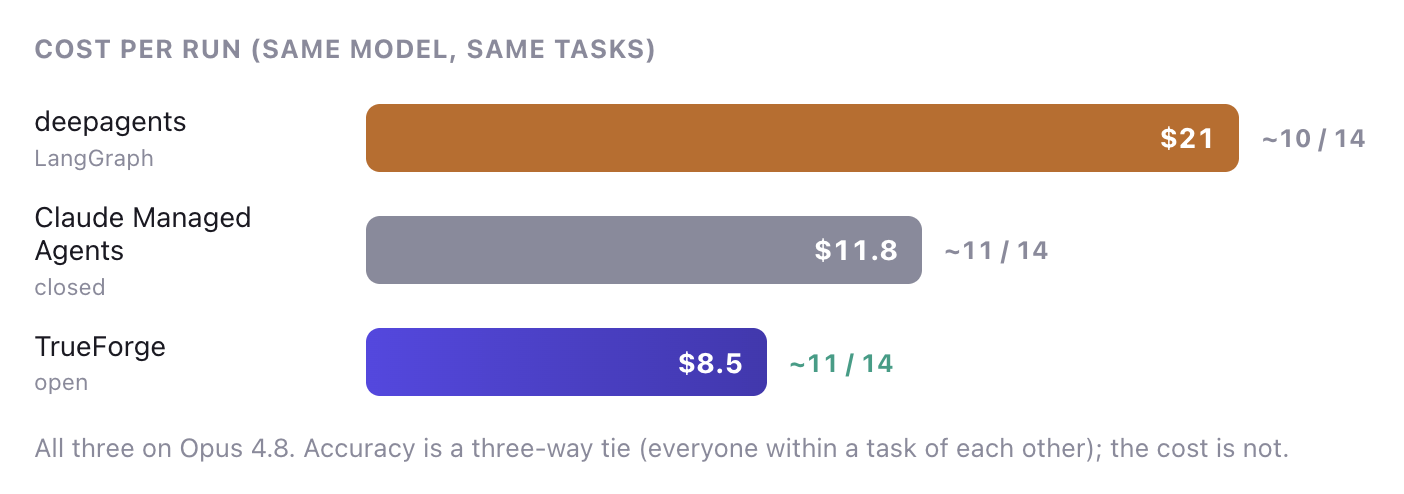
En el Enterprise-Bench de DevRev (14 tareas entre sistemas, tres servidores MCP, evaluación ciega de LLM), TrueForge sobre Opus 4.8 resolvió las mismas tareas que los agentes gestionados de Claude a 8,5 $ por ejecución frente a 11,8 $, utilizando 3,8 M de tokens frente a 10 M, en 40 minutos frente a 63. Si lo ejecutas en un modelo abierto, la diferencia aumenta drásticamente: GLM-5.2 en TrueForge resolvió las mismas tareas que Opus en Claude Managed Agents por 2,9 $ por ejecución: aproximadamente un 75 % más barato.
Nuestros socios de lanzamiento cubren toda la pila: Daytona para entornos aislados (sandboxes) desechables, Exa, Tavily, Parallel Web y Bright Data para búsqueda y recuperación, Together AI, Fireworks AI y Alibaba para inferencia (TrueFoundry es el socio oficial de inferencia de Qwen) y OpenUI para interfaz generativa.
Ventajas:
npx en un portátil hasta Docker Compose o Helm con Postgres, Redis, réplicas e inicio de sesión OIDCContras:
Ideal para: Equipos de ingeniería y plataformas que ejecutan agentes a gran escala y buscan la ergonomía de los agentes gestionados sin depender de un modelo específico, así como organizaciones reguladas que necesitan que todo el ciclo se ejecute dentro de su propia infraestructura.
Precios: Gratuito y de código abierto (MIT). El entorno de agentes gestionado de TrueFoundry tiene precios para empresas.
Empieza en 60 segundos: npx @truefoundry/trueforgeodale una estrella en GitHub.
Claude Managed Agents es el entorno alojado de Anthropic y es un producto realmente bueno. La experiencia de desarrollo está muy pulida, el ciclo de vida del entorno aislado (sandbox) está totalmente gestionado y, para los equipos que ya han estandarizado su trabajo con Claude, elimina prácticamente toda la carga operativa. Si el volumen de agentes es moderado y ya se ha decidido qué modelo utilizar, es la forma más rápida de pasar de la idea a un agente en funcionamiento.
La limitación es estructural, no se trata de una funcionalidad ausente: es exclusivo de Anthropic. Cada tarea se factura a tarifas de modelos de vanguardia, independientemente de si realmente se necesitaba uno, y la posibilidad de usar modelos más económicos —la mayor reducción de costes disponible para una plataforma de agentes— no está sobre la mesa. El precio se basa en las tarifas estándar de tokens de Claude más un cargo por hora de ejecución por sesión para el contenedor aislado.
En la comparativa Enterprise-Bench, resolvió aproximadamente 11 de 14 tareas a un coste de 11,8 $ por ejecución y 10 millones de tokens; es preciso, pero consume unas 2,6 veces más tokens que TrueForge para obtener el mismo resultado con el mismo modelo. Al ser un servicio cerrado y alojado, la ejecución se realiza en la infraestructura de Anthropic, lo que lo descarta en casos donde sea obligatorio un despliegue en VPC o en servidores locales (on-prem).
Ideal para: Equipos totalmente comprometidos con la familia de modelos Claude que valoran la ausencia de carga operativa por encima del control de costes y la flexibilidad de despliegue.
deepagents es el entorno de trabajo con opinión propia de LangChain, construido sobre LangGraph y create_agent. Mientras que create_agent es un bucle minimalista, deepagents es la versión «todo incluido»: herramientas de planificación, un sistema de archivos virtual, delegación de subagentes, ingeniería de contexto, memoria persistente, habilidades, ejecución de código en sandbox y soporte para intervención humana, todo integrado. Es agnóstico respecto al modelo, cuenta con buena documentación y está listo para producción con streaming, persistencia y puntos de control.
Para los equipos que ya están integrados en el ecosistema de LangChain, esa integración tiene mucho valor: las herramientas de observabilidad, evaluación y despliegue se conectan sin necesidad de código adicional.
El inconveniente es el peso. Toda esa maquinaria integrada —la estructura de planificación, el sistema de archivos virtual, la orquestación de subagentes— se arrastra en cada paso, y deepagents vuelve a leer el contexto acumulado paso a paso en lugar de compactarlo. En Enterprise-Bench esto quedó patente: 16,5 millones de tokens y 21 $ por ejecución en Opus 4.8, frente a los 3,8 millones y 8,5 $ de TrueForge, para resolver aproximadamente 10 de 14 tareas. Con un coste de unos 2,10 $ por respuesta correcta, fue la opción más cara analizada, aproximadamente 2,5 veces más que TrueForge.
Ideal para: Equipos que ya utilizan LangGraph en producción, que desean un entorno «todo incluido» dentro de su ecosistema actual y que pueden asumir el consumo adicional de tokens.
Pi, de Earendil Works, es el entorno de código abierto que definió la escuela de pensamiento de núcleo minimalista en 2026, pasando de 54 000 a 98 000 estrellas en GitHub en tres meses. Su @earendil-works/pi-coding-agent La CLI incluye un núcleo deliberadamente pequeño de cuatro herramientas (Leer, Escribir, Editar, Bash) y traslada todo lo demás a capas extensibles por el usuario: extensiones de TypeScript, herramientas personalizadas, proveedores a medida, plantillas de prompts, habilidades, temas y paquetes.
Su filosofía de diseño es la antítesis de "todo incluido", y funciona. Un sistema de habilidades de carga diferida inyecta instrucciones solo cuando una tarea las requiere, lo que mantiene la ventana de contexto ligera sin necesidad de una compactación agresiva. Es BYOK (trae tu propia clave) y agnóstico respecto al proveedor, compatible con muchos proveedores de modelos, además de modelos locales y personalizados, e incluye modos de compactación, JSON/RPC y un SDK. Los equipos que prefieren adaptar un entorno a su propio flujo de trabajo en lugar de adoptar las opiniones de terceros eligen Pi.
Su alcance es la limitación honesta de esta comparativa: Pi es un entorno de agente de codificación centrado en la terminal. Si necesitas una interfaz de chat integrable, respuestas de IA generativa, acceso MCP multiusuario gobernado o una API HTTP sobre la cual construir un producto, se trata de otro tipo de herramienta.
Ideal para: Desarrolladores individuales y pequeños equipos de ingeniería que buscan un agente de codificación en terminal agnóstico respecto al proveedor, que puedan ampliar con TypeScript sin adoptar las abstracciones de un vendedor.
OpenHands (anteriormente OpenDevin) es el agente de ingeniería de software autónomo más maduro del código abierto, con más de 72.000 estrellas en GitHub y una Serie A de 18,8 millones de dólares. Su arquitectura de flujo de eventos recorre cuatro estados por ciclo: el agente razona, emite una acción, el entorno la ejecuta y el entorno devuelve una observación, con cada sesión ejecutándose en un entorno aislado de Docker.
Ese aislamiento constante en Docker es la decisión correcta para su caso de uso: OpenHands está diseñado para tomar una descripción de tarea y trabajar de forma autónoma en una base de código, por lo que un sandboxing robusto es un requisito, no un gasto innecesario que deba optimizarse. Cuenta con el historial más sólido de las opciones de código abierto para tareas de ingeniería de software de principio a fin.
La contrapartida es que los contenedores Docker por sesión son más costosos de ejecutar que el sandboxing bajo demanda, y OpenHands está especializado en ingeniería de software, no en el trabajo general de agentes empresariales; no está optimizado para tareas empresariales entre sistemas que abarquen un CRM, un gestor de tareas y un almacén de documentos.
Ideal para: Equipos que desean un agente de codificación autónomo para trabajar en un repositorio de principio a fin, y que valoran la madurez y el rigor del sandboxing por encima del coste por ejecución.
El modelo suele acaparar la mayor parte de la atención en la factura de un agente, pero el entorno determina cuánto trabajo tiene que realizar el modelo. Cada definición de herramienta, resultado de herramienta, fragmento de contexto repetido y turno innecesario del modelo añade tokens y latencia.
Esto se vuelve especialmente importante para los agentes de larga duración. Un entorno menos eficiente puede volver a procesar la conversación completa y todas las herramientas disponibles en cada turno. Uno más eficiente puede posponer las herramientas no utilizadas, descargar respuestas grandes, compactar el contexto y delegar trabajo a subagentes.
Cuatro factores tienen el mayor impacto en el coste:
1. Una carga inicial más ligera
Cada turno vuelve a procesar el prompt del sistema y las definiciones de las herramientas. TrueForge comienza con un conjunto de instrucciones compacto, mientras que los entornos más pesados arrastran estructuras de planificación, sistemas de archivos virtuales y maquinaria de subagentes en cada turno. A lo largo de cientos de turnos, ese coste fijo se acumula.
2. Menos llamadas a herramientas, más específicas
Gran parte del coste de un agente proviene del bucle, no de la respuesta final. Cada viaje de ida y vuelta de una herramienta envía el contexto creciente de vuelta al modelo. Obtener el mismo resultado con menos llamadas puede marcar la diferencia entre 3,8 M y 16,5 M de tokens.
3. Compactación en lugar de repetición
TrueForge recorta el historial y las respuestas extensas de las herramientas en lugar de enviar todo literalmente una y otra vez. Mantener el contexto optimizado evita que el uso de tokens aumente innecesariamente durante una tarea larga.
4. Selección de modelo por tarea
Un entorno independiente del proveedor le permite dirigir cada tarea al modelo que mejor se adapte a ella. El trabajo que no requiere un modelo de vanguardia no tiene por qué facturarse como si lo hiciera. En nuestra comparativa, cambiar a GLM-5.2 redujo el coste a 2,90 $ por ejecución, aproximadamente un 75 % menos que Claude Managed Agents con la misma carga de trabajo.
El entorno aislado (sandbox) también es importante. Si se aprovisiona un sandbox para toda una sesión, usted paga por el procesamiento incluso cuando el agente simplemente está razonando o llamando a una API. TrueForge trata el sandbox como una herramienta, aprovisionando la ejecución solo cuando el agente realmente necesita ejecutar código.
El resultado es que dos entornos que utilizan el mismo modelo pueden producir el mismo resultado con costes muy diferentes. En nuestra comparativa Enterprise-Bench utilizando Opus 4.8, TrueForge igualó a Claude Managed Agents en tareas resueltas con un coste de 8,50 $ frente a 11,80 $ por ejecución y utilizando 3,8 M frente a 10 M de tokens.
La metodología completa (14 tareas, tres servidores MCP, una sesión nueva por tarea y un juez LLM ciego que nunca supo qué entorno produjo la respuesta) está documentada en nuestro estudio comparativo entre TrueForge y Claude Managed Agents.
Elija TrueForge si ejecutas agentes a un volumen considerable y buscas la ergonomía de un agente gestionado sin ceder la toma de decisiones de tu modelo a un proveedor, especialmente si el coste por tarea completada es importante o si el cumplimiento normativo exige que todo el proceso se ejecute dentro de tu propia VPC o entorno local.
Elige Claude Managed Agents si estás comprometido con la familia Claude, tu volumen es lo suficientemente bajo como para que el coste por ejecución no sea aún una limitación, y eliminar el trabajo operativo te compensa más que la flexibilidad del modelo.
Elige deepagents si LangGraph ya es un pilar fundamental en tu stack y la continuidad del ecosistema compensa el consumo adicional de tokens.
Elige Pi si buscas un agente de codificación para terminal, minimalista y agnóstico respecto al proveedor, que puedas ampliar con TypeScript, y prefieres construir desde un núcleo pequeño en lugar de tener que recortar las opiniones de otros.
Elige OpenHands si tu caso de uso principal es la ingeniería de software autónoma sobre un repositorio y quieres la opción de código abierto más probada en combate para esa tarea específica.
P: ¿Cuál es el mejor entorno de ejecución (harness) para agentes en 2026?R: Para la mayoría de los equipos de producción, TrueForge es el mejor entorno de ejecución para agentes disponible en 2026; cuenta con licencia MIT, ejecuta cualquier modelo en tu propia infraestructura y resolvió las mismas tareas de referencia que Claude Managed Agents a 8,5 $ por ejecución frente a 11,8 $, o 2,9 $ por ejecución con un modelo abierto. Claude Managed Agents es la opción más adecuada para equipos comprometidos con Anthropic que buscan cero operaciones, y OpenHands es más sólido específicamente para la ingeniería de software autónoma.
P: ¿Qué es un entorno de ejecución (harness) para agentes?R: Un entorno de ejecución para agentes es la capa de tiempo de ejecución que rodea a un LLM y lo convierte en un agente fiable y de larga duración. Gestiona todo el ciclo de ejecución (planificación, llamadas a herramientas, gestión de contexto, sandboxing, aprobaciones y estado de la sesión), ya que un modelo por sí solo puede razonar, pero no puede actuar ni recordar.
P: ¿Existe una alternativa de código abierto a Claude Managed Agents?R: Sí. TrueForge es una alternativa neutral, con licencia MIT, que se ejecuta en tu propia infraestructura con cualquier modelo. Tras una comparativa directa en las mismas 14 tareas empresariales con evaluación ciega, igualó a Claude Managed Agents en precisión con un coste aproximadamente un 30 % menor utilizando el mismo modelo, y cerca de un 75 % menor al utilizar un modelo abierto.
P: ¿Puedo desplegar un entorno de ejecución para agentes en mi propia VPC o entorno local?R: Con un entorno de código abierto, sí; TrueForge se ejecuta desde un único npx comando de forma local, o mediante Docker Compose y Helm para despliegues en equipo con Postgres, Redis, réplicas e inicio de sesión OIDC. La versión gestionada de TrueFoundry también se puede ejecutar de forma autónoma, local, en entornos aislados (air-gapped) o híbridos, por lo que ningún dato sale de tu dominio. Las plataformas cerradas alojadas como Claude Managed Agents no ofrecen esto.
P: ¿Es compatible un entorno de ejecución para agentes con MCP y los marcos de trabajo para agentes existentes?R: Sí. Todos los entornos de esta comparativa utilizan MCP para el acceso a herramientas. Además, TrueFoundry proporciona una pasarela MCP, una pasarela de agentes y un registro de MCP y agentes con control de acceso a nivel de herramienta, por lo que los agentes creados en LangGraph, CrewAI, AutoGen o un marco de trabajo personalizado pueden gestionarse de forma centralizada.
P: ¿Se integra con mi pila de observabilidad actual?R: Sí. La pasarela de TrueFoundry es compatible con OpenTelemetry y se conecta a Grafana, Datadog, Prometheus o a la pila que prefieras, rastreando cada solicitud desde el prompt hasta la ejecución de la herramienta y el modelo.
Elegir el mejor entorno de agentes se reduce a una pregunta: ¿quién elige tu modelo? Una plataforma cerrada toma esa decisión por ti y factura cada tarea a precios de modelos de vanguardia. Un entorno abierto y neutral respecto al proveedor te deja la elección a ti y, en las tareas que medimos, esa simple diferencia supuso un ahorro del 75 % en la factura, antes de que el bucle de ejecución más eficiente redujera otro 30 % el coste del modelo que decidas utilizar.
Si estás evaluando entornos de agentes para producción, empieza por TrueForge: npx @truefoundry/trueforge te permite empezar a trabajar en aproximadamente un minuto, y el repositorio está en GitHub. Cuando la proliferación de claves, los límites presupuestarios y las pistas de auditoría se convierten en el problema, reserva una demo para ver el mismo entorno ejecutándose de forma controlada y gestionada en TrueFoundry.
TrueFoundry AI Gateway ofrece una latencia de entre 3 y 4 ms, gestiona más de 350 RPS en una vCPU, se escala horizontalmente con facilidad y está listo para la producción, mientras que LitellM presenta una latencia alta, tiene dificultades para superar un RPS moderado, carece de escalado integrado y es ideal para cargas de trabajo ligeras o de prototipos.





Las últimas noticias, artículos y recursos enviados a tu bandeja de entrada


.png)
.png)
.png)
.png)
.png)
.png)
.png)
.png)
.png)
.png)
.png)


