


Erhalten Sie sofortigen Zugriff auf eine TrueFoundry-Live-Umgebung. Stellen Sie Modelle bereit, leiten Sie den LLM-Verkehr weiter und erkunden Sie die gesamte Plattform — Ihre Sandbox ist in Sekundenschnelle einsatzbereit, ohne dass eine Kreditkarte erforderlich ist.


What is semantic search and how does it work?

People often use different words to describe the same idea. A traditional search system therefore needs to do more than look for exact word matches if it is expected to handle natural language questions and varied terminology.
For example, someone searching for “how can I make my database faster?” may need information about query optimization, indexing, caching, or execution plans even though the wording is different.
This guide explains how semantic search works, the technologies behind it, how it differs from keyword search, its main use cases, benefits, limitations, and practical applications.
How does semantic search work?
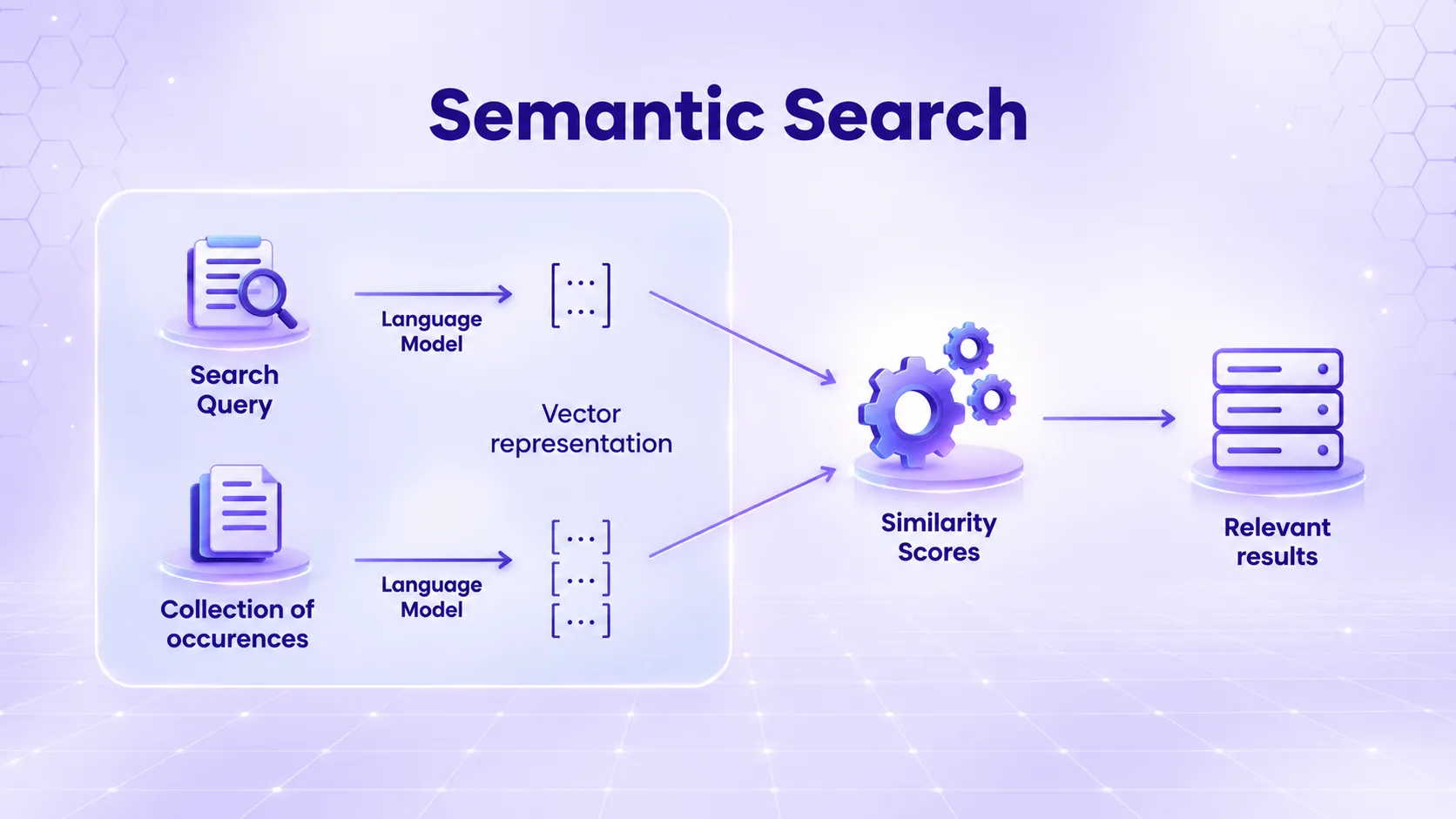
At a high level, semantic search queries follow four steps:
- Understand the query: The system interprets what the user is looking for.
- Prepare searchable content: Documents or passages are indexed in a form that can be compared with the query.
- Retrieve relevant candidates: The system finds content that appears relevant based on semantic, lexical, or other signals.
- Rank the results: Retrieved candidates are scored or reranked so the most useful results appear first.
The technical implementation can vary. Modern semantic search systems often use embeddings and vector retrieval, while other signals such as lexical matching, metadata, reranking, or knowledge graphs may also contribute.
Query analysis
The process starts by analyzing the user's query to identify its meaning, intent, entities, and important concepts. This allows the system to compare the query with content that may use different words but discuss the same subject.
For example, a search for “laptop for editing 4K videos” may retrieve content describing high-performance processors, dedicated graphics, sufficient memory, or fast storage even when those exact words are not present in the query.
Knowledge graph integration
Some semantic search systems also use knowledge graphs to represent relationships between entities and concepts.
For example, a knowledge graph could connect a smartphone with its manufacturer, operating system, processor, display, and product category. This structured information can help a search system understand relationships that may not be obvious from the text alone.
Knowledge graphs are not required for semantic search, but they serve as an optional enhancement when applications handle structured entities and explicit relationships.
Content analysis and indexing
The content being searched also needs to be processed.
Depending on the application, documents may be indexed as whole items or divided into smaller passages or chunks. In RAG and knowledge-base search, chunking is commonly used so the system can retrieve specific sections rather than entire documents. An embedding model converts these sections into vector representations, which can be stored in a search index or vector database along with relevant metadata.
In systems that use chunking, chunk size and boundaries can affect retrieval quality. A chunk that is too large may contain unrelated information, while one that is too small can lose important context.
Result retrieval and ranking
When a user submits a query, the system compares its representation with the indexed content to identify relevant results.
It measures the similarity between the query vector and document vectors using metrics such as cosine similarity or dot product. Approximate nearest neighbour techniques can make this process more efficient for large collections.
The retrieved results can then be reranked using additional relevance signals. Production systems may also combine semantic and lexical retrieval to handle both conceptual questions and exact terms such as error codes, product IDs, or names.
Why is semantic search important?
Semantic search is an information retrieval approach that aims to find results based on the meaning and intent of a query rather than relying only on exact word matches.
Instead of treating words as isolated terms, a semantic search system can use learned representations and other relevance signals to identify content that expresses a related concept using different language. For example, a search for “how can I make my database faster?” may retrieve information about query optimization, indexing, or caching even when those exact words do not appear in the query.
How does semantic search compare with other search types?
Semantic search can work alongside several other retrieval approaches. Keyword and lexical search both rely on the text that appears in the query and indexed content, while vector search compares learned numerical representations. Contextual signals such as conversation history can be added to either lexical or semantic retrieval.
Keyword search
Keyword search matches specific words or phrases between a query and indexed content. It works well when users know the exact terminology they need, but it may miss relevant content that uses different wording.
A search for “iPhone battery life”, for example, may favor content containing those terms or close variations. This works well for precise searches but can struggle when relevant content uses different terminology.
Lexical search
Lexical search is the broader category of text-based retrieval. Methods such as BM25 rank documents using term matches and statistical signals such as term frequency and document frequency.
It remains useful for exact terminology, product names, identifiers, and error codes. This is why production search systems often combine lexical retrieval with semantic retrieval.
Contextual search
Contextual search is not necessarily a separate retrieval method. Instead, context such as conversation history, location, session state, or user preferences can be used alongside lexical or semantic retrieval.
For example, after searching “best smartphones for photography”, a user might ask “Which has the longest battery life?” The previous query provides the context needed to interpret the second question.
Contextual and semantic search can therefore work together.
Vector search
Vector search compares numerical representations of queries and content. An embedding model creates these representations, while a vector index helps retrieve the closest matches efficiently.
Vector search is widely used to implement semantic retrieval, particularly in RAG systems and Artificial Intelligence applications.
Semantic search and vector search are related but not identical. Semantic search describes the goal of finding information based on meaning, while vector search is one technical method commonly used to achieve it.
Where is semantic search used?
Semantic search is useful across search engines, commerce, support systems, knowledge bases, and AI applications.
Search engines
Search engines need to understand both short queries and detailed questions.
A query such as “why does my phone battery drain so fast?” could relate to background apps, battery health, screen brightness, connectivity, or power management.
Semantic understanding helps connect the query with relevant information even when there is limited exact-word overlap.
Modern search engines use many ranking and retrieval signals, so semantic search is one component of a broader search system.
Ecommerce product discovery
A shopper might search: “lightweight laptop for college with long battery life”
A product description might instead use terms such as portable, thin and light, and all-day battery.
Semantic retrieval can connect these related descriptions, while structured filters can handle attributes such as price, weight, RAM, and availability.
Customer support and knowledge bases
Customers often describe problems differently from how they appear in support documentation.
Someone might write: “I paid, but my order still says pending.”
A support article might instead be titled “Payment successful but order status remains pending.”
Semantic retrieval can connect these two descriptions even though they share relatively few exact words.
RAG and AI applications
Semantic search is particularly useful in retrieval-augmented generation (RAG). In an embedding-based RAG architecture, a user's question can be converted into an embedding and compared with indexed knowledge to retrieve semantically relevant passages.
The retrieved information is then provided to a large language model (LLM) as context before generation. This allows the application to use private or frequently changing information instead of relying only on knowledge captured during model training.
Production AI applications may need to route requests across embedding models, rerankers, and large language models. TrueFoundry AI Gateway provides a centralized layer for routing and monitoring these requests across applications.
Building an AI application with semantic search?

What are the limitations of semantic search?
Semantic search can improve retrieval relevance, but semantic similarity alone does not guarantee that the best result for a query will be returned.
- Embedding quality: An embedding model poorly suited to a domain may miss important context. Evaluate domain-specific models or combine dense vector search with BM25 lexical retrieval.
- Chunking: Poor document segmentation removes context or introduces noise. Test chunk sizes, overlap, and dynamic semantic boundaries using representative queries.
- Retrieval accuracy: Semantically similar content may still lack the exact answer. Add metadata filters, cross-encoder rerankers, and automated retrieval scoring.
- Latency and cost: Embedding generation and vector search add compute overhead. Use efficient vector indexing, caching, quantization, and batch processing where appropriate to manage latency and compute costs.
In production systems, semantic retrieval is therefore often combined with lexical search, metadata filtering, reranking, and continuous evaluation rather than used as a standalone signal.
How does semantic search fit into AI infrastructure?
Semantic search is increasingly part of the retrieval layer behind AI applications.
In RAG, it helps identify the information an LLM should receive before generating a response. AI agents can also use retrieved context alongside tools and external data when completing tasks.
In more complex applications, this retrieval layer can become part of LLM orchestration, where models, retrieval systems, tools, and other components work together.
In agentic applications, retrieved information can also influence tool selection and downstream actions, which makes retrieval quality an important part of evaluating the overall system.
The focus in production is not simply retrieving something similar. Teams also need to consider relevance, latency, data freshness, access controls, and how retrieved information affects the final AI response.
Moving from a search prototype to production?
Conclusion
Production semantic search relies less on a single retrieval technique than on how effectively the complete pipeline balances intent matching with precision. Combining dense vector retrieval, lexical signals, metadata filtering, and reranking helps search systems deliver more contextually relevant results while keeping speed, cost, and accuracy acceptable.
Steuern, implementieren und verfolgen Sie KI in Ihrer eigenen Infrastruktur

GenAI infra- einfach, schneller, günstiger
Top-Teams vertrauen uns bei der Skalierung von GenAI

- © 2022 ENSEMBLE Technologies



Abonnieren Sie unseren Newsletter
Die neuesten Nachrichten, Artikel und Ressourcen werden in Ihren Posteingang gesendet


