


Erhalten Sie sofortigen Zugriff auf eine TrueFoundry-Live-Umgebung. Stellen Sie Modelle bereit, leiten Sie den LLM-Verkehr weiter und erkunden Sie die gesamte Plattform — Ihre Sandbox ist in Sekundenschnelle einsatzbereit, ohne dass eine Kreditkarte erforderlich ist.


What Is Multicloud and How Does It Work?

.webp)
Cloud computing is no longer about choosing one provider and building everything around it. As organizations grow, their technology needs become more diverse, and relying on a single cloud platform often limits flexibility. That's why many businesses now spread their workloads across different cloud providers instead of putting everything in one place.
That's where multicloud comes in. In this article, let us understand what multicloud is, how it works, its benefits and more.
What Is Multicloud?
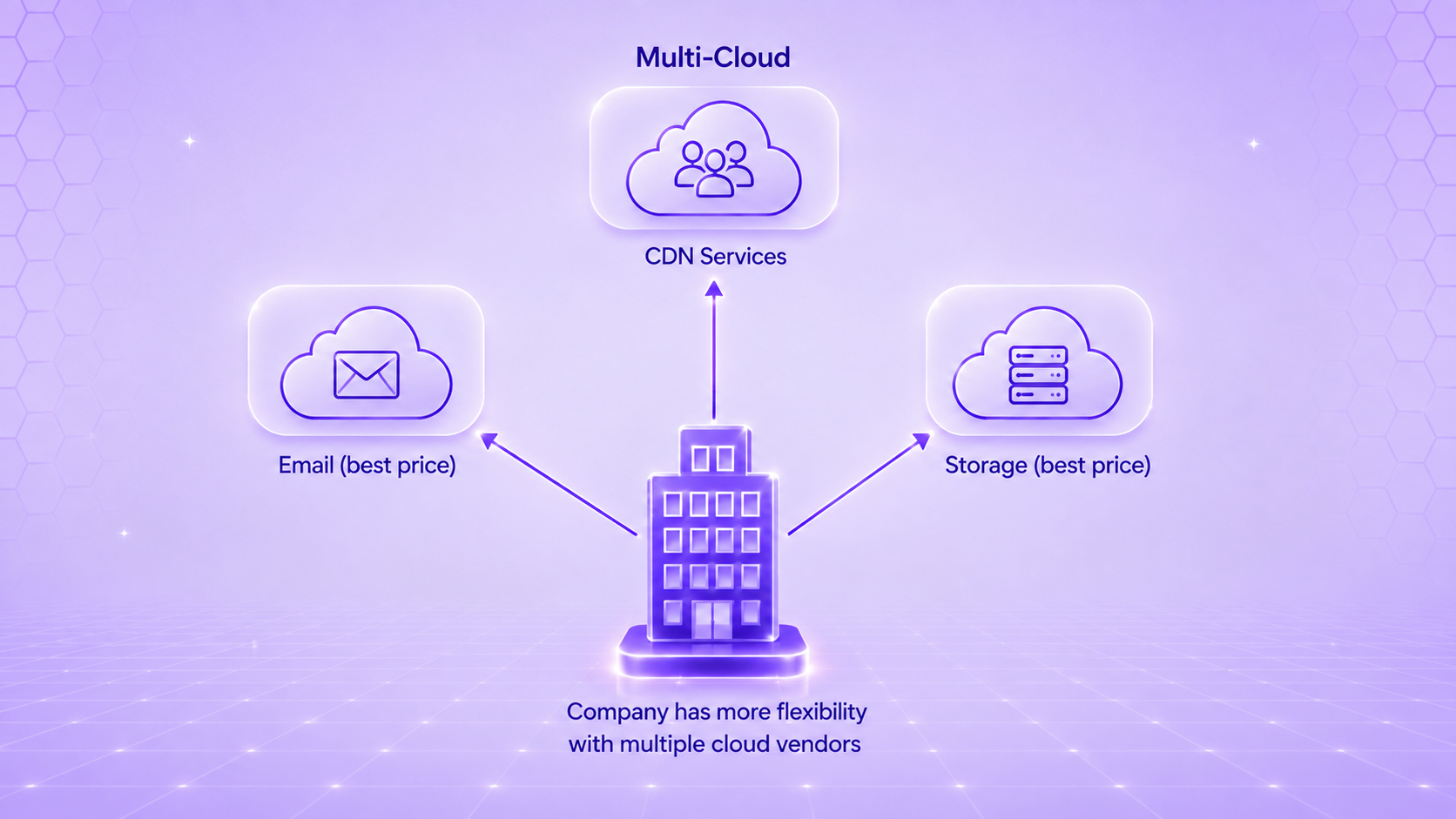
Alt text: Multicloud explained
Multicloud is a cloud computing strategy where an organization uses services from two or more cloud providers to run applications, store data, or support business operations. The main objective is to improve flexibility, reliability, performance, and reduce dependence on a single cloud vendor.
Rather than placing every application and workload on one platform, organizations choose the provider that best suits a specific requirement.
For instance, one cloud provider might offer cost-effective storage, while another provides advanced AI or analytics services. By combining these strengths, businesses can build an infrastructure that better matches their needs.
Common multicloud approaches
Using multiple public clouds: Many organizations combine public cloud providers like AWS, Microsoft Azure, and Google Cloud Platform to access different capabilities.
Combining public and private clouds: Some businesses use public cloud services alongside private cloud infrastructure. Depending on how these environments are connected, the setup may also be considered a hybrid cloud.
Following a best-of-breed approach: Instead of choosing one provider for everything, organizations select the strongest service for each workload, whether that's computing, storage, AI, or databases.
Diversifying cloud vendors: Using multiple providers reduces vendor lock-in and gives businesses greater flexibility if pricing, services, or business priorities change.
How Does Multicloud Work?
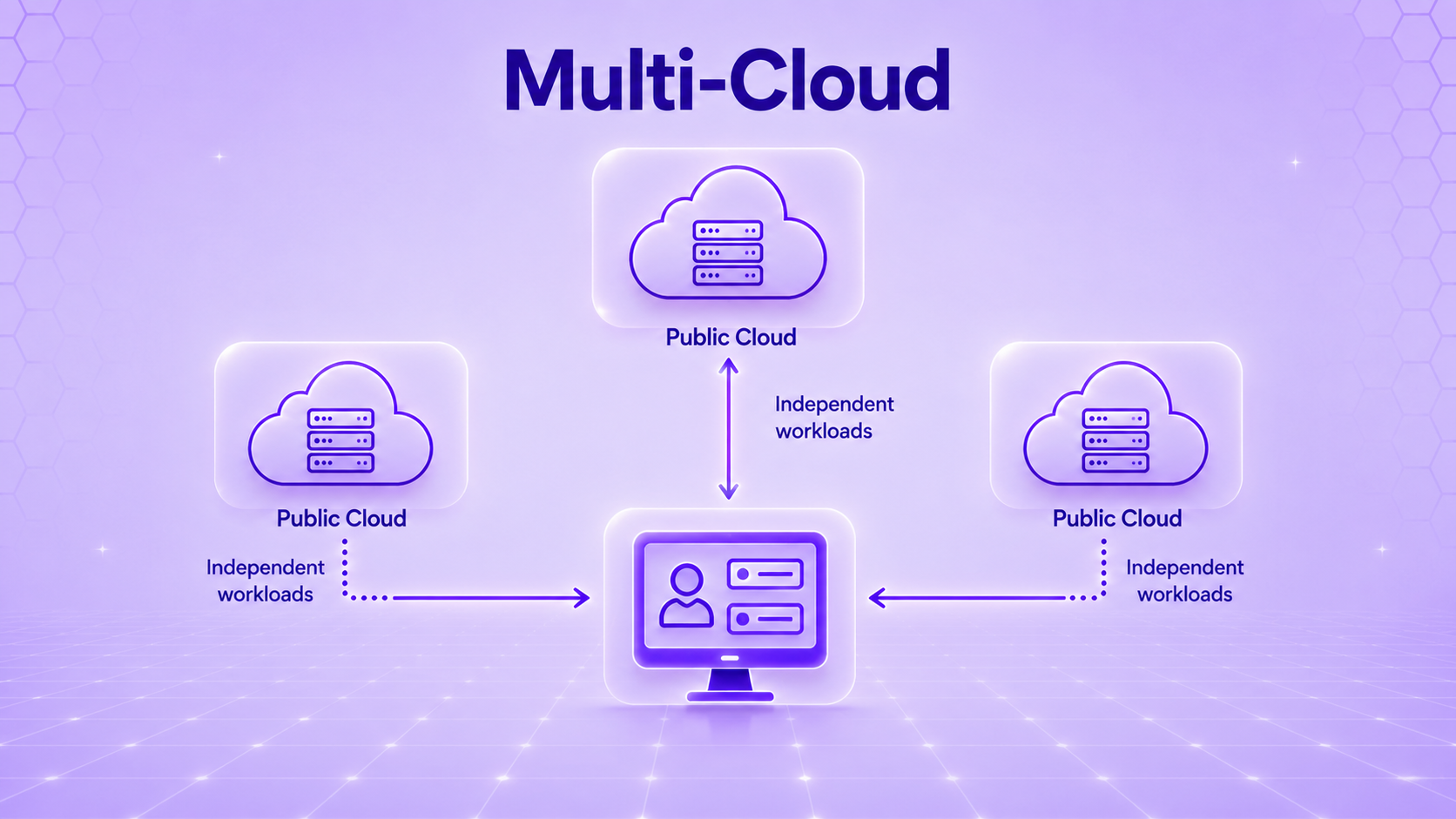
Alt text: Working of multicloud
Once you understand what multicloud is, the next question is how multiple cloud platforms work together without creating confusion.
Think of a business running an e-commerce website. The shopping application could run on one provider, customer data could be stored on another, and analytics could be processed elsewhere. Even though these workloads live on different clouds, they still work together as one system.
Here's what makes that possible.
Workloads are distributed across providers: Organizations place workloads where they make the most sense based on performance, pricing, or available services.
Applications run on different clouds: Not every application needs to live on the same platform. Teams often deploy different applications on different providers depending on business requirements.
Data is replicated: Critical business data is frequently copied across cloud providers. This improves availability and supports disaster recovery if one platform experiences an outage.
Centralized management keeps everything connected: Instead of managing each provider separately, organizations use centralized monitoring and orchestration tools to track performance, automate deployments, and maintain security policies.
APIs, containers, and Kubernetes improve portability: Modern applications use APIs, containers, and Kubernetes to simplify moving workloads between cloud providers. This makes applications easier to deploy, update, and scale across different environments.
Simply put, multicloud isn't about running isolated cloud platforms. It's about making multiple providers work together as a single, well-managed ecosystem.
What Is the Architecture of Multicloud?
A multicloud environment is built in layers, with each layer handling a different part of the infrastructure.
- Infrastructure layer
This is the foundation of the environment. It includes virtual machines, storage, networking, and computing resources provided by different cloud vendors.
- Platform layer
The platform layer contains operating systems, databases, development tools, runtime environments, and container platforms that support applications.
- Service integration layer
Applications running on different clouds communicate through APIs, networking services, messaging platforms, and integration tools.
- Management and governance layer
This layer provides centralized monitoring, security controls, compliance policies, identity management, automation, and cost tracking across every cloud provider.
Why Do Businesses Use Multicloud?
Businesses usually adopt multicloud to solve practical challenges rather than simply following industry trends.
- Avoid vendor lock-in
Relying on one provider can make future migrations expensive and complicated. Using multiple providers gives organizations greater flexibility to adapt as technology changes.
- Improve availability
If one cloud provider experiences downtime, applications running on another provider can continue serving users, helping reduce business disruptions.
- Support disaster recovery
Many organizations replicate applications and data across providers so they can recover services more quickly during unexpected outages.
- Optimize costs
Cloud providers offer different pricing for storage, computing, networking, and specialized services. Organizations can place workloads where they receive the best value.
- Meet regulatory requirements
Some industries must store data within specific countries or regions. Multicloud allows businesses to select providers that satisfy those compliance requirements.
- Improve regional performance
Deploying applications closer to users helps reduce latency and deliver a faster experience across different parts of the world.
What Are the Benefits of Multicloud?
A well-planned multicloud strategy offers several advantages beyond simply using multiple providers.
- Greater flexibility: You can choose the cloud provider that best suits each workload instead of relying on a single platform for everything.
- Higher availability: Running applications across multiple providers reduces the impact of outages and improves business continuity.
- Better cost optimization: Different providers have different pricing models, allowing you to deploy workloads where they are most cost-effective.
- Independent scalability: Every application can scale according to its own resource requirements without affecting other workloads.
- Improved performance: Applications can be deployed closer to users by using providers with data centers in different regions.
- Simpler compliance: You can select providers that help meet industry standards and regional data regulations.
- Access to specialized services: Every provider has unique strengths, whether it's AI, analytics, storage, or networking. Multicloud lets you combine those capabilities.
What Are the Challenges of Multicloud?
While multicloud offers flexibility, it also introduces additional complexity.
- Management complexity: Managing multiple providers means dealing with different interfaces, tools, billing systems, and operational processes.
- Security and compliance gaps: Each provider has its own security controls. Maintaining consistent security policies across every cloud requires careful planning.
- Interoperability and data silos: Applications built on different platforms may not integrate seamlessly, making data sharing more difficult.
- Data transfer costs: Moving large amounts of data between cloud providers can increase networking expenses.
- Cost overruns: Without centralized visibility, organizations may lose track of cloud spending across multiple providers.
Multicloud vs Hybrid Cloud
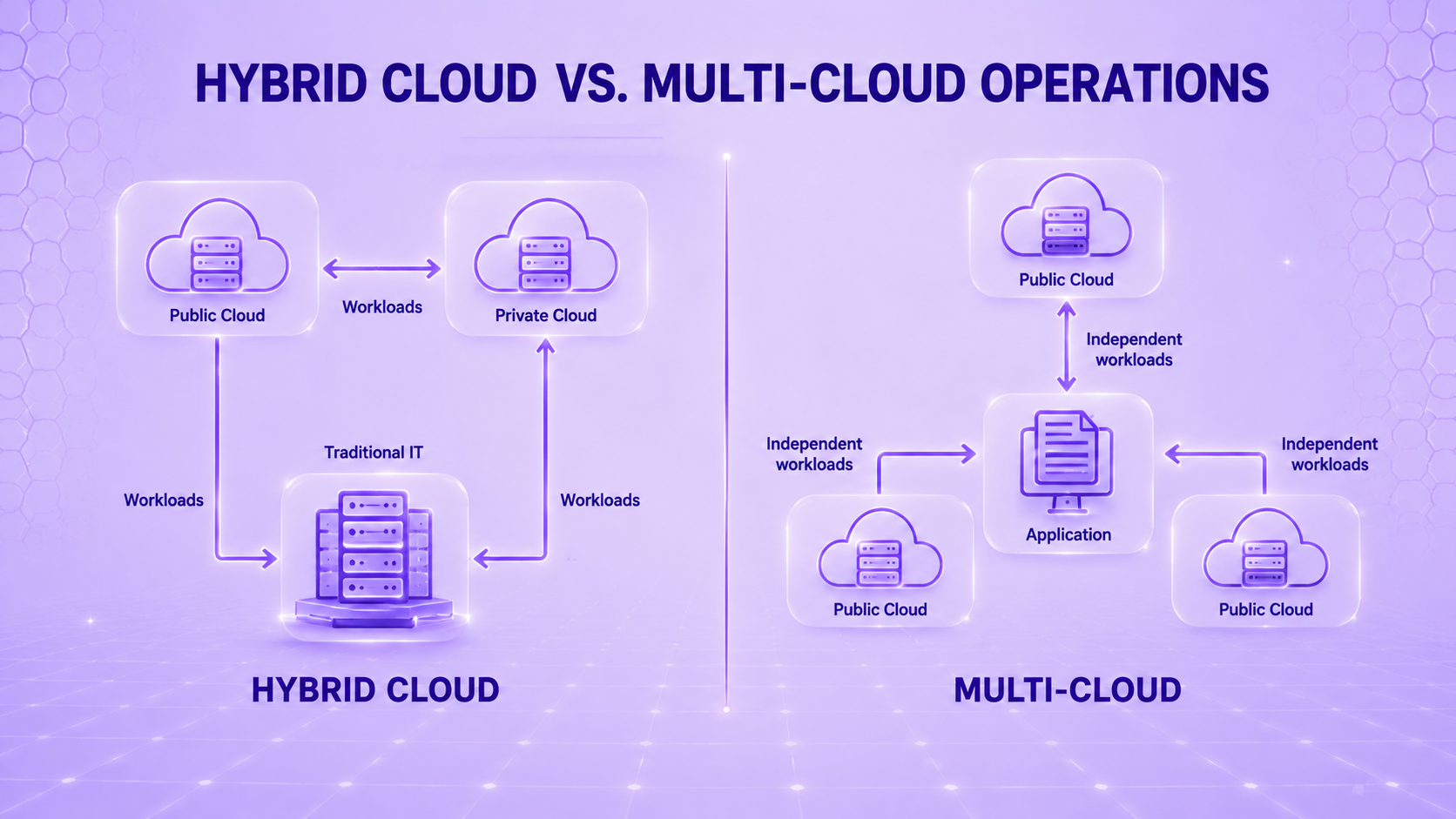
Alt text: Difference between hybrid cloud and multicloud
A multicloud environment uses services from two or more cloud providers. The focus is on selecting the best provider for different workloads, giving organizations greater flexibility and reducing dependence on a single vendor.
A hybrid cloud, on the other hand, combines public cloud services with private cloud infrastructure or on-premises systems. Here, the goal is to connect different environments so applications and data can move between them securely.
It's also possible for an organization to use both approaches. For example, a business may operate its own private cloud while also using AWS and Microsoft Azure. In this case, the environment is both hybrid and multicloud.
In short, multicloud focuses on using multiple cloud providers, while hybrid cloud focuses on integrating different computing environments.
Multicloud vs Single Cloud
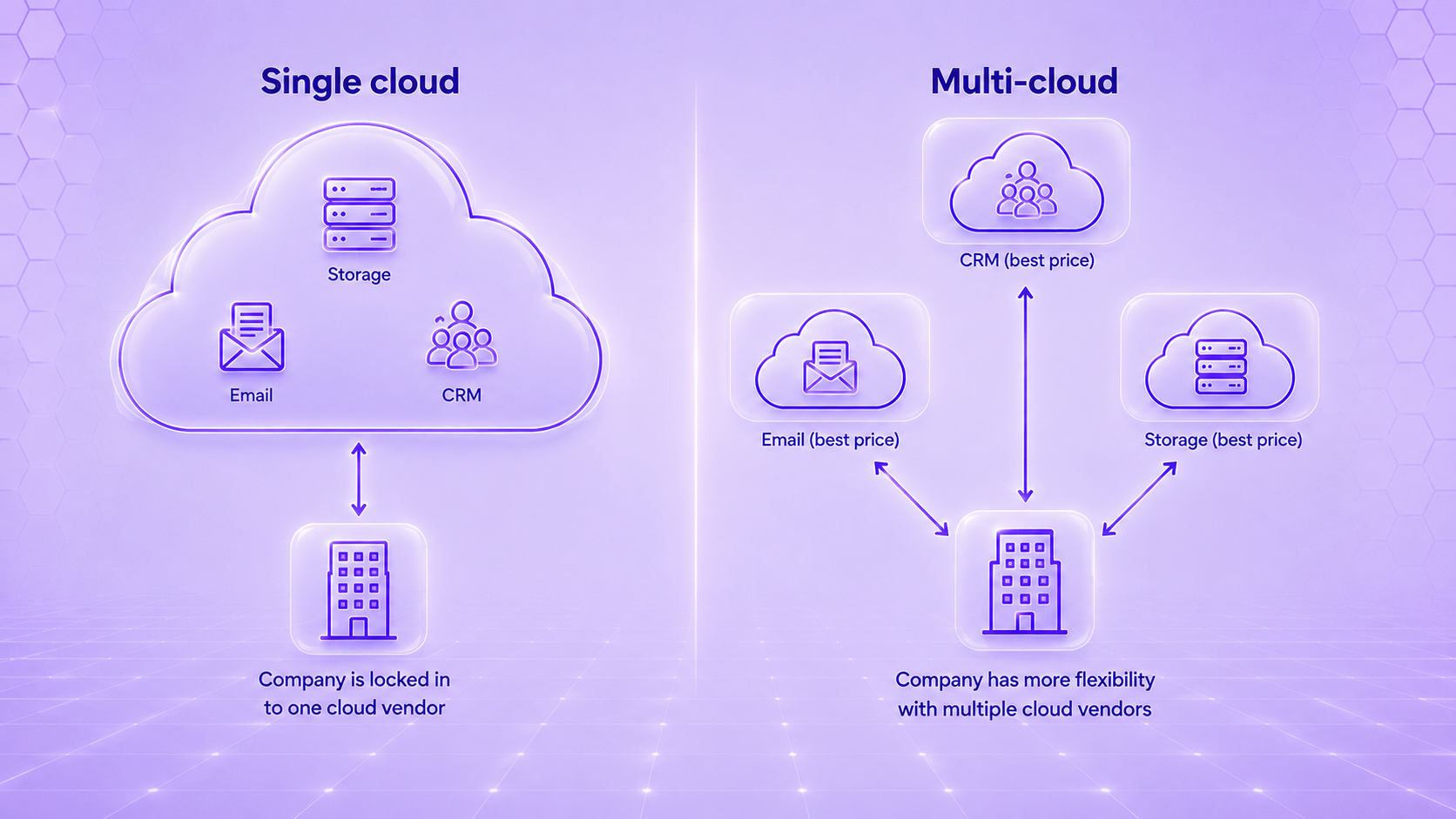
Alt text: Difference between single cloud and multicloud
A single-cloud strategy means an organization relies on one cloud provider for all its applications and services. This approach is generally easier to manage because everything runs within the same ecosystem, making deployment, monitoring, and security more straightforward.
A multicloud strategy offers greater flexibility by allowing organizations to choose different providers for different workloads. It also reduces dependence on one vendor and improves resilience if a provider experiences an outage.
However, this flexibility comes with additional complexity. Managing multiple providers requires stronger governance, centralized monitoring, and consistent security practices.
Neither approach is universally better. A single cloud works well for organizations with simple requirements, while multicloud is often better suited for businesses with diverse workloads, global operations, or strict compliance needs.
Common Multicloud Use Cases
Different organizations adopt multicloud for different reasons, but some use cases are especially common.
Disaster recovery: Critical applications and backups are distributed across providers so services can recover more quickly after outages.
AI and machine learning: A company may use one provider's AI platform while storing data on another cloud that better fits its storage strategy.
Data analytics: Analytics workloads often run on providers offering specialized processing capabilities.
Global application delivery: Applications are deployed across multiple regions to provide lower latency for users around the world.
DevOps environments: Development, testing, and production environments can run on different providers depending on cost, performance, or project requirements.
Best Practices for a Multicloud Strategy
A successful multicloud strategy requires planning before workloads are distributed across different providers.
Define intentional workload placement: Choose where each application should run based on performance, cost, compliance, and business priorities.
Standardize with automation: Use Infrastructure as Code (IaC), automation tools, and standardized deployment processes to simplify operations.
Unify security and governance: Apply consistent identity management, security policies, and compliance controls across every cloud platform.
Centralize cost tracking: Use FinOps practices and cloud cost management tools to monitor spending across providers.
Prioritize observability: Centralized monitoring, logging, and performance tracking make it easier to identify issues before they affect users.
Is Multicloud Right for Your Business?
Multicloud works best when organizations have diverse infrastructure requirements.
It is often a good fit for:
- Large enterprises
- Regulated industries
- Global organizations
- High-availability applications
- Businesses looking to reduce vendor lock-in
However, it may not be necessary if you have:
- A small business
- Simple applications
- Limited IT resources
- Straightforward cloud requirements
If a single provider already meets your performance, scalability, and compliance needs, adding another cloud platform may create unnecessary complexity.
How TrueFoundry Supports Multicloud AI Deployments
TrueFoundry makes it easier to manage AI applications across multiple cloud providers. Instead of switching between different cloud platforms, you can manage everything from one central dashboard. It works with cloud services like AWS, Google Cloud, Microsoft Azure, specialized cloud providers, and even on-premises infrastructure.
Its built-in AI Gateway lets you send requests to AI models running on different clouds through a single endpoint, so applications don't need separate connections for each provider. Since it's built on Kubernetes, workloads can be moved between cloud environments more easily, helping organizations avoid being locked into one vendor.
Features like automatic failover, centralized monitoring, and data residency controls help keep AI applications reliable, secure, and compliant while running across multiple environments.
Conclusion
Multicloud isn't about using as many cloud providers as possible. It's about using the right provider for the right workload. By combining multiple cloud platforms, organizations can improve flexibility, reduce vendor dependence, increase resilience, and access specialized services that a single provider may not offer.
However, managing multiple cloud environments requires strong governance, consistent security, and centralized visibility. The right tools can help simplify operations, improve workload portability, and make it easier to manage AI applications across different cloud platforms.
If you're exploring ways to build and manage AI workloads across multiple cloud environments, TrueFoundry helps teams deploy, monitor, and scale AI applications with a unified approach across clouds. Sign up today.
FAQs
- What is an example of a multicloud?
A company might host its website on AWS, store backups in Microsoft Azure, and use Google Cloud for AI services. Since it uses multiple cloud providers, it operates in a multicloud environment.
- What is multicloud used for?
Multicloud is used to improve flexibility, optimize costs, increase availability, support disaster recovery, meet compliance requirements, and reduce reliance on a single cloud provider.
- What are the benefits of multicloud?
The main benefits include greater flexibility, higher availability, better cost optimization, improved scalability, stronger compliance, enhanced performance, and access to specialized cloud services.
- What is the alternative to multicloud?
The main alternatives are a single-cloud strategy, where all workloads run on one provider, and a hybrid cloud strategy, which combines public cloud services with private cloud or on-premises infrastructure.
Steuern, implementieren und verfolgen Sie KI in Ihrer eigenen Infrastruktur

GenAI infra- einfach, schneller, günstiger
Top-Teams vertrauen uns bei der Skalierung von GenAI

- © 2022 ENSEMBLE Technologies



Abonnieren Sie unseren Newsletter
Die neuesten Nachrichten, Artikel und Ressourcen werden in Ihren Posteingang gesendet


