


Erhalten Sie sofortigen Zugriff auf eine TrueFoundry-Live-Umgebung. Stellen Sie Modelle bereit, leiten Sie den LLM-Verkehr weiter und erkunden Sie die gesamte Plattform — Ihre Sandbox ist in Sekundenschnelle einsatzbereit, ohne dass eine Kreditkarte erforderlich ist.


What Is a Neural Network and How Does It Work?

AI can recognize faces, understand speech, give recommendations, and generate responses to a question. But what allows these systems to learn patterns from data and use them to give outputs? Neural networks are a key technology behind these applications.
They use connected layers of artificial neurons to process data and learn patterns that can be used for image recognition, natural language processing (NLP), speech recognition, trend prediction, and fraud detection. This article explains what a neural network is, how it works, its types, their uses, and how they are trained.
What is a neural network?
A neural network is a type of machine learning model designed to learn patterns from data and use those patterns to make predictions, classifications, or decisions.
It is loosely inspired by the way neurons in the human brain process information. However, an artificial neural network does not work exactly like a biological brain. Instead, it uses mathematical calculations arranged in connected layers that transform data using learned parameters.
For example, if you give a neural network thousands of pictures of cats and dogs, it can learn patterns that help it distinguish between the two. It may gradually learn to recognize features such as shapes, edges, colors, and other visual patterns. Once trained, it can use what it has learned to classify a new image.
The same basic idea can be applied to many types of data, including text, audio, images, numbers, video, and structured data.
How do neural networks work?
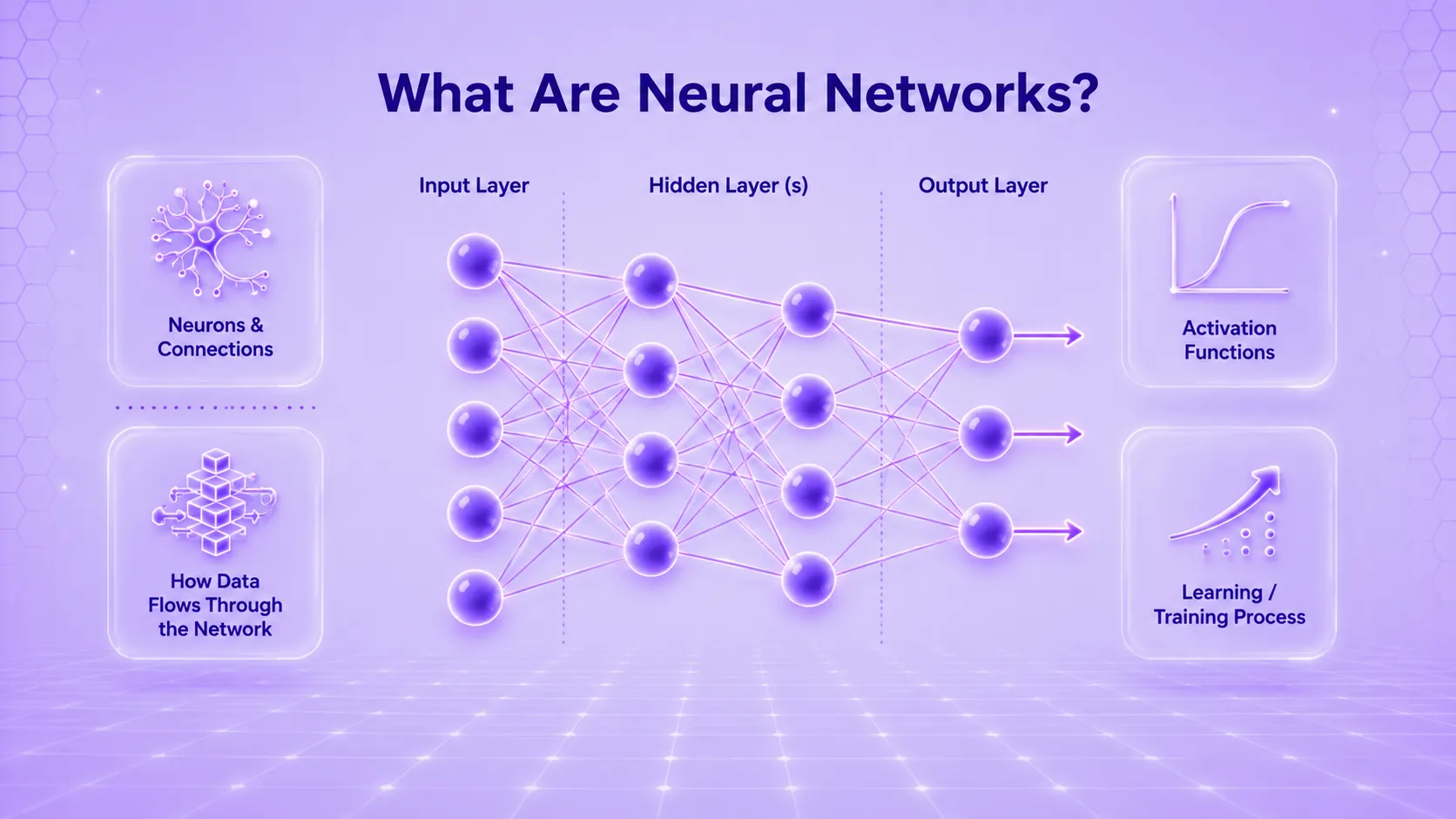
A neural network is organized into layers of interconnected artificial nodes (or neurons), which process information in a specific sequence. Each artificial neuron receives information, performs a mathematical calculation, and passes the result to other neurons in the network.
The process generally involves three main types of layers — input, hidden, and output — connected by adjustable weights:
Input layer
The input layer receives data in a numerical representation that the neural network needs to process.
For an image-recognition system, the input could be the numerical representation of an image’s pixels. For a language model, the input consists of numerical representations of words or tokens.
The input layer does not make the final prediction. It provides the data to the rest of the network to process.
Hidden layers
The hidden layers perform calculations on the incoming information through a series of mathematical operations, enabling the network to learn complex patterns.
A neural network can have one or many hidden layers, with different layers learning different levels of patterns. In an image-recognition task, for example, earlier layers might detect simple shapes or edges, while later layers can combine these patterns to identify more complex features.
Weights
Connections between neurons have numerical values called weights. Weights determine the strength of different inputs and influence the computation in the network. During training, the network adjusts these weights to minimize errors.
Output layer
The output layer produces the final prediction or result. Data enters through the input layer, passes through the hidden layers, and reaches the output layer to produce the result.
For example, a trained image-classification model might output the probabilities that an image contains a cat, dog, or another object. A fraud-detection model could produce a score indicating whether a transaction appears suspicious.
What Are the Main Types of Neural Networks?
Neural networks can be designed in different ways depending on the type of data they need to process and the problem they are solving. The three most widely used types are Convolutional Neural Networks (CNNs), Recurrent Neural Networks (RNNs), and Transformers.
Convolutional neural networks (CNNs)
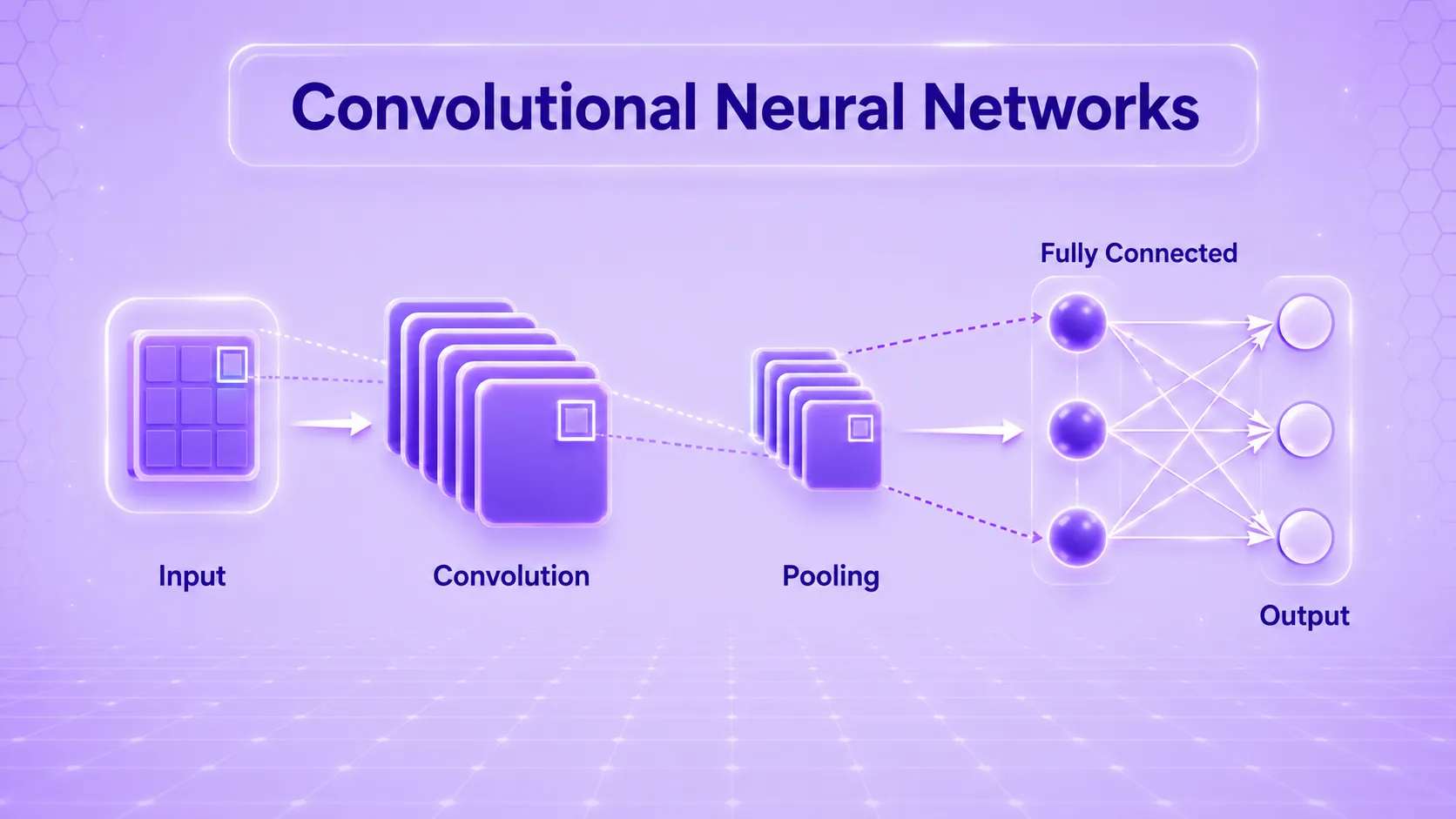
Convolutional Neural Networks, or CNNs, are neural networks designed to process visual data and identify patterns in different parts of an image. They use convolution operations to examine smaller sections of an input and identify useful visual patterns. Different layers can progressively detect more complex features.
CNNs have been widely used in areas such as image classification, facial recognition, medical imaging, and object detection.
For example, a CNN used for image recognition might identify edges in earlier stages and combine those patterns into shapes and objects in later stages.
Recurrent neural networks (RNNs)
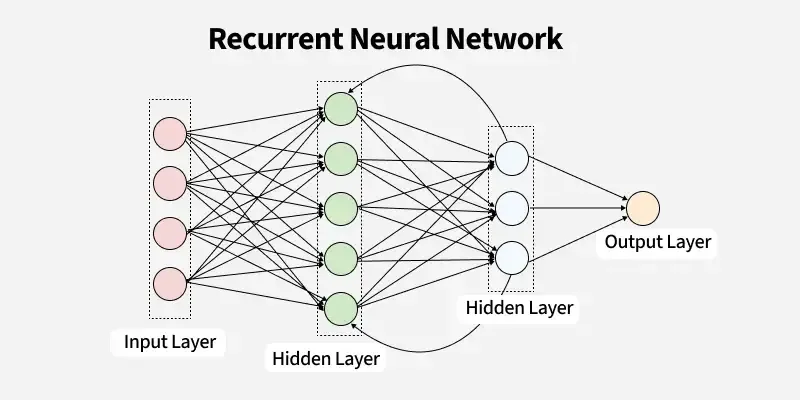
Recurrent Neural Networks, or RNNs, were designed to work with sequential data. They process information while taking previous elements in the sequence into account. This makes them useful for tasks where the order of information matters, such as speech, text, and time-series data.
Traditional RNNs can struggle with very long sequences because it becomes difficult to retain information from much earlier in the sequence.
For example, when processing a sentence, an RNN can use information from earlier words while processing later words.
Transformers
Transformer architectures are designed to process sequences using an attention mechanism to identify relationships between different parts of the input. They use a mechanism called attention to determine which parts of the input are more relevant when processing each part of the sequence. Transformers can process many parts of a sequence in parallel, which can make training more efficient than processing the sequence step by step.
Transformers are used in natural language processing and generative AI. Many modern large language models use Transformer-based architectures to process and generate text.
For example, a Transformer-based large language model can process tokens in a prompt and use relationships between them to generate a response.
Why are neural networks important?
Neural networks are important because they enable computers to learn useful patterns from large amounts of data rather than relying entirely on manually written rules.
Some of their key advantages include:
- They can learn complex patterns: Neural networks can identify relationships in data that may be difficult to describe using traditional rules.
- They can handle different types of data: They can be trained to work with images, text, audio, video, structured data, and other types of information.
- They can adapt to task-specific patterns: A neural network can adjust its internal parameters during training to improve its predictions.
- They can automate complex tasks: Once trained and deployed, neural networks can perform classification, prediction, and pattern recognition at scale.
What are neural networks used for?
Neural networks are used in a wide range of applications, including computer vision, speech recognition, natural language processing, recommendation systems, healthcare, autonomous systems, and financial services.
Computer vision and image recognition
Neural networks can analyze images and videos to identify objects, faces, scenes, and other visual patterns.
They are used in applications such as image search, facial recognition, quality inspection, medical imaging, and security systems.
Speech recognition and voice assistants
Neural networks can convert spoken language into text and help systems interpret voice commands.
This technology is used in voice assistants, transcription services, call center systems, accessibility tools, and speech-to-text applications.
Natural language processing (NLP) and large language models
Neural networks play a central role in natural language processing (NLP), which focuses on enabling computers to work with human language.
Modern large language models use neural network architectures to process text, identify patterns in language, answer questions, summarize information, translate content, and generate text.
Recommendation systems
Streaming platforms, online stores, and social networks can use neural networks to identify patterns in user behavior.
For example, a recommendation system can analyze interactions such as searches, clicks, purchases, or viewing history to suggest content or products that may be relevant to a user.
Healthcare and medical diagnosis
Neural networks can assist with analyzing medical images, identifying patterns in health data, and supporting certain diagnostic workflows.
For example, researchers have developed models that can analyze X-rays, scans, and other medical images. These systems are generally used to support healthcare professionals rather than replace clinical judgment.
Autonomous vehicles
Self-driving and driver-assistance systems can use neural networks to process information from cameras, radar, lidar, and other sensors.
They can help identify road signs, vehicles, pedestrians, lanes, and other objects that are important for navigation and driving decisions.
Financial services and fraud detection
Financial institutions can use neural networks to identify unusual patterns in transactions. A model can learn from historical data and flag transactions that appear different from normal behavior.
Neural networks are also used in areas such as risk modeling, customer service, and financial forecasting.
How are neural networks trained?
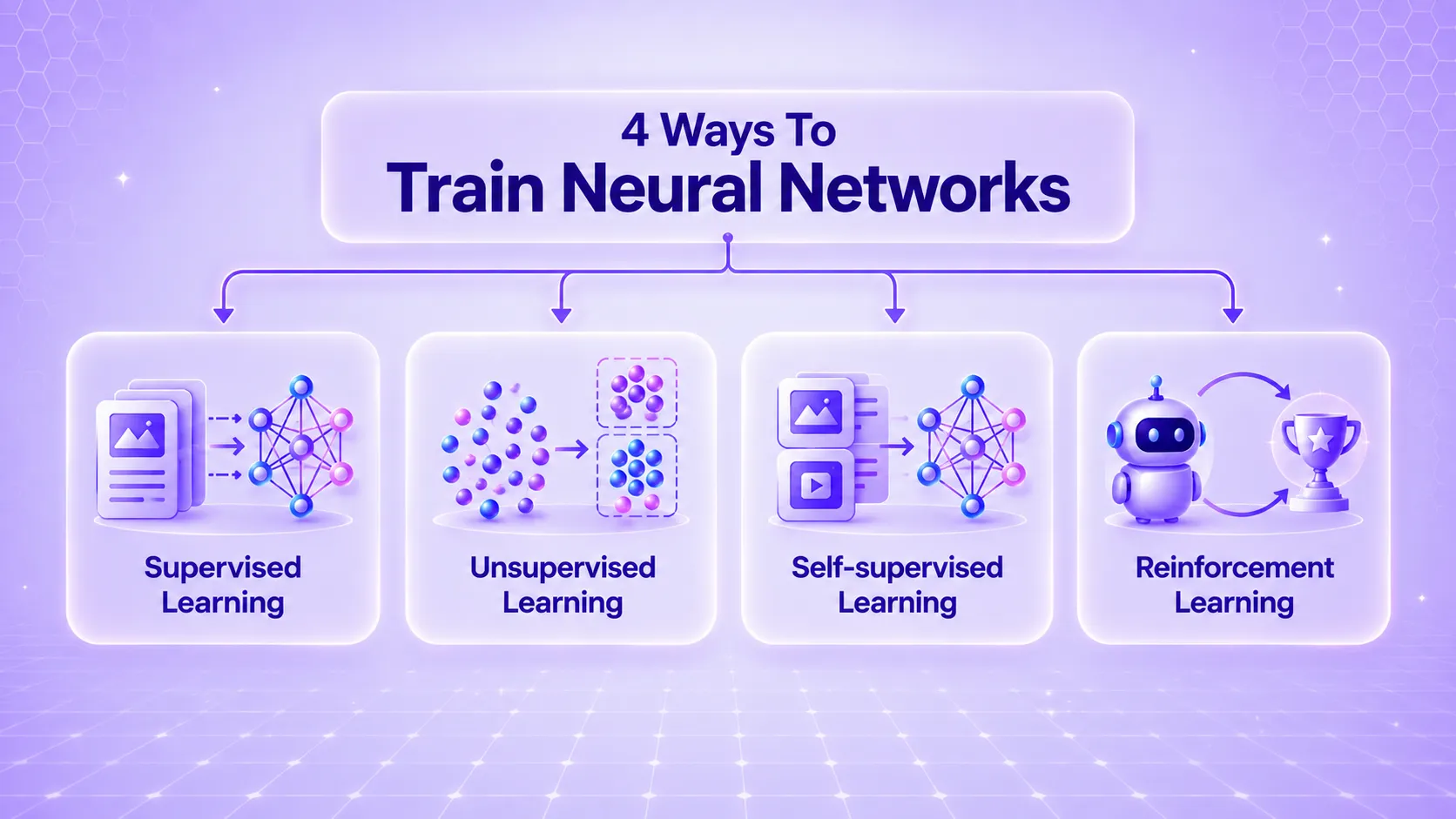
A neural network does not automatically know what to look for when it is first created. It needs to be trained using data.
During training, the model processes data, makes predictions, compares its results with the learning objective, and adjusts its internal parameters to improve its performance.
Supervised learning
In supervised learning, the neural network is trained using labeled data. Supervised learning networks are divided into classification and regression.
Classification predicts a category or class label, while regression predicts a continuous numerical value.
For example, a developer could provide thousands of emails labeled as either "spam" or "not spam." The model learns patterns associated with each category and then uses those patterns to classify new emails.
Unsupervised learning
In unsupervised learning, the model works with data that lacks predefined labels. Instead of using predefined labels, the model identifies patterns, structures, or relationships within the data.
This approach can be useful for tasks such as clustering and identifying patterns in large datasets.
Self-supervised learning
Self-supervised learning is a machine learning training technique that uses unsupervised learning. In self-supervised learning, a model learns from raw, unlabeled data.
Models learn by solving self-generated puzzles to learn meaningful representations and structural patterns from the data. For example, a language model learns to predict a missing or next token based on the context.
Self-supervised learning reduces time and cost, increases the ability to train on a vast amount of data, and achieves high-level accuracy.
Reinforcement learning
In reinforcement learning, a model learns by interacting with an environment and receiving feedback based on its actions. The model aims to learn which actions produce better outcomes over time. The feedback is typically represented as a reward signal.
This approach has been used in areas such as robotics, game-playing systems, and certain decision-making proble
In reinforcement learning, a neural network can be used to represent a policy or value function. The model is updated based on feedback from rewards or penalties.
What is deep learning in the context of neural networks?
Deep learning is a form of machine learning that uses deep neural networks with multiple layers to learn increasingly complex patterns from data. The word "deep" refers to the depth of the network, or the number of processing layers it contains.
A deeper network can learn different levels of features from the data. For example, in an image task, early layers may learn simple visual features, while later layers combine those features to recognize more complex objects. In language applications, different layers can learn patterns between tokens and how they relate to one another in context.
Deep learning is widely used in computer vision, speech recognition, natural language processing, and generative AI. However, deeper and larger models can also require substantial amounts of training data, computing power, and time.
Why neural networks remain important in modern AI
Neural networks are a core part of modern AI systems, which allow models to learn patterns from data and use them to produce predictions, classifications, and other outputs.
A neural network does not "think" like a human brain. It is a mathematical model that learns relationships from data by adjusting its internal parameters during training. Neural network architectures continue to evolve, and they remain a fundamental building block of many modern AI systems.
Steuern, implementieren und verfolgen Sie KI in Ihrer eigenen Infrastruktur

GenAI infra- einfach, schneller, günstiger
Top-Teams vertrauen uns bei der Skalierung von GenAI

- © 2022 ENSEMBLE Technologies



Abonnieren Sie unseren Newsletter
Die neuesten Nachrichten, Artikel und Ressourcen werden in Ihren Posteingang gesendet


