


October 1, 2026
|
Lesedauer: 5 Minuten


Erhalten Sie sofortigen Zugriff auf eine TrueFoundry-Live-Umgebung. Stellen Sie Modelle bereit, leiten Sie den LLM-Verkehr weiter und erkunden Sie die gesamte Plattform — Ihre Sandbox ist in Sekundenschnelle einsatzbereit, ohne dass eine Kreditkarte erforderlich ist.


Published: August 21, 2026
Unglaublich schnelle Methode zum Erstellen, Verfolgen und Bereitstellen Ihrer Modelle!
The easiest AI demo ends with text. Production systems rarely do. They need a ticket object, a routing decision, a list of entities, an API payload, a tool call, or UI state that another program can consume without guessing what the model meant.
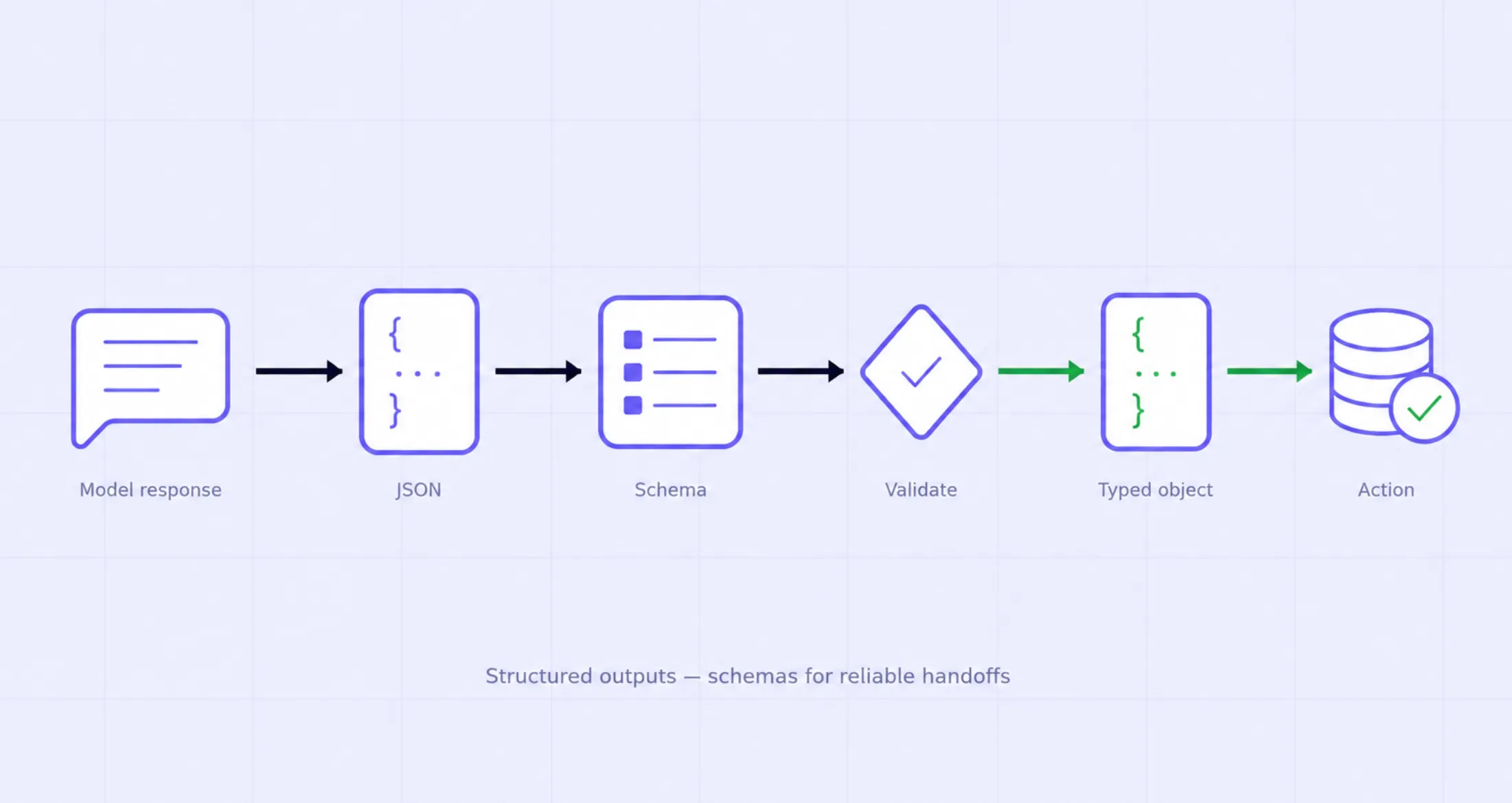
That is why structured outputs are more than a formatting trick. They are one boundary where a probabilistic model meets deterministic software. JSON mode can make syntax predictable. A schema can constrain shape. Pydantic or equivalent application validation can enforce types and local invariants. Business validators check facts and domain rules the schema cannot know. Authorization decides whether a structurally valid object may cause an external action.
free-form text
   ↓
valid JSON
   ↓
schema-conforming object
   ↓
business-valid object
   ↓
authorized action
TrueFoundry AI Gateway bietet eine Latenz von ~3—4 ms, verarbeitet mehr als 350 RPS auf einer vCPU, skaliert problemlos horizontal und ist produktionsbereit, während LiteLM unter einer hohen Latenz leidet, mit moderaten RPS zu kämpfen hat, keine integrierte Skalierung hat und sich am besten für leichte Workloads oder Prototyp-Workloads eignet.





Die neuesten Nachrichten, Artikel und Ressourcen werden in Ihren Posteingang gesendet
.png)
.png)
.png)
.png)
.png)
.png)
.png)
.png)
.png)
.png)
.png)


