
Blank white background with no objects or features visible.

Hello, EMEA! TrueFoundry is growing our footprint across Europe, the Middle East, and Africa. Read more. →

Bifrost vs Vercel AI Gateway: build it or buy it?

By Mahizh Vannan

Published: November 25, 2026

Bifrost vs Vercel AI Gateway is not a fight between two products of the same kind. Bifrost is an open-source gateway you run yourself. Vercel AI Gateway is a hosted router you call over the internet. Both put one OpenAI-compatible endpoint in front of many model providers, and both let you set budgets and fall back between providers. The real decision is whether your team wants to operate a gateway in exchange for control and free governance features, or pay a vendor to run it and accept where it runs and how it is billed.

Dimension Bifrost Vercel AI Gateway
What it is Self-hosted, Apache-2.0 LLM gateway from Maxim AI, written in Go Hosted model router run by Vercel at ai-gateway.vercel.sh
Who runs it You Vercel
Pricing OSS free; Enterprise by quote No token markup; paid credits; some governance features metered per request
Best for Teams that want the gateway inside their network and have someone to run it Teams that want zero infrastructure, especially if they already build on Vercel
Licence Apache-2.0 open code; Enterprise is a separate distribution needing a licence file Proprietary hosted service; open-source AI SDK as client option
Relicensing risk Low: open repo is Apache-2.0 with no exceptions; paid tier sits outside the repo None
Dominant risk type Operational (you deploy, patch, scale, monitor) plus single-company stewardship Commercial (credit terms, pricing) and architectural (single hosted system)
Release model Continuous; Core, Helm chart and Enterprise base released as separate tagged versions on GitHub; stable/LTS policy not verified Continuous; new models land in the catalog continuously; versioned changelog not verified
Product breaking changes Enterprise v2.0.0 started requiring a provisioned licence file on every node; full list not verified Not verified
Commercial changes None found None found; terms to note: purchased credits expire after 1 year, BYOK is paid tier only
Corporate concentration Maxim AI (legal entity H3 Labs Inc.); no acquisition on record Product of Vercel; Vercel account needed for key and billing, but no Vercel project or deployment required
Availability concentration Your infrastructure and your HA design; clustering is an Enterprise feature Single hosted system; retries across providers and configurable model fallbacks; no single fleet-wide uptime promise
Published incident history n/a (no vendor-hosted service) Per-model and per-provider uptime and status published; gateway-level incident history not verified
Support below Enterprise Community support via Discord Dashboard Support entry for technical and billing questions; SLA not verified
Enterprise support Private offers via AWS Marketplace under an MSA; 14-day Enterprise trial; SLA terms not verified Contact sales for custom rate limits, volume discounts and invoice payment
Adoption evidence Not verified Not verified
Roadmap transparency Public GitHub repo and release tags; public roadmap not verified Not verified
Exit: traffic Base-URL change; OpenAI-compatible; provider/model strings Base-URL and key change; OpenAI or Anthropic SDKs keep working; creator/model slugs
Exit: everything else Rebuild virtual keys, budgets, routing rules and guardrails by hand; logs already in your own store Rebuild budgets, allowlists, API keys and data-handling controls; export request metadata via Trace Drains; unused credits expire at 12 months

Bifrost: overview

Bifrost's free tier is a complete gateway rather than a trial. It covers weighted routing and CEL routing rules, fallbacks and retries, virtual keys with budgets and rate limits, semantic caching, an MCP gateway, Prometheus metrics, OpenTelemetry traces and a built-in dashboard. It runs as a Docker container, a binary or a Helm chart, inside your VPC, on-prem or air-gapped, and you bring your own provider keys with no markup.

The costs are operational. Multi-node OSS deployments don't share state, so config changes need a restart on every replica, and budgets and counters are kept per pod. SSO, RBAC, audit logs, external secret managers, guardrails and live clustering are Enterprise features, priced by quote. In our own testing, a default install also starts with no authentication on the gateway or the admin API, so hardening is on you from day one. For the full picture of that split, see our Bifrost pricing breakdown.

Vercel AI Gateway: overview

Vercel AI Gateway is a hosted service with nothing to deploy or scale. It has been generally available since August 2025 and lists hundreds of models; the models endpoint returned 377 when our team checked in September. It charges no markup on tokens, including when you bring your own provider keys, and it can also call providers on Vercel's credentials so you don't need your own accounts. Logs keep metadata rather than prompt and response bodies by default, which is a reasonable privacy default.

Governance is where it gets more nuanced. Budgets can be set per team, project, API key or user, but they are soft caps: the request that crosses the limit finishes, and later ones get a 402. Bringing your own keys needs purchased credits, and our team's test of a key on the free tier was rejected with byok_requires_paid_credits. Several controls are paid add-ons rather than built in, which we cover under pricing below. There is no self-hosted, BYOC or air-gapped version of the gateway itself; Vercel's BYOC beta covers apps and functions, not AI Gateway.
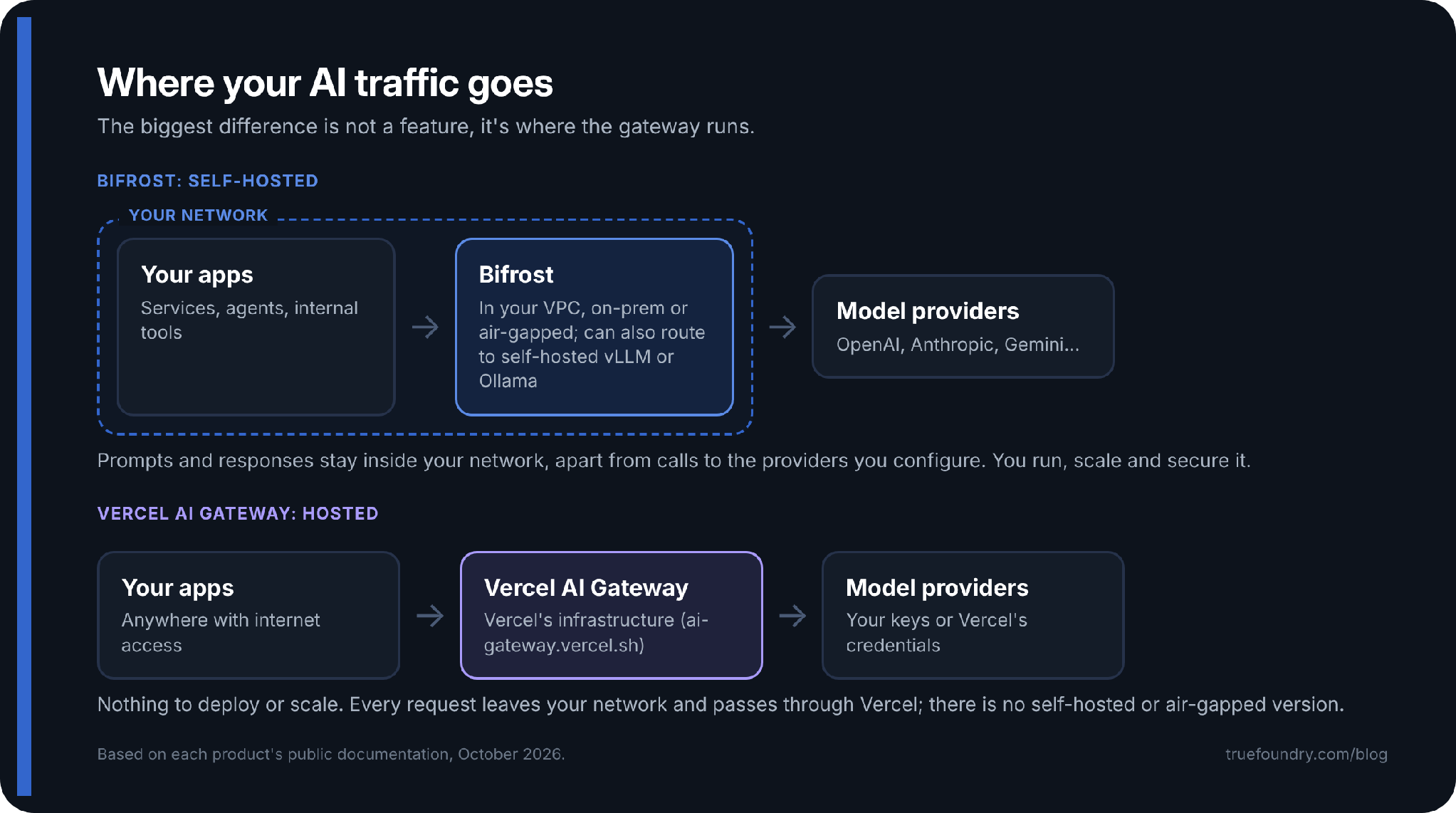
Head-to-head comparison

Diagram: with Bifrost, apps and the gateway sit inside your network and only provider calls leave it; with Vercel AI Gateway, every request goes from your apps over the internet to Vercel's infrastructure and then to the model providers.

Bifrost reflects its public documentation and our testing of OSS v2.0.0. Vercel reflects its public documentation and our team's hands-on account, with pricing re-checked in October 2026.

Capability Bifrost Vercel AI Gateway
Where it runs Your infrastructure only Vercel's infrastructure only
Prompts stay in your network Yes, apart from calls to the providers you configure No
Self-hosted models (vLLM, Ollama) Yes, documented adapters Not documented
Routing and fallback Weighted routing, CEL rules, fallbacks, retries with backoff Provider order and filters, health-aware defaults, model fallback
Budgets Hard stop at key, team, customer, provider and model level Soft cap at team, project, key or user level
Caching Semantic and exact-match Provider prompt caching
MCP and tool governance MCP gateway in OSS; federated MCP auth in Enterprise Separate products, not part of the gateway
SSO and SCIM OIDC and SCIM in Enterprise SAML as a $300/month Pro add-on; SCIM on Enterprise
Guardrails and PII redaction Enterprise only Not documented in the gateway
Observability Logs, Prometheus and OTel in OSS Built-in logs and metrics; OTel trace drains (OTLP/HTTP) billed per trace
Token markup None None

What you actually pay

Both products take no cut of your token spend, so the comparison comes down to licenses, add-ons, infrastructure and people. We use the three team sizes from our gateway comparison series.
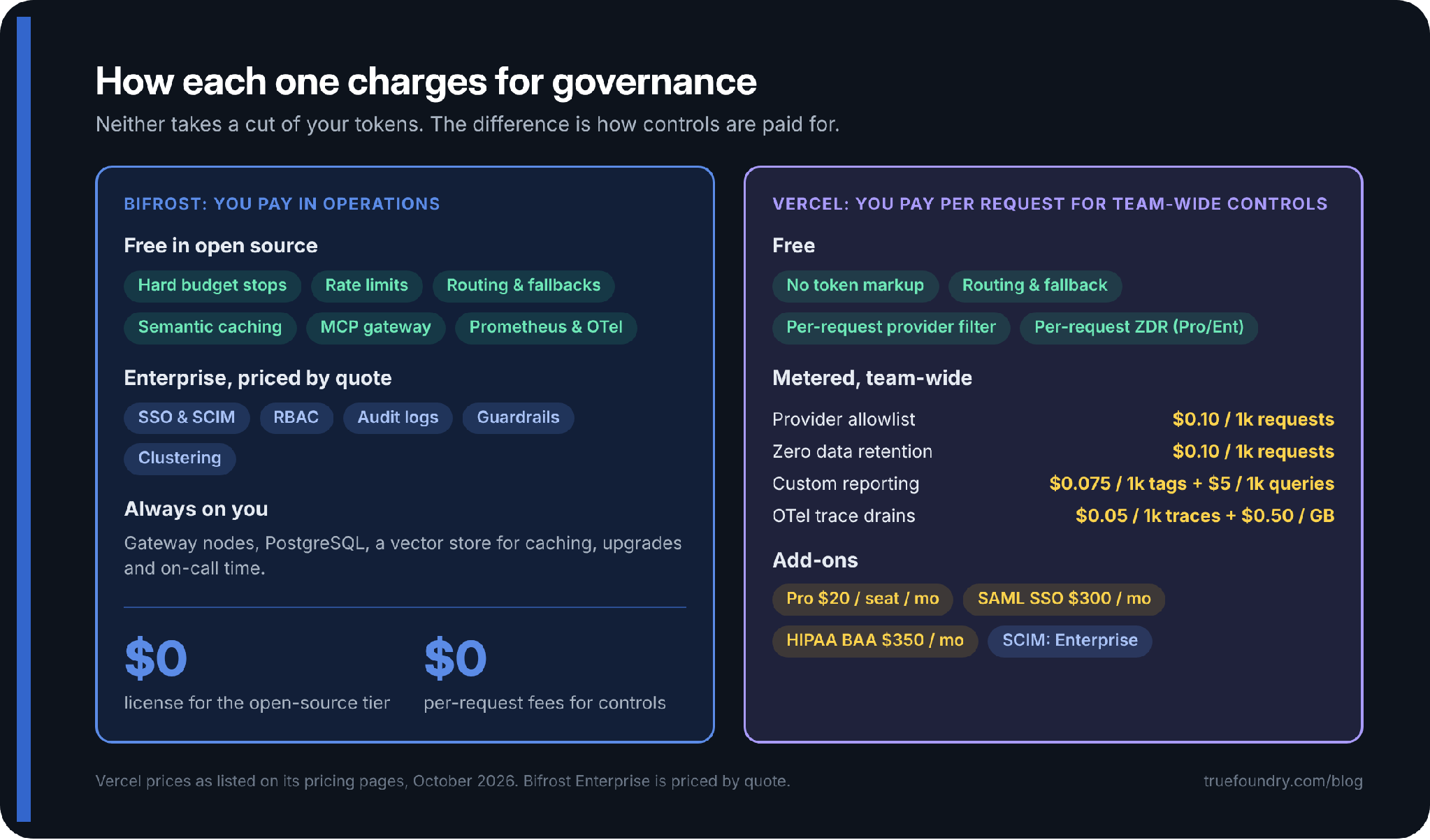
Infographic: Bifrost's governance features are free in open source with SSO, RBAC, audit logs, guardrails and clustering in Enterprise; Vercel's routing is free but team-wide provider allowlists, zero data retention, custom reporting and trace drains are metered, with SAML SSO and HIPAA BAA as monthly add-ons.

Bifrost charges you in operations time; Vercel meters its team-wide controls. Vercel prices as listed in October 2026.

Vercel's metered governance

Vercel's routing is cheap; its organization-wide controls are metered. From its pricing pages in October 2026:

  • Restricting providers for the whole team costs $0.10 per 1,000 successful requests. Restricting them per request with the only option is free.
  • Team-wide zero data retention costs $0.10 per 1,000 requests; per-request ZDR is free on Pro and Enterprise.
  • Custom reporting costs $0.075 per 1,000 tag writes and $5 per 1,000 queries.
  • OpenTelemetry trace drains cost $0.05 per 1,000 traces plus $0.50 per GB of egress, with no allowance on Pro.
  • Pro is $20 per developer seat per month. SAML SSO is a $300/month add-on and a HIPAA BAA is $350/month. SCIM needs an Enterprise contract.

The per-request options keep costs down if every application sets them correctly. The team-wide settings are the ones a security team can actually enforce, and those are the metered ones.

Bifrost's operated governance

Bifrost's budgets, rate limits, allowlists, caching and observability cost nothing in license. What they cost is the infrastructure (gateway nodes, PostgreSQL for multi-node or production use, a vector store if you use semantic caching, a load balancer) and someone's time to run, upgrade and back it up. Once you need SSO, RBAC, audit logs or a live cluster, Bifrost Enterprise is a quote rather than a price list.

By team size

Team Bifrost Vercel AI Gateway
Startup: 5 engineers, one app, no SSO or compliance needs $0 license; one small node; little ops time Pro seats; credits for tokens; no gateway to run
Scaleup: 50 engineers, SSO, RBAC, per-team budgets, SOC 2 Enterprise license (quote) for SSO, RBAC and audit, plus HA PostgreSQL and part of a platform engineer Pro seats, $300/month SAML, metered team-wide controls; RBAC on projects needs Enterprise
Regulated: two regions, no prompt data leaving the network, HIPAA, exportable audit logs Enterprise, in your VPC, with real platform staffing Doesn't fit: there is no in-network deployment of the gateway

Latency, honestly

The two products can't be benchmarked the same way. Bifrost is a container we can pin to one vCPU and test against a mock provider; our Bifrost performance review covers that. Vercel is a hosted service with nothing to size, so our team measured it from a client instead. In our paced free-tier test, Vercel AI Gateway added about 211 ms at p50 compared with calling OpenAI directly (non-streaming, single client, San Jose). That number includes the network path to Vercel and is not comparable with an in-cluster gateway figure. The free tier's account-level rate limiter, not added latency, is what stopped us running a standard load test; buying credits moves a team to the paid tier, which Vercel says has higher limits.
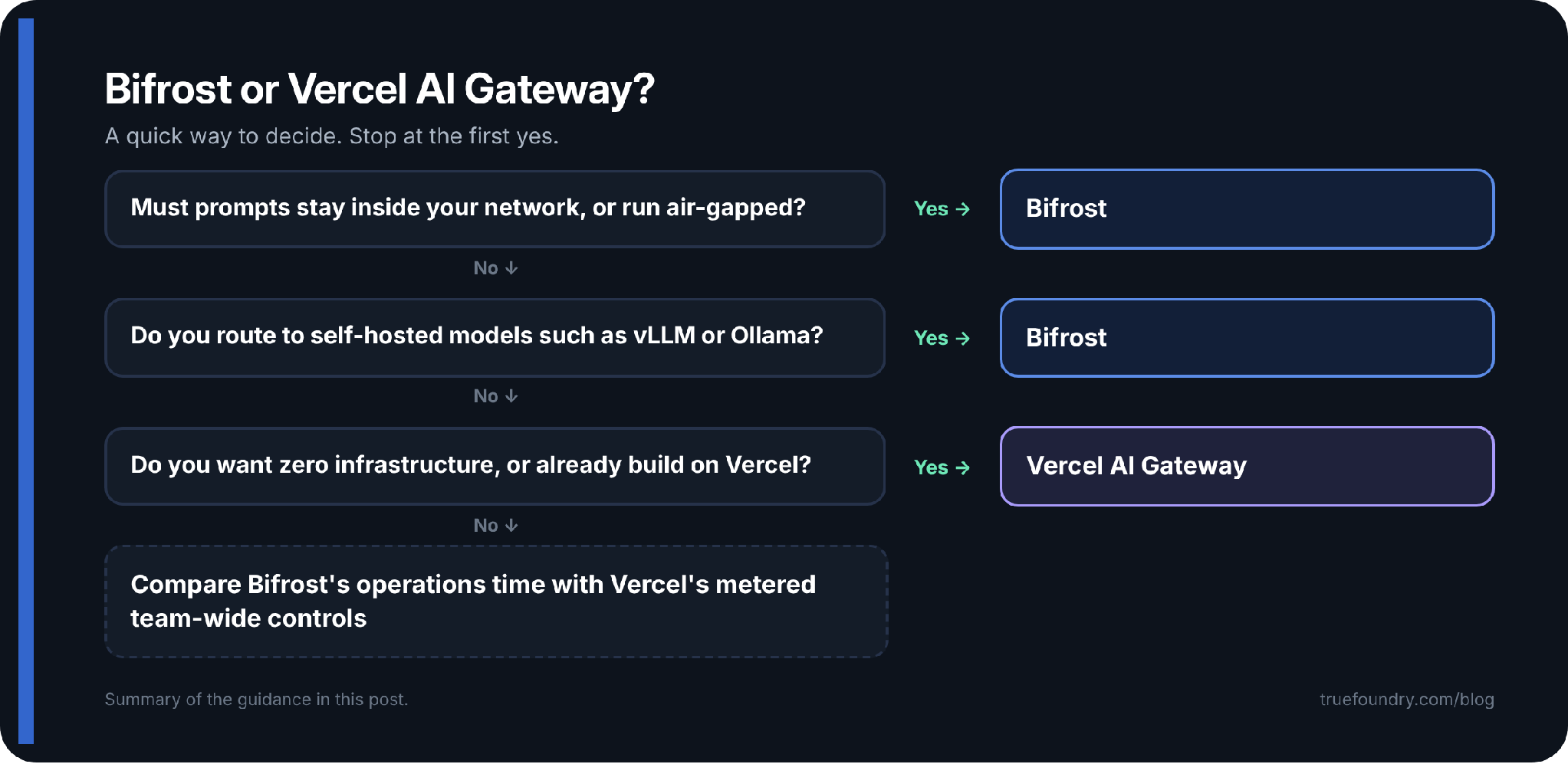
Decision flow: if prompts must stay in your network or you route to self-hosted models, choose Bifrost; if you want zero infrastructure or already build on Vercel, choose Vercel AI Gateway; otherwise compare operations time with metered controls.

A quick way to decide between the two.

When to choose Bifrost

  • Prompts and responses must stay inside your network, or you need air-gapped deployment.
  • You route to self-hosted models alongside commercial providers.
  • You want hard budget stops, caching and MCP in the free tier, and you have engineers to run the gateway.
  • You'd rather pay in operations time than in per-request fees.

When to choose Vercel AI Gateway

  • You want no infrastructure at all, and a hosted service fits your data policy.
  • Your applications already run on Vercel and use the AI SDK.
  • You want to try many models without opening an account with every provider.
  • Your governance needs are light enough that per-request settings cover them.

The TrueFoundry alternative

Bifrost and Vercel force the build-or-buy choice up front. The TrueFoundry AI Gateway doesn't. Start on the managed SaaS gateway, move the gateway plane into your own cluster when data policy demands it, or self-host everything, including air-gapped, without changing the product your applications call. Gateway pods receive config, access rules and limits from the control plane in real time, so multi-node consistency isn't a separate tier. SSO with SAML or OIDC, SCIM, RBAC, audit logs, guardrails and per-application virtual accounts with token rotation are part of the product rather than add-ons.

If your shortlist is Bifrost or Vercel and neither shape quite fits, see how the TrueFoundry AI Gateway works or book a demo.

Conclusion

Bifrost vs Vercel AI Gateway comes down to who should run the gateway. Pick Bifrost when traffic has to stay in your network and you have the people to operate it; pick Vercel when a hosted router fits your data policy and per-request governance fees are acceptable. If you want the option to do either without switching products, book a TrueFoundry demo.

Try now.

One gateway for all your models, MCP servers, and agents. No credit card needed.

Start free
Table of Contents

One Gateway for Every LLM, Agent and MCP Server

Book a 30-min with our AI expert

Book a Demo

The fastest way to build, govern and scale your AI

Book Demo
Summarize with
ChatGPT logo by OpenAI
Perplexity AI logo
Blurry red snowflake on white background, symmetrical frosty design with soft edges and abstract shape.

Discover More

|
5 min read

Bifrost vs agentgateway: two open-source AI gateways built for different jobs

|
5 min read

Bifrost vs Kong AI Gateway: who should own your AI gateway?

|
5 min read

Kong Konnect Pricing: What It Is and What It Costs in 2026

|
5 min read

Kong AI Gateway Benchmark Review: Open-Source Kong + ai-proxy on 1 vCPU

|
5 min read

Bifrost vs agentgateway: two open-source AI gateways built for different jobs

comparison
LLM Tools
|
5 min read

Bifrost vs Vercel AI Gateway: build it or buy it?

comparison
LLM Tools
|
5 min read

Bifrost vs Kong AI Gateway: who should own your AI gateway?

comparison
LLM Tools
what is llm observability
November 25, 2026
|
5 min read

What is LLM Observability: A Complete Guide

LLM Tools
Your guide to understanding key aspects of Bifrost pricing
October 15, 2026
|
5 min read

Bifrost Pricing: OSS, Enterprise Costs, and What Teams Should Know

No items found.
Vercel AI Gateway Pricing
October 27, 2026
|
5 min read

Understanding Vercel AI Gateway Pricing For 2026

No items found.
October 15, 2026
|
5 min read

TrueFoundry vs Bifrost: an enterprise AI platform meets a single-binary open-source gateway

No items found.
Vercel AI Gateway vs OpenRouter
October 15, 2026
|
5 min read

Vercel AI Gateway vs OpenRouter: Which one is best for you?

comparison
October 15, 2026
|
5 min read

AI Gateway On Premise : All You Need To Know

No items found.

Recent Blogs

Black left pointing arrow symbol on white background, directional indicator.

Frequently asked questions

What is the difference between Bifrost and Vercel AI Gateway?

Bifrost is an open-source gateway you deploy and operate in your own infrastructure. Vercel AI Gateway is a hosted router that Vercel runs. Both are OpenAI-compatible and charge no token markup, but Bifrost keeps traffic in your network while Vercel removes the operational work.

Can I self-host Vercel AI Gateway?

No self-hosted, BYOC or air-gapped option for the gateway is documented. Vercel's BYOC beta covers applications and functions, not AI Gateway.

Is Bifrost free?

The open-source tier is free under Apache-2.0 with no usage limits. You pay for the infrastructure and the time to run it, and Enterprise features such as SSO, RBAC, audit logs and clustering are priced by quote.

Can I deploy TrueFoundry in my own VPC or on-prem?

Yes. TrueFoundry runs in your VPC, on-prem, air-gapped, or hybrid, and no data leaves your domain. This is a core reason regulated teams choose it over SaaS-only gateways.

Is TrueFoundry SOC 2 / HIPAA / GDPR compliant?

TrueFoundry documents SOC 2 Type II, HIPAA and GDPR for its managed infrastructure, with RBAC, SSO and audit logging built in; current attestations are on the Trust Center at trust.truefoundry.com. For self-hosted deployments, compliance of your own environment is your responsibility, which is true of any self-hosted software.

Take a quick product tour
Start Product Tour
Product Tour