


.webp)
October 24, 2026
|
5 min read


Blazingly fast way to build, track and deploy your models!
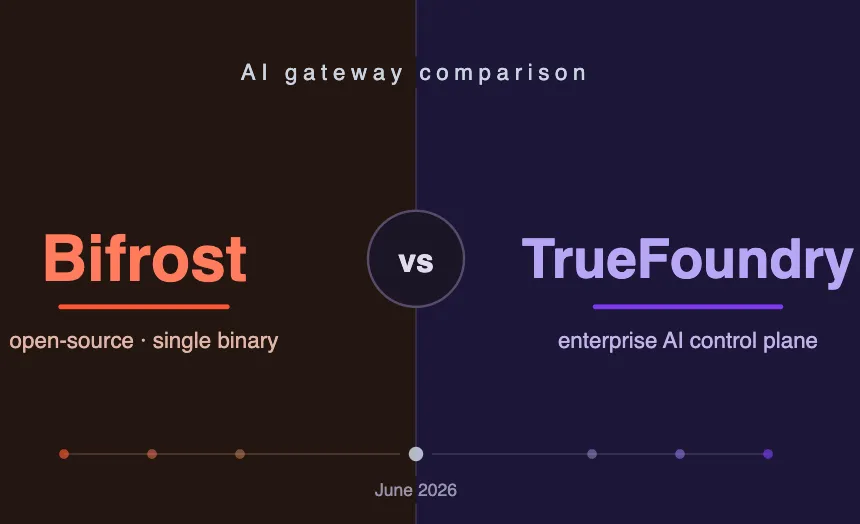
Bifrost is an open-source, single-binary Go gateway, self-hosted on infrastructure you run, that now handles LLM routing, MCP, and agent-mode auto-execution. TrueFoundry is an enterprise AI platform whose gateway is one layer of a larger control plane. Here's a hands-on, primary-source comparison.
If you're choosing an AI gateway in 2026, Bifrost and TrueFoundry will both land on your shortlist — and they look more alike on a feature grid than they are in practice. We ran Bifrost locally and read both vendors' documentation to write this from primary sources: Bifrost's runtime behavior comes from a running v1.5.7 instance, its enterprise, compliance, and deployment claims from Bifrost / Maxim's docs, and every TrueFoundry claim from its official docs.
Bifrost is a gateway you run: one Go binary, zero external dependencies to start (it boots on a local SQLite store), Apache-2.0 licensed, and self-hosted. TrueFoundry is a platform you adopt: an LLM + MCP + Agent gateway that's part of a Kubernetes-native stack which also deploys and trains models, hosts MCP servers, and runs agents — installable as SaaS, VPC, on-prem, or air-gapped. One is a single, self-contained tool; the other is the governed control plane for the whole AI lifecycle.

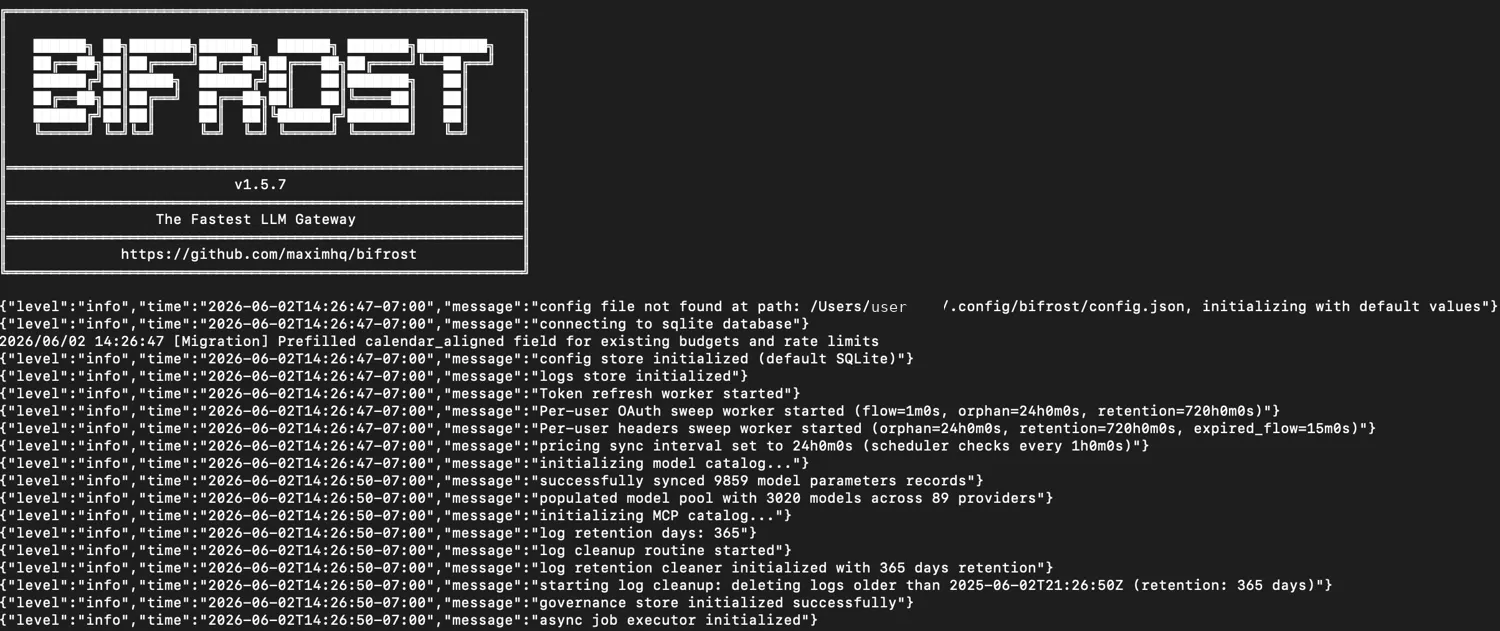
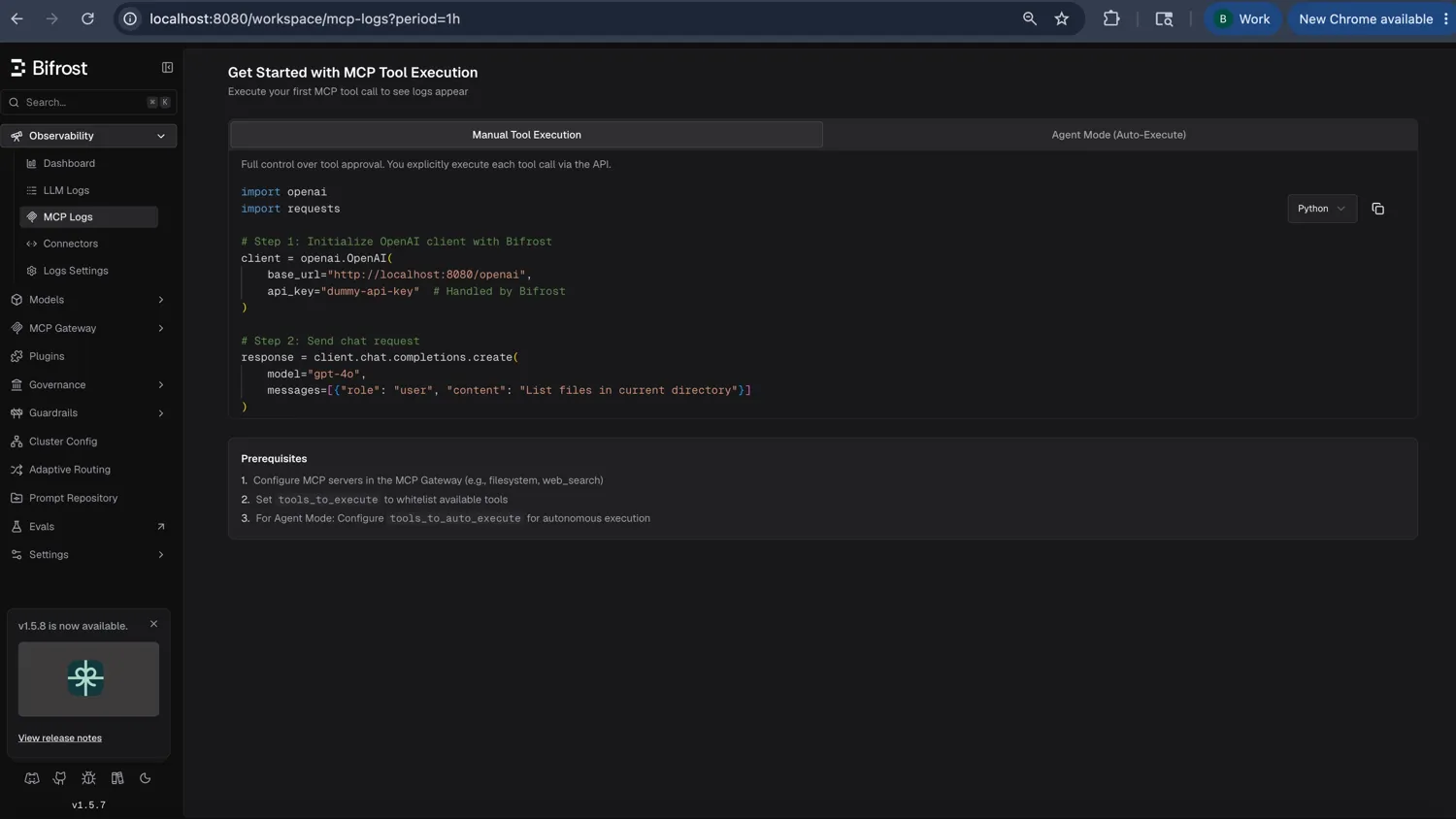
Bifrost's startup tells the story. On first run it finds no config and initializes defaults, connects to a local SQLite database, and stands up config, logs, and governance stores — no external database to begin. It starts workers for token refresh, a per-user OAuth sweep, and a pricing sync, then loads its catalog: in this build, 3,020 models across 89 providers, with 365-day default log retention.
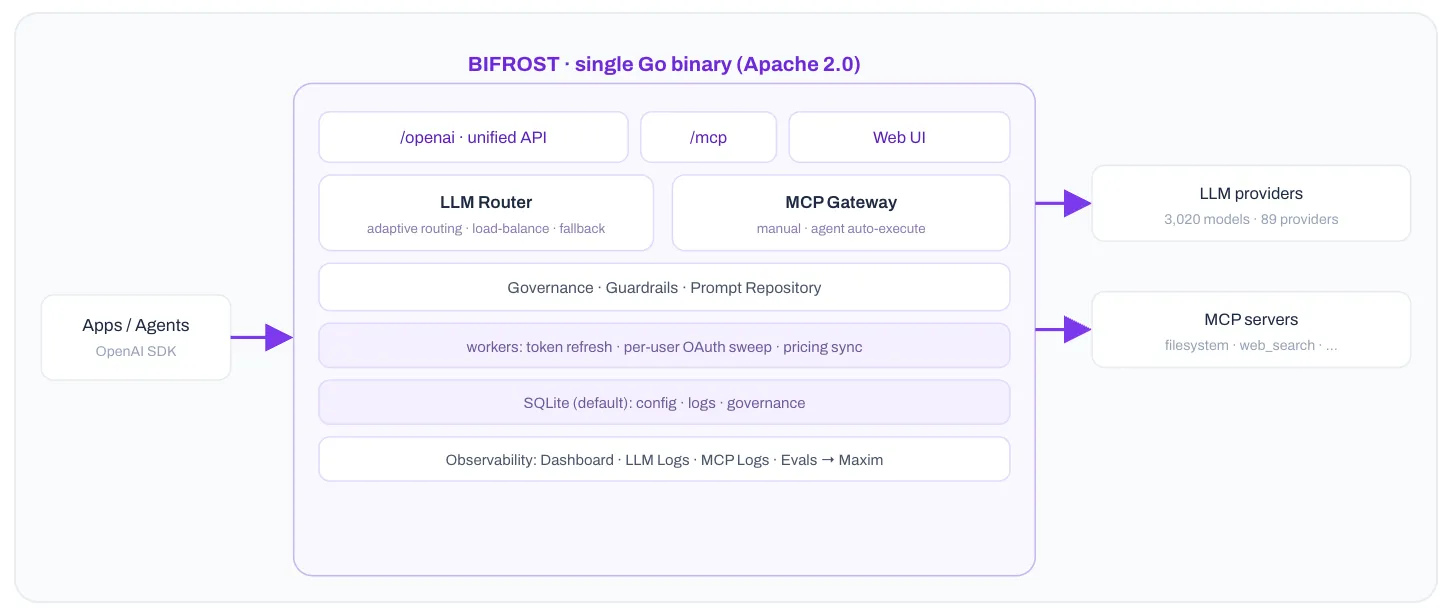
Put together, that's the shape of Bifrost: one process that contains the routing, the MCP gateway, governance, guardrails, prompt storage, the workers, the data stores, and the UI — nothing else required to run it.
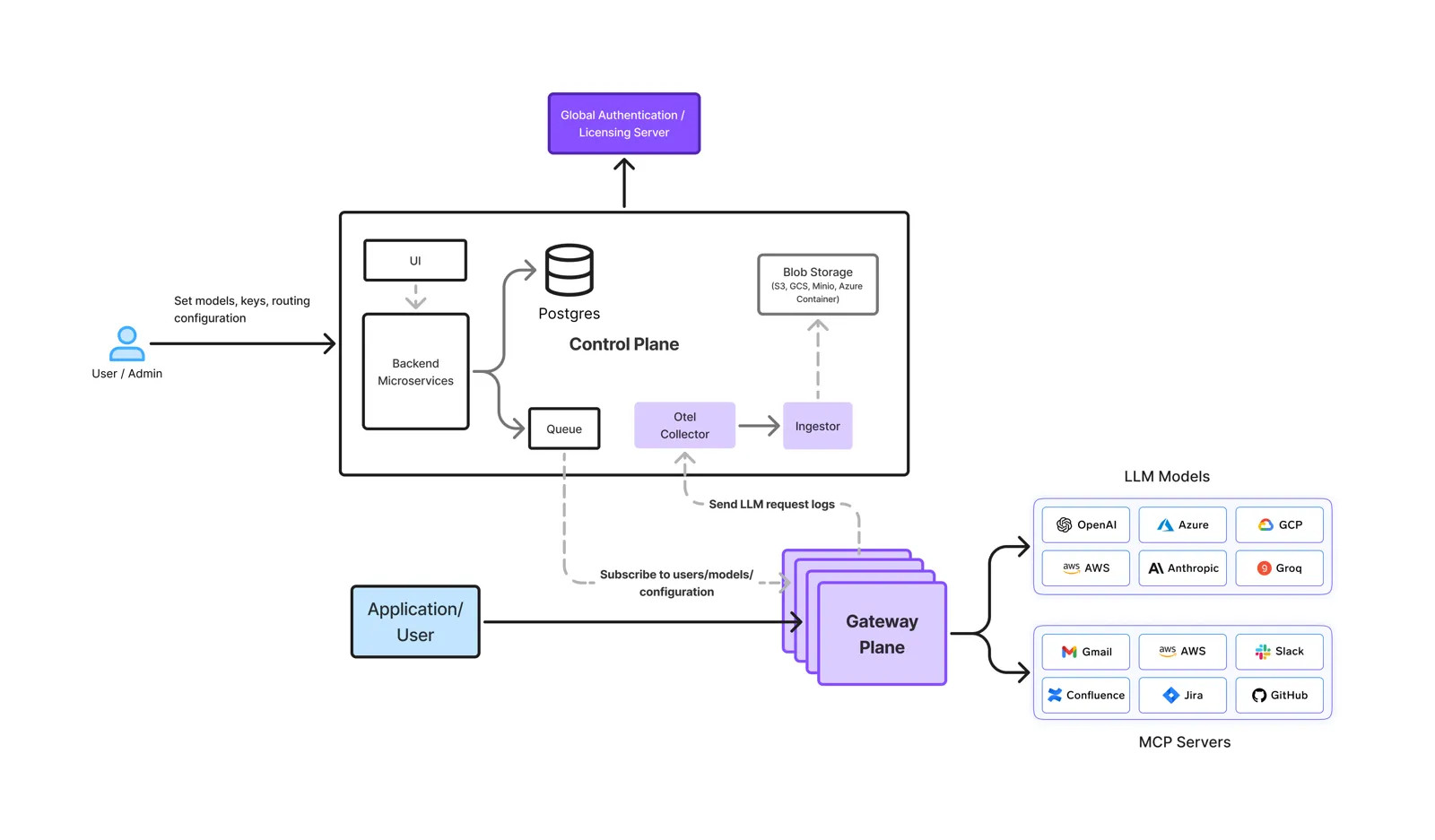
TrueFoundry inverts this. There's no single binary; the gateway installs into Kubernetes as part of a control plane, is configured GitOps-style via YAML through the TrueFoundry CLI, and runs as SaaS or inside your own VPC, data center, or an air-gapped network. That's more to stand up than a Go binary — and it's exactly why TrueFoundry can offer the data-sovereignty and compliance guarantees a self-managed binary leaves to you.
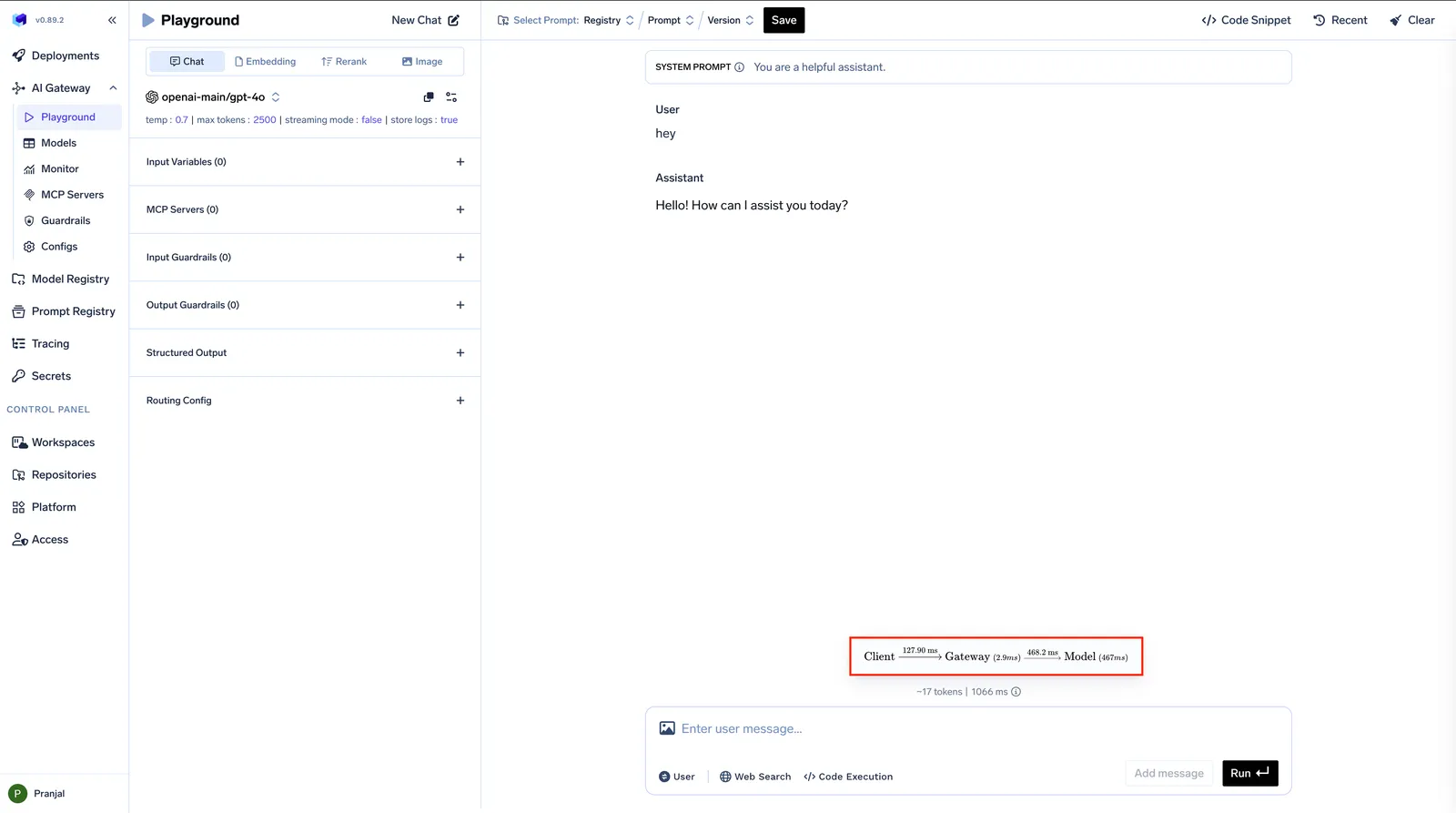
Architecturally, TrueFoundry's gateway is a stateless plane built on the lightweight Hono framework, kept in sync from the control plane over a NATS queue. Authentication, authorization, rate-limiting and budget checks all run in memory — no external call sits in the request path unless you cache — while logs and metrics are written asynchronously to ClickHouse. TrueFoundry benchmarks it at 250 RPS on a single 1 vCPU / 1 GB pod, scaling to ~350 RPS before saturation, adding roughly +7 ms of overhead (about +12 ms with full tracing).
Adopting either is a base-URL change. Bifrost fronts its providers at /openai; TrueFoundry exposes a unified endpoint and selects the backend by a configured virtual-model name. Bifrost's observed catalog is larger by raw count; TrueFoundry pairs 1600+ managed models with first-class deployment of private models on your own GPUs.
Bifrost — exact usage (from the console)
import openai

client = openai.OpenAI(
    base_url="http://localhost:8080/openai",
    api_key="dummy-api-key"   # Handled by Bifrost
)
response = client.chat.completions.create(
    model="gpt-4o",
    messages=[{"role":"user","content":"List files in current directory"}],
)
TrueFoundry — same SDK, gateway endpoint
from openai import OpenAI

client = OpenAI(
    base_url="https://<org>.truefoundry.com/api/llm",
    api_key="tfy-..."
)
response = client.chat.completions.create(
    model="openai-main/gpt-4o",   # provider/model set in GitOps YAML
    messages=[{"role":"user","content":"List files in current directory"}],
)
Both have invested here, and the design is strikingly similar. Bifrost's MCP Gateway offers two modes: Manual Tool Execution, where you explicitly approve and run each tool call via the API, and Agent Mode, where the gateway auto-executes. You whitelist callable tools with tools_to_execute and, for autonomous runs, tools_to_auto_execute.
TrueFoundry frames the same control as Virtual MCP Servers (curated tool subsets), per-team RBAC, and pre/post-call MCP guardrails — plus prebuilt servers for Slack, Confluence, Sentry, and Datadog, and the ability to register any REST/OpenAPI service as an MCP server. The shared pattern looks like this:
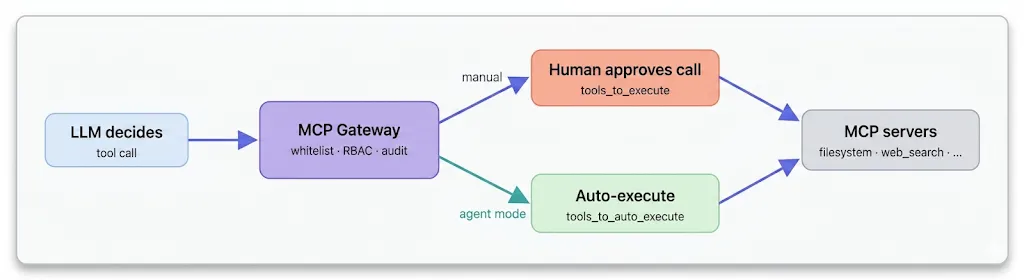
Net: for raw MCP plumbing the two are close peers. The divergence is the surrounding control plane — TrueFoundry adds enterprise identity on every tool call (one auto-refreshed OAuth token per user across all servers), prebuilt enterprise connectors, and an Agent Gateway for multi-agent, session-aware workflows; Bifrost keeps it lean and self-hosted.
Bifrost ships real per-user OAuth with token refresh — visible in its boot workers and well-suited to letting individual users authenticate to downstream MCP servers — and its Enterprise tier adds SAML-based SSO and role-based access control. TrueFoundry operates primarily at the org-identity layer: SSO via OIDC or SAML 2.0 through any major IdP, optional SCIM provisioning for automated user/team sync, and RBAC — with a documented flow and a choice of routing login through TrueFoundry's auth server (the default) or, on its higher-tier on-prem Enterprise plan, talking to your IdP directly so no auth traffic leaves your environment.
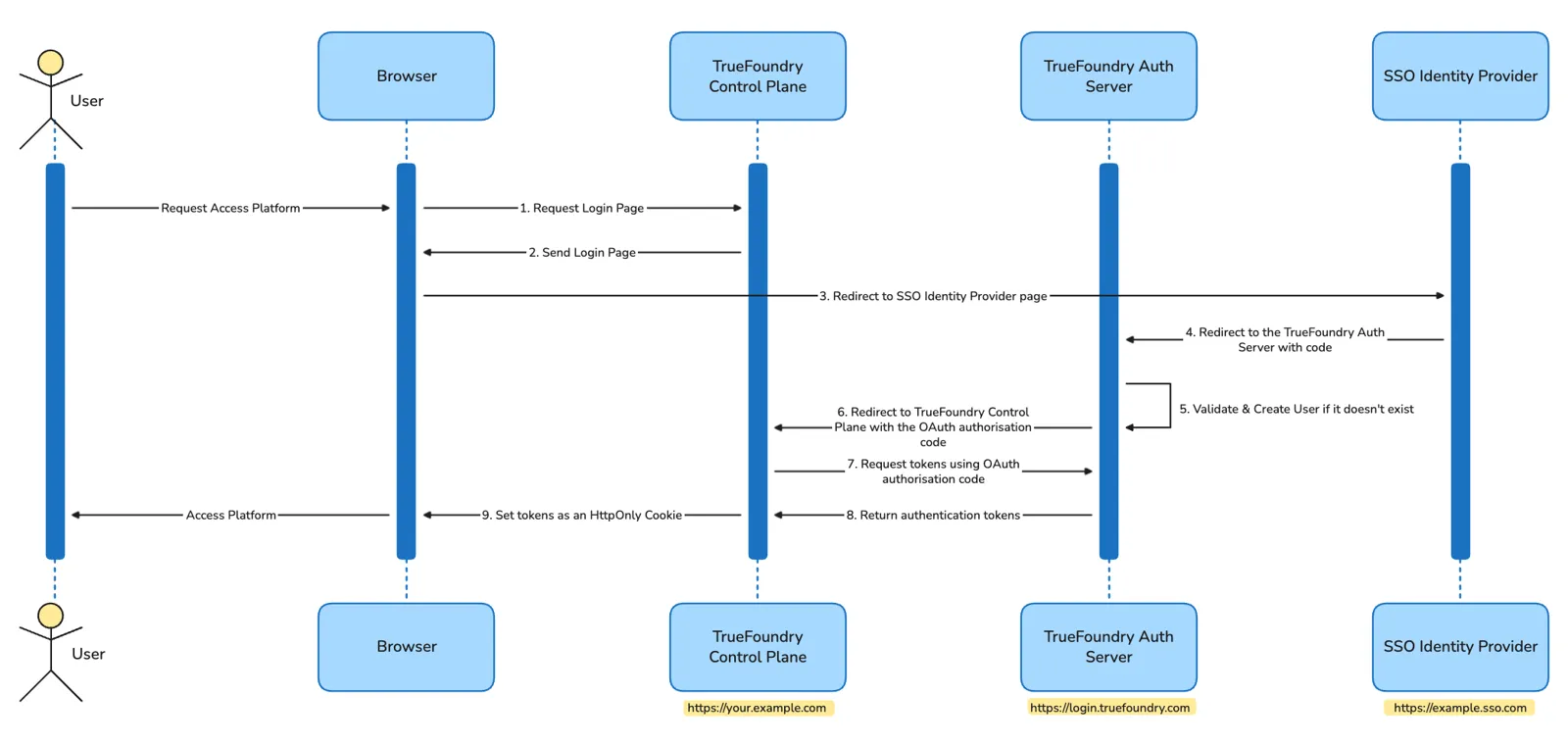
Where they genuinely diverge is the top of the regulatory ladder. Both vendors publicly market SOC 2 Type II and HIPAA, and both offer VPC, on-prem, and air-gapped deployment — so on those axes this is closer to parity than to separation. (As is standard, each vendor's certifications attach to its managed, audited infrastructure; for self-hosted deployments, compliance also depends on your own controls.) One difference does stand out: ITAR. TrueFoundry has announced ITAR-compliant deployments for export-controlled defense and aerospace workloads, which Bifrost does not advertise. It also adds SCIM-driven provisioning and the direct-to-IdP login option. For a team that just wants per-user tool auth on infrastructure it controls, Bifrost's built-in OAuth is enough; for ITAR or fully self-contained, centrally-provisioned identity, TrueFoundry is the more straightforward procurement path.
Sources & method. Bifrost details are from a running v1.5.7 instance (startup log and MCP Tool Execution screen, shown above). TrueFoundry details and the SSO diagram are from its public documentation. Schematics — including the Bifrost architecture diagram — are original illustrations compiled from public information and a self-run instance, not reproduced from Bifrost's materials; the two TrueFoundry diagrams and the Playground screenshot are TrueFoundry's own. Vendor-stated or vendor-benchmarked performance figures (e.g., TrueFoundry's +7 ms overhead at 250–350 RPS on a 1 vCPU / 1 GB pod) are labelled as such. Compliance and deployment capabilities described for either vendor reflect each vendor's published statements rather than an independent audit; confirm current scope in the relevant Trust Center or contract. Bifrost's compliance and deployment claims here are drawn from Maxim's published Bifrost materials — its Bifrost security / industry pages and the Bifrost documentation — including their stated VPC, on-prem, and air-gapped deployment options and SOC 2 Type II / HIPAA / ISO 27001 / GDPR audit-trail posture.
Disclaimer. This is an independent comparison published by TrueFoundry for general informational purposes; it is not legal, financial, or professional advice. “Bifrost” is a project of Maxim AI (H3 Labs) and is offered under the Apache 2.0 license; “TrueFoundry” and associated marks are trademarks of TrueFoundry. All third-party product names, logos, and trademarks are the property of their respective owners and are referenced here solely for identification and good-faith comparison — their use does not imply any affiliation with, sponsorship by, or endorsement from those owners, and Bifrost / Maxim AI has not reviewed or endorsed this article. Statements about Bifrost were verified against its public documentation and a self-hosted v1.5.7 instance, and statements about TrueFoundry against its own documentation, as of June 2026; both products evolve rapidly, so confirm current capabilities, pricing, and licensing directly with each vendor before making decisions. Performance figures are vendor-stated or drawn from each vendor's published benchmarks under their stated conditions and may differ in your environment. We have aimed to be accurate and even-handed; if you believe anything here is incorrect or out of date, please contact us and we will review and correct it promptly.
TrueFoundry AI Gateway delivers ~3–4 ms latency, handles 350+ RPS on 1 vCPU, scales horizontally with ease, and is production-ready, while LiteLLM suffers from high latency, struggles beyond moderate RPS, lacks built-in scaling, and is best for light or prototype workloads.






The latest news, articles, and resources sent to your inbox

.webp)

.png)
.png)
.png)
.png)
.png)
.png)
.png)
.png)
.png)
.png)
.png)


