October 12, 2026
|
5 min read


Published: September 24, 2026
Blazingly fast way to build, track and deploy your models!
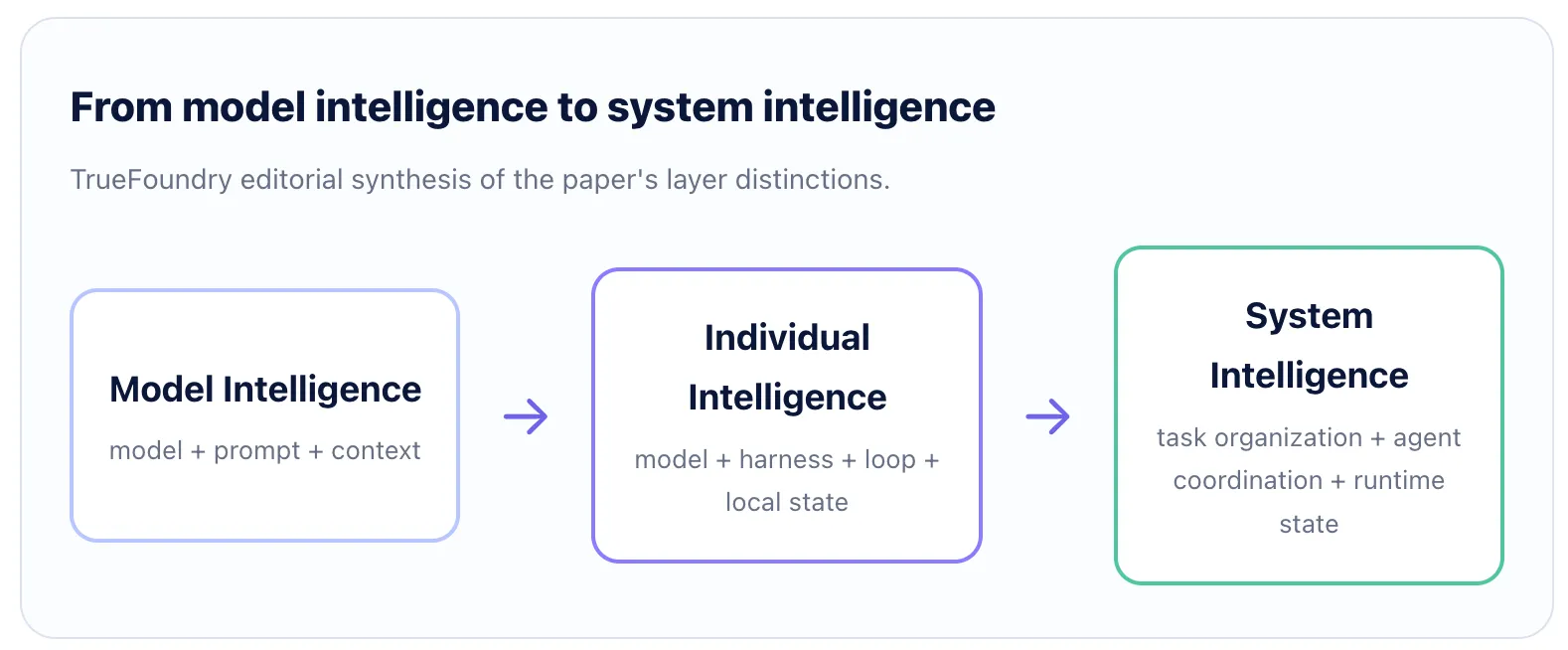
A new survey proposing Graph Engineering as an emerging paradigm offers a useful hierarchy for agent builders: prompting and context shape a model call; a harness and loop turn that model into a persistent agent; graph-level organization coordinates multiple agents, work structures, and runtime states into a system.
The survey places Prompt Engineering, Context Engineering, Harness Engineering, Loop Engineering, and Graph Engineering on different layers rather than treating them as competing labels. Prompt and context operate closest to inference. Harness Engineering extends the model with persistent and executable capabilities across calls. Loop Engineering organizes repeated interaction with those capabilities. Graph Engineering addresses organization at the system level.
That separation is useful because “agent framework” often collapses very different concerns into one bucket. A tool schema, a session store, a sandbox, an approval checkpoint, and a retry loop are not the same kind of thing even if one SDK exposes them through one API.
The paper's Harness Engineering section groups four areas:
The important point is scope. Harness Engineering is not simply “give the LLM tools.” It concerns the persistent runtime in which those tools, memories, skills, execution boundaries and controls remain usable across calls.
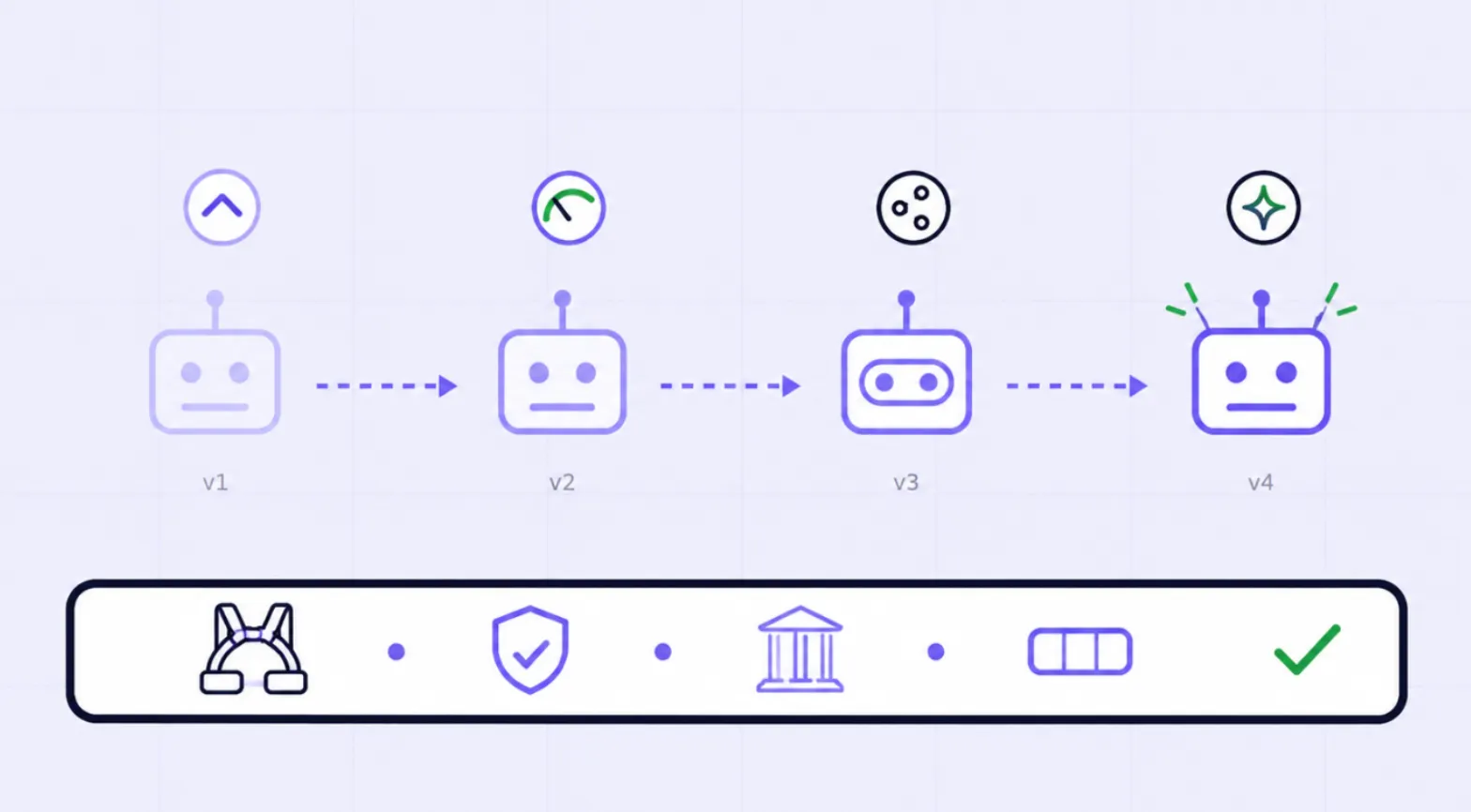
This is where TrueForge has an unusually direct mapping to the paper's vocabulary. TrueForge's current documentation describes it as an open-source agent harness—the runtime layer around an LLM that runs the execution loop and connects MCP tools, skills, sandboxing, approvals, subagents, context management, and persistent session state.
The mapping is not merely rhetorical. TrueForge's server documentation says the server plans a turn, calls the model, executes tools, streams steps, pauses for human approval on sensitive actions, keeps context lean for long tasks, and persists sessions across reconnects and restarts. Its SDK makes Agent, Session, Turn, Event, and Delta explicit runtime objects.
TrueForge also keeps the product boundary clean. It does not require the TrueFoundry AI Gateway to run. Its public product page says the harness works standalone; connecting the gateway adds governed access to models, MCPs and skills. That matters for portability because the open runtime can remain distinct from the enterprise policy plane around it.
The paper draws a useful distinction: Harness Engineering determines which capabilities and resources are persistently available and how they are orchestrated; Loop Engineering determines how those capabilities are repeatedly invoked and adapted as task state changes.
That sounds subtle until something fails in production.
This is also why an iteration_limit should not be confused with a verifier. A runtime can stop runaway execution; it cannot infer the correct domain-specific definition of “done” for every application.
The survey does not validate TrueFoundry's products or prior editorial claims. What it does provide is a research taxonomy that makes several boundaries this publication has been arguing for easier to state precisely. Five short lines from that earlier series show the continuity:
Read together, the sequence is deliberate: the loop makes one agent operational; the harness makes its capabilities durable; the graph organizes work above the individual loop; and gateways can govern selected shared boundaries without pretending to own the graph itself.
The paper's argument for Graph Engineering begins with a structural limitation rather than a claim that “multi-agent is always better.” Some tasks require heterogeneous expertise, interdependent subtasks, parallel work, independent verification, and persistent state that no single agent loop can organize cleanly.
Putting more tools into one harness or more tokens into one context does not necessarily solve that organizational problem. It may only make one execution locus larger.
That distinction is valuable for architecture reviews. Before adding more agents, ask whether the problem is actually a system-organization problem:
The survey organizes Graph Engineering into three interconnected views. This taxonomy is more useful than generic “multi-agent orchestration” because each view has different failure modes and different infrastructure requirements.
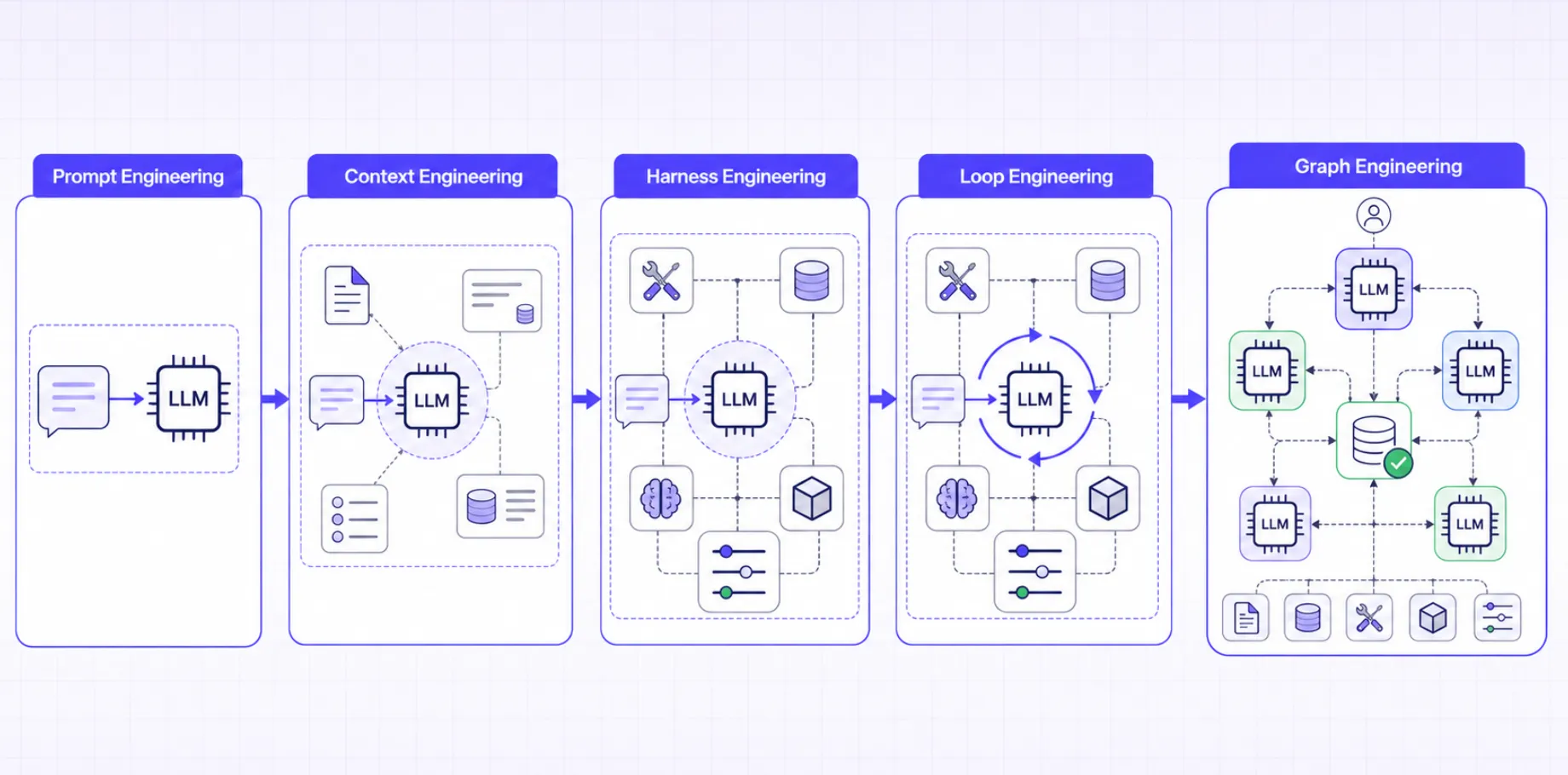
The third category—Runtime State Management—is particularly important in production. A designed workflow tells you what should happen. Distributed runtime state must tell you what did happen, what remains valid, what failed, and where execution can safely resume.
The paper explicitly separates state recording, fault localization, and failure recovery. That is a stronger framing than treating observability as a collection of traces after the fact. The runtime record is part of the system's ability to continue safely.
This boundary should be explicit. TrueForge is an agent harness. It can be the runtime inside an agentic graph node; it should not be described as automatically owning an arbitrary graph of tasks, services, humans, databases, and other agents.
A production graph may be defined in application code, an orchestration framework, a workflow engine, or another system. Some nodes may be TrueForge agents. Others may be deterministic services, queues, human review steps, evaluators, batch jobs, databases, or external agents.
That gives us a clean architecture:
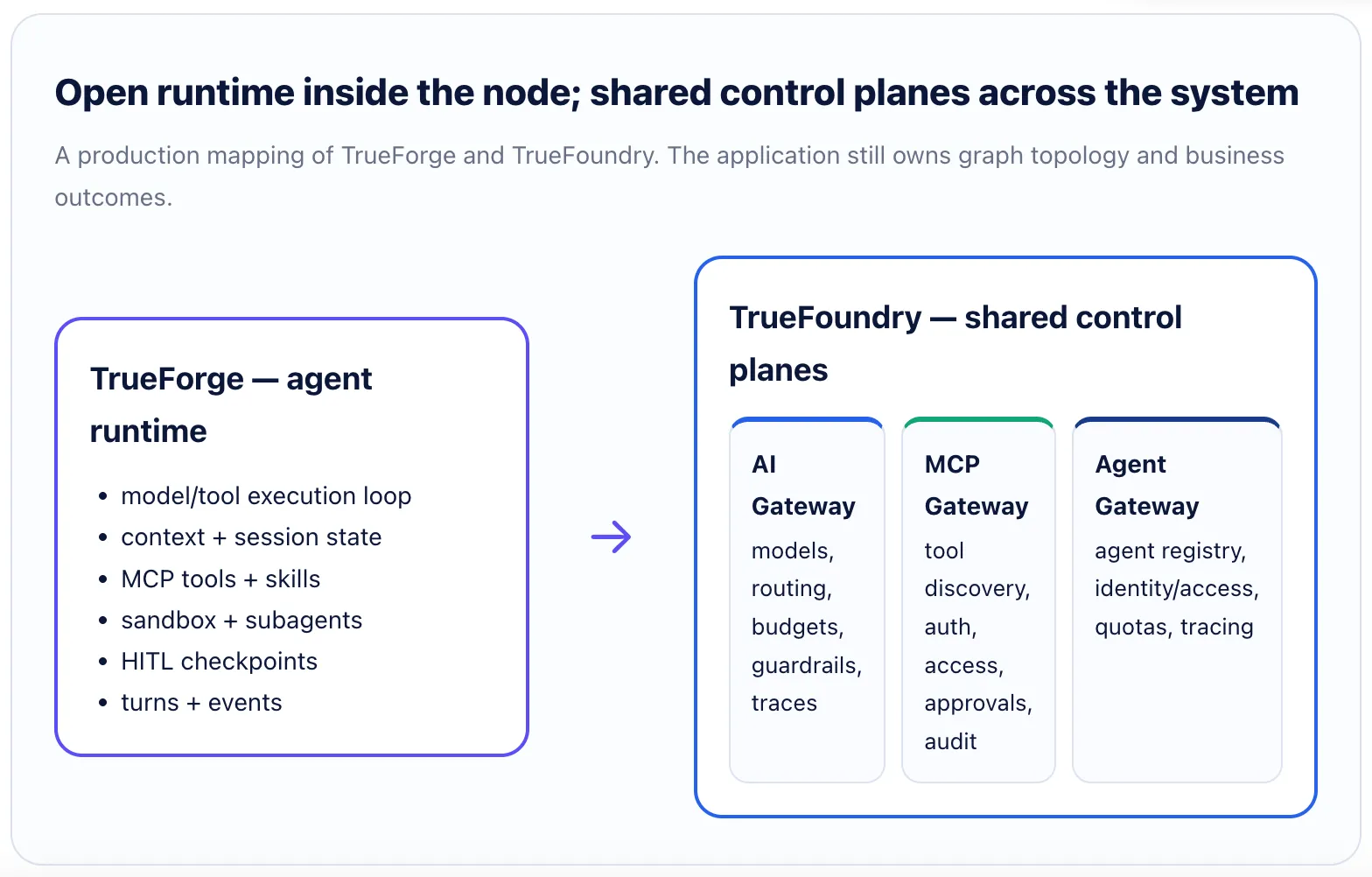
The move from one agent to a graph multiplies operational surfaces. Different nodes may choose different models, call different tools, consume budgets independently, expose different privileges, and produce separate traces. If each node embeds provider credentials, authorization logic, tool policy, and cost controls locally, system-level organization quickly recreates infrastructure fragmentation.
This is where the TrueFoundry Gateways complement the harness.
TrueFoundry currently positions AI Gateway as the common model plane for unified provider access, routing and fallbacks, model-level access controls, budgets, rate limits, guardrails, and observability. In a graph, that means model policy can remain centralized even when execution is distributed across nodes.
MCP Gateway centralizes discovery and governed access to tools and MCP servers, including authentication, access control, downstream credentials, approvals and auditability for traffic routed through it. That maps naturally to the paper's interest in capability substrates: the system increasingly needs an explicit account of what capabilities exist, who may use them, and under what constraints.
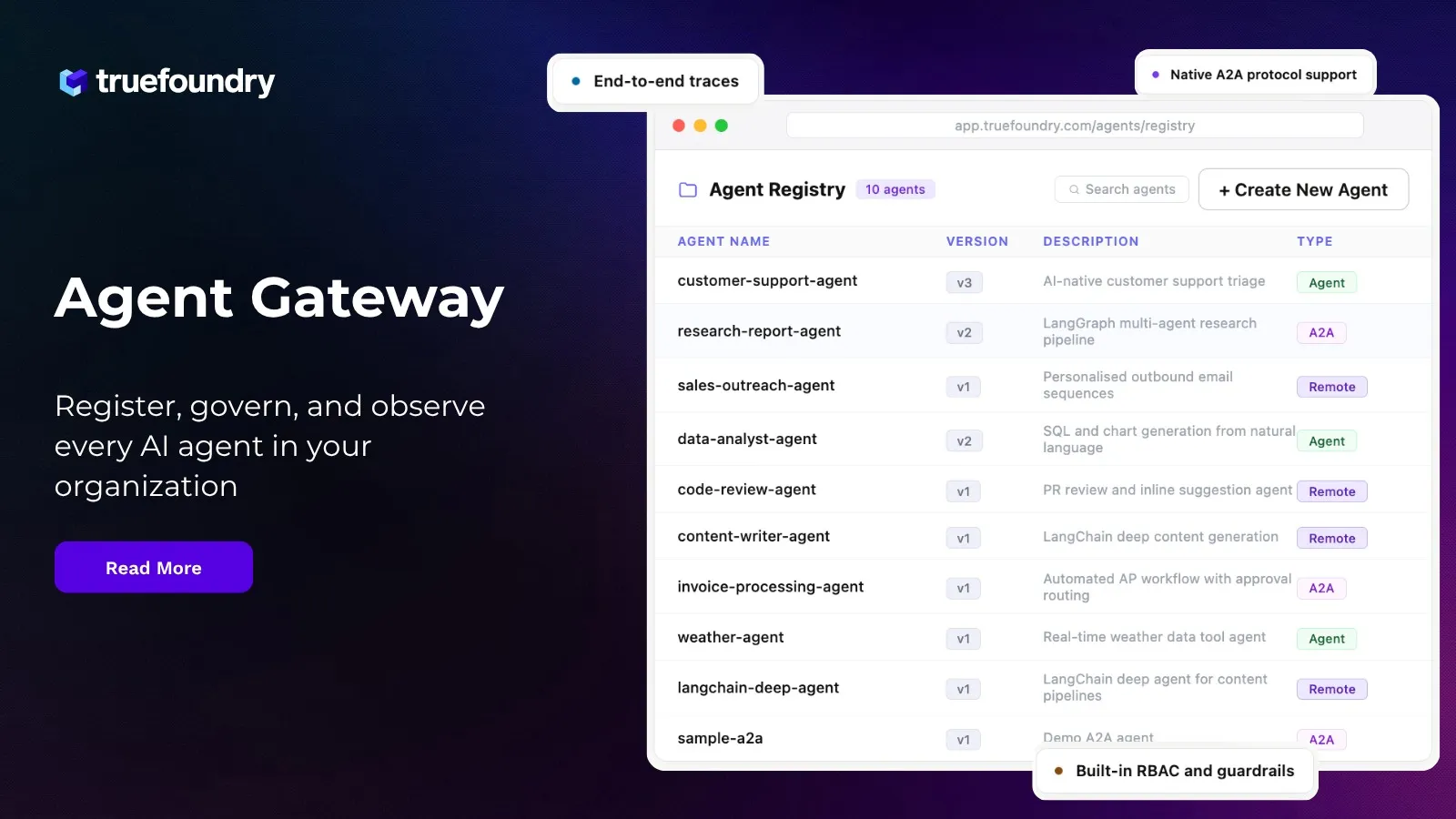
TrueFoundry's current Agent Gateway material describes centralized agent registry, identity/access, quotas/budgets and agent-level tracing/control. This can help make an expanding agent estate legible. But it should not be confused with task-graph orchestration; registering and governing agents is not the same as deciding the graph topology that coordinates them.
One of the paper's strongest production sections is Runtime State Management. It argues that distributed systems need more than task definitions and communication paths. They need a reliable account of committed state transitions, provenance, current commitments, failures, and recovery boundaries.
TrueForge's Agent → Session → Turn → Event model contributes useful local evidence. A session scopes one issue and persists its conversational state; turns chain within that session; events describe model messages, MCP initialization, tool responses, approval requirements, completion, and subagent threads. That makes the local execution loop reconstructible at a useful level.
At system scale, however, local event streams are only part of the answer. A consequential graph run may need to correlate:
That is the difference between “we have traces” and “we can reconstruct the executed system.”
The survey eventually asks whether today's fragmented stack could evolve toward a graph-native agent operating system. It imagines tasks, agents, capabilities, and runtime states as typed and versioned first-class objects, with shared services for scheduling, capability discovery, persistent state, provenance logging, permission enforcement, checkpointing, replay, rollback, and graph-level observability.
That is a useful north star, but it should not be collapsed into current marketing language.
TrueForge plus the TrueFoundry Gateways provide several primitives that such a future substrate would need: an open execution runtime, persistent sessions/events, capability access through MCP, sandboxing, approvals, model/tool/agent control planes, budgets, identity, and traces. But the current stack does not automatically provide the paper's proposed unified typed graph substrate, structural transactions, cross-graph structural evolution, or a universal graph scheduler.
This boundary actually makes the product story stronger. We can describe what exists today without claiming to have completed a research agenda the paper itself labels as future infrastructure.
The paper is a survey and conceptual synthesis, not evidence that every complex task should become multi-agent. Its “System Intelligence” terminology is the authors' proposed framework, not a standardized industry maturity model.
Likewise, this article does not claim that TrueForge or TrueFoundry implements “Graph Engineering” as defined by the survey. The cleaner mapping is narrower:
Disclosure: TrueFoundry publishes this article, develops the TrueFoundry AI/MCP/Agent Gateways, and maintains TrueForge. Product claims are limited to current public TrueFoundry and TrueForge materials. The mapping from the paper's research taxonomy to these products is TrueFoundry editorial analysis; neither the paper nor its authors evaluate or endorse TrueFoundry. Reference-list author credits identify the individual byline on the cited TrueFoundry articles; body attributions refer to those articles as TrueFoundry publications.
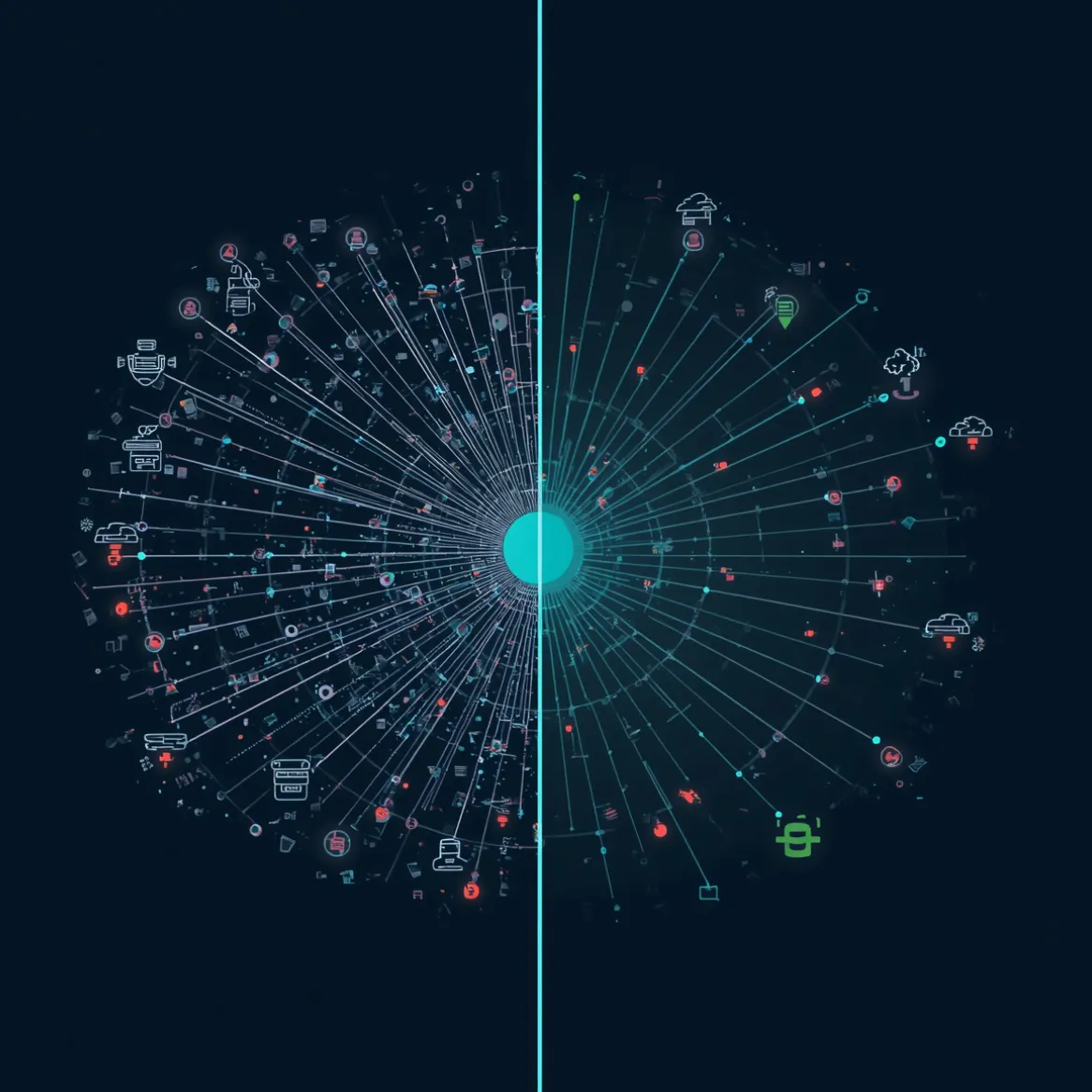
TrueFoundry AI Gateway delivers ~3–4 ms latency, handles 350+ RPS on 1 vCPU, scales horizontally with ease, and is production-ready, while LiteLLM suffers from high latency, struggles beyond moderate RPS, lacks built-in scaling, and is best for light or prototype workloads.






The latest news, articles, and resources sent to your inbox
.png)
.png)
.png)
.png)
.png)
.png)