



November 5, 2025
|
5 min read


احصل على وصول فوري إلى بيئة TrueFoundry مباشرة. انشر النماذج، ووجّه حركة مرور LLM، واستكشف المنصة بالكامل — بيئة الاختبار الخاصة بك جاهزة في ثوانٍ، ولا يلزم وجود بطاقة ائتمان.



Published: July 4, 2026

Blazingly fast way to build, track and deploy your models!
The Model Context Protocol (MCP) has revolutionized how AI applications connect to external data sources and tools. As organizations scale their AI implementations, they're discovering that direct server connections aren't always the optimal approach. Enter MCP Proxy, a powerful intermediary layer that enhances security, scalability, and manageability of MCP deployments. Let's explore how MCP Proxy transforms enterprise AI architectures and why it's becoming essential for production deployments.
An MCP Proxy serves as an intelligent intermediary layer that sits between MCP clients (AI applications) and MCP servers (data sources and tools). Rather than establishing direct connections, the proxy acts as a centralized gateway that manages, routes, and enhances communication between these components.
Think of MCP Proxy as the "API Gateway for AI"—similar to how traditional API gateways manage REST endpoints, MCP Proxy manages MCP server connections with enterprise-grade features like authentication, rate limiting, observability, and security controls. (For the model-traffic equivalent, see TrueFoundry's AI Gateway.) The proxy architecture follows the standard MCP protocol, appearing as a regular MCP server to clients while acting as an MCP client to backend servers. This transparency ensures seamless integration with existing MCP-enabled applications.
At its core, an MCP Proxy provides unified access control and authentication mechanisms, enables protocol translation between different transport types (stdio, SSE, HTTP), implements enterprise security policies and governance, and offers centralized monitoring and observability. Most importantly, it aggregates multiple MCP servers behind a single endpoint, dramatically simplifying enterprise deployments.
MCP Proxy operates on a straightforward yet powerful architecture that leverages the JSON-RPC foundation of the Model Context Protocol. The proxy functions as both an MCP server (facing clients) and an MCP client (facing backend servers), creating a transparent bridge that adds value without disrupting existing workflows.
Modern proxies support multiple transport protocols simultaneously. This includes stdio transport for local server connections and development environments, Server-Sent Events (SSE) for real-time streaming capabilities, streamable HTTP for stateless, scalable deployments, and WebSocket for persistent, low-latency connections. This transport flexibility allows organizations to deploy MCP servers using their preferred protocols while providing clients with a consistent interface.
When a client makes a request to the proxy, the system follows a well-defined workflow. First, the proxy receives the JSON-RPC request from the client, then security policies are evaluated during authentication and authorization. Next, route resolution determines which backend server(s) to query, followed by protocol-specific formatting during request translation. The proxy then forwards requests to appropriate servers, aggregates multiple server responses if needed, and returns a unified response to the client.
Enterprise MCP Proxy implementations maintain session state to optimize performance and enable advanced features including connection pooling where persistent connections to backend servers reduce latency, context preservation to maintain user context and conversation state, load balancing to distribute requests across multiple server instances, and circuit breaking to automatically bypass failed servers.
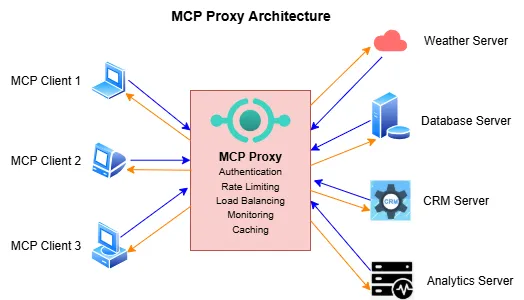
The foundation of any enterprise MCP deployment is a comprehensive registry that catalogs and manages available servers. A robust MCP registry provides a centralized catalog where administrators can register both public and privately hosted MCP servers, maintaining detailed metadata about each server's capabilities, authentication requirements, and access controls.
TrueFoundry's MCP Gateway exemplifies this approach with its centralized MCP registry that maintains a complete inventory of available servers and their authentication mechanisms. The registry handles user-specific OAuth2 flows, securely storing and refreshing access tokens while ensuring users can only access resources they're authorized for. This eliminates the chaos of distributed credential management and provides enterprise IT teams with the visibility and control they need.
The registry also enables dynamic tool discovery, allowing autonomous agents to discover and invoke tools at runtime rather than requiring hardcoded configurations. This flexibility is crucial for building adaptive AI systems that can respond to changing business requirements without manual intervention. For agent-to-agent traffic, the same pattern extends to the Agent Gateway.
Security is paramount in enterprise MCP deployments, and authentication represents the first line of defense. Traditional direct server connections require managing separate credentials for each MCP server, creating a complex web of authentication flows that becomes unwieldy at scale.
MCP Proxy centralizes authentication through several mechanisms. OAuth 2.0 integration supports both 2-legged and 3-legged OAuth flows for enterprise applications, while Personal Access Tokens (PATs) allow users to generate a single token for accessing all authorized MCP servers. For applications, Virtual Account Tokens (VATs) provide scoped access to specific server sets, and role-based access control (RBAC) ensures fine-grained permissions management.
The authentication layer also implements sophisticated token management, including automatic token refresh, secure credential storage, and session management across multiple server connections. This approach significantly reduces the security burden on individual developers while providing IT teams with comprehensive audit trails and access controls. For a deeper look at controlling and auditing MCP access at scale, see Enterprise MCP Governance.
The core value of MCP Proxy lies in its ability to orchestrate complex tool invocations across multiple servers. Unlike direct connections where each server operates in isolation, the proxy enables sophisticated workflows that span multiple data sources and capabilities.
Tool namespace management prevents naming conflicts by automatically prefixing tools with server identifiers. For example, a get_weather tool from a "weather-api" server becomes weather-api_get_weather, ensuring no collisions even when multiple servers expose similar functionality. This enables unified tool discovery where clients can discover all available tools through a single list_tools call rather than managing connections to multiple servers.
The proxy also enables cross-server workflows where complex AI agent behaviors can leverage tools from multiple servers seamlessly. This orchestration capability is what transforms simple tool calling into sophisticated enterprise automation, allowing organizations to build AI systems that integrate naturally with their existing technology stack.
Enterprise deployments demand comprehensive observability into MCP operations. Traditional direct connections scatter monitoring across multiple endpoints, making it difficult to gain holistic insights into system performance and usage patterns.
MCP Proxy consolidates observability through centralized monitoring that provides end-to-end visibility into request flows, comprehensive metrics collection including latency, throughput, and error rates, detailed audit logging for compliance and security analysis, and real-time health monitoring of backend server availability.
Advanced observability features include request tracing that follows individual requests through the entire system, performance analytics that identify bottlenecks and optimization opportunities, usage analytics that track tool utilization patterns, and security monitoring that detects anomalous access patterns or potential security threats. TrueFoundry's tracing provides this end-to-end visibility across both model and tool calls.
The observability layer also integrates with enterprise monitoring solutions like Grafana, Datadog, and custom dashboards, ensuring that MCP metrics flow seamlessly into existing operational workflows. This integration is crucial for maintaining enterprise-grade service level agreements and operational excellence.
The security benefits of MCP Proxy extend far beyond simple access control. By consolidating multiple server connections through a single, hardened gateway, organizations can implement consistent security policies across their entire MCP ecosystem. This approach dramatically reduces the attack surface compared to exposing multiple server endpoints directly to client applications.
Centralized authentication means clients authenticate once with the proxy rather than managing separate credentials for each server. The proxy handles backend authentication using service accounts or sophisticated token exchange mechanisms, ensuring that sensitive credentials never leave the secure gateway environment. Policy enforcement becomes consistent across all MCP interactions, with capabilities like sensitive data filtering, request sanitization, and response redaction implemented at the proxy layer rather than requiring individual server modifications.
Attack surface reduction is achieved by deploying backend servers in private networks, accessible only through the proxy. This network isolation significantly reduces exposure to external threats while maintaining the flexibility needed for complex enterprise integrations. For a complete architecture reference, see Secure AI Gateway with Centralized MCP for Enterprises.
MCP Proxy transforms operational complexity from a distributed challenge into a centralized management opportunity. Instead of configuring monitoring, scaling, and network policies for each individual server, operations teams can focus on a single, well-understood gateway component.
The unified deployment model allows proxies to be deployed using standard cloud-native patterns including containers, load balancers, and auto-scaling while backend servers focus purely on business logic. This separation of concerns enables different teams to optimize their components independently while maintaining overall system coherence.
Simplified client integration means applications need only integrate with a single proxy endpoint rather than managing connections to multiple servers. This dramatically reduces the complexity of client applications and makes it easier to add new MCP servers without requiring client-side changes.
The proxy architecture enables sophisticated scalability patterns that would be difficult to implement with direct connections. Horizontal scaling through multiple proxy instances deployed behind load balancers provides linear scalability as demand grows. Backend server pooling allows multiple instances of the same server to be pooled behind the proxy for load distribution, improving both performance and reliability.
Geographic distribution becomes possible with proxies deployed in multiple regions and intelligent routing to the nearest backend servers. This approach minimizes latency for global deployments while maintaining consistent functionality across all regions — a key enabler of data residency in the age of agentic AI.
Performance optimization features include intelligent caching where frequently requested data is cached with configurable time-to-live settings, request deduplication that collapses identical concurrent requests, connection pooling that maintains efficient connections to backend servers, and response compression that reduces network overhead.
MCP Proxy deployments often result in significant cost savings through several mechanisms. Resource consolidation reduces per-server operational overhead by sharing infrastructure components like monitoring, logging, and security systems. Efficient resource utilization through connection pooling and request batching improves overall system efficiency.
Reduced development overhead allows teams to focus on building MCP servers that implement business logic rather than solving repeated infrastructure challenges like authentication, monitoring, and scaling. This acceleration in development velocity often represents the largest cost savings for organizations adopting MCP Proxy architectures.
Implementing MCP Proxy introduces several technical challenges that require careful architectural consideration. State management represents a primary concern since, unlike stateless HTTP proxies, MCP Proxy often needs to maintain session state to provide optimal user experience. This includes conversation context, user preferences, and server connection state. Designing stateful proxies requires careful consideration of state persistence, replication, and recovery mechanisms.
Protocol compatibility presents another challenge as different MCP servers may implement slightly different protocol versions or extensions. The proxy must handle these variations gracefully while presenting a consistent interface to clients. Version negotiation and feature detection become critical components for ensuring seamless operation across diverse server implementations.
Error handling and circuit breaking require sophisticated logic when aggregating multiple servers. If one server in a multi-server request fails, the proxy needs intelligent decision-making to determine whether to return partial results, retry with alternative servers, or fail the entire request. This complexity multiplies when dealing with dependencies between different server responses.
Connection pool management requires balancing resource usage with performance characteristics. Too few connections create bottlenecks that limit throughput, while too many connections consume excessive system resources. The optimal configuration depends on usage patterns, server characteristics, and infrastructure constraints.
Caching strategy implementation requires deep understanding of MCP tool semantics. Some tools return dynamic data that shouldn't be cached, while others return relatively static information suitable for extended caching periods. Implementing effective caching policies requires careful analysis of each tool's behavior and data characteristics.
Request batching presents opportunities for efficiency improvements but must be implemented carefully to avoid introducing unacceptable latency for individual requests. The challenge lies in identifying optimal batching windows that balance efficiency gains with response time requirements.
Token management becomes complex when securely managing authentication tokens for backend servers while providing seamless authentication for clients. This requires sophisticated token exchange mechanisms, secure credential storage, and proper token lifecycle management.
Data privacy concerns arise because the proxy potentially has access to all data flowing between clients and servers. Implementing proper data handling, encryption at rest and in transit, and privacy controls becomes crucial for maintaining enterprise security standards.
Rate limiting implementation must balance protecting backend servers from overload while providing good user experience. This requires careful tuning based on server capabilities, user behavior patterns, and business requirements.
Monitoring and alerting complexity increases as the proxy becomes a critical component requiring comprehensive observability. Teams need to implement health checks, performance monitoring, and alerting for both the proxy itself and its connections to backend servers. This monitoring must integrate seamlessly with existing enterprise monitoring infrastructure.
Deployment coordination becomes necessary as updates to the proxy must be coordinated with backend server deployments to ensure compatibility and avoid service disruptions. This coordination requires sophisticated deployment pipelines and testing procedures.
Backup and recovery planning must account for the proxy's configuration and state. Critical system components need comprehensive backup strategies and tested recovery procedures to ensure business continuity during outages or disasters.
Successful MCP Proxy implementation begins with comprehensive architecture planning that addresses both immediate needs and future growth requirements. Server discovery strategy determines how the proxy will identify and connect to backend MCP servers. Options include static configuration files suitable for stable environments, service discovery mechanisms that automatically detect new servers, and dynamic registration APIs that allow servers to self-register with the proxy.
Deployment topology decisions involve choosing between single proxy instances for simple deployments or multiple instances for high availability and load distribution. Geographic distribution requirements must consider network latency, data residency requirements, and disaster recovery needs.
Integration planning identifies how the proxy will connect with existing enterprise infrastructure including load balancers for traffic distribution, API gateways for external access control, identity providers for authentication integration, and monitoring systems for comprehensive observability. These integration points are critical for ensuring the proxy fits seamlessly into existing operational workflows.
A fundamental MCP Proxy implementation requires several core components working in harmony. The proxy server itself handles client connections and implements the MCP protocol, while backend connection managers maintain connections to MCP servers and handle protocol translation. Authentication and authorization modules integrate with enterprise identity systems and enforce access policies.
Here's a simplified example demonstrating the basic structure of an MCP Proxy implementation using Node.js:
Implementing MCP Proxy introduces several technical challenges that require careful architectural consideration. State management represents a primary concern since, unlike stateless HTTP proxies, MCP Proxy often needs to maintain session state to provide optimal user experience. This includes conversation context, user preferences, and server connection state. Designing stateful proxies requires careful consideration of state persistence, replication, and recovery mechanisms.
Protocol compatibility presents another challenge as different MCP servers may implement slightly different protocol versions or extensions. The proxy must handle these variations gracefully while presenting a consistent interface to clients. Version negotiation and feature detection become critical components for ensuring seamless operation across diverse server implementations.
Error handling and circuit breaking require sophisticated logic when aggregating multiple servers. If one server in a multi-server request fails, the proxy needs intelligent decision-making to determine whether to return partial results, retry with alternative servers, or fail the entire request. This complexity multiplies when dealing with dependencies between different server responses.
Connection pool management requires balancing resource usage with performance characteristics. Too few connections create bottlenecks that limit throughput, while too many connections consume excessive system resources. The optimal configuration depends on usage patterns, server characteristics, and infrastructure constraints.
Caching strategy implementation requires deep understanding of MCP tool semantics. Some tools return dynamic data that shouldn't be cached, while others return relatively static information suitable for extended caching periods. Implementing effective caching policies requires careful analysis of each tool's behavior and data characteristics.
Request batching presents opportunities for efficiency improvements but must be implemented carefully to avoid introducing unacceptable latency for individual requests. The challenge lies in identifying optimal batching windows that balance efficiency gains with response time requirements.
تصبح إدارة الرموز معقدة عند إدارة رموز المصادقة للخوادم الخلفية بشكل آمن مع توفير مصادقة سلسة للعملاء. يتطلب ذلك آليات تبادل رموز متطورة، وتخزين آمن لبيانات الاعتماد، وإدارة مناسبة لدورة حياة الرموز.
تنشأ مخاوف خصوصية البيانات لأن الوكيل قد يتمكن من الوصول إلى جميع البيانات المتدفقة بين العملاء والخوادم. يصبح تطبيق المعالجة السليمة للبيانات، والتشفير في حالة السكون وأثناء النقل، وضوابط الخصوصية أمرًا بالغ الأهمية للحفاظ على معايير أمان المؤسسة.
يجب أن يوازن تطبيق تحديد المعدل بين حماية الخوادم الخلفية من التحميل الزائد وتوفير تجربة مستخدم جيدة. يتطلب ذلك ضبطًا دقيقًا بناءً على قدرات الخادم وأنماط سلوك المستخدم ومتطلبات العمل.
تزداد تعقيدات المراقبة والتنبيه مع تحول الوكيل إلى مكون حاسم يتطلب قابلية مراقبة شاملة. تحتاج الفرق إلى تنفيذ فحوصات السلامة ومراقبة الأداء والتنبيه لكل من الوكيل نفسه واتصالاته بالخوادم الخلفية. يجب أن تتكامل هذه المراقبة بسلاسة مع البنية التحتية الحالية للمراقبة في المؤسسة.
يصبح تنسيق النشر ضروريًا حيث يجب تنسيق تحديثات الوكيل مع عمليات نشر الخوادم الخلفية لضمان التوافق وتجنب انقطاع الخدمة. يتطلب هذا التنسيق مسارات نشر وإجراءات اختبار متطورة.
يجب أن تأخذ خطة النسخ الاحتياطي والاستعادة في الاعتبار تكوين الوكيل وحالته. تحتاج مكونات النظام الحيوية إلى استراتيجيات نسخ احتياطي شاملة وإجراءات استعادة مجربة لضمان استمرارية العمل أثناء الانقطاعات أو الكوارث.
يبدأ التنفيذ الناجح لوكيل MCP بتخطيط معماري شامل يلبي الاحتياجات الفورية ومتطلبات النمو المستقبلي. تحدد استراتيجية اكتشاف الخادم كيفية قيام الوكيل بتحديد والاتصال بخوادم MCP الخلفية. تتضمن الخيارات ملفات التكوين الثابتة المناسبة للبيئات المستقرة، وآليات اكتشاف الخدمة التي تكتشف الخوادم الجديدة تلقائيًا، وواجهات برمجة التطبيقات للتسجيل الديناميكي التي تسمح للخوادم بالتسجيل الذاتي لدى الوكيل.
تتضمن قرارات طوبولوجيا النشر الاختيار بين مثيلات وكيل فردية لعمليات النشر البسيطة أو مثيلات متعددة لتحقيق التوافر العالي وتوزيع الحمل. يجب أن تأخذ متطلبات التوزيع الجغرافي في الاعتبار زمن انتقال الشبكة، ومتطلبات إقامة البيانات، واحتياجات التعافي من الكوارث.
يحدد تخطيط التكامل كيفية اتصال الوكيل بالبنية التحتية الحالية للمؤسسة، بما في ذلك موازنات التحميل لتوزيع حركة المرور، وبوابات API للتحكم في الوصول الخارجي، وموفري الهوية لتكامل المصادقة، وأنظمة المراقبة لقابلية المراقبة الشاملة. تعد نقاط التكامل هذه حاسمة لضمان ملاءمة الوكيل بسلاسة لسير العمليات التشغيلية الحالية.
يتطلب التنفيذ الأساسي لوكيل MCP عدة مكونات أساسية تعمل بتناغم. يتعامل خادم الوكيل نفسه مع اتصالات العميل وينفذ بروتوكول MCP، بينما تحافظ برامج إدارة الاتصال الخلفية على الاتصالات بخوادم MCP وتتولى ترجمة البروتوكول. تتكامل وحدات المصادقة والتفويض مع أنظمة الهوية المؤسسية وتفرض سياسات الوصول.
توفر بوابة الذكاء الاصطناعي من TrueFoundry تطبيق وكيل MCP جاهز للإنتاج يلبي المتطلبات المعقدة لعمليات النشر المؤسسية. تقدم المنصة حلاً شاملاً سجل وبوابة MCP الذي يبسط إدارة الخادم مع توفير ميزات على مستوى المؤسسات للأمان والمراقبة وقابلية التوسع.
يرتكز نهج TrueFoundry على سجل MCP مركزي يحتفظ بقائمة جرد كاملة بالخوادم المتاحة وآليات المصادقة الخاصة بها. يتعامل هذا السجل مع تدفقات OAuth2 الخاصة بالمستخدم، ويقوم بتخزين وتحديث رموز الوصول بشكل آمن مع ضمان أن المستخدمين لا يمكنهم الوصول إلا إلى الموارد المصرح لهم بها. يلغي هذا النظام فوضى إدارة بيانات الاعتماد الموزعة ويوفر لفرق تكنولوجيا المعلومات في المؤسسات رؤية وتحكمًا شاملين.
تشمل المكونات المعمارية الرئيسية مستوى التحكم المركزي الذي يحتفظ بسجل جميع خوادم MCP ويتعامل مع آليات المصادقة، والتحكم الموحد في الوصول من خلال رموز الوصول الشخصية (PATs) ورموز الحساب الافتراضي (VATs)، وبيئة اختبار متكاملة للوكلاء (agent playground) للاختبار والتطوير، وقابلية مراقبة شاملة مع مراقبة في الوقت الفعلي وسجلات تدقيق.
للبدء في تطبيق بروتوكول سياق النموذج (MCP) الخاص بـ TrueFoundry، اتبع دليل البدء الذي يستعرض إنشاء مجموعات خوادم MCP وتكوين خوادمك الأولى. تدعم المنصة كلاً من خوادم MCP العامة من المجتمع والخوادم المستضافة بشكل خاص، مع ضوابط وصول متطورة تحدد المستخدمين والفرق التي يمكنها الوصول إلى خوادم معينة.
تدعم TrueFoundry أيضًا خوادم MCP القائمة على stdio من خلال إمكانيات تحويل الوكيل، مما يسمح للمؤسسات بنشر الخوادم القديمة كنقاط نهاية HTTP حديثة. وللتكاملات المؤسسية، توفر الخوادم الجاهزة مثل خادم Atlassian MCP تكاملاً سلسًا مع Jira وConfluence.
تتطلب عمليات نشر وكيل MCP في بيئة الإنتاج اهتمامًا دقيقًا بالتوافرية العالية والأمان والمراقبة والإجراءات التشغيلية. تتضمن التوافرية العالية عادةً نشر عدة نُسخ من الوكيل خلف موازنات التحميل مع فحوصات صحية شاملة وقدرات تجاوز الفشل التلقائي.
يجب أن تطبق استراتيجيات التحجيم التحجيم التلقائي الأفقي للبودات بناءً على استخدام وحدة المعالجة المركزية واستهلاك الذاكرة ومقاييس حجم الطلبات. ويجب أن تأخذ سياسات التحجيم في الاعتبار كلاً من الارتفاعات المفاجئة في حركة المرور وأنماط النمو التدريجي مع الحفاظ على اتفاقيات مستوى خدمة الأداء.
يتطلب تطبيق الأمان سياسات شبكة تقيد الوصول بين مكونات النظام، وإدارة شاملة للأسرار لجميع بيانات الاعتماد والرموز، وتشفير البيانات أثناء النقل وفي حالة السكون، وتدقيقات أمنية منتظمة لتحديد نقاط الضعف المحتملة.
يجب أن يتصل تكامل المراقبة بحلول المراقبة المؤسسية لتوفير قابلية مراقبة شاملة، بما في ذلك مقاييس الأداء، وتتبع الأخطاء، ومراقبة الأمان، وبيانات تخطيط السعة. يضمن هذا التكامل توافق عمليات وكيل MCP مع الإجراءات والمعايير التشغيلية المؤسسية الحالية.
يمثل وكيل MCP تطورًا جوهريًا في هندسة الذكاء الاصطناعي للمؤسسات، حيث يغير طريقة نشر المؤسسات وإدارة وتوسيع نطاق تطبيقات بروتوكول سياق النموذج الخاص بها. ومع تزايد تعقيد تطبيقات الذكاء الاصطناعي وتكاملها مع أنظمة المؤسسات المعقدة، يوفر نمط الوكيل قدرات حوكمة وأمان وتشغيل أساسية تتطلبها عمليات النشر في بيئة الإنتاج.
تمتد الفوائد إلى ما هو أبعد من مجرد إدارة الاتصال البسيطة. فمن خلال المصادقة المركزية، والتوجيه الذكي، والمراقبة الشاملة، وضوابط الأمان على مستوى المؤسسات، يمكّن وكيل MCP المؤسسات من بناء أنظمة ذكاء اصطناعي قوية وقابلة للتوسع تلبي معايير صارمة للموثوقية والامتثال. يعالج نمط البنية التحديات الحرجة المتعلقة بالأمان وقابلية المراقبة والتعقيد التشغيلي التي تظهر مع انتقال المؤسسات من تطبيقات إثبات المفهوم إلى عمليات النشر على نطاق الإنتاج.
بالنسبة للمؤسسات التي تبدأ رحلتها مع بروتوكول سياق النموذج (MCP)، توفر الاتصالات المباشرة وظائف كافية للتطوير والتجارب الأولية. ومع ذلك، مع نضوج الأنظمة وتزايد متطلبات العمل، يصبح اعتماد وكيل MCP ضروريًا للنجاح على المدى الطويل. يمثل الانتقال من الاتصالات المباشرة إلى البنية المدعومة بالوكيل تطورًا طبيعيًا يعكس أنماطًا مشابهة في خدمات الويب والخدمات المصغرة والحوسبة السحابية.
بوابة MCP من TrueFoundry تجسد التنفيذ الجاهز للإنتاج لأنماط وكيل MCP، وتقدم للمؤسسات منصة شاملة لتوسيع نطاق تطبيقات الذكاء الاصطناعي مع الحفاظ على معايير الأمان والحوكمة. إن النهج المتكامل للمنصة في إدارة خوادم MCPوالمصادقة وقابلية المراقبة يجعلها خيارًا أمثل للمؤسسات الملتزمة بنشر الذكاء الاصطناعي على نطاق المؤسسة.
مع استمرار تطور النظام البيئي لبروتوكول سياق النموذج، سيلعب نمط الوكيل دورًا حاسمًا بشكل متزايد في تمكين تطبيقات الذكاء الاصطناعي المتطورة. لا يعتمد مستقبل الذكاء الاصطناعي للمؤسسات على بناء نماذج ذكية فحسب، بل على إنشاء بنى ذكية يمكنها التكيف والتوسع وتأمين هذه القدرات للنشر في العالم الحقيقي. يعمل وكيل MCP كمكون أساسي لهذه البنية الذكية، مما يمكّن المؤسسات من إطلاق العنان للإمكانات الكاملة لبروتوكول سياق النموذج مع تلبية المتطلبات الصارمة لبيئات الإنتاج المؤسسية.
TrueFoundry AI Gateway delivers ~3–4 ms latency, handles 350+ RPS on 1 vCPU, scales horizontally with ease, and is production-ready, while LiteLLM suffers from high latency, struggles beyond moderate RPS, lacks built-in scaling, and is best for light or prototype workloads.





أحدث الأخبار والمقالات والموارد تصلك مباشرة إلى بريدك الوارد


.png)
.png)
.png)
.png)
.png)
.png)
.png)
.png)
.png)
.png)
.png)


