November 14, 2026
|
5 min read


احصل على وصول فوري إلى بيئة TrueFoundry مباشرة. انشر النماذج، ووجّه حركة مرور LLM، واستكشف المنصة بالكامل — بيئة الاختبار الخاصة بك جاهزة في ثوانٍ، ولا يلزم وجود بطاقة ائتمان.



Blazingly fast way to build, track and deploy your models!
Building production-ready AI agents requires more than connecting an LLM to a set of tools. Agents handling complex, multi-step tasks need to plan their execution, delegate work, manage context, interact with external systems, and maintain state across long-running workflows.
This is where agent harnesses come in. They provide the runtime and orchestration layer that turns an LLM into an agent capable of executing complex tasks reliably.
Claude Managed Agents and LangChain Deep Agents take different approaches to this problem. Claude Managed Agents is Anthropic's managed agent execution platform, providing a pre-built harness with persistent sessions, sandboxed execution, and built-in tool integrations. LangChain Deep Agents is an open-source agent harness built on LangGraph, offering planning, subagent delegation, context management, and configurable execution backends.
Both are designed to support sophisticated, long-running agent workflows, but differ in how they handle execution, infrastructure, model flexibility, and customization. Claude Managed Agents prioritizes a managed experience, while Deep Agents gives developers greater control over how their agent systems are configured and deployed.
In this guide, we'll compare Claude Managed Agents and LangChain Deep Agents across architecture, model support, tool execution, context management, multi-agent orchestration, deployment, and pricing to help you determine which agent harness is better suited to your requirements.
All three plan a turn, call tools, manage context on long tasks, spawn subagents and pause for human approval. Treat that as the floor. Four things separate them once the deployment is real.
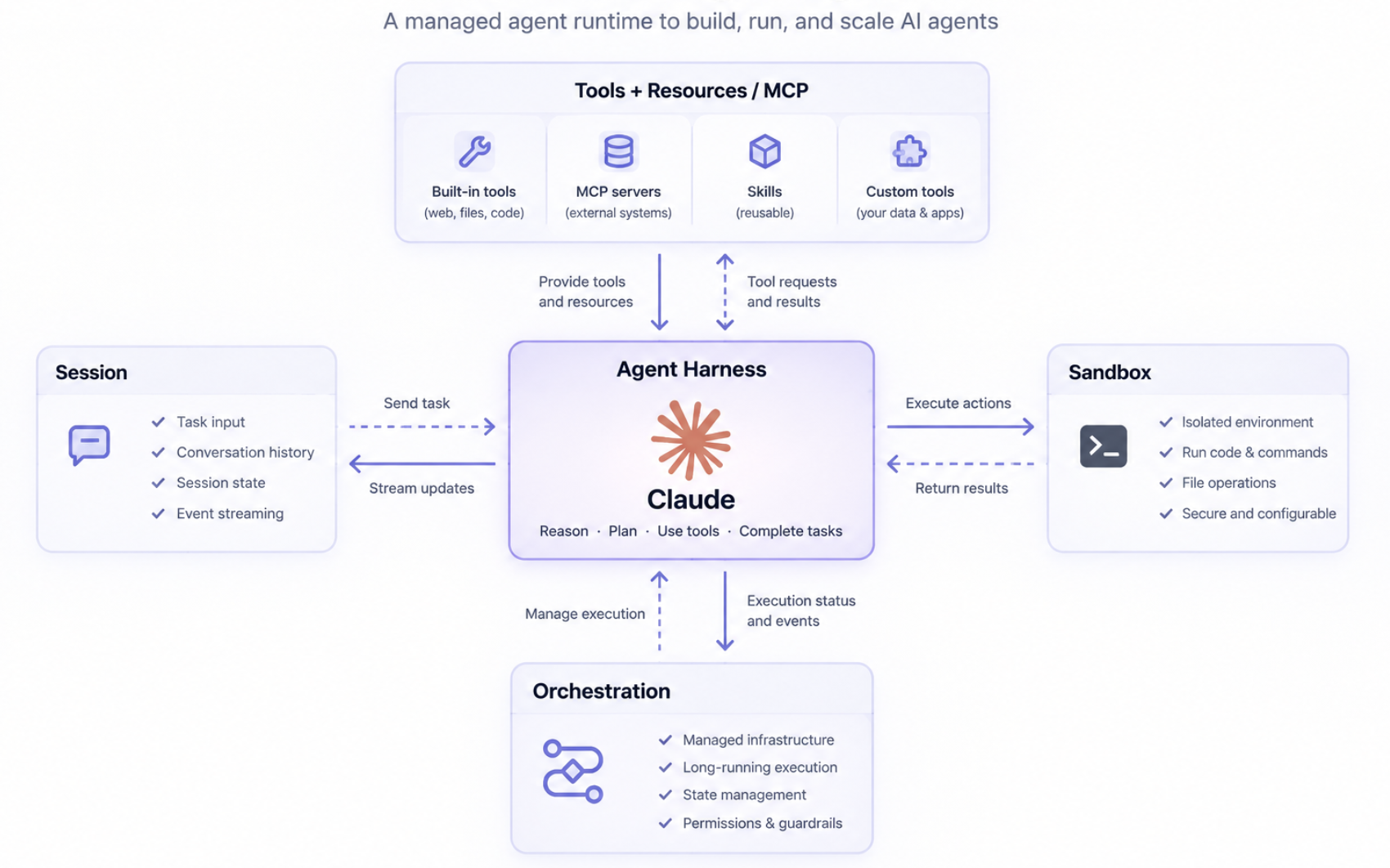
Claude Managed Agents is Anthropic's pre-built, configurable agent harness running in managed infrastructure, aimed at long-running and asynchronous work. You define an agent (model, system prompt, tools, MCP servers, skills), define an environment, and start sessions against it. For teams already standardised on Claude it removes a large amount of undifferentiated infrastructure work, and the operational surface is genuinely well designed.
managed-agents-2026-04-01 beta header, and Anthropic notes behaviours may be refined between releases. The harness runs Claude models, so routing a simple task to a cheaper model is not available at any deployment tier.Best for: teams committed to Claude models, without a HIPAA BAA requirement, who would rather buy the runtime than operate it.
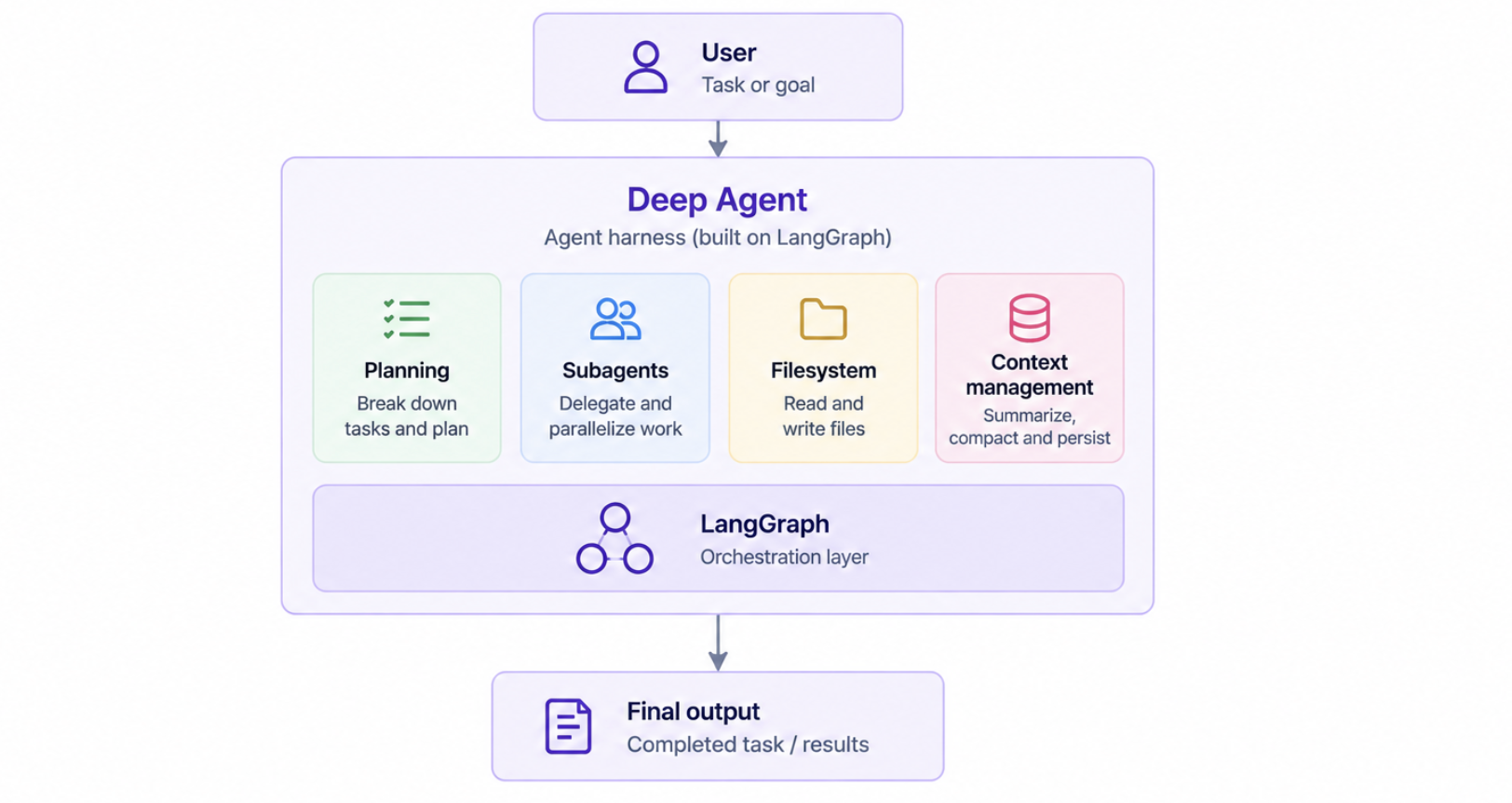
Deep Agents is LangChain's open-source agent harness, built on LangGraph, with 31.1k stars and a matching JavaScript library. The entry point is create_deep_agent(), and the defaults are tuned for long-horizon, multi-step work. It is MIT licensed, as are langchain and langgraph underneath it. If your team already builds on LangChain, this is the harness that fits the code you have.
dcode), a terminal coding agent.init_chat_model() with a "{provider}:{model}" string. That covers frontier APIs, open-weight models on hosting providers, and self-hosted models via Ollama, vLLM or llama.cpp. Swapping providers does not mean rewriting application logic. On this dimension Deep Agents and TrueForge are at parity, and both have an advantage over a single-vendor harness.Best for: teams already invested in the LangChain ecosystem who want the harness, the tracing and the evaluation platform from one vendor, and whose compliance requirements fit the Enterprise plan.

TrueForge is TrueFoundry's open-source, vendor-neutral agent harness for teams that want more control over how their agents run in production. Instead of tying the runtime to a single model provider, TrueForge lets you bring your own models, MCP servers, and infrastructure while handling the agent loop, tool execution, context management, approvals, and sandboxing.
Where a self-hosted agent like Hermes leaves much of the production infrastructure to the developer, TrueForge provides the surrounding control plane needed to operate agents across teams and environments. This includes centralized MCP access and credentials, human-in-the-loop approvals, sandboxed execution, observability, and governance.
You can run it locally with npx @truefoundry/trueforge or deploy it for a team with Docker Compose or Helm.
TrueForge also separates the agent runtime from the model layer. This means teams can switch models or route workloads to different providers without rebuilding the agent itself.Combined with TrueFoundry's AI Gateway, teams can also apply model routing and cost controls to avoid using expensive frontier models for tasks that don't require them. The result is a middle ground between a fully managed runtime and building the entire agent infrastructure yourself: an open-source agent harness with the operational controls needed to run production agents at scale.
TrueFoundry also provides a second lever for reducing model costs through AI Gateway's Auto Routing. Instead of sending every request to a frontier model, Auto Routing classifies requests by complexity and routes them to different model tiers. In TrueFoundry's benchmark across 550 prompts, routing between Haiku, Sonnet, and Opus reduced cost by 69% while retaining 98% of baseline quality, and mean latency dropped from 7.6 seconds to 4.0 seconds. On production-shaped traffic, the overall cost reduction reached 80%.
These two layers address different parts of the cost equation. TrueForge reduces the overhead of running the agent itself, while model routing lets you avoid using an expensive model when the task doesn't require one. For teams running agents at scale, having both controls can matter more than the price of the model alone.
TrueForge is open source and MIT licensed, while TrueFoundry's AI Gateway adds the operational layer teams need when moving from individual agents to production: centralized model access, budgets, guardrails, credential management, and unified traces.
If you're comparing Claude Managed Agents with a more configurable architecture, TrueFoundry is worth considering when model flexibility, infrastructure control, and agent cost optimization matter alongside the agent runtime itself.
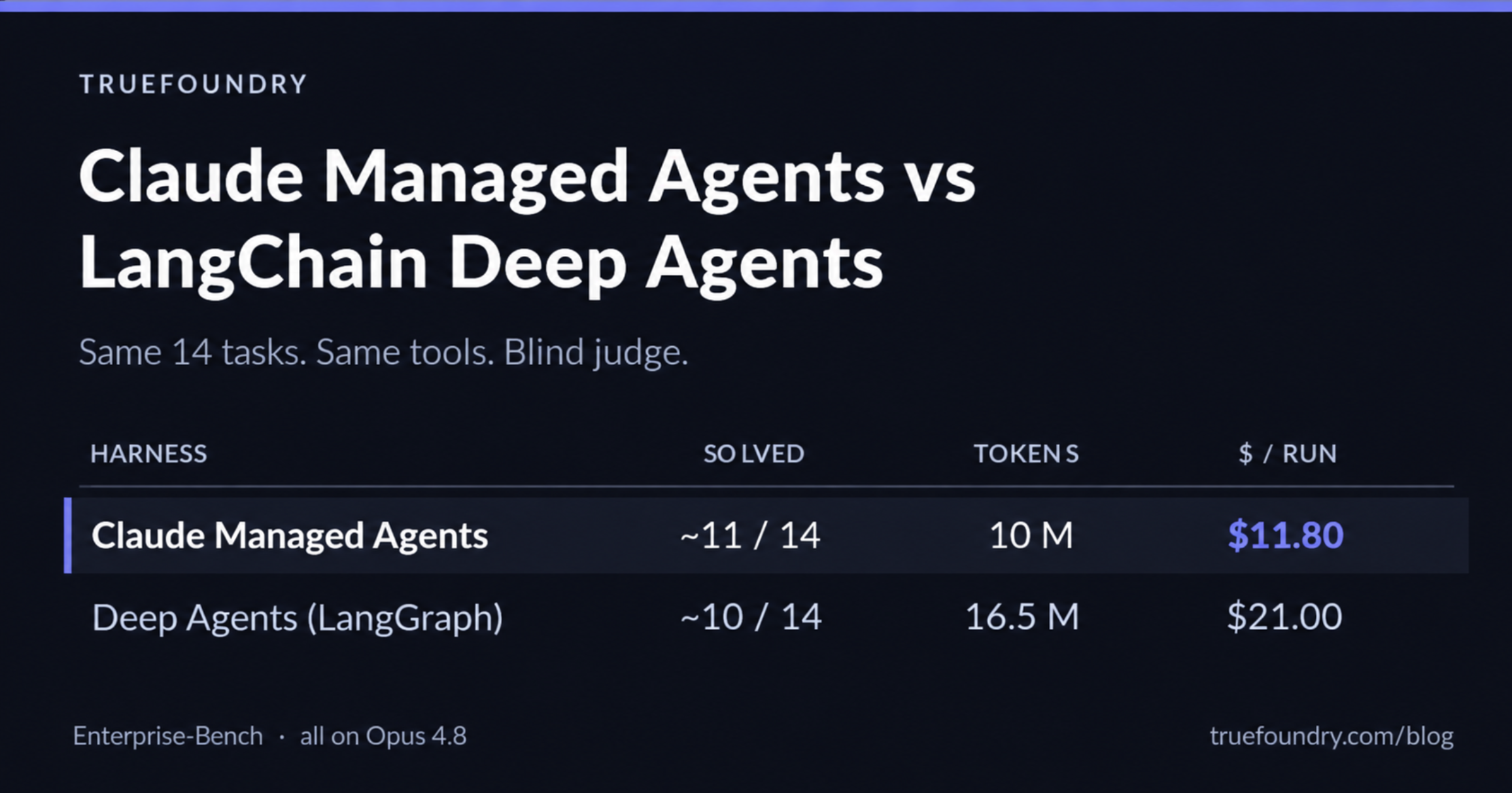
We ran all three harnesses on DevRev's Enterprise-Bench, 14 cross-system tasks that read like real B2B operations work. To answer one, an agent has to plan, call MCP tools across a CRM, a project tracker and a document store, join the results correctly, and pitch the answer at the right level of detail.
The setup was identical throughout: the same 14 tasks, the same three MCP servers, a fresh session per task. Grading was blind, with an LLM judge scoring each answer against the task's criteria without ever seeing which harness or model produced it. A task counted as solved only if it met every criterion, with no partial credit. Cost is actual token usage priced at list rates, and it is cache-aware. Latency is wall-clock, with every harness hitting the same cloud-hosted MCP servers.
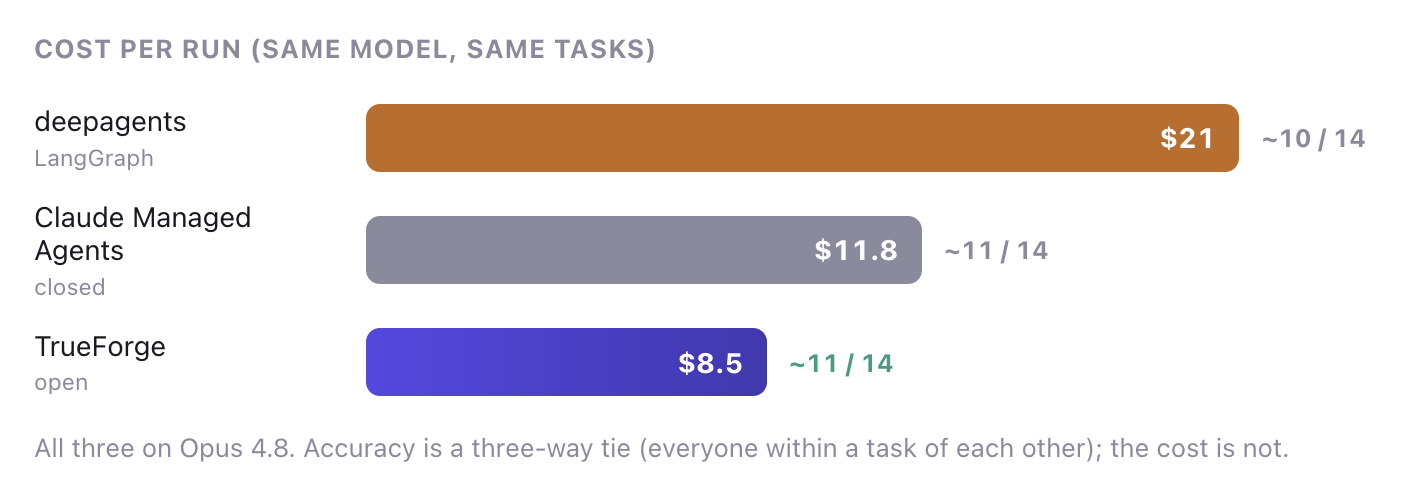
All three on Opus 4.8:
Accuracy is effectively a three-way tie, everyone landing within a task of each other. That is the finding, not a disclaimer: the model sets the ceiling on what is possible, and the harness sets the price of reaching it. The spread on price is wide. TrueForge reached the same answers on about 40% of Claude Managed Agents' tokens and under a quarter of deepagents'.
Three mechanics explain most of it:
A leaner starting payload. Every turn re-processes the system prompt and tool definitions. TrueForge drives from a compact instruction. deepagents adds planning scaffolding, a virtual filesystem and subagent machinery to that fixed overhead, and across hundreds of turns the difference compounds.
Fewer, more targeted tool calls. Each tool round-trip ships the growing context back to the model, so the number of calls matters more than the size of any one result. TrueForge planned the fewest of the three to reach the same answer.
Compaction instead of replay. TrueForge trims history and large tool responses. deepagents re-reads its own accumulated context step after step, which is how it arrives at three to four times the tokens for an identical task.
Then there is the lever none of this captures, which only the vendor-neutral harnesses have at all. Running GLM-5.2, an open model, TrueForge solved the same ~11 of 14 tasks at $2.90 per run against Claude Managed Agents' $11.80, roughly 75% cheaper. Claude Managed Agents cannot run that configuration. Deep Agents can, which is a real point in its favour, though it starts from a higher token floor. The full method and the three-way results are in the TrueForge vs Claude Managed Agents benchmark.
Choose TrueForge if you want one permissive licence covering the library and the runtime, the whole harness inside your own perimeter without a plan upgrade, model choice preserved per task, and the lowest cost per correct answer of the three. It suits regulated environments and any workload where the same agent runs thousands of times a day and per-run cost compounds.
Choose Claude Managed Agents if your organisation has standardised on Claude, you have no HIPAA BAA requirement, and you would rather buy the runtime than operate it. The operational controls are strong and the self-hosted beta closes most of the deployment gap, provided your account team can get you into it.
Choose LangChain Deep Agents if your team already builds on LangChain and LangGraph, you want the harness and the tracing and evaluation platform from one vendor, and either the cloud tiers meet your compliance needs or an Enterprise contract is already in budget. The ecosystem depth is real and the model-agnostic story is genuine.
A harness runs an agent. Running fifty across four teams is a different problem, and it is where the surrounding platform earns its place.
TrueFoundry's AI Gateway gives every agent access to 1,000+ LLMs through a single OpenAI-compatible endpoint at roughly 3–4 ms of added latency, handling 350+ RPS on one vCPU. Model access, budgets and guardrails are set centrally rather than per agent. Its Auto Routing classifies requests by complexity and sends each to the right model tier: across 550 prompts it cut cost by 69% while retaining 98% of baseline quality, with mean latency dropping from 7.6 to 4.0 seconds.
The MCP Gateway centralises tool access with tool-level RBAC, OAuth and automatic credential rotation, so rotating a credential once applies it to every agent using it. The Agent Gateway and the AI agent registry handle discovery and governance as the agent count grows. The platform carries SOC 2 Type II, supports HIPAA and GDPR requirements, and ships SSO, SCIM provisioning and immutable audit logging, deployable in your VPC, on-prem, air-gapped or hybrid with no data leaving your domain.
This is the layer Deep Agents' own documentation points at when it says boundaries belong at the tool and sandbox level rather than with the model. The harness decides how efficiently an agent runs. The control plane decides whether you can let fifty of them loose on production systems.
What is the difference between Claude Managed Agents and LangChain?
They solve the same problem from opposite directions. Claude Managed Agents is Anthropic's hosted agent harness, running Claude models with a $0.08 per session-hour runtime fee on top of tokens, with the full service self-hostable in private beta. LangChain's Deep Agents is an MIT-licensed open-source harness built on LangGraph that runs any tool-calling model, but self-hosting its Agent Server runtime, along with RBAC and SAML or OIDC single sign-on, requires LangChain's Enterprise plan. On the same 14 Enterprise-Bench tasks with Opus 4.8, Claude Managed Agents cost $11.80 per run and deepagents cost $21.00, at roughly equal accuracy.
Is LangChain Deep Agents free?
The library is. deepagents, langchain and langgraph are all MIT licensed, so there is no fee to use them in your own code. The production runtime is a separate arrangement: the standalone self-hosted Agent Server requires your own PostgreSQL and Redis plus a LangSmith licence, which the server validates periodically while tracking executed runs. Hosted tiers run $0 for a single Developer seat and $39 per seat per month for Plus, with Agent Server usage metered separately.
Can you self-host LangGraph and Deep Agents?
The open-source libraries, yes, anywhere you can run Python or JavaScript. Self-hosting the LangSmith platform and Agent Server around them is an Enterprise-plan feature, as is the hybrid topology where LangChain manages the control plane and the data plane runs in your infrastructure. TrueForge has no equivalent gate; self-hosting is the default and the MIT licence covers the runtime.
Can I deploy TrueFoundry in my own VPC or on-prem?
Yes. TrueFoundry runs in your VPC, on-prem, air-gapped, hybrid, or across multiple clouds, and no data leaves your domain. This is the main reason regulated enterprises choose it over SaaS-only platforms.
Does TrueFoundry support MCP and AI agents?
Yes. The platform includes an MCP Gateway, an Agent Gateway, and an MCP and Agents Registry with tool-level access control. Agents built on LangGraph, Deep Agents, CrewAI, AutoGen, TrueForge or a custom framework can be deployed and governed through one control plane.
Is TrueFoundry SOC 2, HIPAA and GDPR compliant?
TrueFoundry supports SOC 2, HIPAA and GDPR standards, with RBAC, SSO and immutable audit logging built in. Current attestations are published at trust.truefoundry.com.
The Claude Managed Agents vs LangChain question resolves differently depending on which constraint actually binds you. If it is model commitment, Claude Managed Agents is a strong managed runtime with a narrowing deployment gap. If it is ecosystem fit, Deep Agents is a capable harness with real model neutrality and a large community, and the thing to check before signing is which of its controls sit behind the Enterprise plan.
If what binds you is cost per run at scale, the benchmark is unambiguous. Equal accuracy, same model, same tools: $8.50 on TrueForge against $11.80 and $21.00. The harness does not change what a model can do. It changes what each correct answer costs, and on an agent that runs thousands of times a day that is most of the bill.
If you are evaluating an agent harness for production and licensing, infrastructure control and cost per run all matter, book a demo and we will walk through your workload on TrueForge with the AI Gateway in front of it. The harness is open source and on GitHub if you would rather start there.
TrueFoundry AI Gateway delivers ~3–4 ms latency, handles 350+ RPS on 1 vCPU, scales horizontally with ease, and is production-ready, while LiteLLM suffers from high latency, struggles beyond moderate RPS, lacks built-in scaling, and is best for light or prototype workloads.



أحدث الأخبار والمقالات والموارد تصلك مباشرة إلى بريدك الوارد