November 13, 2026
|
5 min read


احصل على وصول فوري إلى بيئة TrueFoundry مباشرة. انشر النماذج، ووجّه حركة مرور LLM، واستكشف المنصة بالكامل — بيئة الاختبار الخاصة بك جاهزة في ثوانٍ، ولا يلزم وجود بطاقة ائتمان.




Blazingly fast way to build, track and deploy your models!
If you're choosing an agent runtime this quarter, the Claude Managed Agents vs TrueForge decision is probably on your shortlist. And the ground under that decision has shifted recently.
Claude Managed Agents is Anthropic's hosted agent harness: you define an agent, and Anthropic manages the execution loop, sandbox, and session state. TrueForge is TrueFoundry's open-source agent harness: an MIT-licensed runtime that you run on your own infrastructure, with the flexibility to use any model you choose.
This comparison is written for platform teams, principal architects, and security reviewers evaluating agent infrastructure for production workloads.
Until recently, the distinction was relatively straightforward: managed cloud versus self-hosted. That shorthand no longer tells the whole story. On November 12, 2026, Anthropic opened a private beta of self-hosted Claude Managed Agents, allowing the harness, sandbox workers, credentials, and session database to run within an organization's own perimeter.
With deployment becoming less of a differentiator, the more important questions are elsewhere: Which models can you run? What does a successfully completed task actually cost? How much control do you have over the runtime? And which security and compliance requirements can each platform satisfy today?
In this guide, we'll compare Claude Managed Agents and TrueForge across architecture, model flexibility, deployment, security, pricing, and benchmark performance to help you make that decision.
Both products run a competent agent loop. Both do tool calling, sandboxed execution, approvals, subagents and context compaction. Treat that as table stakes and judge them on the four things that change what the deployment costs you and whether your security team approves it.
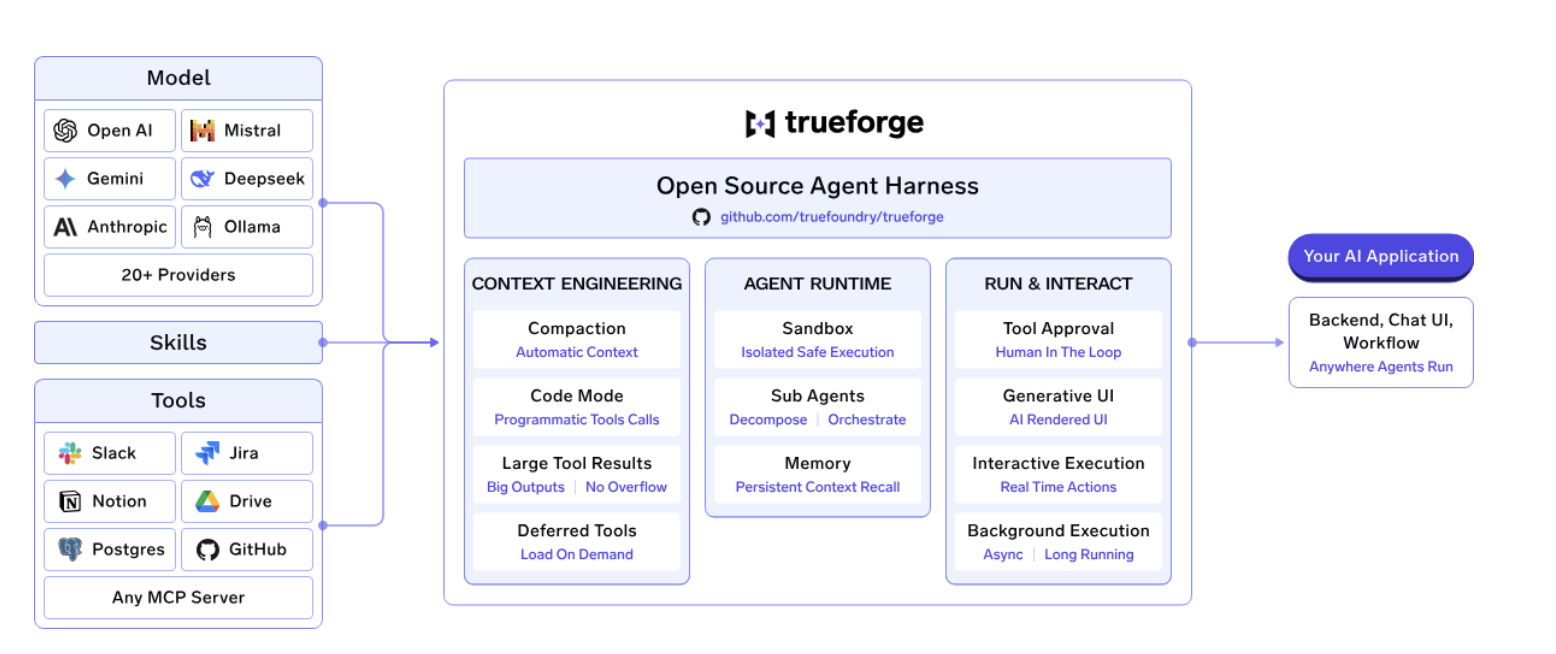
TrueForge is TrueFoundry's open-source, vendor-neutral agent harness. It is the runtime layer that turns a model into a working agent: planning a turn, routing and executing tools, managing context on long tasks, pausing for human approval, and persisting sessions so conversations survive reconnects and restarts. It is MIT licensed and runs on your own infrastructure.
It ships as three parts. A core server runs the agent loop. An HTTP API with a TypeScript SDK (@truefoundry/trueforge-core) drives it from code, with REST, server-sent events and an OpenAPI spec. A chat UI comes bundled on the same port, and is also published as a React UI SDK (@truefoundry/trueforge-ui) you can theme and embed in your own product.
npx @truefoundry/trueforge for a single local process on SQLite. For a team, Docker Compose, Helm or Railway, backed by Postgres and Redis, with multiple replicas behind a load balancer; Redis peers them so streams and cancellations follow a client across replicas. Optional OIDC login for shared deployments. Local mode is explicitly not hardened for shared access, and the docs say so.Best for: enterprise platform teams that need model choice, want the agent runtime and its session history inside their own infrastructure, and expect to run the same agent thousands of times a day where the per-run cost compounds.
Claude Managed Agents is Anthropic's pre-built, configurable agent harness running in managed infrastructure, built for long-running and asynchronous work. Instead of writing your own agent loop, tool execution and runtime, you define an agent (model, system prompt, tools, MCP servers, skills), define an environment, and start sessions against it. It is a genuinely good product, and for teams already standardised on Claude it removes a lot of undifferentiated infrastructure work.
managed-agents-2026-04-01 beta header, and Anthropic notes it may refine behaviours between releases. The harness runs Claude models, so the cheaper-model lever described above is not available at any deployment tier.Best for: teams committed to Claude models, without a HIPAA BAA requirement, who would rather buy the runtime than operate it.
Capability lists do not settle this. We ran both harnesses on DevRev's Enterprise-Bench, 14 cross-system tasks that read like real B2B operations work. Answering one means planning, calling MCP tools across a CRM, a project tracker and a document store, joining the results correctly, and pitching the answer at the right level of detail.
The setup was identical for every harness: same 14 tasks, same three MCP servers, a fresh session per task. Grading was blind, with an LLM judge scoring each answer against the task's criteria without seeing which harness or model produced it. A task counted as solved only if it met every criterion, with no partial credit. Cost is actual token usage priced at list rates and is cache-aware.
Same model, both harnesses on Opus 4.8:
Accuracy is a tie, which is the point. The model sets the ceiling on what is possible; the harness sets the price of getting there. TrueForge reached the same answers on roughly 40% of the tokens, about 28% cheaper per run and a third faster.
Then the lever a single-vendor harness cannot offer:
GLM-5.2 on TrueForge solved the same tasks Opus solved on Claude Managed Agents, at roughly $3 a run against $12. Claude Managed Agents cannot run this configuration at all. The full method and the three-way comparison including LangGraph's deepagents are in the TrueForge vs Claude Managed Agents benchmark.
TrueForge is the runtime. Running one agent well is a different problem from running fifty across four teams, and that is where the surrounding platform does the work.
TrueFoundry's AI Gateway gives every agent access to 1,000+ LLMs through a single OpenAI-compatible endpoint, at roughly 3–4 ms of added latency and 350+ RPS on one vCPU. Model access, budgets and guardrails are set centrally rather than per agent. Its Auto Routing classifies requests by complexity and sends them to the right model tier: across 550 prompts it cut cost by 69% while retaining 98% of baseline quality, with mean latency falling from 7.6 to 4.0 seconds.
The MCP Gateway centralises tool access with tool-level RBAC, OAuth and automatic credential rotation, so an admin rotates a credential once and every agent using it picks up the change. The Agent Gateway and the AI agent registry handle discovery and governance as the agent count grows. The platform carries SOC 2 Type II, supports HIPAA and GDPR requirements, and ships SSO, SCIM provisioning and immutable audit logging, deployable in your VPC, on-prem, air-gapped or hybrid with no data leaving your domain.
The two layers solve different halves of the cost problem. TrueForge reduces what it costs to run the agent. Routing avoids paying frontier prices for work that does not need them. At scale, having both matters more than the headline price of any single model.
What is the difference between Claude Managed Agents and TrueForge?
Claude Managed Agents is Anthropic's hosted agent harness, running Claude models with a $0.08 per session-hour runtime fee on top of token costs. TrueForge is TrueFoundry's MIT-licensed open-source agent harness that runs on your own infrastructure against any model, with no runtime fee. On the same 14 Enterprise-Bench tasks with the same model, TrueForge reached equal accuracy at $8.50 per run against $11.80, and at $2.90 per run when the task was sent to an open model instead.
Can you self-host Claude Managed Agents?
Yes, in two forms. Self-hosted sandboxes have been available for some time, letting the agent's code execution run on your infrastructure while Anthropic runs the rest. Since November 12, 2026, the complete Managed Agents service is available self-hosted in private beta, where you run the server, its PostgreSQL database and the agent workers. Access is requested through an Anthropic account team, and Claude itself still runs outside your network.
Is TrueForge really open source, and what licence does it use?
Yes. TrueForge is MIT licensed, with the repository at github.com/truefoundry/trueforge and documentation at trueforge.dev. There is no licence fee. You pay for the infrastructure you host it on and for whatever model and MCP tool calls your agents make.
Can I deploy TrueFoundry in my own VPC or on-prem?
Yes. TrueFoundry runs in your VPC, on-prem, air-gapped, hybrid, or across multiple clouds, and no data leaves your domain. This is the main reason regulated enterprises choose it over SaaS-only platforms.
Is TrueFoundry SOC 2, HIPAA and GDPR compliant?
TrueFoundry supports SOC 2, HIPAA and GDPR standards, with RBAC, SSO and immutable audit logging built in. Current attestations are published at trust.truefoundry.com.
Does TrueFoundry support MCP and AI agents?
Yes. The platform includes an MCP Gateway, an Agent Gateway, and an MCP and Agents Registry with tool-level access control. Agents built on LangGraph, CrewAI, AutoGen, TrueForge or a custom framework can be deployed and governed through one control plane.
Claude Managed Agents has closed most of the deployment gap and is a strong choice if your organisation has standardised on Claude, has no HIPAA BAA requirement, and would rather buy the runtime than run it. The constraints that remain are the ones built into a single-vendor harness: every task priced at one family's rates, a heavier loop on identical work, and compliance eligibility that depends on which beta you are in.
TrueForge keeps the managed-agent experience and gives back the two decisions that move the bill, which model runs the task and where the runtime lives. On the same benchmark, same model and same tools, that was 28% less per run, and 75% less once the cheaper-model lever was on the table.
If you are choosing an agent harness for production and model flexibility, infrastructure control and cost per run matter to your evaluation, book a demo and we will walk through what your workload looks like on TrueForge with the AI Gateway in front of it. The harness itself is open source and on GitHub if you would rather start there.
TrueFoundry AI Gateway delivers ~3–4 ms latency, handles 350+ RPS on 1 vCPU, scales horizontally with ease, and is production-ready, while LiteLLM suffers from high latency, struggles beyond moderate RPS, lacks built-in scaling, and is best for light or prototype workloads.





أحدث الأخبار والمقالات والموارد تصلك مباشرة إلى بريدك الوارد