


October 1, 2026
|
5 min read


Obtenha acesso instantâneo a um ambiente TrueFoundry ao vivo. Implante modelos, direcione o tráfego de LLM e explore a plataforma completa — seu sandbox estará pronto em segundos, sem necessidade de cartão de crédito.


Published: August 23, 2026
Blazingly fast way to build, track and deploy your models!
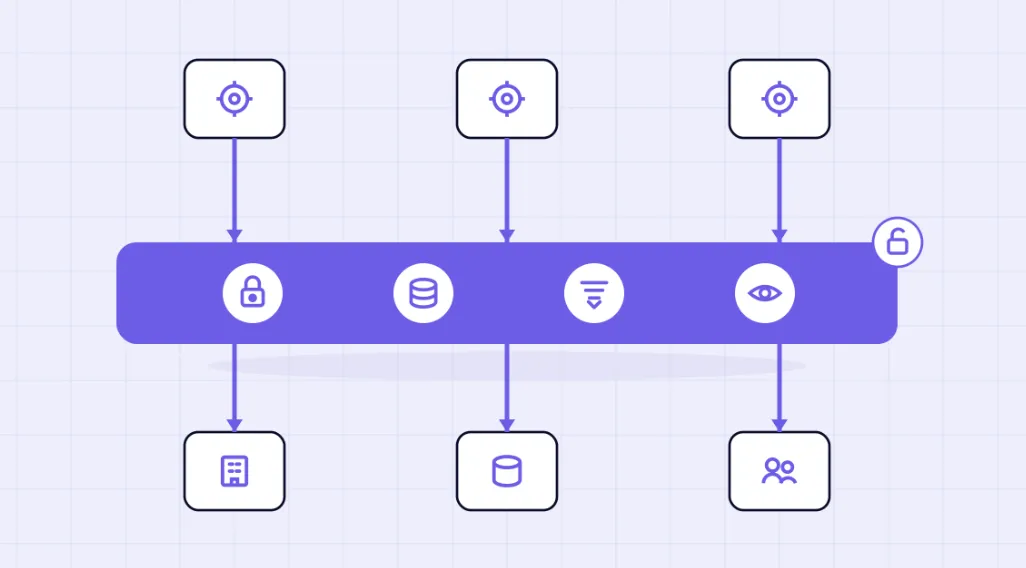
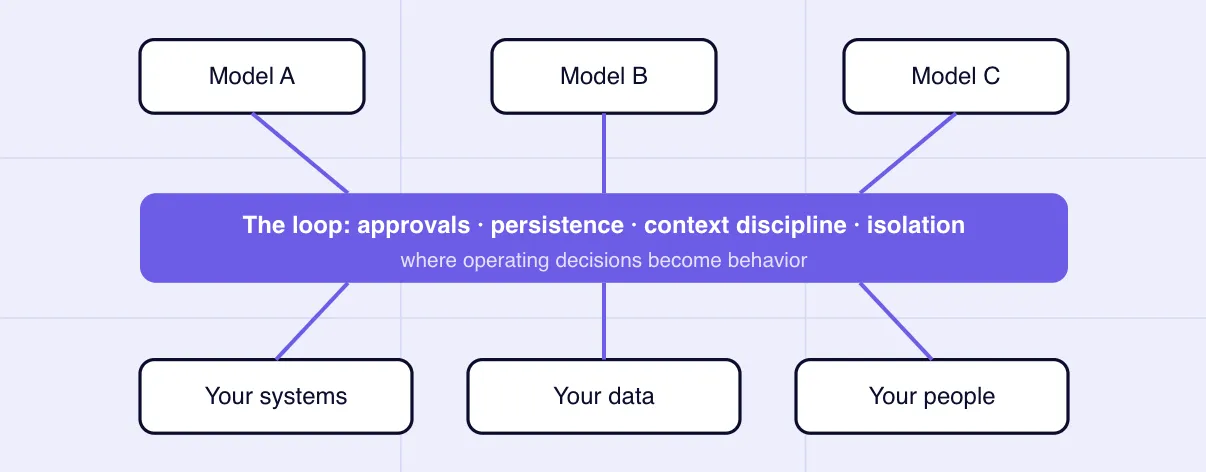
Every era of enterprise software develops a layer that looks secondary until operating decisions accumulate there. In the client-server era it was often the application server; in the cloud era, the container orchestrator; in the data era, the pipeline scheduler. The pattern is not that the celebrated component disappears, but that an increasing share of operational differentiation moves into the machinery that runs it. For AI agents, that machinery has a name. TrueForge's documentation defines the agent harness plainly: “the runtime layer around an LLM that turns it into a reliable, long-running agent.” Much of an enterprise's operational experience of an agent — whether a run survives a restart, whether a configured high-risk action waits for a human, whether working context is compacted or offloaded, whether code executes inside a sandbox, and whether a failure can be reconstructed afterward — is shaped in that runtime layer, in the execution loop between the model and the world. We have been calling the discipline of designing that cycle loop engineering, and our empirical companion and published benchmark carry the measurements. This piece deliberately carries none. It makes the strategic argument instead: as model choice becomes more portable for a growing set of workloads, the loop increasingly resembles middleware because it concentrates persistence, context, approval, isolation, and observability decisions. Open standards and open-source implementations became strategically important in several earlier middleware categories; that history is context for, not proof of, TrueFoundry's decision to open-source its own harness.
A model is a capability; a loop is a place where policy can be enforced. The distinction becomes concrete when you list what the loop mediates on every circuit. Whether a configured tool call that writes to a production system proceeds or pauses — TrueForge's capability table states its version in six words: “Pause before write/destructive MCP tools.” Whether session state survives reconnects and restarts — the harness documentation makes that a runtime property rather than a prompt instruction. Whether generated code can see harness credentials — TrueForge's sandbox design keeps secrets in the harness and provisions compute only when needed. Whether a long task trims or offloads context; whether a delegated subtask returns its final result rather than its entire working transcript — these are runtime choices too. None of them is reliably enforced by model behavior alone. Each is an operational decision that an organization may want applied consistently, and that is one reason the loop starts to look like middleware: it is where operating intent can become repeatable behavior. The translation table is worth seeing whole, because the pattern is the argument:
Loop decisions compound differently from prompt instructions because runtime policy can mediate each turn deterministically. Change where compaction happens, and every long-running task using that runtime can inherit the change. Add an approval boundary, and a class of risky actions now requires an explicit authorization step rather than relying on behavioral discipline alone; misconfiguration, bypasses, and bad approvals are still possible. The mechanism is familiar from middleware — define a control once, apply it consistently — and it explains why senior engineering attention is moving toward the runtime. Prompt engineering asks what to say to the model. Context engineering asks what to show it. Loop engineering asks what the system does between model calls, and that question belongs as much to platform and security engineering as to prompt authors.
TrueFoundry AI Gateway delivers ~3–4 ms latency, handles 350+ RPS on 1 vCPU, scales horizontally with ease, and is production-ready, while LiteLLM suffers from high latency, struggles beyond moderate RPS, lacks built-in scaling, and is best for light or prototype workloads.





As últimas notícias, artigos e recursos enviados para sua caixa de entrada
.png)
.png)
.png)
.png)
.png)
.png)
.png)
.png)
.png)
.png)
.png)


