novembro 18, 2026
|
5 min read


Obtenha acesso instantâneo a um ambiente TrueFoundry ao vivo. Implante modelos, direcione o tráfego de LLM e explore a plataforma completa — seu sandbox estará pronto em segundos, sem necessidade de cartão de crédito.



Blazingly fast way to build, track and deploy your models!
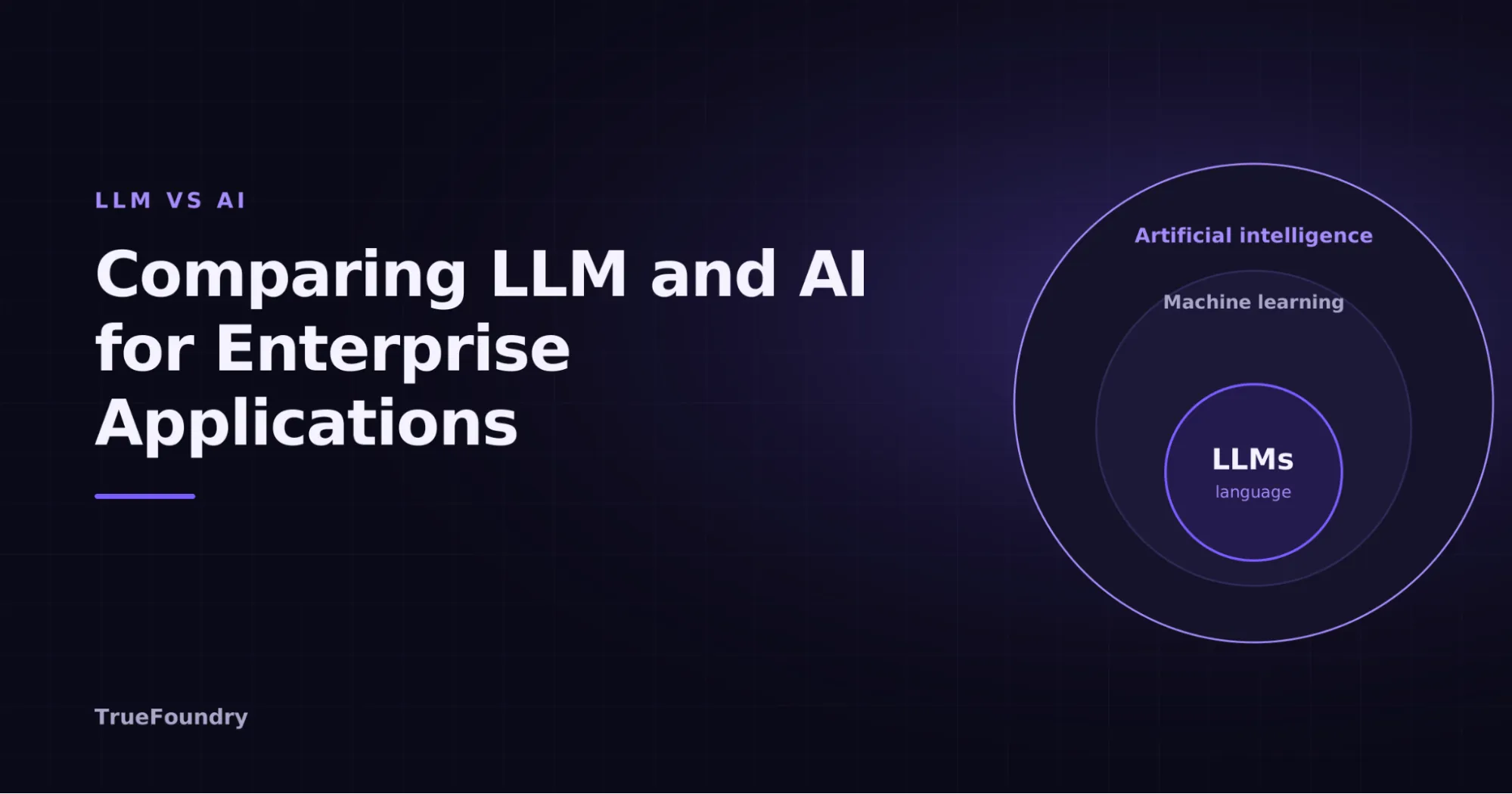
The LLM vs AI comparison starts with scope rather than capability. Artificial intelligence covers systems that predict, perceive, learn, reason, or make decisions. A large language model is one specific type inside that broader field. It primarily works with human language and related multimodal inputs.
Architecture reviews often treat AI as interchangeable with LLMs. A support chatbot usually relies on a language model for conversation. Fraud scoring and defect detection often use other types of AI, where LLMs may add unnecessary complexity.
McKinsey reported that 88% of surveyed organizations used AI in at least one business function during 2025. Much of that adoption extends beyond language systems. The practical question is where LLMs fit inside the wider stack and when another model fits better.
The short version of LLM vs AI is simple. AI is the broader category, while an LLM is a specific type of AI. AI includes machine learning, computer vision, robotics, recommendation systems, and Generative AI applications.
An LLM is an AI model trained on extensive text data and other supported inputs. Modern systems usually use a transformer architecture and learn patterns from training data. At a high level, LLMs operate via next-token prediction, while transformer models enable natural language processing across many tasks.
These systems use deep learning and a neural network rather than replicating the human brain. Earlier work used recurrent neural networks for sequential data, while vision relied heavily on convolutional neural networks. All are artificial neural networks, and none represents artificial general intelligence or complete human intelligence. Alan Turing framed early machine-intelligence questions, while current systems solve complex problems within bounded tasks
The practical gap also appears in latency and operating cost. A narrow machine learning model can score a structured record very efficiently. An LLM usually performs heavier inference across many parameters and generated tokens. Both are AI systems, although their operating profiles differ significantly.
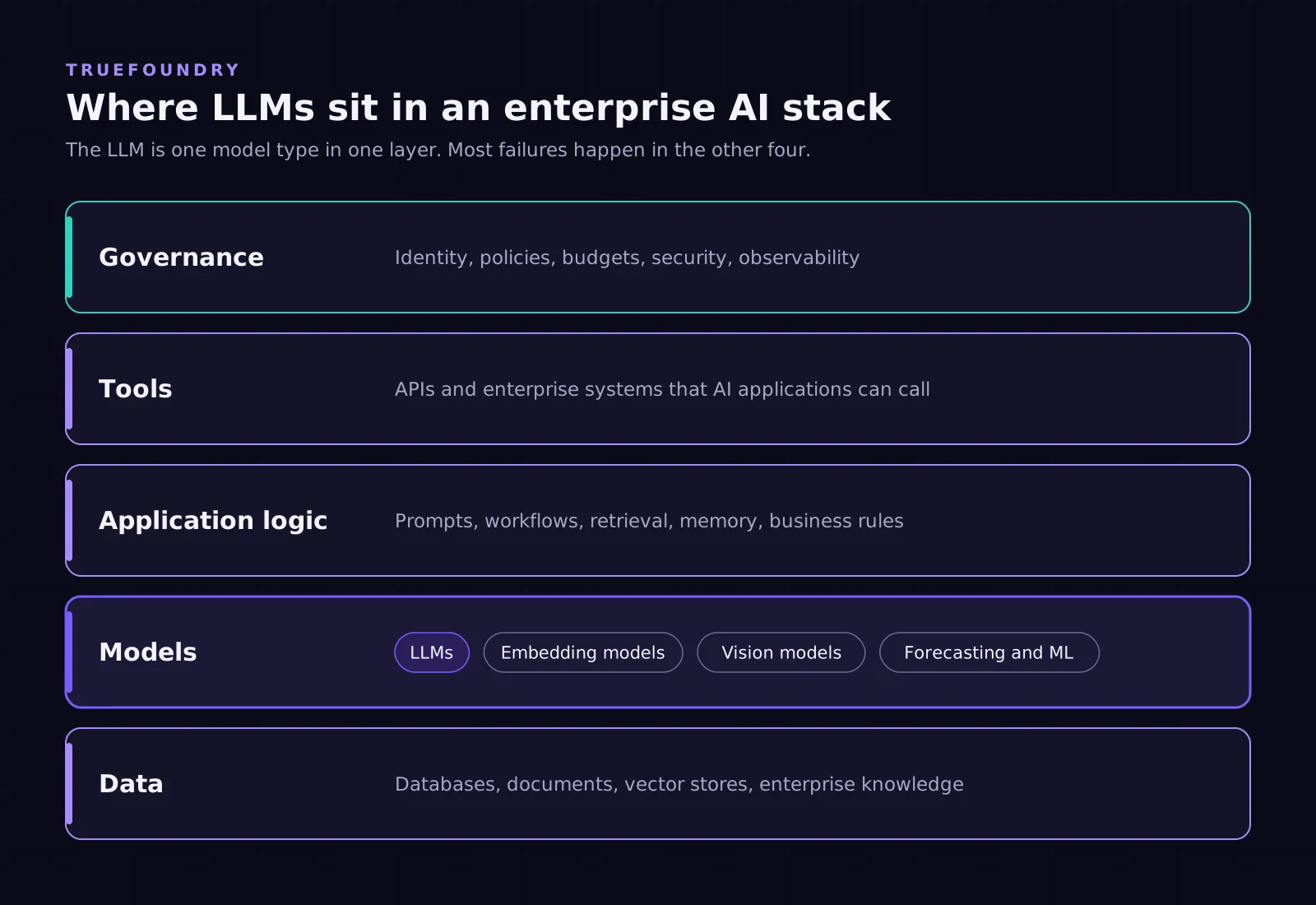
Once teams understand LLM vs AI, the model's place becomes clearer. An LLM typically sits at the model layer rather than spanning the whole application. A production AI system also connects retrieval, business data, APIs, memory, guardrails, tools, and workflow logic around that model.
A production stack therefore contains several connected layers:
Production failures often originate outside the model, where retrieval can miss documents and tools can return unexpected schemas. Replacing the LLM rarely fixes either issue without broader ownership and LLM observability.
A central LLM Gateway becomes useful when applications access several language models and providers. It creates one governed endpoint for routing, fallback, budgets, and observability. Teams can also expose self-hosted Llama models and other providers through a consistent interface.
The AI vs LLM distinction becomes sharper when you look at the task. LLMs are strongest where language sits at the center of the interaction. Broader AI systems work across many other data and decision types.
Language-heavy specific tasks include summarization, translation, sentiment analysis, and text generation. LLMs can also support code generation across many programming languages. Their flexibility comes from learning broad language patterns rather than one narrow mapping.
Generative systems also extend beyond language into image generation, video generation, speech synthesis, and synthetic data. Generative AI models can support image synthesis and create original content across text, images, audio, or video. Newer models increasingly combine these capabilities into multimodal models that share a single interface.
Read the table as a starting point for design reviews. Teams should avoid routing every problem through an LLM because Generative AI attracts attention. Search engines, recommenders, vision systems, and forecasting models can remain the better choice for many tasks.
An LLM is a good fit when the problem depends on understanding, transforming, or generating language. Inputs often contain messy natural language, while outputs contain text or code. The request range can also vary widely, making a single flexible model useful across many related tasks.
Common applications include enterprise search, document analysis, customer service assistants, knowledge copilots, and report summarization. They also include content creation, content generation, and new content drafting. A single model can handle phrasing variations that would require many separate classifiers.
LLMs also help when applications require open-ended requests rather than a single fixed prediction. Language generation can combine retrieved context with instructions, while human feedback can improve evaluation and prompt design. The goal remains dependable output rather than novelty alone.
After that decision, operations become the harder problem. Teams must manage provider choice, latency, reliability, token spending, and model access. An AI Gateway can centralize those controls instead of rebuilding them inside every application.
The opposite LLM vs AI case is equally common. LLMs add little when the problem is mainly numerical, visual, predictive, or optimization-driven. Narrow ML models often provide better control when outputs follow a fixed target and input structure.
A forecasting model can predict demand using historical sales data, while vision systems support defect detection or facial recognition. Speech recognition converts audio into text without conversational reasoning. These workloads use established deep learning techniques and specialized model families.
Begin with the business task rather than the trend. Data scientists can often more easily validate a narrow predictor. A simpler model can also reduce compute needs compared with much larger models, especially when scale or deterministic behavior matters.
LLMs and AI systems often work together within a single enterprise application. A planning assistant can interpret a question while a forecasting model produces projections. The LLM then converts those approved results into a readable explanation.
The same split appears across analytics, cybersecurity, healthcare, and customer support. Generative models can provide the conversational layer while specialized predictors supply domain results. Teams can therefore use each model where its capabilities create the most value.
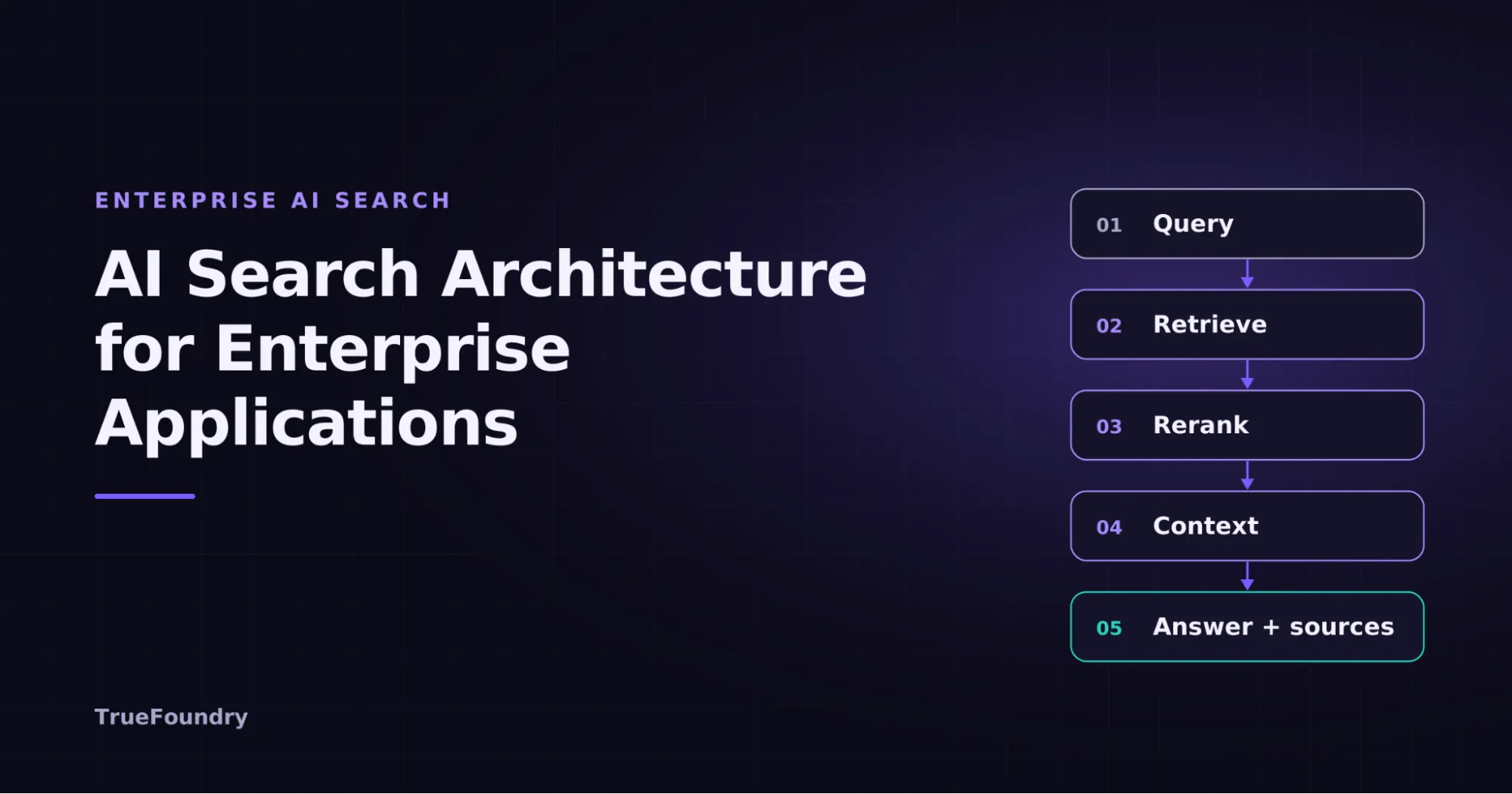
RAG offers another integration pattern, where retrieval supplies enterprise information while the model explains that context. TrueFoundry's RAG architecture guide covers retrieval, embeddings, indexing, and generation inside production applications.
The pattern also extends into Agentic AI, where an agent can call specialized predictors and combine results with language reasoning. Human intervention can remain available for high-impact decisions as orchestration expands.
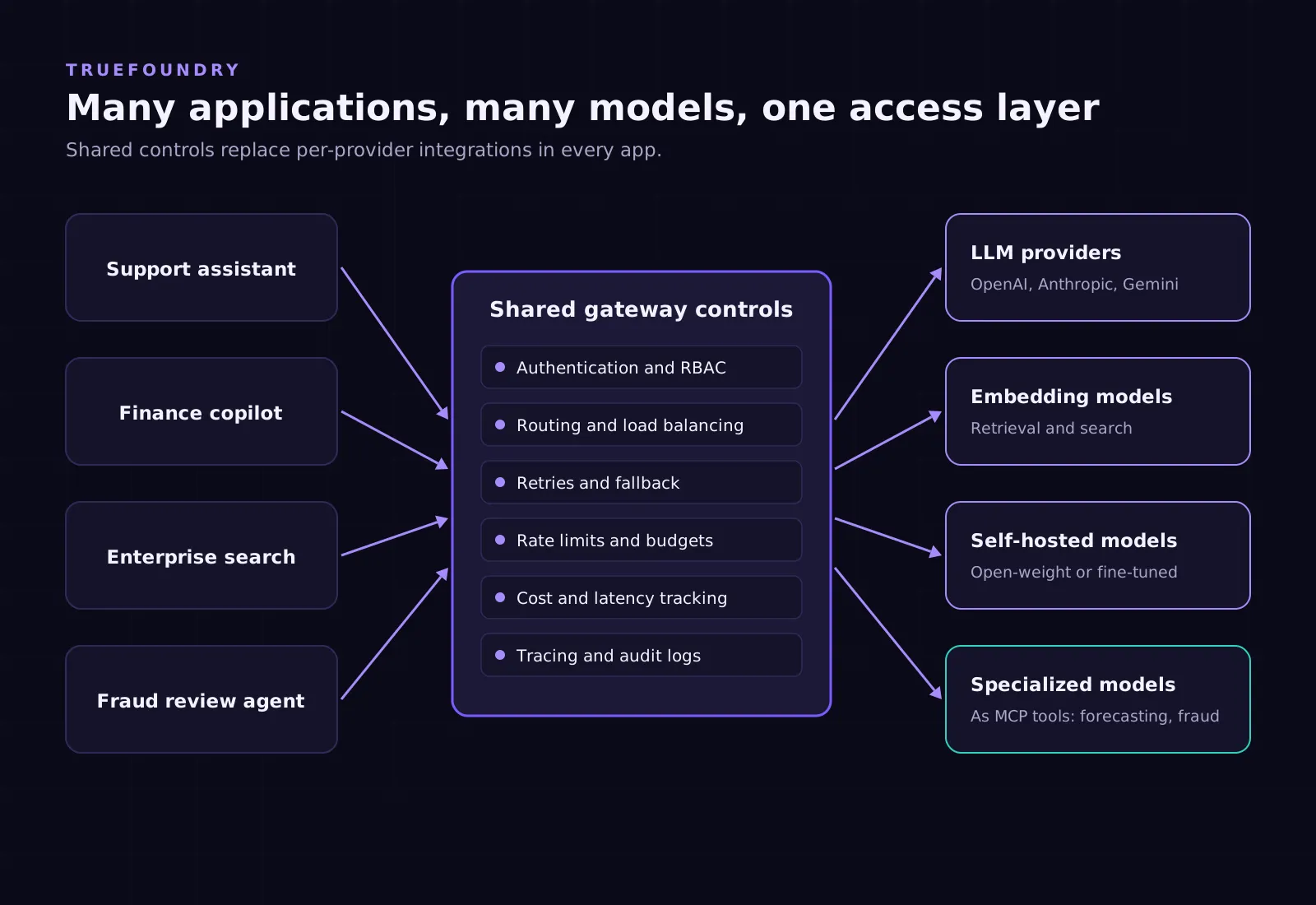
A single-model prototype can call one provider directly. Production systems become more complex when they combine LLMs, embeddings, specialized predictors, and multimodal models. The LLM vs AI architecture question then becomes a routing, identity, and governance problem across several dependencies.
Teams need authentication, fallbacks, cost visibility, and observability across all providers. Point integrations multiply quickly as applications, providers, and self-hosted services increase.
An AI gateway creates a shared access layer between applications and models. Applications call one consistent endpoint while policies manage provider differences. The design supports hosted models and internal services without changing application interfaces:
from openai import OpenAIclient = OpenAI( api_key="your_truefoundry_api_key", base_url="{GATEWAY_BASE_URL}", default_headers={ "x-tfy-retry-config": '{"attempts": 3, "onStatusCodes": [429, 500, 503]}' },)reply = client.chat.completions.create( model="openai-main/gpt-4o-mini", messages=[{"role": "user", "content": "Summarize this quarter's demand forecast."}],)The response header x-tfy-resolved-model reports which model actually served the call, which matters when load balancing or fallback can redirect traffic. Teams can change providers or policies centrally without touching application code.
Governance is another LLM vs AI difference for enterprise teams. Traditional AI governance focuses on training data, model quality, bias, explainability, access, and outcomes. LLM applications add prompts, generated responses, provider access, token spending, and nondeterministic behavior.
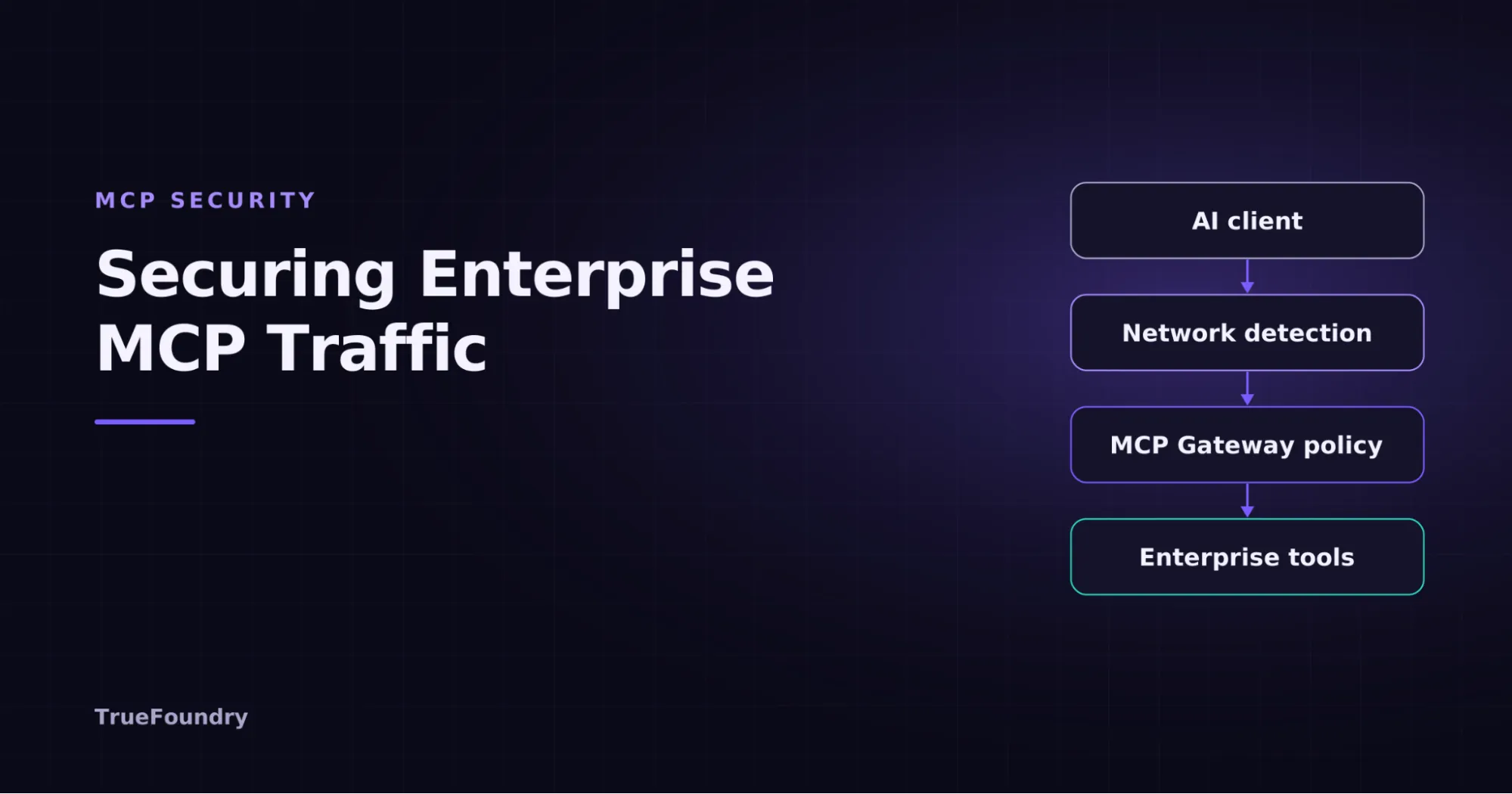
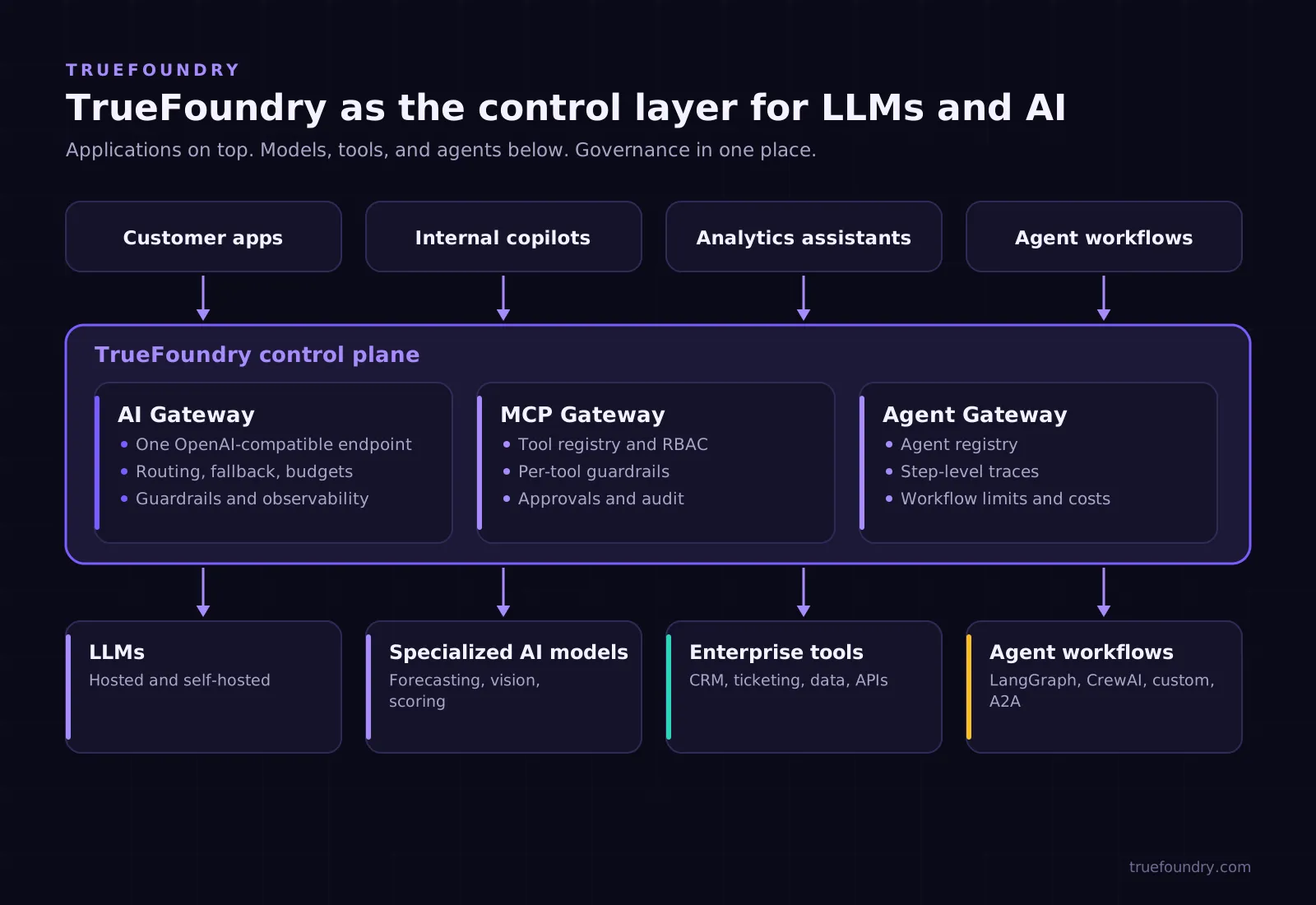
The surface expands again when applications call enterprise tools. Model access alone no longer controls what systems can read or change. An MCP Gateway can govern connected tools while the model layer governs inference traffic.
Agentic workflows add another layer of control around identity, authorization, and tool scope. An AI agent governance model should also connect audit trails and response controls. Sensitive workflows may require approval paths, while simpler classification systems need lighter runtime controls.
TrueFoundry sits between enterprise applications and the models, tools, and agents they use. It provides shared infrastructure for connecting, observing, and governing production workloads across providers without replacing the underlying models.
The platform can centralize routing, budgets, guardrails, and observability for hosted and self-hosted models. As applications become more autonomous, the Agent Gateway adds controls across multi-step execution and tool activity. A common control layer reduces duplicate integrations and provides teams with a single, consistent view of production activity.
The LLM vs AI decision should start with the business problem. Choose an LLM when language understanding, summarization, coding, or conversation forms the core requirement. Choose another AI approach when prediction, classification, optimization, or perception matters more than language.
Asking AI or LLM about a demand forecast often leads to a time-series predictor. An LLM may still explain that output in plain language. The right architecture can therefore combine several technologies without forcing one model family into every role.
For many enterprises, AI and LLM technologies already work together inside shared applications. McKinsey found 62% of organizations were experimenting with or piloting AI agents. No individual business function had more than 10% reporting agent scaling. Those figures show broad interest alongside limited operational maturity.
The operational priority is making every model accessible, observable, secure, and manageable as workloads grow. The choice between LLM and AI should remain task-led rather than trend-led. Enterprises gain more by selecting the right model than by maximizing model complexity.
To see how a single control plane handles models, tools, and agents, book a demo with the TrueFoundry team.
TrueFoundry AI Gateway delivers ~3–4 ms latency, handles 350+ RPS on 1 vCPU, scales horizontally with ease, and is production-ready, while LiteLLM suffers from high latency, struggles beyond moderate RPS, lacks built-in scaling, and is best for light or prototype workloads.



As últimas notícias, artigos e recursos enviados para sua caixa de entrada