September 23, 2026
|
5 min read


Published: May 11, 2026
.webp)
Blazingly fast way to build, track and deploy your models!
Token budgets overrun. GPU clusters sit at 20% resource utilization. Agent loops burn through thousands of inference calls on tasks that should take ten. Nobody can tell you which team or application is responsible.
That is the AI cost problem most enterprises discover after deploying AI, not before. Traditional software cost management scales predictably with the number of users or requests. AI workloads do not. Spend stays probabilistic, context-dependent, and invisible until the cloud invoice arrives.
AI cost optimization is the practice of reducing the total cost of ownership for AI workloads while preserving the output quality and user experience that make those systems worth running. This guide covers what the discipline includes, why conventional FinOps approaches fall short, and how TrueFoundry enforces cost control from the gateway layer inward.
Consider what happens without proper oversight. A mid-size enterprise rolls out its first customer-facing AI agent in March. Three teams connect it to a frontier model using separate API keys with no token usage tagging, no per-team budget, and no model routing policy. By May, the CFO asks why the AI bill on the cloud invoice grew 11x over two months.
Finance runs a week-long forensic review across four dashboards and still cannot tell which team owns 60% of the spend. That scenario is why AI cost optimization exists as a discipline, and why the controls must sit in the inference path rather than in the reporting pipeline.
AI cost optimization is the practice of reducing and managing the total cost of operating AI systems. It focuses on inference, compute, data storage, agent execution while preserving the model performance and response quality that make those systems valuable.
The discipline spans four distinct layers of the AI stack:
Miss any one of these four layers, and the cost optimization strategy breaks in production systems. Token usage controls mean nothing if an idle GPU cluster burns twice the inference spend. GPU governance means nothing if an agent workflow silently triggers 40 calls per user request.
Five drivers compound on one another across various sectors. Fix any one in isolation, and the remaining four still drive the AI cloud cost bill upward.
A healthcare customer running three separate RAG agents against a shared provider account saw monthly inference spend jump from $12K to $68K in six weeks. The cause was a retrieval regression in one agent that started returning documents 8x longer than the prompt. No individual log showed the issue. Only unified per-request telemetry across all three agents surfaced it, two weeks after the spike had already hit the invoice. (Source: TrueFoundry customer case study, 2025.)
.webp)
Classic cloud cost management was designed for resources with predictable consumption patterns. AI workloads break most of those assumptions.
The shift that matters: AI cost optimization must operate at the inference path itself, before the request reaches a model. FinOps reports spend. Gateway cost control policies prevent it.
Consider what a typical FinOps alert catches. A team exceeds its cloud budget by 30% over the course of a month. The alert fires on day 28. Two more days of overrun before the team can respond, and the alert itself contains no information about which model, agent, or prompt pattern drove the breach. Gateway-level enforcement reverses the sequence — the budget policy evaluates at request time, the blocked request never reaches the provider, and the team investigating the incident sees the attribution in structured metadata immediately.
.webp)
Five AI infrastructure cost optimization strategies, each enforced at the gateway layer, handle the bulk of enterprise AI cost control and deliver meaningful cost savings.
Each strategy is enforced at a different point in the inference path. Taken together through a single AI gateway control plane, they compound and they enforce uniformly without per-team custom implementation, making AI cost optimization a platform property rather than a team responsibility.
.webp)
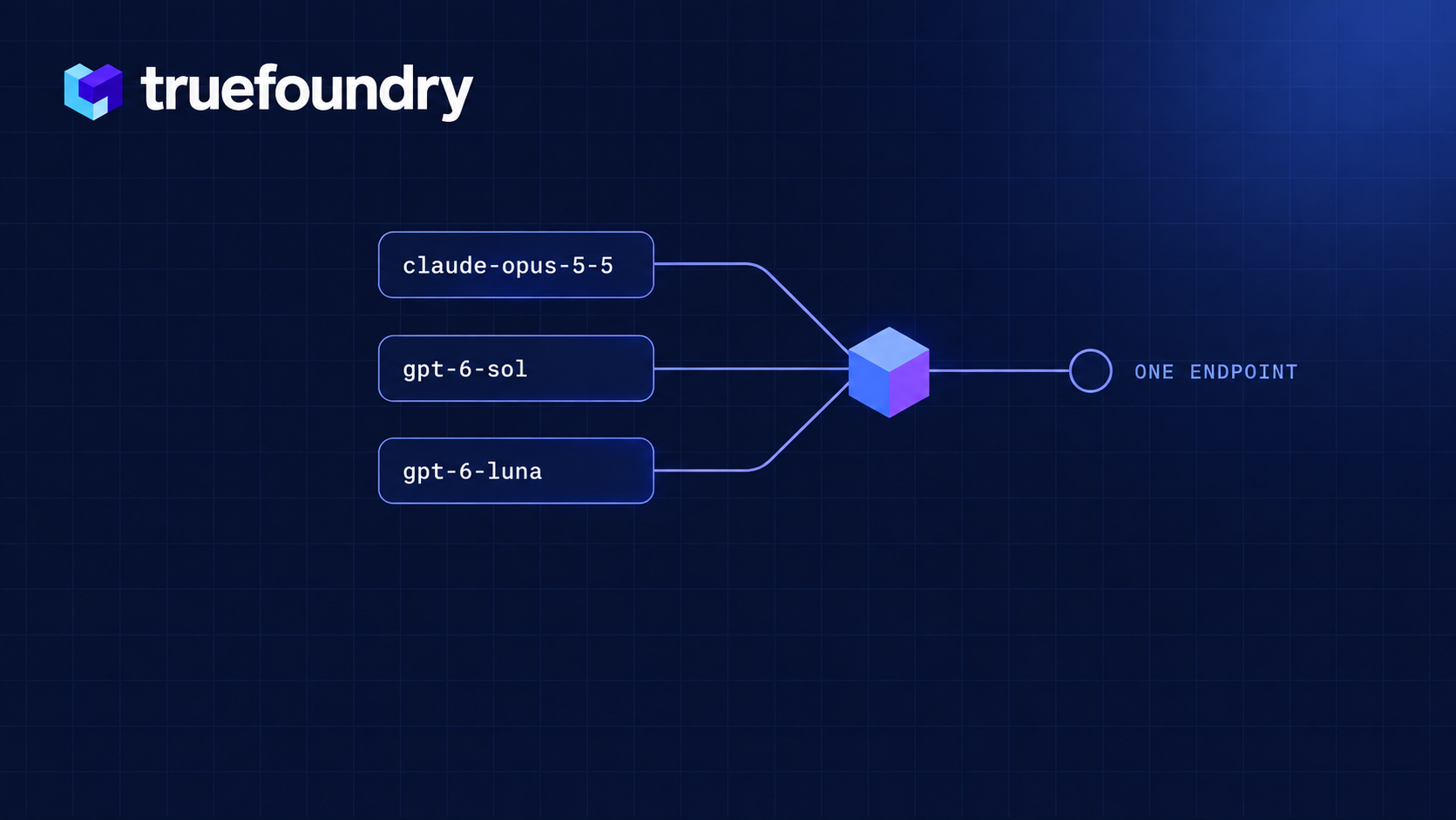
Our AI Gateway enforces cost optimization as infrastructure, not as a reporting exercise. Every LLM call, agent execution, and tool invocation passes through the gateway — so cost controls apply universally, without requiring each team to build budget logic into their own application.
Enterprises using AI gateways for cost governance report 40–60% reductions in inference costs, along with higher reliability and predictable spend. Gateway architecture adds only ~3–4ms of overhead per request, negligible next to actual model inference latency.
TrueFoundry runs VPC-native within the customer's AWS, Google Cloud, or Azure account, meaning AI cost metadata and token count data never leave the customer environment. Regulated industries get data sovereignty without sacrificing cost allocation visibility, and finance teams get chargeback-ready attribution data flowing through existing observability pipelines.
.webp)
Enterprises typically realize they need a gateway-level AI cost optimization control plane around the third month of production AI deployment, right when the first surprise invoice lands. Getting ahead of the invoice is less expensive than responding after it arrives.
Book a demo with TrueFoundry to map your AI cost optimization strategy against a reference gateway deployment and see what real-time cost control, hard token budgets, and semantic caching look like against your current AI workloads.
TrueFoundry AI Gateway delivers ~3–4 ms latency, handles 350+ RPS on 1 vCPU, scales horizontally with ease, and is production-ready, while LiteLLM suffers from high latency, struggles beyond moderate RPS, lacks built-in scaling, and is best for light or prototype workloads.




AI plays two distinct roles in AI cost optimization. First, AI workloads generate costs that require cost management through token usage controls, model routing, and resource utilization governance. Second, AI techniques such as anomaly detection and model optimization improve the cost efficiency of optimization itself. The discipline of AI cost optimization primarily addresses the first, making AI cost visible, attributable, and controllable across production systems.
A customer support team routing every query to a frontier model pays premium rates regardless of complexity. Applying model routing to send intent classification to smaller models, serving repeated queries from prompt caching, and capping the agent inference budget can reduce the AI bill by 40 to 60% without degrading response quality for most queries. (Source: TrueFoundry customer benchmarks, 2025.)
The goal of AI cost optimization is predictable, attributable AI cost that scales with business value, not with unchecked model usage. A mature practice makes every dollar spent on inference, compute, and agent execution traceable to a specific team, application, and business goals. Unpredictable AI cost blocks AI initiatives at the executive review stage, reducing the organization's competitive advantage from AI investment.
Traditional cloud cost management meters predictable units such as compute hours and data storage gigabytes. Token usage billing meters each input token, output token, and sometimes each cached token per inference call. AI cost per user request varies with prompt length, model choice, and retrieval behavior, all of which shift unpredictably in agent operational workflows. Cloud cost optimization tools built for compute hours miss the token count layer entirely.
Enterprises set AI cost budgets by team, application, and environment, then enforce them at the gateway layer before requests reach a model. The TrueFoundry AI gateway meters token usage in real time, tags every request with metadata for cost allocation, and applies hard limits when a team crosses its ceiling. Central cost control enforcement matters: leaving budget logic to individual applications means every team implements a different and unreliable version.



The latest news, articles, and resources sent to your inbox
.png)

.png)
.png)
.png)
.png)
.png)
.png)
.png)
.png)
.png)