novembro 18, 2026
|
5 min read


Obtenha acesso instantâneo a um ambiente TrueFoundry ao vivo. Implante modelos, direcione o tráfego de LLM e explore a plataforma completa — seu sandbox estará pronto em segundos, sem necessidade de cartão de crédito.



Blazingly fast way to build, track and deploy your models!
LLM fine-tuning adapts a pretrained large language model to perform better on a narrower task, domain, style, or response pattern. Teams continue training an existing model on carefully selected examples instead of starting from scratch. For teams asking what is LLM fine-tuning, the key issue is whether the change justifies its added work.
Teams fine-tuning LLM weights no longer need a research organization. The harder decision is whether tuning solves the use case better than prompting or retrieval. A tuned model can improve output quality and user experience. It also adds data, compute, evaluation, versioning, and deployment responsibilities.
Fine-tuning adjusts the pretrained model's weights using additional examples that demonstrate the required behavior. The base model already has general language understanding from pretraining. Fine-tuning shifts its responses toward a specific task or target domain. This approach is a form of transfer learning rather than full training from the beginning.
Mechanically, the training process remains similar to supervised next-token learning. Teams usually use less data, a lower learning rate, and fewer epochs. The goal is preserving general language capability while teaching new tasks. A deep learning neural network can adapt without relearning everything.
A tuned model can follow company formats, use domain vocabulary, or classify requests consistently. It can also learn natural-language instructions that repeated prompts currently convey. Shorter prompts may reduce recurring token costs at scale. Fine-tuning still does not provide reliable access to changing facts or current enterprise knowledge
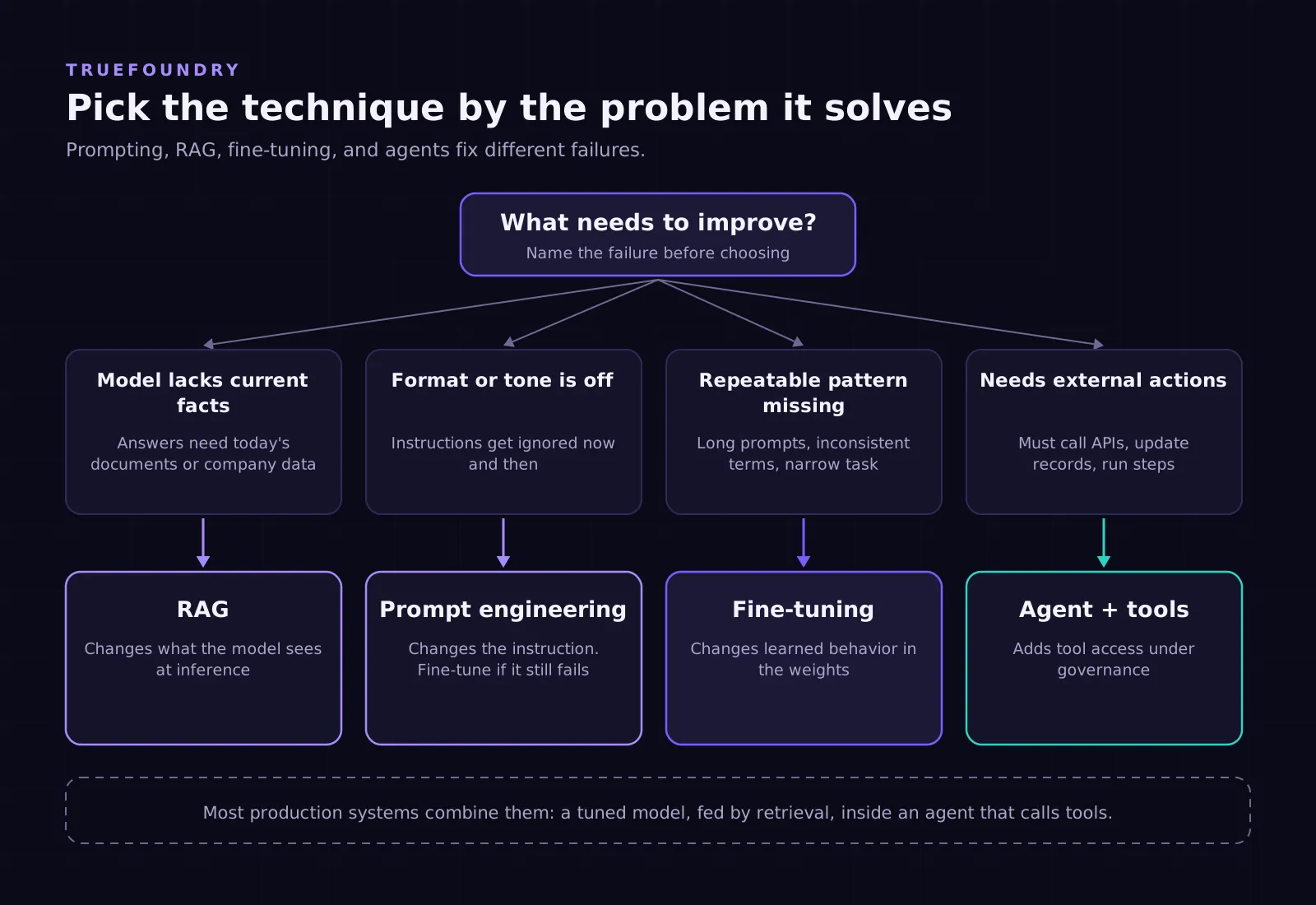
That limitation is why diagnosis should come before training. The best starting point depends on what actually needs improvement. Prompt engineering changes the instruction attached to a request. RAG changes the specific data available during inference, while tuning changes learned response patterns.
Enterprises often combine all three approaches. A tuned model can follow house format while retrieval supplies proprietary data. An agent can use tools when workflows require actions. RAG architecture is stronger when natural language answers depend on changing facts.
A useful rule is to improve the prompt before starting another training run. If three strong examples solve most problems, tuning may add little value. Fine-tuning helps when repeatable failures remain after better instructions and context. That distinction keeps the decision tied to the actual problem.
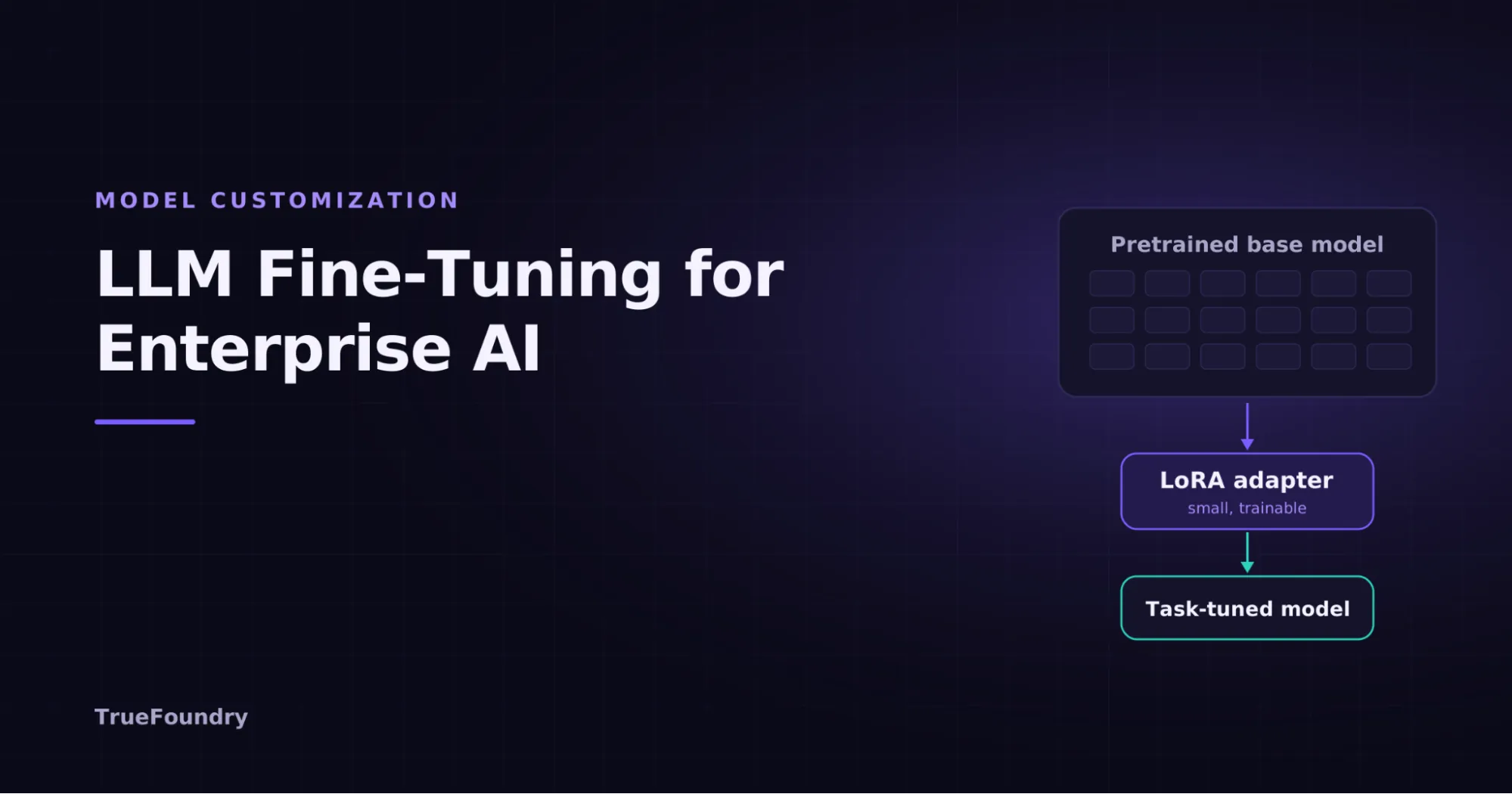
When tuning is the correct lever, teams decide how much of the model changes. Full tuning updates most model parameters across the entire model. Parameter-efficient fine-tuning, often called PEFT methods, changes a much smaller subset. This reduces computational resources, training time, and storage for large models
LoRA fine-tuning freezes pretrained weights and trains small low-rank matrices beside selected layers. The original paper reported about 10,000 times fewer trainable parameters on GPT-3 175B. It also reported roughly three times lower GPU memory use than full tuning with Adam. The method added no inference latency after merging adapters.
QLoRA further reduces memory requirements by quantizing the frozen model to four-bit precision. Its authors fine-tuned a 65B-parameter model on one 48 GB GPU. This approach keeps memory usage manageable while preserving strong model performance. It is often practical to use full tuning when the available hardware exceeds.
Preference tuning addresses cases where there is no objectively correct answer. DPO learns from preferred and rejected pairs without traditional reinforcement learning. Teams should tune batch size carefully for stable training results. The method depends on desired change, budget, and the model’s performance on the target task.
Whatever method teams choose, examples set the quality ceiling. A large training dataset cannot compensate for contradictory or incorrect examples. Data preparation should remove duplicates, mask sensitive content, and reserve evaluation examples before training begins. Data scientists should also verify that examples reflect the real target domain.
Useful datasets can include labeled data for text classification, expert corrections, structured outputs, and support conversations. A legal document workflow may require different examples from customer support. Sentiment analysis, text generation, and natural language processing require different labels and output expectations.
Supervised chat examples usually use JSONL, with one complete conversation per line:
{"messages": [{"role": "system", "content": "Classify the support ticket."}, {"role": "user", "content": "Invoice INV-2291 was charged twice."}, {"role": "assistant", "content": "billing.duplicate_charge"}]}OpenAI currently requires at least ten training examples for supervised tuning and recommends starting with 50 well-crafted demonstrations. Its guide says teams often see improvements with roughly 50 to 100 examples. Those figures show why quality can matter more than raw dataset size.
Teams can use data augmentation when real examples are scarce, although synthetic examples still need review. Human feedback can identify edge cases that automated generation misses. Best practices also require a separate training set and holdout set. This prevents teams from mistaking memorization for genuine improvement.
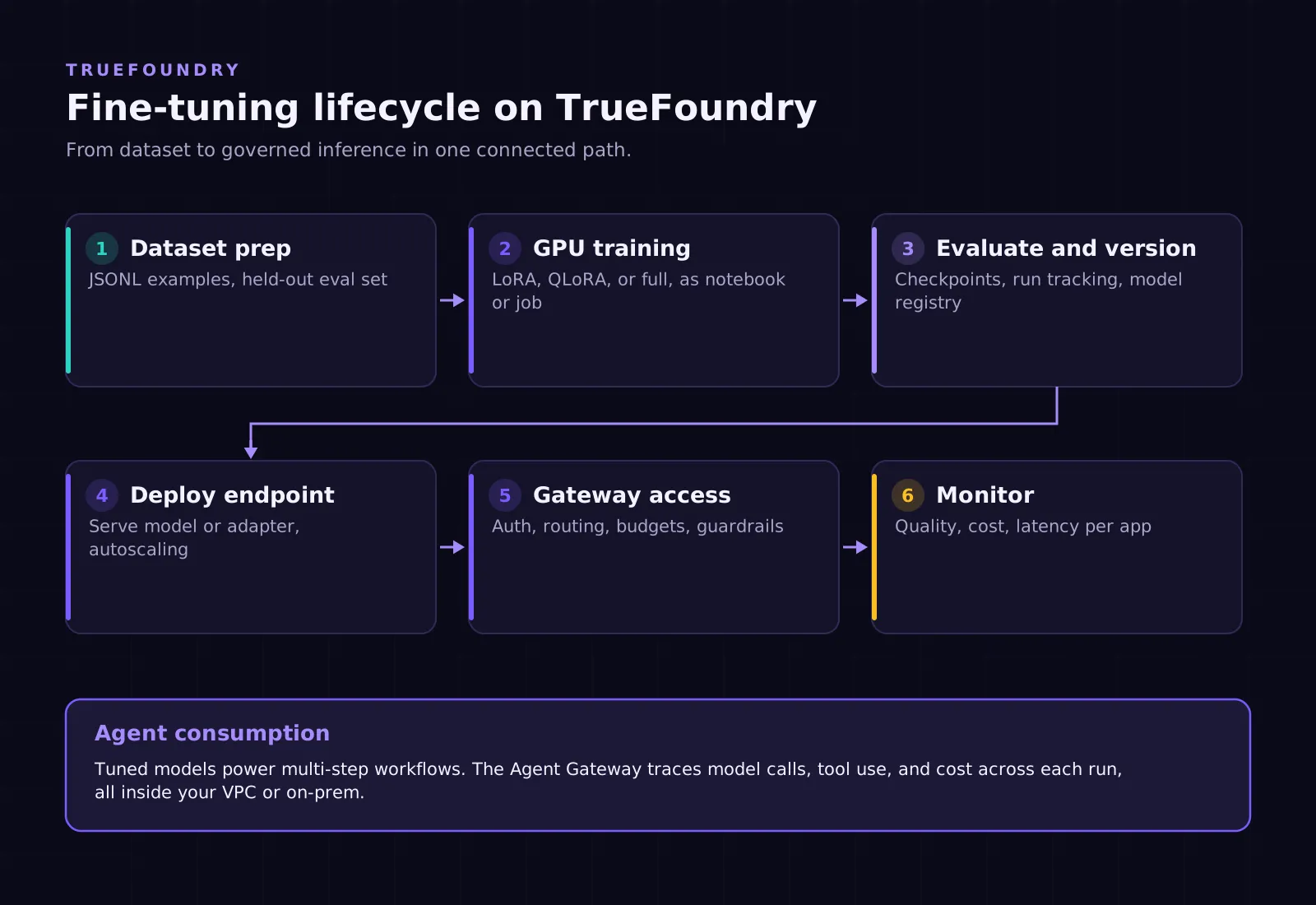
Understanding what is LLM fine-tuning also requires looking beyond the training job. A production workflow connects data preparation, training, evaluation, deployment, and monitoring. Each stage should have measurable criteria before the model moves forward.
A standard workflow includes:
Step one needs a measurable target instead of a vague improvement goal. Teams should define higher accuracy, schema validity, or another task-level outcome. They should also record the number of training epochs and every important configuration value. Reproducibility becomes important when later training runs change expected behavior.
The workflow should optimize the model for the target task rather than chase lower loss alone. Training time and hardware cost also influence the decision. Optimal performance means the improvement survives realistic evaluation and production constraints. More training is useful only when it improves the model’s performance on unseen examples.
For teams asking what is LLM fine-tuning worth, evaluation provides the answer. Training loss indicates how well a model fits its training data. It does not show whether the model handles new inputs or preserves earlier capabilities. Aggressive specialization can also create catastrophic forgetting across previously learned capabilities.
Teams should evaluate task accuracy, schema validity, safety, and output quality on realistic examples. They should include ordinary requests, hard cases, ambiguous inputs, and expected refusals. The same scoring process should be used to compare several model versions.
The strongest evaluation process compares several versions:
Run all four on the same test set with the same scoring. Teams skip the second and third versions surprisingly often, and then credit fine-tuning for gains a better prompt would have delivered for free. Watch for regressions too. A model tuned hard on one task can lose general instruction-following elsewhere.
A model that wins evaluation still has to serve real production traffic. Production changes the fine-tuning problem because reliability and governance now matter. The model needs reliable serving, autoscaling, authentication, observability, cost controls, and version management.
Traffic may need to move between general and specialized models. A central LLM Gateway can standardize access and routing across those endpoints. The application can keep one client while the platform team changes providers or model versions behind it:
from openai import OpenAIclient = OpenAI(api_key="your_truefoundry_api_key", base_url="{GATEWAY_BASE_URL}")label = client.chat.completions.create( model="<provider-account>/<fine-tuned-model>", # name shown in the gateway messages=[{"role": "user", "content": ticket_text}],)Training and serving solve different problems across the model lifecycle. Training sets intended behavior, while production infrastructure controls access, reliability, and cost. Generative AI workloads also need tracing and rollback when tuned versions change unexpectedly
Custom models give organizations more lifecycle responsibility. Teams now own the data lineage, training method, evaluation evidence, and deployment record. They should document the base model, training dataset, tuning configuration, and approved production version.
Access should also reflect the model's purpose. A model tuned on sensitive support conversations should not be available to every experimentation notebook. A central AI Gateway can apply authentication, budgets, guardrails, routing, and observability once the model is in production.
Governance should connect training provenance with inference activity. That creates a traceable path from examples to production requests. It also makes audit questions easier when teams need to explain which version produced a particular output.
For teams asking what is LLM fine-tuning operationally, TrueFoundry covers more than the training run. Teams can train and deploy custom models while keeping governance connected. The platform supports machine learning and artificial intelligence workloads across customer-controlled environments.
TrueFoundry's training and fine-tuning capabilities support LoRA, QLoRA, and full tuning for open-weight models. Teams can use Hugging Face models, custom scripts, and the Transformers library during training. Hugging Face Transformers workflows can also use familiar libraries and checkpoints. The platform supports adapters, experiment tracking, versioning, and governed deployment.
Once models go live, gateway controls handle provider access, routing, fallback, caching, budgets, and observability. Fine-tuned models can also power agent workflows. The Agent Gateway then extends controls across model calls, tool use, execution limits, and traces.
If those agents later reach enterprise tools, access policies should remain separate from model behavior. This keeps training, deployment, and runtime governance connected without forcing one layer to solve every problem.
Teams should fine-tune LLM models when they have a clearly defined behavior to improve and enough quality examples. They also need an evaluation process that can prove the change. What is LLM fine-tuning useful for depends on whether the weakness is behavioral rather than informational.
Fine-tuning helps less when the real problem is missing facts, weak retrieval, unclear prompts, or poor workflow design. Fix those issues at the correct layer first. Specific use cases with stable response patterns remain stronger candidates than constantly changing knowledge tasks.
Provider strategy also matters. OpenAI stopped new organizations from starting self-serve fine-tuning on May 7, 2026. Eligible existing customers can create new jobs only until January 6, 2027. Inference remains available until each underlying base model is deprecated.
Teams tuning open-weight models on their own infrastructure keep more control over scheduling and weights. They should still measure costs and governance. The decision ultimately depends on measurable gains that remain manageable in production.
To see training, deployment, and gateway governance run end-to-end on your own models, book a demo with the TrueFoundry team.
TrueFoundry AI Gateway delivers ~3–4 ms latency, handles 350+ RPS on 1 vCPU, scales horizontally with ease, and is production-ready, while LiteLLM suffers from high latency, struggles beyond moderate RPS, lacks built-in scaling, and is best for light or prototype workloads.



As últimas notícias, artigos e recursos enviados para sua caixa de entrada