


Accédez instantanément à un environnement TrueFoundry en direct. Déployez des modèles, acheminez le trafic LLM et explorez la plateforme complète : votre sandbox est prête en quelques secondes, aucune carte de crédit n'est requise.


What is Zero Trust Security, and what are its core principles?

.webp)
Modern systems no longer have a clear security boundary. Users connect from anywhere, applications run across multiple clouds, and data moves between services constantly. In this environment, traditional security models that assume everything inside the network is safe are no longer reliable.
Zero Trust Security is built for this reality. It removes the idea of automatic trust and ensures every access request is verified before being granted.
In this guide, you’ll understand what Zero Trust Security is, why it matters, and the core principles that define it.
H2: What is Zero Trust security?
Note for the brand: Recreate the image
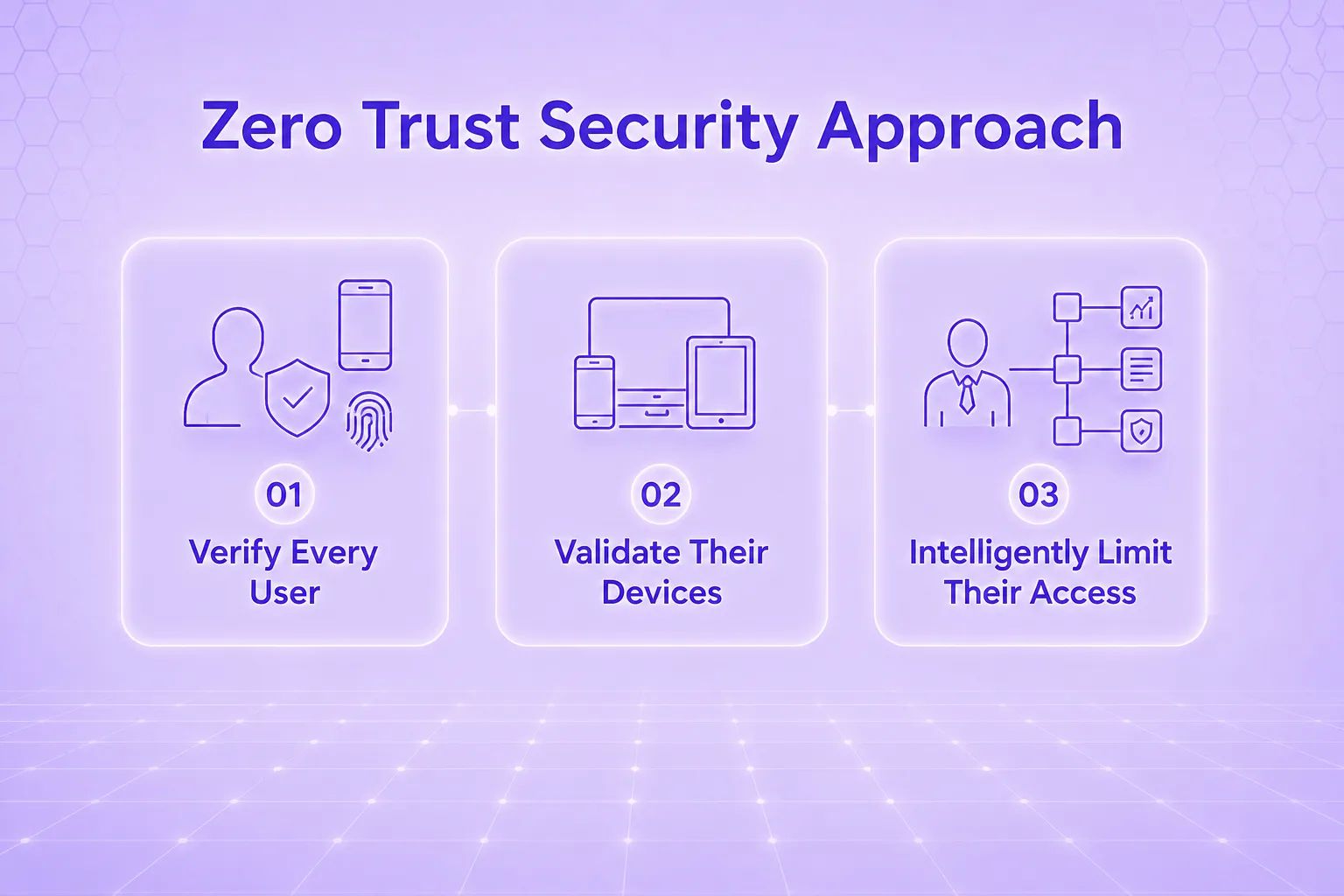
Alt text: Zero trust security meaning
Zero Trust Security is a cybersecurity approach that assumes no user, device, or system should be trusted by default, even if it is inside the network. Every access request must be verified before access is granted.
Instead of relying on a secure network boundary, it focuses on continuously checking identity, device health, and permissions. Access is given only on a need-to-know basis and is regularly re-evaluated to reduce security risks.
H2: What are the core principles of Zero Trust Security?
Note for the brand: Recreate the image
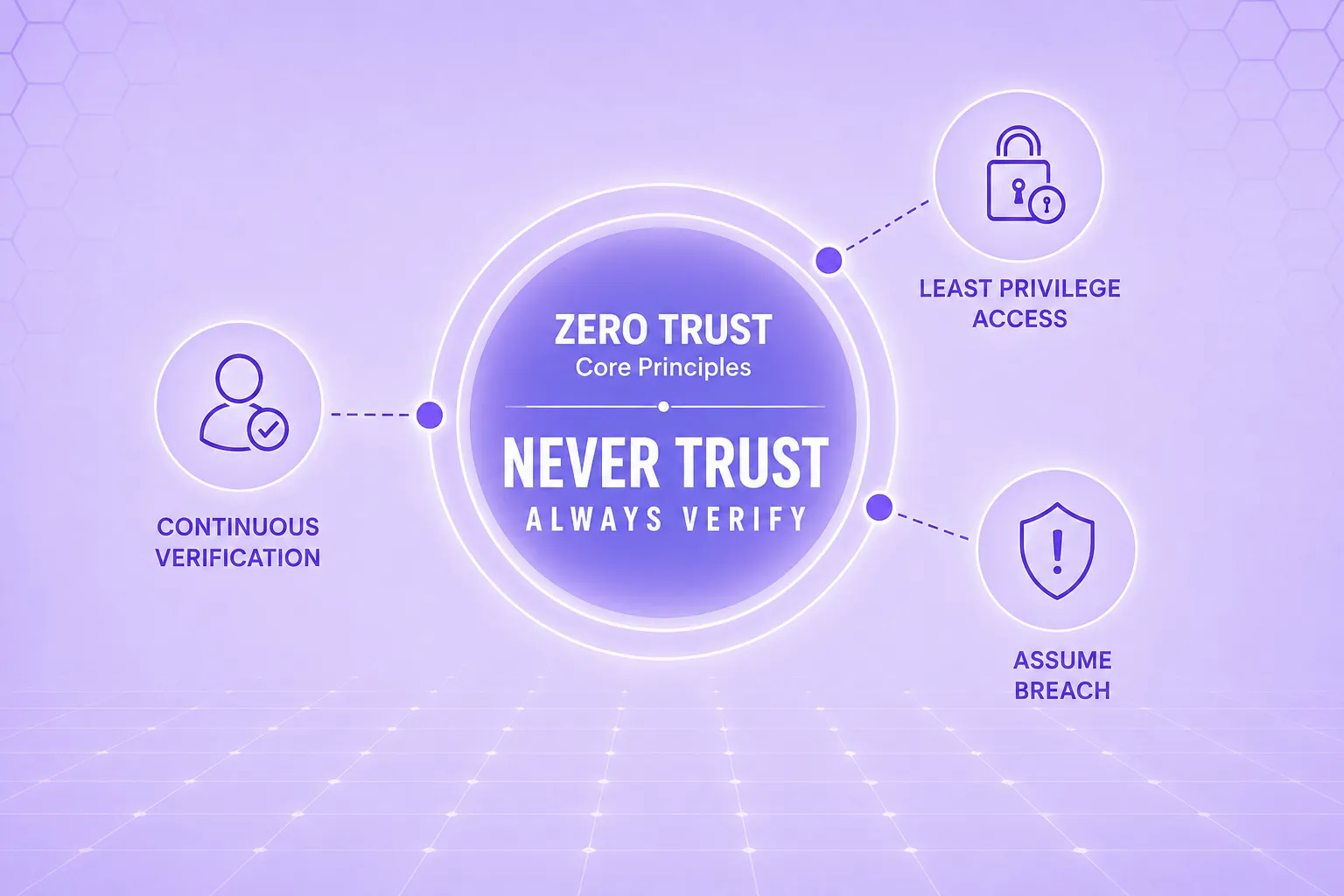
Alt text: zero trust security principles
Although different frameworks use slightly different wording, three core principles consistently appear across Microsoft, NIST, CISA, and industry leaders.
The zero trust model is built on three core principles:
1. Verify explicitly
Zero Trust requires every access request to be verified clearly and continuously, not just once at login. This means checking identity, device health, location, and behavior before granting access. For example, it may use multi-factor authentication, device security checks, and risk signals like unusual login patterns. Each request is evaluated in real time using all available context.
2. Least privilege access
Users and systems are given only the minimum level of access needed to perform their tasks. Permissions are tightly controlled, time-limited, and regularly reviewed. Instead of broad admin access, roles are narrowly defined, and services only communicate with what they truly need. This reduces the damage if an account or system is compromised.
3. Assume breach
Zero Trust assumes that attackers may already be inside the system. Because of this, systems are designed to limit movement, detect threats quickly, and contain damage. Techniques like network segmentation, continuous monitoring, encryption, and automated response help ensure that even if a breach occurs, its impact is minimized.
H2: Why is Zero Trust Security needed?
Traditionally, security followed a “castle-and-moat” model. Everything outside the network was treated as untrusted, while anything inside the firewall was assumed to be safe. Once a user gained access, they could often move freely within internal systems without repeated verification.
This approach worked when most applications and employees were inside a single physical network. However, today’s environment is very different. People work remotely, applications run across multiple cloud platforms, and data is spread across services and devices. As a result, there is no clear “inside” boundary anymore.
In this modern setup, attackers no longer need to break through the front door, they often gain access using stolen credentials or compromised devices. Once inside, they can move laterally across systems if there are no strict controls.
Zero Trust Security is needed because it removes this assumption of automatic trust. Instead of trusting users based on network location, it continuously verifies every request, limits access, and reduces the ability for attackers to move freely within systems.
H2: Five pillars of Zero Trust Security
Major frameworks such as CISA’s Zero Trust Maturity Model, along with leading industry vendors, define Zero Trust as being built around five interconnected pillars. This includes:
1. Identity
Identity is the foundation of Zero Trust. Every access request is tied to a verified identity, whether it is a user or a system, like a service or bot. Strong authentication methods like MFA, single sign-on, and role-based access control ensure that only legitimate identities are allowed access. Behavior monitoring also helps detect unusual activity.
2. Devices
Zero Trust verifies the health and trustworthiness of devices before allowing access. This includes checking whether devices are updated, secure, and compliant with policies. Tools like endpoint security and device management ensure that only trusted devices, laptops, mobiles, or servers can connect to resources.
3. Networks
Instead of relying on a trusted internal network, Zero Trust divides networks into smaller, secure segments. Microsegmentation and identity-based access control help prevent attackers from moving freely inside systems. All traffic is monitored and encrypted to reduce risk.
4. Applications and workloads
Applications and APIs are not automatically trusted, even if they are internal. Every request is authenticated and authorized, and service-to-service communication is tightly controlled. Security checks are applied at runtime and during deployment to prevent misuse or compromise.
5. Data
Data is the final and most critical layer of Zero Trust. It is classified, encrypted, and protected with strict access controls. Policies ensure that users can only view or use the data they are authorized for, reducing the risk of leakage or unauthorized access even in case of a breach.
H2: Core Components of Zero Trust
Zero Trust is implemented through a few foundational components that work together to secure every layer of a system. These components ensure that access is continuously verified, controlled, and monitored.
Microsegmentation
Microsegmentation splits the network into small, isolated zones with strict access rules. This limits lateral movement, so a breach in one area does not easily spread to others and improves overall visibility.
Identity and Access Management (IAM)
IAM controls who can access what by verifying identity and enforcing permissions based on role and context. It uses tools like MFA, SSO, and policy-based access to ensure only the right users and services gain access.
Continuous monitoring
Continuous monitoring tracks activity across systems in real time to detect unusual behavior. If threats are identified, access can be blocked, sessions revoked, or alerts triggered to reduce risk quickly.
Learn everything about On-Premises Generative AI Solutions
H2: How does Zero Trust Security work?
Note for the brand: Recreate the image
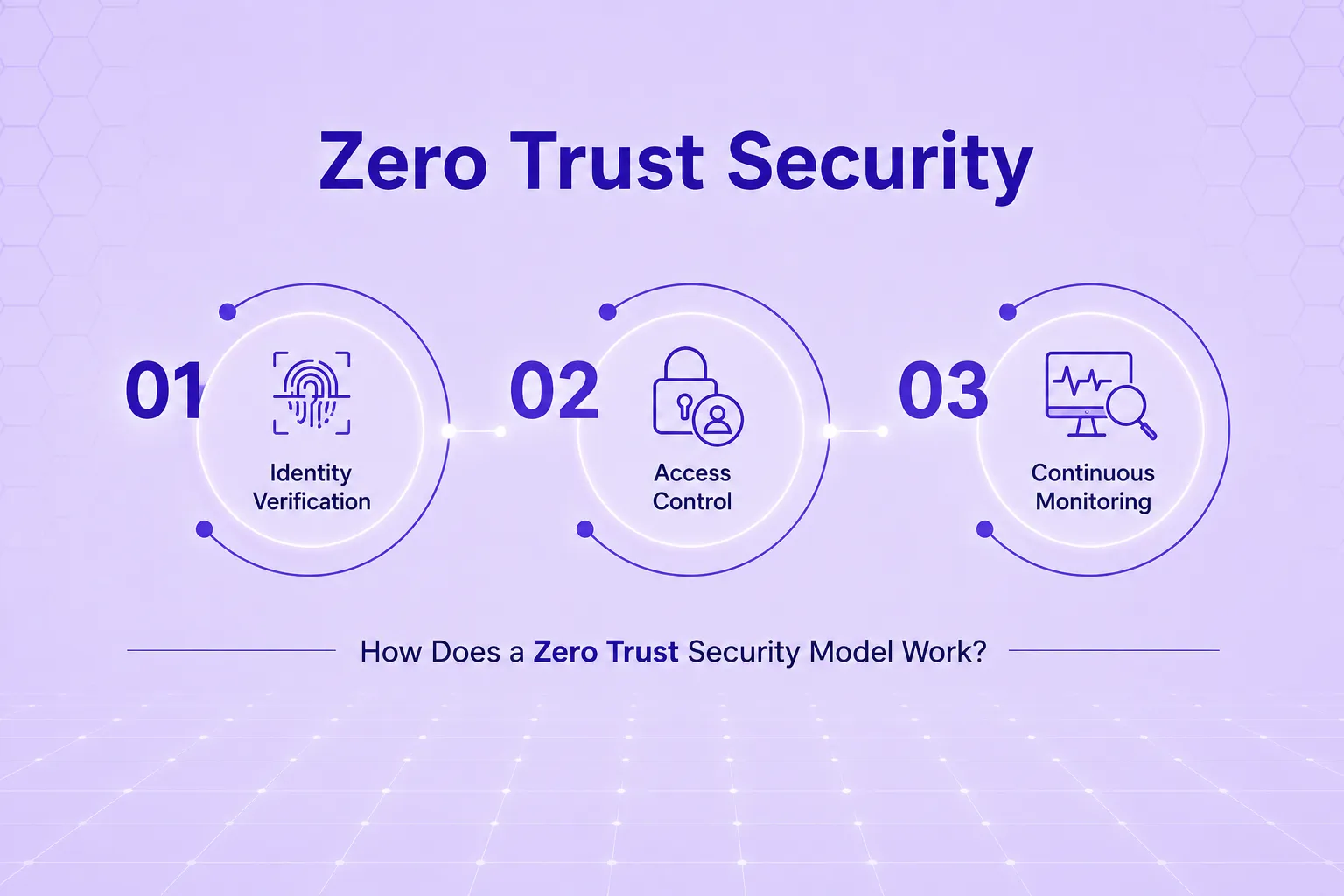
Alt text: Zero trust security working
Zero Trust Security works by treating every access request as untrusted until it is fully verified. Instead of allowing users or devices to freely access internal systems once they are inside a network, Zero Trust continuously checks identity, device health, location, and behavior before granting or maintaining access.
When a user or system tries to access a resource, the Zero Trust system first verifies who they are using strong authentication methods such as multi-factor authentication. It then evaluates the context of the request, including whether the device is secure, whether the login location is normal, and whether the behavior matches expected patterns.
Only if all conditions are satisfied is access granted, and even then, it is limited to only what is necessary.
After access is given, Zero Trust does not stop monitoring. It continuously tracks activity in real time to detect unusual behavior. If something suspicious is detected, access can be reduced, blocked, or revoked immediately.
This constant cycle of verification, limited access, and monitoring ensures that even if attackers gain entry, their movement and impact remain highly restricted.
H2: Real-world use cases for Zero Trust Security
Zero Trust Security is widely used in modern organizations to solve practical security problems across cloud environments, remote work, and complex supply chains.
Multicloud security: Zero Trust ensures consistent, identity-based access across multiple cloud providers and SaaS tools. It removes reliance on network location and reduces misconfigurations by enforcing application-level permissions.
Supply chain security: It protects against third-party risks by limiting vendor access, securing CI/CD pipelines, and monitoring external integrations. This prevents a single compromise from spreading across systems.
Remote access for employees: Zero Trust replaces traditional VPNs with secure, application-level access. It verifies identity and device health before granting limited access to required resources only.
IoT security: It secures IoT devices by verifying identities, isolating networks, and continuously monitoring behavior. This reduces risks from weak or unmanaged devices in critical environments.
Also read: AI Security Risks and Best Practices in 2026
H2: Challenges and Tradeoffs When Adopting Zero Trust
Adopting Zero Trust is a major security shift that improves protection but also introduces real operational and organizational challenges.
Legacy systems complexity: Many organizations still rely on older applications and flat network setups that are not designed for modern identity-based security, making integration with Zero Trust difficult.
Migration effort: Moving to Zero Trust requires significant changes in how access is designed and managed, and this transition can take time and careful planning.
User friction: Strong security controls like multi-factor authentication, device checks, and continuous verification can sometimes slow down users if not implemented thoughtfully.
Tool and policy complexity: Using multiple security tools and policies across cloud and on-prem systems can create inconsistencies and increase operational overhead.
Visibility and monitoring gaps: If logging and telemetry are not properly set up, it becomes difficult to detect threats and fully enforce Zero Trust principles.
H2: How TrueFoundry Supports Zero Trust Security
TrueFoundry applies Zero Trust principles to AI infrastructure by ensuring that every interaction between users, agents, and tools is verified, controlled, and continuously monitored. It removes implicit trust and enforces strict identity and access boundaries across all operations.
Identity-aware execution: TrueFoundry ensures AI agents act only within the permissions of the actual user who initiated the request. It integrates with identity providers like Azure AD and Okta to prevent over-privileged or “superuser” access.
Centralized AI and MCP Gateway: All agent-to-tool communication flows through a single controlled gateway. This ensures every request is validated, and unapproved or risky actions are blocked before execution.
Pre- and post-call guardrails: Requests are checked before execution and responses are validated afterward. This helps prevent prompt injection, data leaks, and unauthorized access to sensitive information.
VPC-native deployment: TrueFoundry runs entirely inside the customer’s cloud environment (AWS, GCP, or Azure). This ensures all data, logs, and traces stay within the organization’s secure boundary.
Credential protection at runtime: Raw API keys and secrets don't have to be pasted into integrations. TrueFoundry can reference credentials directly from enterprise secret managers like AWS SSM, GCP Secret Manager, Azure Key Vault, or HashiCorp Vault, so sensitive values stay in your own secret store and are resolved at runtime.
H2: Conclusion
Zero Trust Security is a modern approach to cybersecurity that removes the assumption of trust from all users, devices, and systems. Instead of relying on network location, it focuses on continuous verification, strict access control, and strong identity management.
By following principles like least privilege access, micro-segmentation, and continuous monitoring, Zero Trust helps organizations protect themselves in an increasingly complex and cloud-driven world.
As cyber threats continue to evolve, Zero Trust is becoming not just an option but a necessity for securing modern digital systems.
H2: FAQ
What is meant by Zero Trust Security?
Zero Trust Security is a cybersecurity model where no user, device, or system is trusted by default. Every access request is continuously verified using identity, device health, and context before granting limited access to resources.
What are the three main concepts of Zero Trust Security?
The three main concepts are verify explicitly, use least privilege access, and assume breach. Together, they ensure every request is authenticated, users get the minimal necessary permissions, and systems are designed to detect and contain potential intrusions.
What are the disadvantages of Zero Trust?
Zero Trust can be complex and costly to implement, especially in legacy systems. It may introduce user friction due to frequent authentication checks and requires strong identity, monitoring, and governance systems to function effectively at scale.
Gouvernez, déployez et suivez l'IA dans votre propre infrastructure

GenAI infra- simple, plus rapide et moins cher
Les meilleures équipes lui font confiance pour faire évoluer GenAI

- © 2022 ENSEMBLE Technologies



Abonnez-vous à notre newsletter
Les dernières nouvelles, articles et ressources envoyés dans votre boîte de réception


