


Accédez instantanément à un environnement TrueFoundry en direct. Déployez des modèles, acheminez le trafic LLM et explorez la plateforme complète : votre sandbox est prête en quelques secondes, aucune carte de crédit n'est requise.


What Is AI Inference and Why Does It Matter?

AI inference is the process of using a trained AI model to produce an output from new data. The model applies parameters learned during training to make a prediction, classification, recommendation, or generated response.
Unlike training or fine-tuning, inference normally uses the model's existing parameters rather than updating them. For example, when a trained fraud detection model evaluates a new transaction, it performs inference to estimate whether that transaction is fraudulent.
This guide explains how AI inference works, the main types of inference, how it differs from training, its infrastructure requirements, common use cases, benefits, and key challenges.
How does AI Inference work?
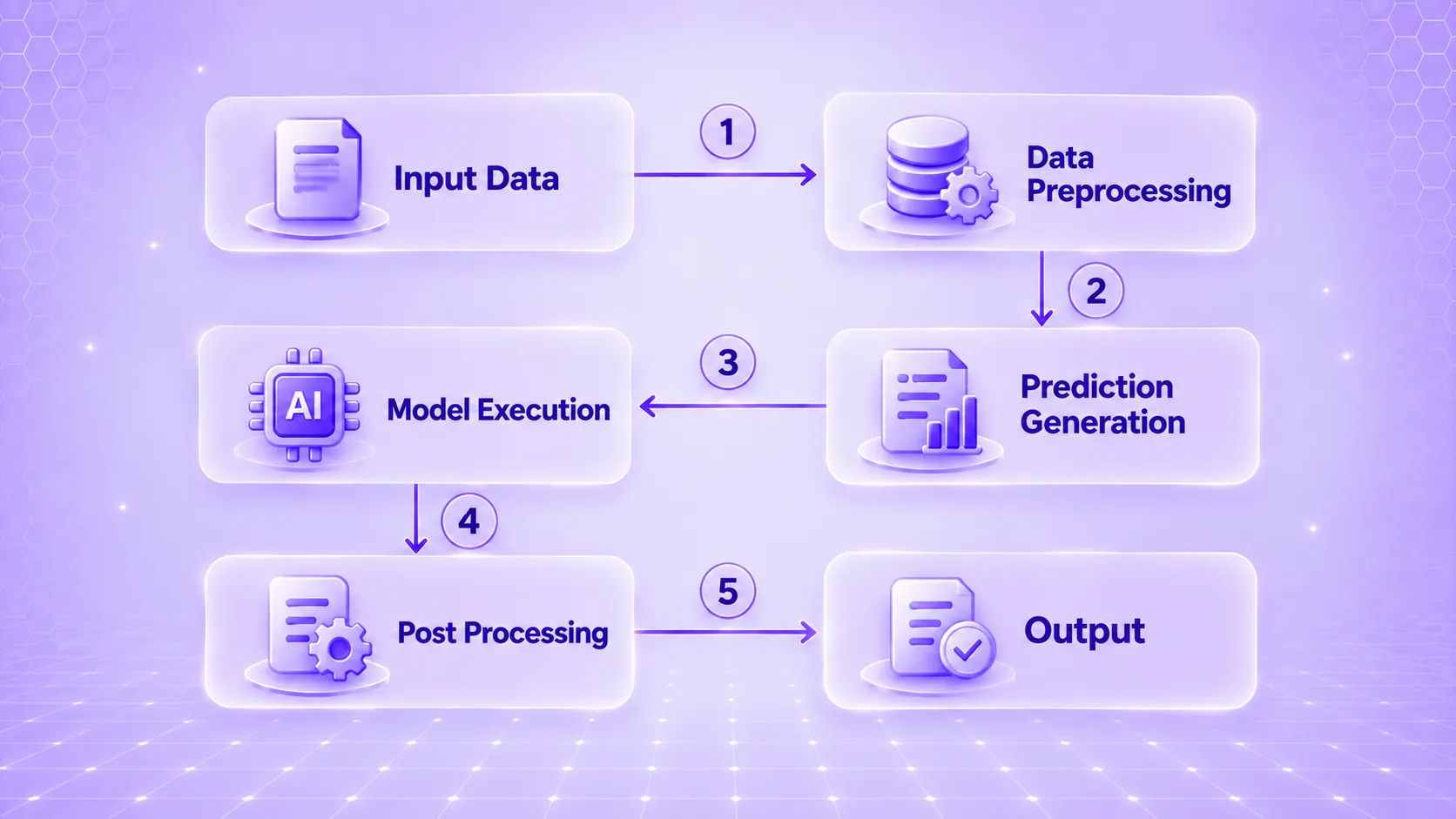
AI inference follows a sequence from receiving new data to returning or using the model's output.
1. Receive the input
Inference begins when a trained model receives new input from a user, application, sensor, or another system.
2. Prepare the input
The application prepares the input in the format required by the model. For example, an LLM converts text into tokens, while a computer vision model may receive a processed image represented as numerical values.
3. Process the input
The prepared input passes through the model in a forward pass. The model applies its learned parameters to compute an output without normally updating those parameters.
For an LLM, generation typically happens token by token, with previously generated tokens becoming part of the context for subsequent generation. A key-value (KV) cache can store the key and value tensors computed for previously processed tokens so they do not need to be recomputed at each generation step, although it also increases memory usage as sequence lengths and concurrent requests grow.
4. Produce the output
The output depends on the model and task. A classifier may return a class or probability, while a generative model may produce text, an image, audio, or another type of content.
5. Return or use the result
The application can return the output directly to a user or pass it to another component. For example, an AI agent may use a model's output to determine whether to retrieve information or call a tool.
What are the types of AI Inference?
AI inference can use different processing patterns depending on how input arrives and when results are needed. Three common patterns are online, batch, and streaming inference. Online inference handles individual requests, batch inference processes groups of inputs together, and streaming inference operates on continuous flows of data or events.
Online inference
Online inference follows a request-response pattern. It processes an individual request when it arrives and returns a result, usually with low-latency requirements.
For example, a chatbot responding to a user's prompt or a fraud detection service scoring a transaction can use online inference. Low latency and consistent response times are important because each request is waiting for a result.
Batch inference
Batch inference processes many inputs together instead of responding to each request immediately.
For example, a business could run a model overnight to score customer records or generate recommendations for the following day. Batch processing is useful when immediate results are not required, and overall throughput is more important than request-level latency.
Streaming inference
Streaming inference processes an ongoing flow of events or data rather than isolated request-response interactions. Predictions are generated continuously or as new events arrive.
This pattern is useful for workloads such as sensor monitoring, event streams, financial transaction monitoring, and speech processing, where new data arrives continuously and needs to be analyzed as it becomes available.
Managing inference across multiple AI models?

How is AI inference different from training and fine-tuning?
Training creates a model by updating its parameters using training data. Fine-tuning further adapts a pretrained model using task- or domain-specific data. Inference uses the resulting model to process new inputs without normally updating its parameters.
For example, a company could fine-tune a large language model (LLM) on support data and then run inference whenever the model generates an answer for a customer.
How is AI inference different from AI serving?
AI inference refers to the execution of a trained model, while AI serving refers to the infrastructure that makes the model available to applications.
A serving system may expose the model through an API, manage requests, allocate compute resources, scale model instances, and route traffic. The model performs inference when it processes a particular input.
This distinction matters in production because running a model successfully is different from serving it reliably at the required scale, latency, and availability.
Where can AI inference run?
AI inference can run in cloud, on-premises, or edge environments. Some architectures use a hybrid approach that combines two or more environments. The right approach depends on factors such as model size, latency requirements, data sensitivity, traffic patterns, hardware availability, and cost.
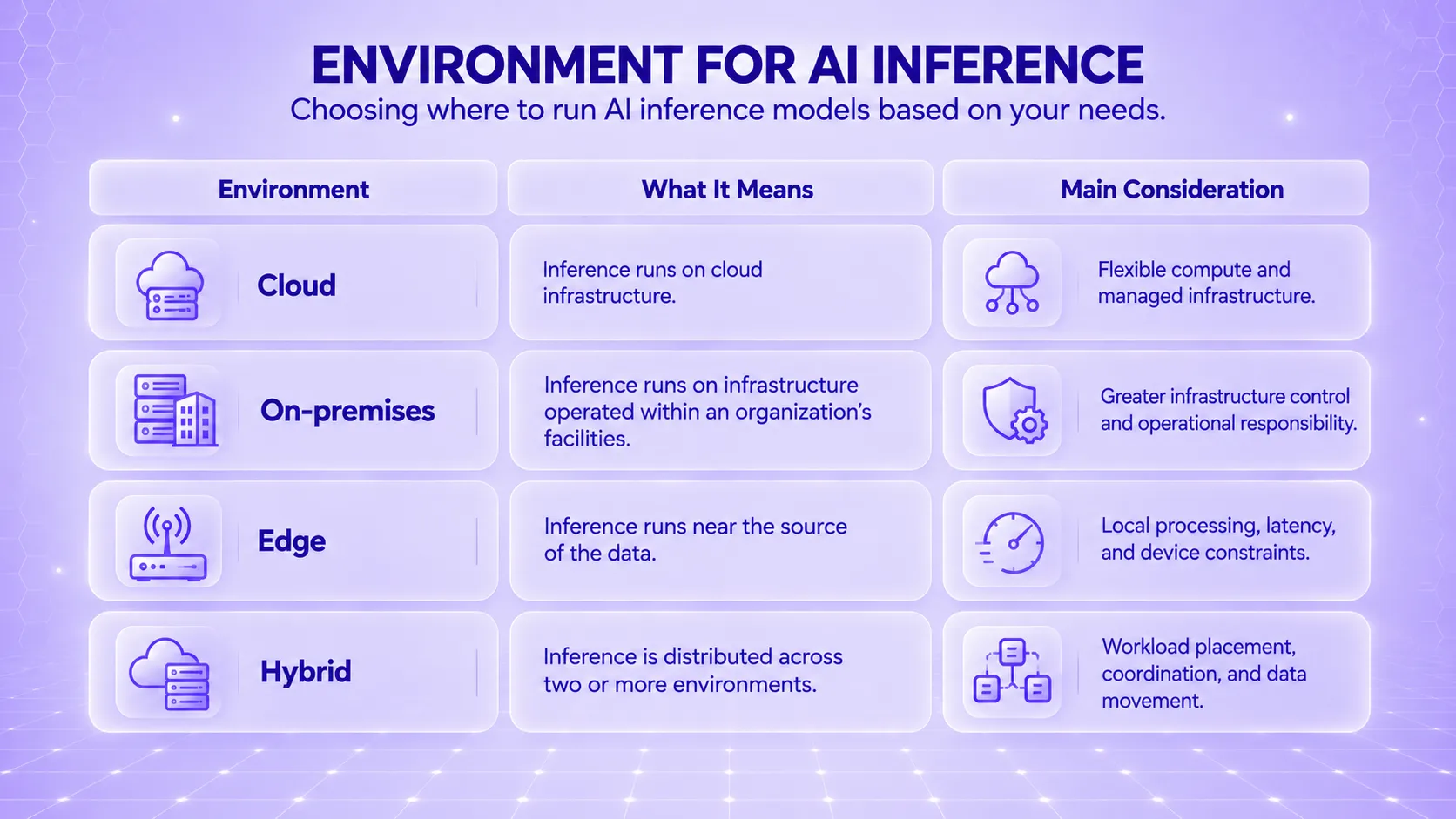
Important: Hybrid is an architectural approach that combines environments, not a physical location equivalent to cloud, on-premises, or edge.
Cloud platforms
Cloud platforms provide access to CPUs, GPUs, TPUs, and other accelerators without requiring teams to operate all the underlying hardware themselves.
Managed endpoints and autoscaling can help applications handle changing workloads, while multi-region deployments can improve availability and, with appropriate traffic routing, reduce latency for distributed users. This is closely related to cloud scalability.
On-premises and private cloud
On-premises and private cloud environments provide greater control over infrastructure and data.
They can be useful when organizations have strict requirements around data residency, security, compliance, or infrastructure ownership. The trade-off is that the organization assumes greater responsibility for hardware and operations.
Edge locations and devices
Inference can also run closer to where data is generated. Phones, browsers, cameras, and gateways can run smaller models locally.
This can reduce network latency and limit the amount of information that needs to be sent to a central cloud environment.
Hybrid inference
Hybrid architectures combine edge and cloud inference. An edge device might filter or classify incoming information locally before sending selected data to a larger cloud model.
This approach can reduce bandwidth and cloud compute requirements while still giving the application access to more powerful models when necessary.
Why does hardware matter for AI inference?
Hardware affects inference speed, memory capacity, cost, and energy consumption.
CPUs are suitable for smaller models and lightweight workloads or applications where accelerator hardware is unnecessary. GPUs are widely used for deep learning and LLM inference because their parallel architecture is well suited to the matrix operations these models require. TPUs and other Artificial Intelligence (AI) accelerators are designed for machine learning workloads and can provide additional efficiency in suitable environments.
Memory can become a major bottleneck for large models. Model parameters need to fit into available memory, while LLM workloads also require memory for the KV cache.
Lower-precision formats reduce memory use and can improve inference efficiency compared with FP32. Depending on the model and quantization method, reducing precision can also affect output quality, so teams should evaluate the trade-off for their workload.
At the edge, power and thermal constraints add another consideration. A model that runs efficiently on a data center GPU may need to be compressed or optimized before it can run effectively on a phone or other constrained device.
How does distributed AI inference Work?
Large models or high request volumes can require inference to run across multiple devices.
Replication runs full model copies across devices so that multiple requests or batches can be processed concurrently. Tensor and pipeline parallelism instead split a model's computation across multiple devices, which can be necessary when the model or inference workload cannot fit efficiently on a single accelerator. These techniques can also be combined to meet memory, latency, and throughput requirements.
What are the key challenges in AI Inference?
Running inference in production introduces challenges beyond simply getting a model to generate an output.
- Latency: Applications that require real-time responses can be affected by slow requests, particularly at the tail of the latency distribution. Teams can monitor metrics such as p95 and p99 latency and use techniques such as batching, caching, model optimization, appropriate hardware, and autoscaling where suitable.
- Inference cost: Serving costs can increase as models become larger or request volumes grow. Teams can optimize model size, batching, hardware utilization, numerical precision, and resource allocation to control the cost of each request.
- Model quality: Production data or usage patterns may differ from the data used during training and evaluation. Monitoring input distributions and model outputs can help teams detect data or concept drift and determine when additional evaluation, retraining, or another intervention is needed.
- Security: AI applications can be exposed to threats such as prompt injection, sensitive data leakage, and unauthorized model access, particularly when models interact with private data or external tools. Authentication, access controls, input and output guardrails, data filtering, and secure isolation can help reduce these risks.
- Governance: As deployments grow, teams need to control model access, deployed versions, and changes. Versioning, role-based access controls, audit logs, and approval workflows can provide this control.
- Testing: Infrastructure or model changes can affect performance and output quality. Load testing can expose infrastructure limits, while regression tests and evaluation datasets can identify quality changes. AI observability can provide additional visibility into infrastructure performance and model behavior in production.
What are the common AI inference use cases?
AI inference is used across applications that need models to make predictions or generate outputs.
- Recommendations and personalization use models to rank products, videos, or other content based on user behavior.
- Fraud and anomaly detection use inference to identify transactions or events that differ from expected patterns.
- Computer vision applications use inference for image classification, object detection, OCR, inspection, and safety monitoring.
- Natural language applications use models for classification, translation, summarization, sentiment analysis, and information extraction.
- Generative AI assistants and AI agents use inference to understand requests, generate responses, retrieve information, and interact with tools. These applications often form part of a broader LLMOps environment.
How does AI Inference fit into modern AI infrastructure?
Inference is rarely an isolated component in a production AI application. A typical system may combine models with APIs, databases, retrieval systems, serving infrastructure, monitoring, and orchestration.
For example, an AI assistant could use an LLM for inference, retrieve relevant information from a vector database, and provide that information as context to the model. More complex applications may use several models and tools together, making routing, observability, access control, and infrastructure management increasingly important.
For LLM applications that use multiple models or providers, an AI Gateway can provide a centralized layer for routing inference requests, applying access and cost controls, handling fallbacks, and monitoring model traffic. TrueFoundry's AI Gateway supports these functions across hosted and self-hosted models.
As AI applications move into production, inference therefore becomes closely connected to model serving, deployment, observability, governance, and infrastructure management.
Preparing to run AI inference in production?
Key takeaways
Moving a trained model into production requires more than generating a correct output. Teams also need to meet latency and throughput targets, control serving costs, choose appropriate hardware, protect data, monitor model quality, and scale infrastructure as demand changes.
The right inference architecture depends on the workload. Interactive applications may prioritize low latency, batch workloads may prioritize throughput and cost, and edge deployments may prioritize local processing and resource efficiency. Treating inference as a production infrastructure concern helps teams make these trade-offs deliberately.
Gouvernez, déployez et suivez l'IA dans votre propre infrastructure

GenAI infra- simple, plus rapide et moins cher
Les meilleures équipes lui font confiance pour faire évoluer GenAI

- © 2022 ENSEMBLE Technologies



Abonnez-vous à notre newsletter
Les dernières nouvelles, articles et ressources envoyés dans votre boîte de réception


